Constrained optimization Newton-like Linear Integer methods - - PowerPoint PPT Presentation

constrained optimization
SMART_READER_LITE
LIVE PREVIEW

Constrained optimization Newton-like Linear Integer methods - - PowerPoint PPT Presentation

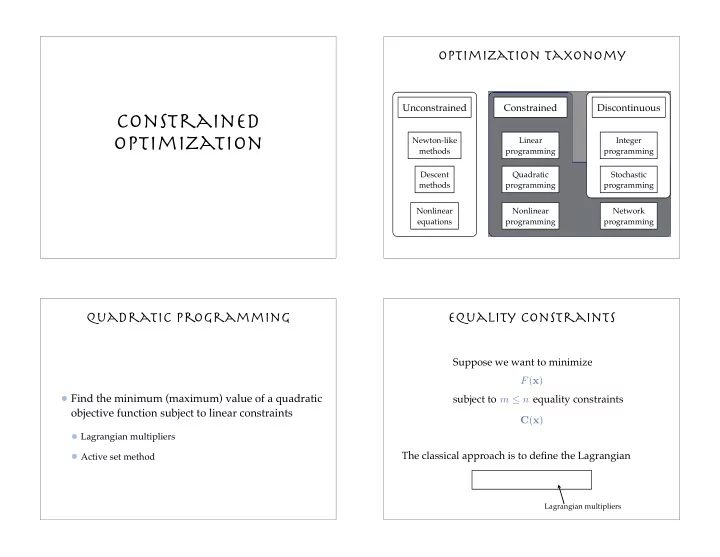
Optimization taxonomy Unconstrained Constrained Discontinuous Constrained optimization Newton-like Linear Integer methods programming programming Descent Quadratic Stochastic methods programming programming Nonlinear Nonlinear


slide-1
SLIDE 1

Constrained

  • ptimization

Optimization taxonomy

Unconstrained Constrained Discontinuous

Newton-like methods Descent methods Nonlinear equations Linear programming Quadratic programming Nonlinear programming Network programming Integer programming Stochastic programming

Quadratic Programming

Find the minimum (maximum) value of a quadratic

  • bjective function subject to linear constraints

Lagrangian multipliers Active set method

subject to equality constraints

Equality constraints

Suppose we want to minimize F(x) C(x) m ≤ n L(x, λ) = F(x) − λT C(x) The classical approach is to define the Lagrangian

Lagrangian multipliers

slide-2
SLIDE 2

Equality constraints

Minimizing the Lagrangian is equivalent to solving

∇xL(x, λ) = 0 ∇λL(x, λ) = 0 ∇xL = g − JT λ = ∇F −

m

  • i=1

λi∇Ci ∇λL = −C(x)

Equality constraints

∇C ∇F(x∗)

At the optimal solution, the gradient of the

  • bjective function is the linear combination of

the constraint gradients The projection of the gradient of the objective function onto the constraint surface is zero at the optimal solution

lagrangian-Newton

Apply the Newton method to find (x, ) that minimizes the Lagrangian

∇xxL = H ∇xλL = −J ∇λxL = −J

Karush-Kuhn-Tucker (KKT) system

  • H

JT J x0 − x∗ λ∗

  • =

g C

  • L(x∗, λ∗) = L(x0, λ0) +
  • ∇xL

∇λL T p + 1 2p

  • ∇xxL

∇xλL ∇λxL ∇λλL

  • p

Inequality constraints

subject to inequality constraints Suppose we want to minimize F(x)

C(x) ≥ 0 Constraints can be partitioned into two sets: active set A and inactive set A’ Identify the active constraints at each iteration and solve for ˜ C

L(x, λ) = F(x) − λT ˜ C(x)

Collection of all points that satisfy the constraints is called the feasible region

slide-3
SLIDE 3

Active set strategy

How do we identify an active set? λ∗ ≥ 0 i ∈ A for Example:

F(x) = x2

1 + x2 2

minimize subject to C(x) = 2 − x1 − x2 ≥ 0

feasible region

Quadratic programming

A quadratic objective Linear constraints

F(x) = gT x + 1 2xT Hx Ax = a Bx ≥ b

and Assume that an estimate of the active set A0 is given in addition to a feasible point x0

Quadratic programming

  • 1. Solve the KKT system with equality constraints and inequality

constraints in the active set

  • 2. Take the largest possible step size in the direction p that

does not violate any inactive inequalities

  • 3. If , then add the limiting inequality to the active set A and

return to step 1. Otherwise, take a full step and check if all are positive, terminate the program

  • therwise, delete the inequality with the most negative from

A and return to step 1 α ≤ 1 α < 1 λ λ λ

Optimization taxonomy

Unconstrained Constrained Discontinuous

Newton-like methods Descent methods Nonlinear equations Linear programming Quadratic programming Nonlinear programming Network programming Integer programming Stochastic programming

slide-4
SLIDE 4

An SQP algorithm

Sequential quadratic programming solves NLP by formulating a sequence of QP subproblems The solution p(k) to each QP determines the search direction Each QP is formulated by

Quadratic approximation to the objective function Linear approximation to the constraints

Globalization Strategies

Merit functions Line search methods Trust region methods

F(x) + σ 2 CT (x)C(x) 1 2pT p ≤ δ2

Summary

What is the physical meaning of Lagrangian multipliers? How does Lagrangian enforce “hard” constraints? How is a nonlinear problem solved using quadratic programming?