
SLIDE 1
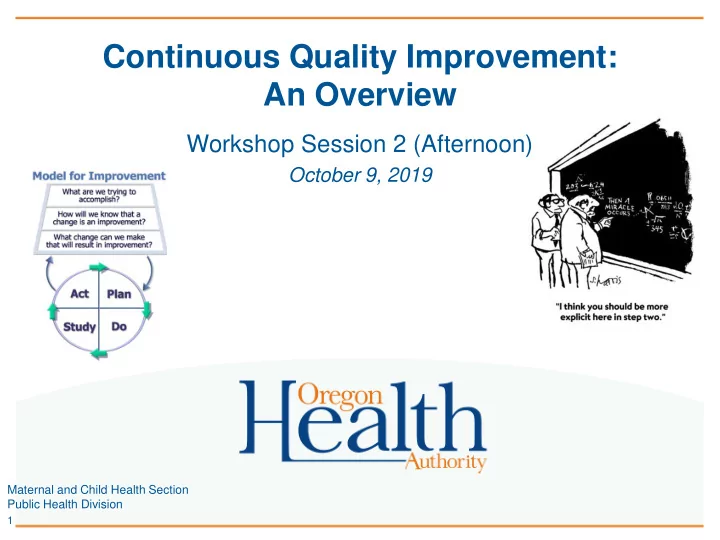
Continuous Quality Improvement: An Overview
Workshop Session 2 (Afternoon)
October 9, 2019
Maternal and Child Health Section Public Health Division
1
Continuous Quality Improvement: An Overview Workshop Session 2 - - PowerPoint PPT Presentation
Continuous Quality Improvement: An Overview Workshop Session 2 (Afternoon) October 9, 2019 Maternal and Child Health Section Public Health Division 1 Agenda and Objectives Agenda Objectives 1. Introduction to CQI 1. Articulate what CQI
Workshop Session 2 (Afternoon)
October 9, 2019
Maternal and Child Health Section Public Health Division
1
Maternal & Child Health Section Public Health Division
2
Agenda Objectives
1. Introduction to CQI 2. CQI Activity: Ms. Potato Head 3. Using Data and Measurement for CQI 4. Identifying Root Causes
1. Articulate what CQI is and the difference between CQI and QA 2. Describe the Model for Improvement and the 4 stages of the PDSA Cycle 3. Practice rapid-cycle PDSA testing 4. Practice developing a SMART aim statement 5. Articulate the difference between outcome and process measures 6. Practice creating a Fishbone Diagram to examine root causes of a problem
process
improving population health
achieve measurable improvements
3
Public Health Division Maternal & Child Health
4
we do
ineffective change strategies are abandoned
learned
Maternal & Child Health Section Public Health Division
5
Maternal & Child Health Section Public Health Division
6
Maternal & Child Health Section Public Health Division
7
Maternal & Child Health Section Public Health Division
8
Public Health Division Maternal & Child Health
9
Plan Do Study Act
What are we trying to accomplish? How will we know that a change is an improvement? What change can we make that will result in improvement?
SMART Aim: Specific, Measurable Actionable, Realistic Timebound
Maternal & Child Health Section Public Health Division
By August 30, 2020 we aim to increase the amount of joy Oregon home visiting professionals experience, as measured by a 12-item Joy in Work pulse survey. Specifically, we will increase the average statewide pulse survey score from 3.96 to 4.25.
Maternal & Child Health Section Public Health Division
Measures should be:
and key processes
Plan Do Study Act
What are we trying to accomplish? How will we know that a change is an improvement? What change can we make that will result in improvement?
Maternal & Child Health Section Public Health Division
Maternal & Child Health Section Public Health Division
13
Joy in Work (SMART aim): average monthly score of pulse surveys (12 questions, 5-item Likert scale)
Question 3 is answered by understanding our system and identifying changes Sources include:
Plan Do Study Act
What are we trying to accomplish? How will we know that a change is an improvement? What change can we make that will result in improvement?
Maternal & Child Health Section Public Health Division
15
Drivers Secondary Drivers Example change ideas to test
Purpose and Recognition
celebrate individual and collective outcomes
responsibilities of the program
spots and connect the work to positive outcomes
meetings
Psychological Safety
and leadership
work environment amongst staff
give feedback anonymously
event 1-2. Provide staff training on culturally and linguistically responsiveness and implicit bias
concerns and leadership to respond
and post times for availability 6-7. Use a check-in app on work issued phones to ensure the home visitor’s whereabouts are known when they are
and Teamwork
collectively
information and skills
accomplishments
team walking meetings
and Resiliency
home visitors and supervisors is occurring
wellness and resilience, including work/life balance, and are informed by principles of trauma-informed care
resilience and stress management
day/week for home visitors to complete data entry
as Mindful Self-Regulation from the Facilitating Attuned iNteractions trainings
Autonomy
flexibility and autonomy
improvements that affect them
balance caseload and workload
leadership meetings
Testing using PDSA cycles. This is the action portion of the model Plan Do Study Act
What are we trying to accomplish? How will we know that a change is an improvement? What change can we make that will result in improvement?
Maternal & Child Health Section Public Health Division
Maternal & Child Health Section Public Health Division
17
Plan Do Study Act
changes
learnings
Act
are to be made?
Plan
predictions (why)
(who, what, where, when)
Study
analysis of the data
predictions
what was learned
Do
and unexpected
the data
“What will happen if we try something different?” “Let’s try it!” “Did it work?” “What’s next? ”
Maternal & Child Health Section Public Health Division
Maternal & Child Health Section Public Health Division
19
Maternal & Child Health Section Public Health Division
20
Implement
Maternal & Child Health Section Public Health Division
21
Test Test Implement
22
result in improvement
conditions
Maternal & Child Health Section Public Health Division
23
Maternal & Child Health Section Public Health Division
24
Primary Driver: Wellness and Resilience Change to test: incrementally increase the number of mindful self-regulation techniques
Maternal and Child Health Section Public Health Division
25
Changes That Result in Improvement
A P S D A P S D
Evidence Best Practice Testable Ideas
Cycle 1: Week 1: 2 home visitors will use at least one Mindful Self Regulation (MSR) technique in 50% of home visits. Cycle 2: Week 2: 2 home visitors will use at least 1-2 MSR technique in 60% of home visits. Cycle 3: Week 3: 2 home visitors will use at least 2 MSR technique in 60% of home visits
Pre/post: On a scale of 1-5, I am able to regulate my stress during client visits (never, rarely, sometimes,
Maternal & Child Health Section Public Health Division
26
27 Maternal & Child Health Section Public Health Division
28
This activity was developed by Williams, DM. Mr. Potato Head Plan, Do, Study, Act (PDSA) Exercise. Austin, TX: DMWAustin , LLC. 2014. (Available on www.DMWAustin .com)
❑3
– All pieces are put exactly in the same position as the photo.
❑2 – All pieces of the Ms.
Potato Head are in place, but one or more pieces are not exactly like the photo.
❑1 – One or more pieces
are not in place on Ms. Potato Head
❑Start: When the time
taker calls start time.
❑End:
When the last piece is positioned in place and you have taken your hands off of
29Maternal & Child Health Section
Public Health Division
PDSA # Theory being tested Prediction 1 2 3 4 5 6
Time
80 70 60
Second s
50 40 30 20 10 Baseline 1 2 3 4 5 PDSA Cycle # Precision Scoring:
❑3 – All pieces exactly in the same position as the photo. ❑2 – All pieces of the Mr. Potato Head in place, but one or more pieces
are not exactly in place like the photo.
❑1 – One or more pieces not in place on Mr. Potato Head.
Maternal & Child Health Section Public Health Division
PDSA # Theory being tested Prediction 1 2 3 4 5 6
Time
80 70 60
Second s
50 40 30 20 10 Baseline 1 2 3 4 5 PDSA Cycle # Precision Scoring:
❑3 – All pieces exactly in the same position as the photo. ❑2 – All pieces of the Mr. Potato Head in place, but one or more pieces
are not exactly in place like the photo.
❑1 – One or more pieces not in place on Mr. Potato Head.
1 person alone is fastest; start with feet Will complete in 12 seconds, precision 3 2 people; start with hands Will complete in 13 seconds; precision 3
X X
14 seconds 13 seconds
X X
Maternal & Child Health Section Public Health Division
32
Maternal & Child Health Section Public Health Division
34
Maternal & Child Health Section Public Health Division
Plan Do Study Act
What are we trying to accomplish? How will we know that a change is an improvement? What change can we make that will result in improvement?
Maternal and Child Health Section Public Health Division
Families will receive services that ensure their children grow up better.
By September 1, 2020, the percent of families enrolled in 2020 in the Happy Homes home visiting program who received the recommended number of home visits prescribed by the model will increase from 60% to 75%.
Maternal and Child Health Section Public Health Division
36
Maternal and Child Health Section Public Health Division
37
(when) (#, % or % change) (whom) (what result, change, benefit)
39
Maternal & Child Health Section Public Health Division
How will we know the key processes are in place and our change is resulting in improvement? Data provide focused and
services and outcomes for families – Track progress over time – Guide improvement – feedback on whether changes are working and support data-driven decision-making in practice Data is for learning not judgment
Maternal and Child Health Section Public Health Division40
41
Public Health Division Maternal & Child Health
42
Public Health Division Maternal & Child Health
Data for Improvement, Accountability and Research
43
Public Health Division Maternal & Child Health
Data for Improvement, Accountability and Research
44
Take home message The role of data for improvement and the spirit in which this data is used is different for CQI, compared to research
Maternal & Child Health Section Public Health Division
45
Public Health Division Maternal & Child Health
Joy in Work Smart Aim: increase our team’s average pulse survey score on satisfaction with their work/life balance from 2.96 to 4.00 by August 31, 2020 (by implementing a policy to allow staff to adjust their schedules to ensure an eight-hour day)
– Average team pulse survey score for question on work/life balance
– # of staff trained in the new policy – # of staff who adjusted their schedules each week
46
Public Health Division Maternal & Child Health Public Health Division Maternal & Child Health
Maternal & Child Health Section Public Health Division 47
Maternal and Child Health Section Public Health Division 48
process
causes associated with a problem
causes are present
Maternal and Child Health Section Public Health Division49
50
51
52
53
People Procedures Environment Materials
Mothers are not screened for intimate partner violence (IPV)
Reporting
The community lacks IPV services Screening tool is not valid Screening tool is cost prohibitive Data system’s auto-scoring function does not work There is currently no formal screening procedure Home visitors lack training Mothers are hesitant to be screened Home visitors are reluctant to ask about sensitive topics
55
56
57
Maternal and Child Health Section Public Health Division
58
59
CQI is meaningful and manageable – Remember the “Power of 1” and start small Data is used for learning, not judgement Conducting small, rapid PDSA cycles can increase your belief that a change will result in improvement and document predictions, actions, and learnings There are many CQI tools available to support CQI efforts
Maternal & Child Health Section Public Health Division
60
61
Maternal & Child Health Section Public Health Division
Public Health Division Maternal & Child Health
For more information related to CQI please contact: Drewallyn Riley: Drewallyn.b.riley@dhsoha.state.or.us