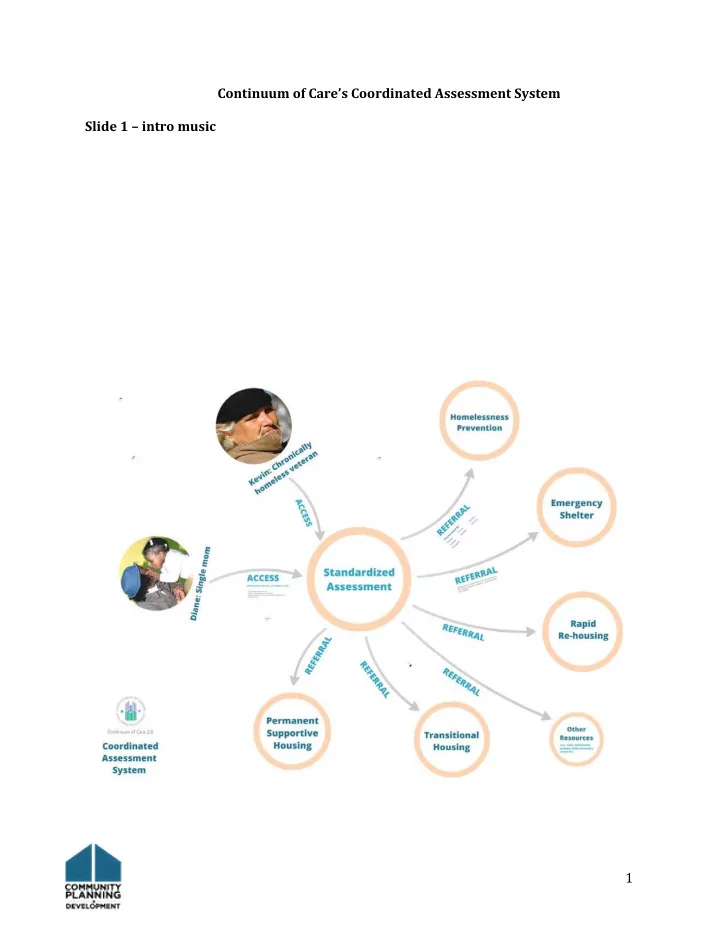
SLIDE 1
¡ ¡ Continuum of Care’s ¡Coordinated Assessment System Slide 1 – intro music 1
SLIDE 2
¡ Slide 2 Under the CoC Program ¡interim ¡rule, the Continuum ¡of Care must establish and operate a coordinated assessment system. This presentation will explain ¡the ¡intent behind this requirement and the details ¡associated ¡with ¡this ¡responsibility. 2
SLIDE 3
¡ Slide 3 The primary purpose of a coordinated assessment system ¡is to make rapid, effective, and consistent client-‑to-‑housing and service matches—regardless ¡of a client’s ¡location ¡within ¡a CoC’s geographic ¡area—by standardizing the access and assessment process and by coordinating ¡referrals ¡across the ¡CoC. 3
SLIDE 4 ¡ ¡ Slide 4 Implementing coordinated assessment can help CoCs:
- reorient housing and ¡service provision ¡to ¡be ¡focused ¡on the ¡needs of the ¡people ¡it
serves, creating a more client-‑focused environment;
- minimize the time and frustration people spend trying to find assistance
- maximize the use of available system ¡resources, including mainstream ¡resources, to
meet their needs
- identify ¡and ¡quantify ¡housing and ¡service gaps ¡and ¡any ¡areas ¡that have ¡excess ¡
capacity 4
SLIDE 5
¡ ¡ Slide 5 As we explore coordinated assessment, let’s consider it from ¡the perspective of Kevin and Diane. Kevin ¡is a 60-‑year-‑old Vietnam ¡War veteran. He is divorced, his children are grown, and he hasn’t had ¡contact with his family in years. After his wife ¡left and ¡he wasn't able ¡to ¡find work, ¡Kevin ¡started drinking. ¡He has been ¡living ¡on ¡the streets for the last ¡few ¡years. 5
SLIDE 6 ¡ ¡ Slide 6 Diane ¡is a 34-‑year-‑old single mother who is looking for housing for herself ¡and ¡her
- daughter. ¡She has intermittent employment and never seems to make enough to cover rent
and child care. She lost her apartment last month, and has run out of other places to stay. 6
SLIDE 7
¡ Slide 7 What does coordinated assessment look like for people like Kevin and Diane, who need housing assistance? 7
SLIDE 8 ¡ Slide 8 Without a clear system ¡for accessing services, Diane and Kevin might have experienced confusion about how and where ¡to ¡go for help. ¡They would have been responsible ¡for navigating loosely affiliated programs on their own, and may have knocked on many doors before finding help. ¡Even if they found an organization to help them, the best the
- rganization ¡could ¡do was ¡ask, ¡“Is ¡this ¡household ¡good for our project?” ¡Without ¡
coordinated assessment, projects tend to make “project-‑centric” decisions, meaning they can decide whether ¡to ¡serve Kevin ¡or Diane, ¡but cannot take ¡responsibility ¡for assessin whether another project ¡is actually a better fit. ¡Project-‑centric access and assessment can result in placing Kevin or Diane ¡in a project ¡that is not necessarily ¡the best option to meet their needs. 8
SLIDE 9
¡ Slide 9 Now imagine Kevin or Diane in a system ¡with an effective and coordinated assessment process that identifies their individual needs and preferences and connects them ¡with appropriate services and supports. ¡With coordinated assessment, when ¡Kevin ¡and Diane approach the system, the intake worker will ask the question: “What ¡housing ¡and service strategy ¡would ¡be ¡best for this ¡household?” The CoC and ¡its projects are ¡collectivel responsible ¡for finding the ¡right type and amount of assistance for each person ¡and the process is seamless, easily accessible, ¡and ¡consistent, regardless ¡of where ¡the ¡person asks ¡ for help. 9
SLIDE 10
¡ Slide 10 In designing a Coordinated Assessment System, a CoC must consider three distinct components: Access 10
SLIDE 11
Slide ¡11 ¡ Assessment ¡ 11 ¡
SLIDE 12
12 ¡ Slide ¡12 ¡ And ¡referral
SLIDE 13
¡ Slide 13 Let’s begin with Access. Access is a defined entry point into the CoC’s system ¡of care. People ¡ experiencing a housing crisis need to ¡understand ¡where ¡to ¡go to ¡get help ¡wherever ¡they ¡ may be. ¡A CoC can structure its access into its homeless assistance system ¡in any number of ways, and from ¡HUD’s perspective, there’s no “one right” way to do it. However, the ¡entry ¡ points should be clearly ¡defined, ¡easily ¡accessible, ¡and well-‑advertised. 13
SLIDE 14
¡ Slide ¡14 A CoC should define its access, or entry points, based on local geography and how the ¡ service system ¡is organized. A CoC may use multiple access points, either in combination or marrying different models of access for different parts of the geography, as long as the full area ¡served by the CoC is covered. Access could be through a 2-‑1-‑1 ¡hotline, ¡a central ¡ assessment center, multiple assessment sites, or even emergency shelters ¡or other ¡ community service providers, typically known ¡as a “No Wrong ¡Door” ¡approach. ¡Thus, with Coordinated Assessment, Kevin ¡and Diane would know ¡where to go to get ¡help, ¡and it ¡ wouldn’t ¡be hard to get ¡there. 14
SLIDE 15
¡ Slide 15 Second, a CoC must create ¡a standardized and comprehensive assessment protocol and tool ¡ that ¡is used to identify ¡and document the needs of all individuals and families seeking housing or services. 15
SLIDE 16 ¡ Slide 16 There is more than one approach to coordinated assessment. CoCs may use progressive ¡ engagement, a multi-‑stage ¡assessment process that begins with an initial triage assessment
- f safety and immediate housing needs, and then ¡moves, sometimes after a few days ¡have ¡
passed, ¡through ¡a more comprehensive assessment to determine i additional services are ¡ needed beyon the initial emergency assistance. ¡The intent of this ¡approach ¡is to minimize the burden ¡of multiple intakes for the client and to avoid consuming case management resources ¡on clients ¡who ¡don't require ¡additional ¡services to ¡exit the ¡shelter ¡system. ¡The goal is to provide ¡just the right level of service intervention that an individual or family needs to exit homelessness. As we consider the assessment process for Kevin or Diane, ¡intake ¡staff would document the clients’ resources, preferences, interests, service needs, and any housin barriers. ¡ Depending on the reach of the assessment system, the intake worker might also collect ¡ additional information to determine if Kevin or Diane was eligible for specific projects, but any information needed for post-‑placement case management would be left for housing program ¡staff to explore. Remember that Kevin is a chronically homeless war veteran ¡who has been struggling with alcohol abuse. Diane is a single mother with a sporadic employment history. During the assessment process, their unique needs would be identified ¡and ¡an individualized ¡plan would be developed. 16
SLIDE 17 ¡ ¡ Slide 17 Note ¡the ¡term ¡“Standardized” as part of the assessment process. The CoC Program ¡interim ¡rule requires a comprehensive and standardized assessment
- tool. ¡Intake staff ¡does not ¡need to conduct ¡a full ¡psycho-‑social evaluation on a client to
determine the type of assistance a client needs, and may be eligible for, but some standardized elements are important. While HUD doesn’t require the assessment process to definitively determine eligibility for projects or to check for availability within ¡a project, ¡ when ¡the coordinated assessment is able to do some of this, the client ¡experience will ¡be significantly ¡better ¡in the ¡long ¡run. 17
SLIDE 18
¡ Slide 18 Before moving on to the referral process, CoCs should note that they need to consider how survivors of domestic violence, ¡dating ¡violence, ¡sexual assault, ¡and ¡stalking ¡will interact with the coordinated assessment process, ¡including safety considerations ¡for survivors who are presenting ¡for ¡services at not-‑victim ¡service providers. Due ¡to ¡the ¡safety ¡needs ¡of survivors, ¡victim ¡service providers may need to establish a separate, but coordinated, assessment system to ensure appropriate access, assessment, and referrals for survivors. For instance, the ¡CoC could ¡establish ¡a dedicated ¡hotline ¡or designate ¡a victim ¡service provider ¡to ¡serve as ¡a central ¡point ¡of access for all survivors. 18
SLIDE 19
Slide 19 Third, a CoC must define protocols for Referrals. 19
SLIDE 20 Slide 20
- Referrals must be aligned with a CoC’s written standards. CoCs are required to
establish ¡written ¡standards ¡for providing assistance, ¡in consultation ¡with area ¡ESG
- recipients. These written ¡standards ¡will define which ¡eligible ¡individuals ¡and ¡
families should be prioritized for assistance within the CoC’s geographic area as ¡well as the amount and type of assistance they are eligible for. These standards are intended to help consistently refer individuals and families to the most appropriate housing and service intervention and to ensure that limited resources ¡are ¡used ¡most
- effectively. Referral ¡protocols ¡should be developed in conjunction with a CoC’s ¡other
planning activities. 20
SLIDE 21 ¡ ¡ Slide 21 Although HUD has not specified explicit requirements for the referral process, the ¡referral process should be:
- Effective, ¡meaning ¡the referral matches people to the housing and services that will
best meet their needs and preferences
- Accurate, meaning that ¡individuals and families will ¡be referred to projects for
which they are eligible, ¡and that the housing and ¡services will meet their ¡needs.
- Informed, meaning the coordinated assessment provider has a real-‑time accounting
- f availability ¡within ¡all projects ¡within ¡the ¡CoC’s ¡geographic ¡area.
- Consistent, meaning a person will get the same type of referral regardless of which
point ¡he or she enters ¡and ¡that the ¡policies ¡will be ¡consistently ¡applied ¡to ¡all individuals and families accessing ¡help. ¡
- Seamless, by transferring all the data collected at assessment to the provider
receiving the ¡referral
- Electronic, ¡building ¡off the HMIS ¡infrastructure to transfer information, and
- Participatory, with full participation from ¡all providers within the CoC’s ¡geographic ¡
area, to maximize the likelihood of a timely, painless placement for the person seeking ¡help. 21
SLIDE 22
¡ Slide 22 So as we think about ¡the referral ¡processes for Kevin ¡and Diane, ¡the Coordinated Assessment staff will consider things such as the very different types and intensity of assistance they ¡each need and availability ¡of assistance within the community. The result will ¡be a referral to the most appropriate project. In each community, the available options will look different, but typical referral options include homelessness prevention, emergency shelter, rapid rehousing, transitional housing, and permanent supportive housing. 22
SLIDE 23
¡ Slide 23 Homelessness Prevention provides short-‑ and/or medium-‑term ¡rental assistance and services to prevent an individual or family at risk of homelessness from ¡becoming homeless. 23
SLIDE 24
Slide 24 Emergency shelter provides temporary shelter for people experiencing homelessness. 24
SLIDE 25
¡ Slide 25 Rapid rehousing ¡provides ¡short-‑ and/or medium-‑term ¡rental assistance and services to help homeless individuals and families move as quickly as possible into permanent housing and achieve stability ¡in ¡that ¡housing. 25
SLIDE 26
¡ Slide 26 Transitional housing provides temporary housing and supportive services to people who are homeless to facilitate their successful movement to permanent housing. 26
SLIDE 27
¡ Slide 27 Permanent supportive housing provides permanent housing and supportive services for individuals and families who are homeless and have a disability, so they can live independently. 27
SLIDE 28
¡ Slide 28 Regardless of the referral options available in a community, the coordinated assessment system ¡facilitates appropriate, individualized matching between people experiencing a housing crisis and ¡the ¡right level of assistance ¡they ¡need to ¡resolve ¡the ¡crisis. To summarize, the core operational components of coordinated assessment are: access, standardized assessment, and referral. These three components work in tandem ¡to help people in need—people ¡like Kevin and Diane—by shifting ¡the responsibility of navigating ¡ complex systems of care to the system ¡itself. 28
SLIDE 29
¡ ¡ 29 ¡