Contraindications to Cisplatin based chemotherapy in the treatment - - PowerPoint PPT Presentation

contraindications to cisplatin based chemotherapy in the
SMART_READER_LITE
LIVE PREVIEW

Contraindications to Cisplatin based chemotherapy in the treatment - - PowerPoint PPT Presentation

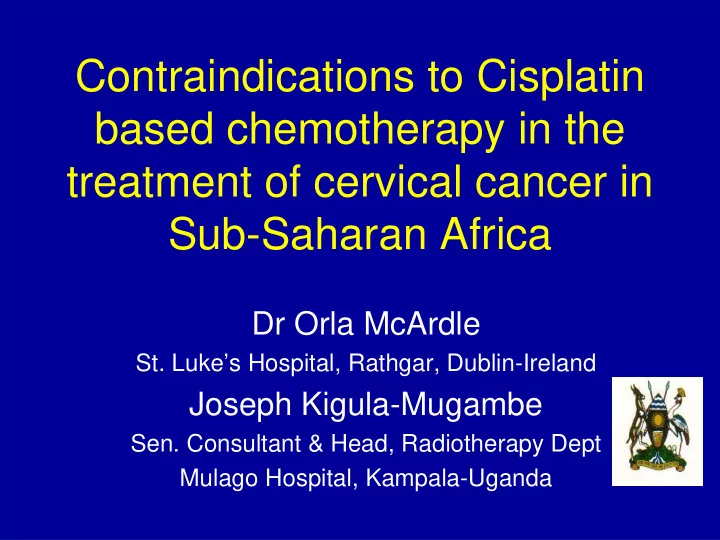
Contraindications to Cisplatin based chemotherapy in the treatment of cervical cancer in Sub-Saharan Africa Dr Orla McArdle St. Lukes Hospital, Rathgar, Dublin-Ireland Joseph Kigula-Mugambe Sen. Consultant & Head, Radiotherapy Dept


slide-1
SLIDE 1

Contraindications to Cisplatin based chemotherapy in the treatment of cervical cancer in Sub-Saharan Africa

Dr Orla McArdle

  • St. Luke’s Hospital, Rathgar, Dublin-Ireland

Joseph Kigula-Mugambe

  • Sen. Consultant & Head, Radiotherapy Dept

Mulago Hospital, Kampala-Uganda

slide-2
SLIDE 2
slide-3
SLIDE 3

Introduction

  • The majority of Cervical cancer patients live

in developing World (Parkin et al, 2002)

  • Uganda incidence is 44.1/100,000 (11)

compared to 4-11/100,000 in the developed world

  • Multiple social-economic factors lead to late

presentation of Cervical cancer

  • Co-existing HIV and other infections, poor

nutritional status and anemia make treatment difficult in Sub-Saharan Africa

slide-4
SLIDE 4

Introduction

  • Concomitant chemoradiotherapy confers an
  • verall survival of 10-16% (Lukka et al 2002,Green

et al, 2005)

  • Now standard of care
  • It however presents multiple challenges with

implications for allocation of scanty resources in Sub-Saharan Africa with a low resource setting.

  • We conducted a prospective study to assess the

proportion of patients with cervical cancer considered suitable for chemotherapy in our department in Kampala, Uganda

slide-5
SLIDE 5

Materials and Methods

  • All patients presenting with biopsy proven

cervical cancer from Aug 2005 – June 2006 were eligible for the study.

  • They had standard work up to assess

suitability including: H&E, KPS, EUA, CBC, RFTS and LFTS, USS (Abdomen and Pelvis) and whenever possible HIV testing

slide-6
SLIDE 6

Exclusion criteria for Cisplatin

  • Stage 1A and stage IV A & B
  • HIV status positive,
  • KPS less than 60
  • Age > 70 years
  • Hydronephrosis
  • Haemoglobin < 8 gm/dl
  • WBC < 2,000/ µL
  • Platelets < 100,000/µL
  • Creatinine > 97µmol/L
  • Previous surgery (as it is difficult to assess

extent of surgery & positive margins from the reports)

slide-7
SLIDE 7

Results

  • 314 patients were referred in the 10

months study period

  • Only 47 patients (15.1%) were eligible
  • 190 patients were NOT eligible
  • In 77 cases (24.4%) eligibility could not be

established as work up was incomplete

  • 37 patients (11.6%) were proven to be HIV

positive but in 38.4% HIV sero-status was not established

slide-8
SLIDE 8

Frequency of exclusion criteria

Exclusion criteria No (=314) % Stage 1A 4 1.1 Stage IV A & B 44 14.0 Age > 70 years 11 3.5 Hydronephrosis 99 31.4 HIV positive 37 11.6 Haemoglobin < 8gm/dl 55 17.4 WBC < 2,000/µL

  • Platelets < 100,000/µL

4 1.2 Postoperative cases 41 12.8 Creatinine > 97µmol/L 47 15.1

slide-9
SLIDE 9

Multiple exclusion criteria

  • The most frequently encountered exclusion

criteria were hydronephrosis and anaemia

  • Cut off point of 8 gm/dl led to exclusion of 55

pts, if 10 g/dl used additional 11 pts

  • Hydronephrosis was in 99 pts, 44% of which

had bilateral hydronephrosis

  • 29 pts (29.3%) of those with hydronephrosis

had abnormal creatinine levels

  • 96 pts (50.5%) of the 190 pts had multiple

exclusion criteria (HIV positive pts were more likely to have multiple criteria (p=0.0000001)

slide-10
SLIDE 10

Frequency of multiple exclusion criteria

No of exclusion criteria HIV positive n=37 No (%) HIV negative n=153 No (%) 1 4 (11) 90 (59) 2 19 (51) 33 (22) 3 11 (30) 26 (17) 4 3 (8) 4 (3)

slide-11
SLIDE 11

Discussion

  • 35-40% of dept workload at Mulago Hospital,

Kampala is composed of cervical cancer

  • Exclusion criteria were selected with a view of

selecting the patients most likely to benefit from chemoradiation while minimizing its side effects as the facilities for supportive care are limited

  • 60.5% of our cervical cancer patients were not

suitable for chemoradiation at presentation

  • Apart from anemia & hydronephrosis, most of the
  • ther criteria are not easily modified by clinical

intervention

slide-12
SLIDE 12

Anemia and hydronephrosis

  • Anemia represents a double disadvantage

for our pts as it prevents the chemotherapy while it is itself associated with poorer treatment outcomes (2,6,7).

  • Cut off at 8 g/dL was chosen because at

this level transfusion with 2-3 units can reverse the anemia. In practice transfusion is not readily available & multiple transfusions difficult

  • 99 pts had hydronephrosis & in our setting

placing of ureteral stents is not possible

slide-13
SLIDE 13

Stage IVA and age above 70 years

  • These are not absolute contraindications
  • Represents only a pragmatic & cautious

approach on our part

  • Omitting these criteria increases the total

eligible patients by 29 (9.2%) leaving the ineligible ones at 47.7%

slide-14
SLIDE 14

HIV/AIDS

  • 11.6% of our patients were HIV patients (UNAIDS

reported HIV prevalence of 6.7% in general population in Uganda in 2005)

  • At present there is no proven survival benefit for

chemoradiation in HIV positive cervical cancer patients

  • Radiation therapy alone has been shown to

produce increased toxicity in HIV positive patients & chemoradiation has clear implications (2,9).

  • HIV/AIDS pts are treated with chemoradiation as

part of an ongoing IAEA coordinated multinational randomized controlled trial (CRP 13120) in our dept.

slide-15
SLIDE 15

Radiotherapy alone?

  • There are however reports which show

impressive results that can be achieved with radiotherapy alone in the developing world setting (Saibishkumar EP et al, 2006)

slide-16
SLIDE 16

Conclusions

  • Our study showed that only a small proportion of
  • ur patients were likely to benefit from

chemoradiotherapy with weekly Cisplatin.

  • This illustrates difficulties of applying a “standard”

cervical cancer treatment to the developing world where the majority of these cancers exist.

  • Introduction of chemoradiotherapy might therefore

not have as a major effect on treatment outcomes for the group as a whole.

  • Alternative chemotherapy agents especially those

not associated with potential renal complications

  • f Cisplatin should be investigated.
slide-17
SLIDE 17

Conclusions - 2

  • The provision of accessible radiotherapy

facilities for the treatment of existing disease and

  • The introduction of national screening /

vaccination programmes to prevent cervical cancer and to catch it while it is in its early stages should be the major priorities in the developing world setting.

slide-18
SLIDE 18

Acknowledgements & references

slide-19
SLIDE 19
slide-20
SLIDE 20

THANK YOU FOR YOUR ATTENTION