Contributors, Collaborators and Cooperators Contributors and - - PDF document

contributors collaborators and cooperators
SMART_READER_LITE
LIVE PREVIEW

Contributors, Collaborators and Cooperators Contributors and - - PDF document

6/10/2020 LESA System Provides Uncertain Efficiency Improvements for Alfalfa Irrigation, Sierra Valley, Sierra Valley Irrigation Tests, 2018 2019 Bachand & Associates In collaboration with U.C. Cooperative Extension June 2020 1


slide-1
SLIDE 1

6/10/2020 1

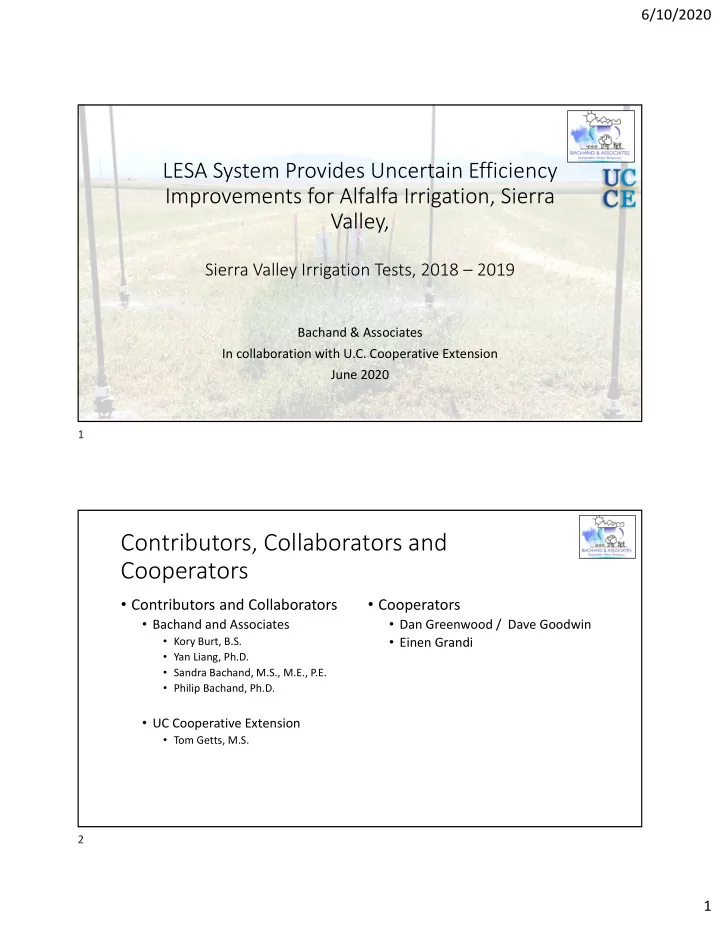
LESA System Provides Uncertain Efficiency Improvements for Alfalfa Irrigation, Sierra Valley,

Sierra Valley Irrigation Tests, 2018 – 2019

Bachand & Associates In collaboration with U.C. Cooperative Extension June 2020

Contributors, Collaborators and Cooperators

  • Contributors and Collaborators
  • Bachand and Associates
  • Kory Burt, B.S.
  • Yan Liang, Ph.D.
  • Sandra Bachand, M.S., M.E., P.E.
  • Philip Bachand, Ph.D.
  • UC Cooperative Extension
  • Tom Getts, M.S.
  • Cooperators
  • Dan Greenwood / Dave Goodwin
  • Einen Grandi

1 2

slide-2
SLIDE 2

6/10/2020 2

Outline

  • Pivot Systems – LESA vs Standard
  • Methods and Results
  • Applied Irrigation Water as Measured by

Flow Meters

  • Irrigation Efficiency
  • Soil Moisture
  • Plant Effects
  • Summary

Standard LESA

Goal = Provide Defensible, non‐biased assessment of pivot technology

Center‐Pivot Systems

Standard LESA

Standard (MESA) – Mid‐Elevation Spray Application LESA – Low Elevation Spray Application

  • Nozzle height and spacing roughly half of Standard
  • Designed to:
  • Reduce water loss
  • Increase irrigation uniformity

3 4

slide-3
SLIDE 3

6/10/2020 3

Flow Meter Totals

  • Installed on center tower
  • Measures and records

instantaneous & total flow

  • Telemetric / cloud‐based data

storage:

  • Protected and secure
  • Real‐time
  • Enables quality control measures and

actions for robust data collection

  • Total irrigation to Field
  • Standardized to Field Area

Standard 6/1/2019 7/1/2019 8/1/2019 9/1/2019 10/1/2019 200 400 600 800 1000 Flow (GPM) 2 4 6 8 10 12 14 16 18 20 Irrigation Depth (in) LESA 6/1/2019 7/1/2019 8/1/2019 9/1/2019 10/1/2019 200 400 600 800 1000 Flow (GPM) 2 4 6 8 10 12 14 16 18 20 Irrigation Depth (in) Instantaneous Flow Cumulative Depth Partial cutting mid Sept.

Applied Water (Inches) For First Three Cuttings: Flow Meter Totals

Standard LESA

Cutting Dates

1. 6/13/19 2. 7/14/19 3. 8/13/19

12 12.9 𝑀𝐹𝑇𝐵 𝑇𝑢𝑒 12 𝑗𝑜𝑑ℎ𝑓𝑡 12.9 𝑗𝑜𝑑ℎ𝑓𝑡 93%

5 6

slide-4
SLIDE 4

6/10/2020 4

Irrigation Efficiency Tests

  • Performed Three replicates on each field for June

and July sampling events

  • Inches Collected: Catch Can Tests
  • Inches Applied: Nozzle Flow Tests

Inches Collected

No Nozzle zzle‐ap applie lied Depth Depth

  • Design Characteristics
  • Different nozzles for LESA & Standard Systems
  • Design flows increase further from center by span
  • Valve Characteristics: Measured vs Design Flows
  • LESA: Measured typically 15 – 30% above Design
  • Standard: Measured typically 5 – 13% above Design

Measured time to fill 1 gallon, 4 tests per nozzle at 3 places in each span Inches Applied

7 8

slide-5
SLIDE 5

6/10/2020 5

Irrigation Application Efficiency (IAE)

= =

Treatment Mean SD N p<0.05 LESA 0.583 0.267 329 Yes Standard 0.761 0.459 327 Yes Irrigation Application Efficiency

Irrigation Application Efficiency Summary

Mean +/- 95%CI of Standardized Irrigation Efficiency by Span Span Irrigation Efficiency (in/in)

LESA

0.62 0.62 0.50 0.0 0.2 0.4 0.6 0.8 1.0

Standard

0.72 0.70 0.87 3 5 7 0.0 0.2 0.4 0.6 0.8 1.0

  • Lots of variance but…
  • IAE relatively similar
  • Across spans (i.e., 3, 5, 7)
  • Across speeds (i.e, 20, 33, 35, 86)
  • Across months (i.e., June, July)
  • Mean IAE statistically higher for

Standard vs LESA (0.76 vs. 0.58)

9 10

slide-6
SLIDE 6

6/10/2020 6

Soil Moisture Probes at Test Fields

  • 3 Moisture Probe Sets Per

Treatment

  • Each Set
  • Replicates
  • Six probes at six soil depths:
  • 6”
  • 12”
  • 18”
  • 24”
  • 36”
  • 48”
  • EC, moisture, temperature
  • Telemetric

Results

Soil Moisture

Cutting 1 Cutting 2 Cutting 3

11 12

slide-7
SLIDE 7

6/10/2020 7

Results

Soil Moisture – Upper Root Zone

  • Maximum weekly irrigation approx. 2 inches

for each system

  • Top soil layers increase moisture in response

Results

Soil Moisture – Deeper Root Zone

  • Lower soil layers showing less obvious affect to irrigation…
  • Though LESA field is in greater general decline than Standard

field….

  • Less likely to recover soil moisture and ….
  • Suggesting more flow to deeper depths under Standard

irrigation

13 14

slide-8
SLIDE 8

6/10/2020 8

Available Water in the Root Zone through Cuttings 1 – 3

Similarities between LESA and Standard

  • Available Water, Average
  • Similar at deeper depths
  • Decreases through the year
  • Similar end value at end of

season

  • Available Water, Variance

(Distribution)

  • Increases through season
  • Higher at shallow depths
  • Similar for both systems

3.8 6.5 1.9 5.7 3.5 2.3 5.8 5.9

Available Water in the Root Zone through Cuttings 1 – 3

Differences between LESA and Standard

  • Available Water decreased

more across LESA system during the season

  • Change in Mean Available

Water Decrease at 0 – 2.5 ft

  • LESA = ‐1.9 inches
  • Standard = ‐1.2 inches
  • Change in Mean Available

Water Decrease at 2.5 – 4 ft

  • LESA = ‐0.8
  • Standard = 0.1

3.8 6.5 1.9 5.7 3.5 2.3 5.8 5.9

15 16

slide-9
SLIDE 9

6/10/2020 9

Crop Yield – Goodwin Ranch

  • Yield decreases throughout

season

  • No significant differences

between LESA and Standard for each cutting

Yield Measurements by Cutting - Goodwin Ranch Cutting Alfalfa Yield (dry tons/acre) 1.53 1.11 1.0 1.1 1.2 1.3 1.4 1.5 1.6 1.7

Goodwin Ranch

1.48 1.13 1 3 1.0 1.1 1.2 1.3 1.4 1.5 1.6 1.7 Mean Mean +/- SE Mean +/- 95%CI

Crop Yield – Grandi Ranch

Yield Measurements by Cutting - Grandi Ranch Cutting Alfalfa Yield (dry ton/acre) 2.32 1.60 1.33 1.0 1.2 1.4 1.6 1.8 2.0 2.2 2.4 2.6

Grandi Ranch

2.18 1.56 1.37 1 2 3 1.0 1.2 1.4 1.6 1.8 2.0 2.2 2.4 2.6 Mean Mean +/- SE Mean +/- 95%CI

  • Yield decreases throughout

season

  • No significant differences

between LESA and Standard for each cutting

17 18

slide-10
SLIDE 10

6/10/2020 10

Hay Quality – Goodwin Ranch

  • Higher quality hay for both LESA and

Standard systems

  • Low NDF
  • High TDN
  • High RFV
  • No significant differences between

systems

Irrigation N Overall Quality1 LESA 9 Premium Standard 9 Premium

1USDA Hay Quality Categorization Nutrient Digestible Fiber for Whole Season - Goodwin Ranch Mean Mean +/- SE Mean +/- 95%CI 35.09 35.29

LESA Standard

Treatment 33.0 33.5 34.0 34.5 35.0 35.5 36.0 36.5 37.0 NDF (%) Relative Feed Value for Whole Season - Goodwin Ranch Mean Mean +/- SE Mean +/- 95%CI 176.8 175.9

LESA Standard

Treatment 168 170 172 174 176 178 180 182 184 186 RFV Total Disgestible Nutrients for Whole Season - Goodwin Ranch Mean Mean +/- SE Mean +/- 95%CI 60.82 60.88

LESA Standard

Treatment 59.0 59.5 60.0 60.5 61.0 61.5 62.0 TDN (%)

Hay Quality – Grandi Ranch

  • Higher quality hay for Standard vs.

LESA system

  • Low NDF
  • High TDN
  • High RFV
  • Standard significantly higher quality

Irrigation N Overall Quality1 LESA 6 Good Standard 6 Premium

1USDA Hay Quality Categorization Nutrient Digestible Fiber, Cuttings 1 & 2 - Grandi Ranch Mean Mean +/- SE Mean +/- 95%CI 37.77 35.08

LESA Standard

Treatment 33 34 35 36 37 38 39 40 NDF (%) Relative Feed Value, Cuttings 1 & 2 - Grandi Ranch Mean Mean +/- SE Mean +/- 95%CI 160.2 176.4

LESA Standard

Treatment 145 150 155 160 165 170 175 180 185 190 RFV Total Digestible Nutrients, Cuttings 1 & 2 - Grandi Ranch Mean Mean +/- SE Mean +/- 95%CI 59.20 60.72

LESA Standard

Treatment 57.0 57.5 58.0 58.5 59.0 59.5 60.0 60.5 61.0 61.5 62.0 TDN (%)

19 20

slide-11
SLIDE 11

6/10/2020 11

Summary comparison of metrics under LESA and Standard Pivot Systems

LESA 3 Standard 3 Notes Irrigation Inches 1 12 12.9 LESA used 7% less water Irrigation Efficiency 58% 76% Std had higher IE but greater variance Average Greater annual decline Lower annual decline Similar overall responses to irrigation upper and lower profiles but greater seasonal decrease for LESA Variance Similar range Similar range Similar variability across time and across locations Operational Flexibilty Lower Higher Std had greater ability to catch up on water deficit but may have greater likelihood of over watering Goodwin Similar 2 Similar 2 Statistically similar averages, variance and trends across cuttings 2 Grandi Similar 2 Similar 2 Statistically similar averages, variance and trends across cuttings 2 Goodwin Similar 2 Similar 2 Statistically similar averages, variance and trends across cuttings 2 Grandi Lower Higher Not statistically different but generally lower quality across all measures 3 Best Similar Worse , Ranking.

  • 1. 7% less water under LESA.
  • 2. Statistically different for p<0.05

Soil Moisture Yield Hay Quality Irrigation Metric Notes

Summary – Confounding Factors

  • Operational
  • Goodwin fields flooded in 2017 and haven’t fully recovered
  • Pivot speeds were adjusted throughout the study
  • Full circle systems keep turning (as on LESA field) whereas half circle needs to

be manually reversed (as on Standard field)

  • Affects water distribution, particularly at the end of a run
  • Environmental
  • Soil types differed between fields
  • Shallow groundwater may have affected soil moisture (capillary pressure)
  • Experimental
  • One year, one farm

21 22

slide-12
SLIDE 12

6/10/2020 12

Summary: Standard vs. LESA

Standard

  • Used slightly more water (7%)
  • Soil moisture declined less

throughout the season

  • Appeared to have more
  • perational flexibility (can catch

up)

  • Yields were similar
  • Hay yield quality tended

towards, premium at both fields

LESA

  • Used slightly less (7%) water
  • Soil moisture declined more

throughout the season

  • Appeared to have less
  • perational flexibility (more

difficult to catch up)

  • Yields were similar
  • Hay quality tended towards

lower, though still good to premium

Operational Observations

  • System maintenance important for irrigation efficiency
  • Nozzle emitters clog easily, can severely affect irrigation uniformity
  • Pump rates decrease during irrigation and throughout season in response

to local groundwater level declines

  • Pivot operation affects water distribution and irrigation uniformity
  • Higher pivot speeds likely lead to greater ET losses (could not be measured here)
  • Changing pivot speeds affects irrigation uniformity
  • On half‐ and quarter‐field pivot systems, pivots stop at the end of the run but

continue pumping

  • Affects irrigation uniformity
  • Automatic pump switch would increase uniformity and water use efficiency

23 24

slide-13
SLIDE 13

6/10/2020 13

Conclusion and Recommendations

  • LESA systems –
  • may provide slight decrease in irrigation water use
  • can reduce crop quality
  • may be more likely to lead to greater soil moisture declines throughout the growing season
  • may be less effective in overcoming soil moisture deficits due to higher design efficiencies
  • valves are more likely to stray from design specifications
  • Groundwater levels (short‐term and long‐term) affect pumping rates
  • Effective pivot system maintenance is required for optimum irrigation system performance
  • Anecdotal information suggests LESA systems require greater maintenance
  • Pivot systems design and operation affect their performance
  • Slower pivot speeds more likely to reduce transpiration losses
  • Slower pivot speeds could lead to greater water losses past the root zone
  • Alfalfa is considered deep rooted crop so may be able to recover deeper water if trained
  • Changes in operation (e.g., pivot speed, clogging) affect water distribution and likely irrigation use efficiencies
  • Improvements in irrigation water use
  • may be achievable with improved pivot operation and appropriate soil moisture monitoring (including to depth)
  • May be more cost effective than transitioning from Standard irrigation systems to LESA systems

25