
Controlling the Controlled Substances: How an Optometrist Can Weed Through the Opioid Options February 15, 20/20 Greg- grubod@gmail.com 814-931-2030 Tracy- drofferdahl@gmail.com 267-241- 9146 1
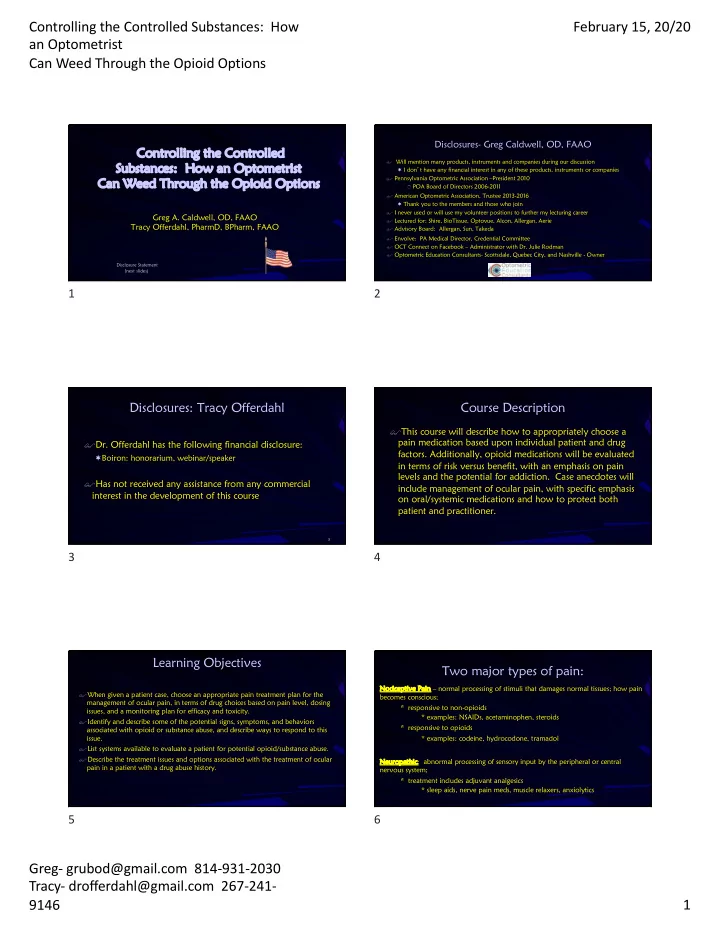
Co Cont ntrolling ng the he Co Cont ntrolled d Su Substances: Ho How an Optometrist Can Can Weed d Thr hrough h the he Opioid d Options ns
Greg A. Caldwell, OD, FAAO Tracy Offerdahl, PharmD, BPharm, FAAO
Disclosure Statement (next slides)
1
Disclosures- Greg Caldwell, OD, FAAO
$ Will mention many products, instruments and companies during our discussion
¬ I don’t have any financial interest in any of these products, instruments or companies
$ Pennsylvania Optometric Association –President 2010 2 POA Board of Directors 2006-2011 $ American Optometric Association, Trustee 2013-2016
¬ Thank you to the members and those who join
$ I never used or will use my volunteer positions to further my lecturing career $ Lectured for: Shire, BioTissue, Optovue, Alcon, Allergan, Aerie $ Advisory Board: Allergan, Sun, Takeda $ Envolve: PA Medical Director, Credential Committee $ OCT Connect on Facebook – Administrator with Dr. Julie Rodman $ Optometric Education Consultants- Scottsdale, Quebec City, and Nashville - Owner
2 Disclosures: Tracy Offerdahl
$Dr. Offerdahl has the following financial disclosure: ¬Boiron: honorarium, webinar/speaker $Has not received any assistance from any commercial
interest in the development of this course
3
3 Course Description
$This course will describe how to appropriately choose a
pain medication based upon individual patient and drug
- factors. Additionally, opioid medications will be evaluated
in terms of risk versus benefit, with an emphasis on pain levels and the potential for addiction. Case anecdotes will include management of ocular pain, with specific emphasis
- n oral/systemic medications and how to protect both
patient and practitioner.
4 Learning Objectives
$When given a patient case, choose an appropriate pain treatment plan for the
management of ocular pain, in terms of drug choices based on pain level, dosing issues, and a monitoring plan for efficacy and toxicity.
$Identify and describe some of the potential signs, symptoms, and behaviors
associated with opioid or substance abuse, and describe ways to respond to this issue.
$List systems available to evaluate a patient for potential opioid/substance abuse. $Describe the treatment issues and options associated with the treatment of ocular
pain in a patient with a drug abuse history.
5 Two major types of pain:
No Nociceptive Pain – normal processing of stimuli that damages normal tissues; how pain becomes conscious; * responsive to non-opioids * examples: NSAIDs, acetaminophen, steroids * responsive to opioids * examples: codeine, hydrocodone, tramadol Ne Neuropathic: abnormal processing of sensory input by the peripheral or central nervous system; * treatment includes adjuvant analgesics * sleep aids, nerve pain meds, muscle relaxers, anxiolytics