COORDINATED SCIENCE - - PDF document

coordinated science
SMART_READER_LITE
LIVE PREVIEW

COORDINATED SCIENCE - - PDF document

February zyxwvutsrqponmlkjihgfedcbaZYXWVUTSRQPONMLKJIHGFEDCBA COORDINATED SCIENCE zyxwvutsrqponmlkjihgfedcbaZYXWVUTSRQPONMLKJIHGFEDCBA UILU-ENG-88-22 14 zyxwvutsrqponmlkjihgfedcbaZYXWVUTSRQPONMLKJIHGFEDCBA CSG-85


slide-1
SLIDE 1

February zyxwvutsrqponmlkjihgfedcbaZYXWVUTSRQPONMLKJIHGFEDCBA

1988

UILU-ENG-88-22 14 zyxwvutsrqponmlkjihgfedcbaZYXWVUTSRQPONMLKJIHGFEDCBA

CSG-85 zyxwvutsrqponmlkjihgfedcbaZYXWVUTSRQPONMLKJIHGFEDCBA

/ / / , I

.'s zyxwvutsrqponmlkjihgfedcbaZYXWVUTSRQPONMLKJIHGFEDCBA

i- zyxwvutsrqponmlkjihgfedcbaZYXWVUTSRQPONMLKJIHGFEDCBA

613

/w 'Lc zyxwvutsrqponmlkjihgfedcbaZYXWVUTSRQPONMLKJIHGFEDCBA

I

~ zyxwvutsrqponmlkjihgfedcbaZYXWVUTSRQPONMLKJIHGFEDCBA

*I,

COORDINATED SCIENCE zyxwvutsrqponmlkjihgfedcbaZYXWVUTSRQPONMLKJIHGFEDCBA

LABORATORY

College of

Engineering

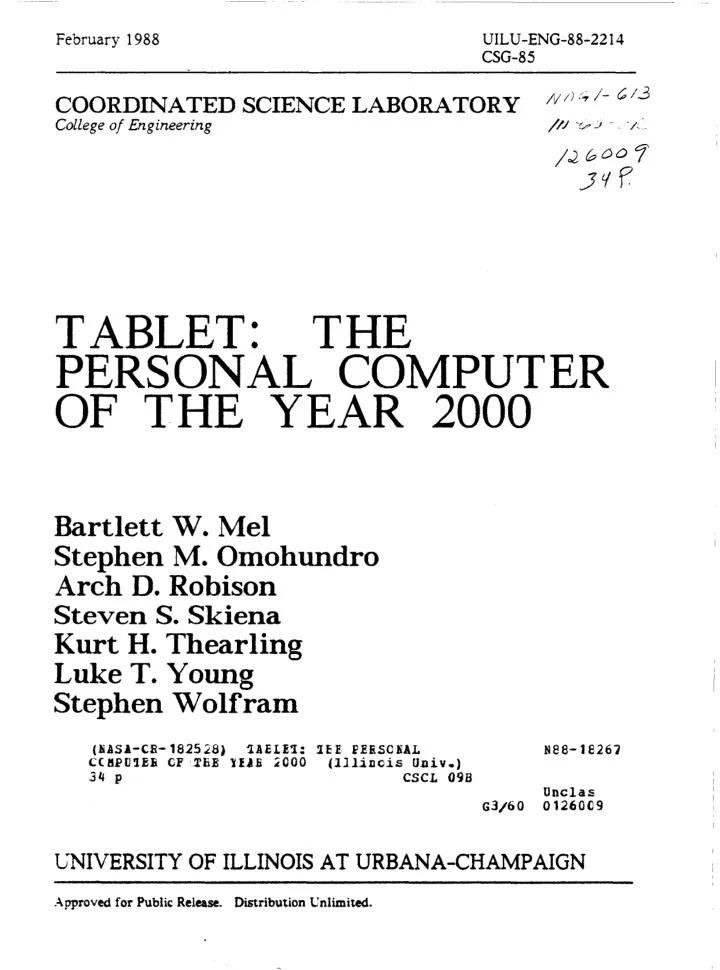
TABLET: THE PERSONAL COMPUTER OF THE YEAR 2000

Bartlett W. Me1 Stephen M. Omohundro Arch D. Robison

Steven S. Skiena

Kurt H. Thearling Luke T. Young Stephen Wolf ram

(BASA-CB-182558)

PAELE'L: f I € E PEBSCB'AL zyxwvutsrqponmlkjihgfedcbaZYXWVUTSRQPONMLKJIHGFEDCBA

N8

8- I E267 CCBi?O!IEB CF 2EiB Ykbii 2000

(lllancis

Uoiv,)

34 p CSCL 09B

Unclas

G3/60

0126069

UNIVERSITY OF ILLINOIS AT URBANA-CHAMPAIGN

.Approved for Public Release. Distribution L'nlirnitcd.

slide-2
SLIDE 2

i zyxwvutsrqponmlkjihgfedcbaZYXWVUTSRQPONMLKJIHGFEDCBA

TABLET: The Personal Computer of the Year 2000

Bartlett W. Me1 Stephen M. Omohundro

Department of Computer Science Center for Complex Systems Research

Arch D. Robison Steven S. Skiena

Department of Computer Science

Kurt H. Thearlhg Luke T. Young

Computer Systems Group Coordinated Science zyxwvutsrqponmlkjihgfedcbaZYXWVUTSRQPONMLKJIHGFEDCBA Laboratory

Stephen Wolfram

Director, Center for Complex Systems Research Departments of Physics, Mathematics, and Computer Science zyxwvutsrqponmlkjihgfedcbaZYXWVUTSRQPONMLKJIHGFEDCBA

February zyxwvutsrqponmlkjihgfedcbaZYXWVUTSRQPONMLKJIHGFEDCBA

1988 Computer Systems Group Coordinated Science Laboratory University of Illinois at Urbana-Champaign

1101 W. Springfield Avenue

Urbana, I

L

61801

slide-3
SLIDE 3

TABLET: zyxwvutsrqponmlkjihgfedcbaZYXWVUTSRQPONMLKJIHGFEDCBA

The Personal Computer of the Year 2000

slide-4
SLIDE 4

ii zyxwvutsrqponmlkjihgfedcbaZYXWVUTSRQPONMLKJIHGFEDCBA

I zyxwvutsrqponmlkjihgfedcbaZYXWVUTSRQPONMLKJIHGFEDCBA

Abstract

I zyxwvutsrqponmlkjihgfedcbaZYXWVUTSRQPONMLKJIHGFEDCBA

The University of Illinois design extends the freedom of pen and notepad with a machine that draws on the projected power of 21st century technology. Without assuming any new, major technological breakthroughs, it seeks to balance the promises of today’s growing techno- logies with the changing role of computers in tomorrow’s education, research, security, and

  • commerce. It seeks to gather together in one basket the matured fruits of such buzzword tech-

nologies as LCD, GPS, CCD, WSI and DSP. The design is simple, yet sleek. Roughly the size and weight of a notebook, the machine has no moving parts and resembles the dark, featureless monolith from a well known movie. Through magneto-optics, a simple zyxwvutsrqponmlkjihgfedcbaZYXWVUTSRQPONMLKJIHGFEDCBA LaserCard provides exchangeable, mass data storage. Its zyxwvutsrqponmlkjihgfedcbaZYXWVUTSRQPONMLKJIHGFEDCBA

ZIO zyxwvutsrqponmlkjihgfedcbaZYXWVUTSRQPONMLKJIHGFEDCBA

surface, in concert with built-in infrared and cellular transceivers, puts the user in touch

with anyone and anything. The ensemble of these components, directed by software that can transform it into anything from zyxwvutsrqponmlkjihgfedcbaZYXWVUTSRQPONMLKJIHGFEDCBA

a keyboard or notepad t

  • an office or video studio, suggests an

instrument of tremendous freedom and power.

I

/

slide-5
SLIDE 5

1 . zyxwvutsrqponmlkjihgfedcbaZYXWVUTSRQPONMLKJIHGFEDCBA The Concept zyxwvutsrqponmlkjihgfedcbaZYXWVUTSRQPONMLKJIHGFEDCBA

I zyxwvutsrqponmlkjihgfedcbaZYXWVUTSRQPONMLKJIHGFEDCBA

Any design represents a compromise between conflicting goals, and the design of the computer of the year 2000 is no exception. We seek something which fits comfortably into zyxwvutsrqponmlkjihgfedcbaZYXWVUTSRQPONMLKJIHGFEDCBA

/

people’s lives while dramatically changing them. This may appear to be a contradiction which cannot be reconciled. But if the technology does not fit easily into the habits and lifestyles of its human users, it will be discarded by those it was meant to help. And if this new tool does not change the life of its owner, it is only because we have been too shortsighted to imagine the possibilities.

O u r way out of this dilemma is to base the design upon something which is already

integrated into everyone’s life, t

  • take a vital tool and give it more life. We have chosen to

improve something that everyone uses everyday, the humble paper notebook. We have all heard that the computer revolution was supposed to eliminate paper from the

  • workplace. Instead, it has lead to desktop publishing, so now we not only write papers but

typeset them. Paper notebooks have many propemes which make them particularly friendly. They are light and portable. No one thinks twice about bringing a pad into a classroom, meet- ing, or the library. They are friendly and natural to use,

as accessible to the toddler as to the

  • ctogenarian and as relevant to the artist as the engineer. They are the ideal medium for

integrating text and graphics, perfect for creative doodling and drawing the picture that is worth a thousand words. They are forgiving of mistakes: Simply peel off a page and start

  • anew. They can be used to communicate with other people by sliding a note under the door or

popping it in an envelope. It is natural to revise and edit written documents. There is some- thing satisfying about crossing out an offending sentence from a written draft, a feeling that

slide-6
SLIDE 6

2 zyxwvutsrqponmlkjihgfedcbaZYXWVUTSRQPONMLKJIHGFEDCBA

word processors have not captured. We aim for a computer which provides all of these benefits and more. Thus, the computer of the year zyxwvutsrqponmlkjihgfedcbaZYXWVUTSRQPONMLKJIHGFEDCBA

2000 will be a portable machine the size of a notebook.

We will write and draw with a stylus on a screen which mimics a physical writing surface. Enhancing this with the powers of computation and communication, we create a tool which will improve the way we live and work. The rest of this essay provides a zyxwvutsrqponmlkjihgfedcbaZYXWVUTSRQPONMLKJIHGFEDCBA

m

  • r

e

concrete depiction of the machine we have in mind. Most of it is devoted t

  • a fairly detailed description of our

machine, describing various subsys- tems, their reasons for being, and technologies to realize them. After this we will forge ahead with some implications and applications of a tool that is much more than the s

u m

  • f its parts.
  • 2. The Machine

O u r

machine will have the same dimensions as a standard notebook. It will look like an 8”xll” monolith from the movie zyxwvutsrqponmlkjihgfedcbaZYXWVUTSRQPONMLKJIHGFEDCBA

2001, and be reminiscent of the zyxwvutsrqponmlkjihgfedcbaZYXWVUTSRQPONMLKJIHGFEDCBA

  • Dynabook. This rectangular

slab will weigh but a few pounds, and have no buttons or knobs to play with. The front sur- face will be a touch-sensitive display screen and will blink to life upon touching two comers. On one of the short sides will be a credit card sized slit, while the other three sides support a ridge with a slight reddish tint. It is targeted towards the professional of the year 2000: the engineer, lawyer, or teacher who is willing to pay the equivalent cost of a microcomputer of today.

slide-7
SLIDE 7

3 zyxwvutsrqponmlkjihgfedcbaZYXWVUTSRQPONMLKJIHGFEDCBA

I zyxwvutsrqponmlkjihgfedcbaZYXWVUTSRQPONMLKJIHGFEDCBA

I zyxwvutsrqponmlkjihgfedcbaZYXWVUTSRQPONMLKJIHGFEDCBA

2 . 1 . The I/O Surface zyxwvutsrqponmlkjihgfedcbaZYXWVUTSRQPONMLKJIHGFEDCBA The most important part of any computer is its interface with the user. The front surface

  • f our

computer is a high-resolution touchscreen, which yields slightly to the touch. With this single input device, we can get a tremendous range of flexibility and options. We can use it to create an entirely soft interface. Fingers are low-resolution devices. They can get in the way in certain applications, espe- cially when they block our view of what they point at. To take true advantage of human motor control and a high-resolution touchscreen, we need a fine-tipped stylus. A walk through any zyxwvutsrqponmlkjihgfedcbaZYXWVUTSRQPONMLKJIHGFEDCBA

art gallery shows what man can do with stylus type

devices.

On powering up our machine, icons representing a typewriter keyboard, a ball point pen, a

telephone, a calendar, a TV, and a host of other applications will appear. By touching and dragging with the stylus, we can manipulate the icons as with a mouse. We can move rapidly through a series of pop-down, drag-off menus by checking o f f what we want with the stylus. Pressing the typewriter icon will cause a keyboard pattern to appear on the screen. This pat- tern can be redrawn like MacPaint objects and zyxwvutsrqponmlkjihgfedcbaZYXWVUTSRQPONMLKJIHGFEDCBA

so be customized to the user’s finger size and t a s t e . Since it is soft, the key pattern can be QWERTY,

Dvorak

  • r based on one of the new,

non-standard shapes like the chord. As we traverse down a menu and we need text input, the keyboard will pop up. But if we are holding a stylus, why bother with the keyboard? Unless the user requires rapid entry, the stylus is a natural way to enter text. Pressing the ball point pen icon will cause a ruled notebook page t

  • appear on screen, right down to simulated looseleaf holes if desired.

With the stylus, we can write and draw directly on the surface of the screen. As we stroke the

slide-8
SLIDE 8

4 zyxwvutsrqponmlkjihgfedcbaZYXWVUTSRQPONMLKJIHGFEDCBA

I

~ zyxwvutsrqponmlkjihgfedcbaZYXWVUTSRQPONMLKJIHGFEDCBA

stylus across the screen, a simulated ink trail is left behind. Nothing beats a pen for writing or doodling, so this will permit the ultimate integration between text and graphics. Some people feel more comfortable composing on paper than on a computer, and this presents the illusion that they are. And, if we wish, handwriting recognition software will convert to zyxwvutsrqponmlkjihgfedcbaZYXWVUTSRQPONMLKJIHGFEDCBA

type all the

text we scrawl out. I zyxwvutsrqponmlkjihgfedcbaZYXWVUTSRQPONMLKJIHGFEDCBA

I I

This metaphor will extend easily to the applications we are familiar with. Text editors can be built around the standard editorial symbols used by proofreaders, where slashing out a word means deleting it and circling two words transposes them. Despite the interactive nature

  • f word processing programs, almost all writers print out a draft and scratch corrections upon it

before pronouncing it ready. O

u r text editor will support this style, and graphics and

mathematics will be integrated in a similar fashion. Without question this is technologically feasible. Our interface relies on three different technologies: display, touchscreen, and optical character recognition. Each of these is pro- gressing nicely towards what we need in zyxwvutsrqponmlkjihgfedcbaZYXWVUTSRQPONMLKJIHGFEDCBA

  • 2000. The density attained in liquid crystal display

(LCD)

technology has increased by a factor of 100 every 7 years [

  • 11. For an 8” by 11” color

display with laser printer resolution we need less than 3x107 pixels, which by extrapolation will be available by 1991 and cheap by 2000. In addition, LCDs represent the perfect founda- tion for a touch-sensitive display. The capacitance of an LCD cell is pressure sensitive, so we can easily detect the tip of a stylus and even how hard it is being applied. Already, LCDs have been used as digitizing tablets [2] and given the resolution of our display we will have no difficulty mimicking the finest ball point.

slide-9
SLIDE 9

Cursive character recognition is a difficult problem, and smacks of artificial intelligence. However, there has been enough progress to show that it is coming. Today, there exist sys- tems with zyxwvutsrqponmlkjihgfedcbaZYXWVUTSRQPONMLKJIHGFEDCBA 97% character recognition accuracy for neat handwriting. Combined with spelling conection, such systems achieve near 100% accuracy zyxwvutsrqponmlkjihgfedcbaZYXWVUTSRQPONMLKJIHGFEDCBA [3]. Adjusting for variations in handwriting is equivalent zyxwvutsrqponmlkjihgfedcbaZYXWVUTSRQPONMLKJIHGFEDCBA t

  • breaking a substitution cipher zyxwvutsrqponmlkjihgfedcbaZYXWVUTSRQPONMLKJIHGFEDCBA

[4,5], a trivial task for our

computer. Training on the owner’s handwriting will lead to the highest possible recognition rate. Of course, no system will recognize 100% of handwritten text, but what isn’t recognized can be highlighted in a different color and reentered by the user. A high resolution, color display can do more than just imitate a notebook page. It will be fast enough to support video. The entertainment possibilities are amusing, such as having a display of thirty-six l”x1” moving icons, each one a different television channel, permitting us

to monitor the action over a large section of the dial. We can watch the bad guy being rubbed

  • ut on channel six while the passion heats up on channel forty. A more important application

is video communications. Video is the next obvious step in the communication evolution which started with text and has progressed to voice. It might seem surprising that o u r design is not built around speech recognition as the cen-

t r a l input technology. Science fiction seems to specialize in talking to computers and listening

to what they have to say. However, in many of the contexts where a portable computer will be used, such as the classroom, the airplane, or a shared o

f f i c e , talking out loud is not acceptable

  • behavior. O

u r

handwritten interface is much less intrusive than speech. This is not to say that speech is not a viable form of input for our

  • design. A microphone and speech recognition pro-

cessor will allow a user to communicate via speech if he or she chooses. For example, a sys-

slide-10
SLIDE 10 I zyxwvutsrqponmlkjihgfedcbaZYXWVUTSRQPONMLKJIHGFEDCBA

tem allowing the user to alternate between a speech-to-text mode and a text editor could spare I

I I I

the user a great deal of time in preparing reports, especially when the words that zyxwvutsrqponmlkjihgfedcbaZYXWVUTSRQPONMLKJIHGFEDCBA

are spoken

match words h a d y appearing somewhere on the screen. In addition, there are circumstances

I I I

r

t

I

where speech may be the only way a user could communicate with our

  • computer. Physically

handicapped users may be unable to easily manipulate the stylus on the zyxwvutsrqponmlkjihgfedcbaZYXWVUTSRQPONMLKJIHGFEDCBA

VO

  • surface. O

u r

design has the flexability of allowing the user to communicate in whatever way is desired.

I zyxwvutsrqponmlkjihgfedcbaZYXWVUTSRQPONMLKJIHGFEDCBA

2.2. zyxwvutsrqponmlkjihgfedcbaZYXWVUTSRQPONMLKJIHGFEDCBA

The zyxwvutsrqponmlkjihgfedcbaZYXWVUTSRQPONMLKJIHGFEDCBA LaserCard Mass Storage Units

The high density read-write storage card unit represents the next milestone in mass storage technology. Replacement of the classical rotating-disldmovable head format will result in spectacular improvements over current mass-storage systems in terms of data capacity, data rates, and integrity of physical construction. These credit card sized optical RAMS will be a convenient, inexpensive, and physically robust data storage medium. People will carry 1 iem in their shirt pockets and trade them zyxwvutsrqponmlkjihgfedcbaZYXWVUTSRQPONMLKJIHGFEDCBA

l i k e

baseball cards. "Can I borrow your reference library, please?" Customized cards will be

  • rdered from information services via electronic menu-driven catalogs, offering a wide variety
  • f books, video and d

a t a ,

all paid for by the gigabyte. The vast storage capacity of LaserCard devices will alter our conception of what should be stored on a computer. Through data compression techniques, a single one-gigabyte card will hold four hours of video or two thousand books from a personal library. Current optical media are limited by the resolution at which a laser can be focused, currently about around one square micrometer, and require a head that sweeps back and forth mechanically over a rotating

slide-11
SLIDE 11

7 zyxwvutsrqponmlkjihgfedcbaZYXWVUTSRQPONMLKJIHGFEDCBA

disk zyxwvutsrqponmlkjihgfedcbaZYXWVUTSRQPONMLKJIHGFEDCBA [6]. Advances in high-resolution optical zyxwvutsrqponmlkjihgfedcbaZYXWVUTSRQPONMLKJIHGFEDCBA

films (such as LCDs)

will allow the fabrication

  • f huge arrays of independently addressable “light-gates,” which can be used to direct the

beam of a short wavelength, solid-state laser directly onto a specific site of the storage medium for reading or writing. The surface-emitting lasers zyxwvutsrqponmlkjihgfedcbaZYXWVUTSRQPONMLKJIHGFEDCBA

w i l l be paired with photo-detectors, in a

relatively lowdensity grid positioned above the optical gating system, defining a set of independently read-writable “laser” sectors. This technology will have no spinning disks, no servoed read-write heads, and no rotating

  • mirrors. The only moving part in the whole machine will be the lid which keeps the optics zyxwvutsrqponmlkjihgfedcbaZYXWVUTSRQPONMLKJIHGFEDCBA

dry if we use it in the rain. Because of its size and durability, the LmerCurd will be an integral component of a powerful portable machine.

2 . 3 . zyxwvutsrqponmlkjihgfedcbaZYXWVUTSRQPONMLKJIHGFEDCBA The Infrared Interface

Along three sides of the box will be an infrared bar interface. This is how we will con- nect our machine to its immediate surroundings. What might we want to connect to? Printers and projectors, stereo headsets and video cameras, toasters and roasters, and just about any- thing else. Microprocessors have already become inexpensive enough that many household items are being made “

s m a r t . ” Smart devices are most useful if they can communicate with

  • ther smart devices. Using a zyxwvutsrqponmlkjihgfedcbaZYXWVUTSRQPONMLKJIHGFEDCBA

256 bit key, we can give every atom in the universe a unique

identification number, let alone give every separate memory location in each smart device its

  • wn unique ID. Thus, when devices talk to each other, they will know to whom and to what

they are speaking.

slide-12
SLIDE 12

I zyxwvutsrqponmlkjihgfedcbaZYXWVUTSRQPONMLKJIHGFEDCBA

8

t zyxwvutsrqponmlkjihgfedcbaZYXWVUTSRQPONMLKJIHGFEDCBA

On clipping a device to the bar, the computer and device will start to talk to each other at near gigabaud rates via infrared [7]. The device can be identified, causing the appropriate icon to appear on the screen. An advantage of using infrared light is that devices need not be physi- cally clipped on while indoors. When you are within the reception area of your printer, the printer icon will appear. There is a tradeoff between dispersal and bandwidth with infrared, and trouble occurs when the scattering delay approaches the distance between bits. Clip-on lightguide cables will be necessary to achieve zyxwvutsrqponmlkjihgfedcbaZYXWVUTSRQPONMLKJIHGFEDCBA

data rates above zyxwvutsrqponmlkjihgfedcbaZYXWVUTSRQPONMLKJIHGFEDCBA

500 kbits/second, and infrared

repeaters stationed in large offices will improve accessibility. What types of peripherals will people need? One of the most widely owned peripherals will be a tactile keyboard. For rapid text entry, nothing beats a good solid keyboard. The fastest recorded human information transfer is music pouring out of the fingers of a concert

  • pianist. The handwriting interface and simulated keyboard will suffice for portable applica-

tions, enough so that we will not want to be hampered by the dead weight and fragility of a keyboard when we zyxwvutsrqponmlkjihgfedcbaZYXWVUTSRQPONMLKJIHGFEDCBA

arc zyxwvutsrqponmlkjihgfedcbaZYXWVUTSRQPONMLKJIHGFEDCBA

  • n the move. But it will be nice to have a real one for some applica-

tions and why not? When we move o u r machine within infrared range of o u r keyboard, a typewriter icon will pop up on the screen, which we can open and then start typing. Another peripheral which will be extremely popular will be a lapel sized video camera. Charge-coupled devices (CCDs) make inexpensive and rugged solid-state cameras. As with

LCD,

CCD production methods are similar to VLSI, and prices will follow the corresponding learning curve. The upshot is that camera devices will be so cheap that everyone can afford

  • ne. They will be useful for recording meetings, self-recorded email videos for instruction and

personal communication, and as a digitizing device for printed documents which remain in the

slide-13
SLIDE 13

9 zyxwvutsrqponmlkjihgfedcbaZYXWVUTSRQPONMLKJIHGFEDCBA

year zyxwvutsrqponmlkjihgfedcbaZYXWVUTSRQPONMLKJIHGFEDCBA

  • 2000. The notion of digitizing documents is important, because a substantial number of

printed documents will remain, such as old books and new contracts. After digitization, the image can be processed to cleanup and recognize the text. Imagine not only carrying a Xerox machine, but one which will permit you to search your xeroxed documents by keyword and

  • context. zyxwvutsrqponmlkjihgfedcbaZYXWVUTSRQPONMLKJIHGFEDCBA

t

It takes only a little more courage to predict a GPS (Global Positioning System) receiver

  • n our machine, either zyxwvutsrqponmlkjihgfedcbaZYXWVUTSRQPONMLKJIHGFEDCBA

as a clip-on or a built-in component. GPS [8] is a satellite-based posi-

tioning system which enables objects to determine their location in the world to within a few

meters, zyxwvutsrqponmlkjihgfedcbaZYXWVUTSRQPONMLKJIHGFEDCBA

  • r

even better if the U

. S .

Department of Defense allows it. By plugging in the Rand zyxwvutsrqponmlkjihgfedcbaZYXWVUTSRQPONMLKJIHGFEDCBA

McNuZZy Road AtZas LuserCurd

and taking our computer for a drive, it can provide us with an ideal route between two points by considering the possible routes, the time o

f day, and current

traac patterns (using an on-line data base, discussed below). The capacity of a LarerCard is

such that we can store all the parking spaces in the state, and have the best spots near that French nstaurant in the city read to us through a speech synthesizer. In addition to communicating with peripherals via infrared, we can also talk to other com-

  • puters. Each machine can continually broadcast what the owner wishes the world to know

about him or her: perhaps their name, face, interests, and zyxwvutsrqponmlkjihgfedcbaZYXWVUTSRQPONMLKJIHGFEDCBA

marital status for openers. Setting

your machine in “get acquainted mode” zyxwvutsrqponmlkjihgfedcbaZYXWVUTSRQPONMLKJIHGFEDCBA

w i l l display the location of all machines in the vicin-

ity and who their owners are. While sitting in your seat on a plane you can scope the crowd, and maybe find someone interesting to talk to during the trip. Just imagine turning this loose in a singles bar!

slide-14
SLIDE 14

10

2.4. zyxwvutsrqponmlkjihgfedcbaZYXWVUTSRQPONMLKJIHGFEDCBA

The zyxwvutsrqponmlkjihgfedcbaZYXWVUTSRQPONMLKJIHGFEDCBA

DataLink zyxwvutsrqponmlkjihgfedcbaZYXWVUTSRQPONMLKJIHGFEDCBA

I I zyxwvutsrqponmlkjihgfedcbaZYXWVUTSRQPONMLKJIHGFEDCBA

If we can take zyxwvutsrqponmlkjihgfedcbaZYXWVUTSRQPONMLKJIHGFEDCBA

  • ur computer anywhere, we need to be able to use it anywhere. This
I I I

includes the communications capabilities. Through our national telephone network, we can

I

I

access any person or machine within seconds. Historically, this depended upon direct physical connection with the phone grid. Cellular telephone technology has changed all this and will change computers as well. What can we expect €?om cellular telephones? Clearly voice communications, but more important for our purposes will be data. Cellular telephones supporting the ISDN standard transmit approximately zyxwvutsrqponmlkjihgfedcbaZYXWVUTSRQPONMLKJIHGFEDCBA

56 kbits/second for each of 400 users per cell. With compression, this

is sufficient to transmit video at conference quality rates today zyxwvutsrqponmlkjihgfedcbaZYXWVUTSRQPONMLKJIHGFEDCBA [9] and will increase perfor- mance dramatically with new adaptive algorithms.

To use this link for voice communications, we will need a microphone and speaker built

into the unit. These are inexpensive and justified by other applications. However, for privacy, in most applications we will use a headset attachment clipped onto the infrared bar. The main use for the cellular link will be to zyxwvutsrqponmlkjihgfedcbaZYXWVUTSRQPONMLKJIHGFEDCBA t a l k to other computers and the people using

  • them. Electronic mail is a wonderful medium for ideas and does not intrude the way a tele-

phone does upon its recipient. It sits there quietly waiting to be read. We will be able to integrate video and graphics as well as text in our email documents. It will also improve more

traditional forms of communication. Filters can be used to eliminate unwanted junk mail.

This will alter the face of advertising. Future advertising will be done by subscription, so if you want to be kept informed about new cars, let the industry know. Finally, it will be wel- come news for romantics. The touchscreen and cellular link will conspire to transmit

slide-15
SLIDE 15

handwritten love letters anywhere in the world in seconds! zyxwvutsrqponmlkjihgfedcbaZYXWVUTSRQPONMLKJIHGFEDCBA

11 zyxwvutsrqponmlkjihgfedcbaZYXWVUTSRQPONMLKJIHGFEDCBA

2.5. The Traditional Computer

The aspect of o u r design which deals with what today is described as the computer, i.e. the processor and its memory, is rather mundane. It is clear that there will be mega-MIPS and giga-bits available to work with, but since our machine is intended to be a commodity, the

speed

will not be a constraint. This is not to say that we will fail to exploit whatever computa- tional power we can get, but nothing we foresee needs more power than is granted us by very conservative projections [lo]. Whatever processor we have under the hood is irrelevant to the rest of the design. Thus we avoid the temptation to guess the exact number of MIPS zyxwvutsrqponmlkjihgfedcbaZYXWVUTSRQPONMLKJIHGFEDCBA

  • r the

memory size of our

  • machine. We also avoid citing exactly how many processors the machine

will have. There will obviously be some form of parallelism, in the tens of processors rather than the thousands, several of which will be special purpose devices for graphics, image compression, and analog signal processing. One would hope that from all the attention focused upon instruction sets i n the R

I S C

vs. CISC debate zyxwvutsrqponmlkjihgfedcbaZYXWVUTSRQPONMLKJIHGFEDCBA

a standard instruction set for general purpose computers will be established by the

year 2000. zyxwvutsrqponmlkjihgfedcbaZYXWVUTSRQPONMLKJIHGFEDCBA Odds are that it will be quite RISCy, and this will permit object code compatibility across a wide range of computers. There is really not a significant difference between the instruction sets of different manufacturers, and enough of them have been burned producing incompatible chips for the industry to lead the push for standard processors. Microprocessors will be pretty much generic, coming in fast, extra fast, and economy sizes. This degree of uni- formity already exists with memories and will drift to more sophisticated components.

slide-16
SLIDE 16

12 zyxwvutsrqponmlkjihgfedcbaZYXWVUTSRQPONMLKJIHGFEDCBA

There will also be standardization among user interfaces, to the extent that all will be con- structed in layers, where all but the highest layer will be a universal standard. Running on these generic processors might be a standard version of UNIX, appropriately updated for paral- lel architectures, which will come out of its shell into a standard Postscript interface. Other hardware standards, like the RS-232 interface and MIDI will zyxwvutsrqponmlkjihgfedcbaZYXWVUTSRQPONMLKJIHGFEDCBA

be simulated over the infrared-bar

interface. What will these processors be m

a d e

  • ut of? zyxwvutsrqponmlkjihgfedcbaZYXWVUTSRQPONMLKJIHGFEDCBA

Odds zyxwvutsrqponmlkjihgfedcbaZYXWVUTSRQPONMLKJIHGFEDCBA

axe silicon, because of the accumulated

manufacturing experience. The only gallium arsenide you will see will be in the infrared bar interface for the LEDs. More exotic technologies such as optical computers, molecular or chemical computers, or superconductors will not mature by that time. Currently, we are only a few years and few orders of magnitudes away from some fundamental limits on feature size in

  • silicon. These will essentially be reached by zyxwvutsrqponmlkjihgfedcbaZYXWVUTSRQPONMLKJIHGFEDCBA

2000, and so research will change direction

towards more reliable processing and higher yields. This makes possible wafer-scale integra- tion zyxwvutsrqponmlkjihgfedcbaZYXWVUTSRQPONMLKJIHGFEDCBA

w i t h a

l l the circuitry sitting on one six-inch diameter wafer. Putting both memory and

processor on the same chunk of silicon will improve performance by reducing buffering and capacitance delays. There will be so much room on a wafer that there will be at least two of each functional unit onboard, dramatically improving yield and reducing costs. Between improvements in semiconductor processing and improvements in design technol-

  • gy, the complexity of I

C ’ s

should continue to quadruple every five years [ll]. With generic processor architectures and room for a wafer full of circuitry, what will there be for the new generation of silicon compilers to do? Crank out special purpose processors, no doubt. Tradi- tionally, co-processor chips were used because there was not room on the chip for the arith-

slide-17
SLIDE 17

13 zyxwvutsrqponmlkjihgfedcbaZYXWVUTSRQPONMLKJIHGFEDCBA

! zyxwvutsrqponmlkjihgfedcbaZYXWVUTSRQPONMLKJIHGFEDCBA

metic or graphics hardware. Now, there will be room for a large graphics processor, analog and d

i g i t a l hardware for image processing, and much more.

Perhaps the most interesting special purpose processor will be a general adaptive data compressor sitting between the memory and the main processors. It will be a hardware imple- mentation of an adaptive algorithm such as Lempel-Ziv zyxwvutsrqponmlkjihgfedcbaZYXWVUTSRQPONMLKJIHGFEDCBA [12] or LZW

[13], or perhaps some

higher level algorithm recognizing features in text and video. This will permit video to be stored on zyxwvutsrqponmlkjihgfedcbaZYXWVUTSRQPONMLKJIHGFEDCBA Lasercurds and transmitted over low bandwidth lines, because image expansion will

  • ccur at video rates. If a picture is indeed worth 1

, O O O words, imagine what can be saved by image compression! Already, through compression researchers have fit 72 minutes of video [14] on a CD-ROM, which is about half the size of our projected LaserCard. This same tech- nology will be essential to transmit video over the cellular phone link. It is ironic that compression becomes even more important as memory size increases, because there is so much more to transmit and access. zyxwvutsrqponmlkjihgfedcbaZYXWVUTSRQPONMLKJIHGFEDCBA

2.6. Power

This machine is designed to bring power to its users. However, with a portable computer,

the user must bring power to the machine. Either the machine must contain its own power

source, or it must take energy from its environment. The only significant power from an indoor environment is light, and we can expect no more than 0.3 Watts even if we cover the entire surface of zyxwvutsrqponmlkjihgfedcbaZYXWVUTSRQPONMLKJIHGFEDCBA

  • ur box with very ugly and efficient solar cells. Fortunately, recent develop-

ments suggest we can plug into battery power.

slide-18
SLIDE 18

i zyxwvutsrqponmlkjihgfedcbaZYXWVUTSRQPONMLKJIHGFEDCBA

14 zyxwvutsrqponmlkjihgfedcbaZYXWVUTSRQPONMLKJIHGFEDCBA

j zyxwvutsrqponmlkjihgfedcbaZYXWVUTSRQPONMLKJIHGFEDCBA

Lithium battery performance has approximately doubled each decade since 1946 [

151.

Already, lithium D-cells can deliver 45 W-hr. This provides all the power we will be able to use without running into heat dissipation problems. Rechargeable lithium batteries exist, and a

~ ~

cute way to recharge them will be with inductive coupling. Park the machine in a holster plugged in an electric outlet and the batteries can be recharged without a wire link. zyxwvutsrqponmlkjihgfedcbaZYXWVUTSRQPONMLKJIHGFEDCBA 2.7. Other Computers in Other Places Much of the communication with other machines will be with those of the same model, through email. We will also make zyxwvutsrqponmlkjihgfedcbaZYXWVUTSRQPONMLKJIHGFEDCBA

use of large data base machines which will spring up as

resource centers. Despite the large storage capacity of zyxwvutsrqponmlkjihgfedcbaZYXWVUTSRQPONMLKJIHGFEDCBA LaserCards, there is no hope that every-

  • ne will physically be able to own all the data they will ever need. This information will sit
  • n a data base machine which we will pay for by the gigabyte whenever information is
  • accessed. There are significant and difficult economic issues about who will pay to create new

infoxmation, and it is reasonable to expect newer infoxmation to be more expensive than old. Simple calculations show that the L

i b r a r y

  • f Congress contains about twenty terabytes of infor-

mation, which will fit on about 2

,

  • LaserCards. Thus the actual size of a data base

machine is not necessarily large. The biggest task for such information centers will be to keep up with and make available new knowledge being created around the globe. One gigabyte per LaserCard is a lot of storage, and twenty terabytes is even larger. Key- words and subject headings will be inadequate for the t a s k

  • f referencing all this information.

There is a famous story [16] about “the universal library”- constructed from all possible character sequences of sufficient length, it contained all the books that could ever be written.

slide-19
SLIDE 19

15 zyxwvutsrqponmlkjihgfedcbaZYXWVUTSRQPONMLKJIHGFEDCBA

Unfortunately, such a library is utterly useless, since the catalog has to be as large as the library itself!

To effectively search zyxwvutsrqponmlkjihgfedcbaZYXWVUTSRQPONMLKJIHGFEDCBA

  • ur

more modest libraries, we will use automatic indexing programs

to construct our

  • catalog. These programs might map all English words and proper names into,

say, 216 different classes. A bit vector of this size can be prepended to each document, where a bit is set if a member of the corresponding word class appears in that document. Thus we can quickly identify the set of documents relevant to our query by comparing the document vector against a vector of all possible aspects, spellings, and synonyms for our

  • search. Such a system

can “infer” by analyzing the similarities between the vectors of related documents. Similar indexing techniques can be used for music and video, so we can search for songs similar to our favorite Beatles tune. Of course, there will exist problems for which the processing power available in an zyxwvutsrqponmlkjihgfedcbaZYXWVUTSRQPONMLKJIHGFEDCBA 8”xll” box is not enough. Large, parallel, special purpose supercomputers will be readily tapped for such applications. One fanciful solution would be for the US government to pull the plug on the six billion dollar supercollider (pending the inevitable progress in high tem- perature superconductors) and use this money to produce a massively parallel computing “power station.” With this amount of resources, a zyxwvutsrqponmlkjihgfedcbaZYXWVUTSRQPONMLKJIHGFEDCBA billion processor Connection Machine [

1 7 ]

  • r a thousand processor Cray could easily be constructed and maintained. Anyone could call

up and use some section of this machine, paying for the time and number of processors used. For research applications, perhaps the entire machine would be devoted to a single problem, making what was once intractable almost instantaneous. Applying such a tool to genetic sequences or long tern weather forecasting has the potential to truly improve the quality of life

slide-20
SLIDE 20

16 zyxwvutsrqponmlkjihgfedcbaZYXWVUTSRQPONMLKJIHGFEDCBA

for everyone. And applying small portions of it to such amusements as interactive mov present interesting possibilities. es zyxwvutsrqponmlkjihgfedcbaZYXWVUTSRQPONMLKJIHGFEDCBA

  • 3. The Implications for Work

A growing number of professionals, bothered by the hassle and inconvenience of com- muting to the city and work, zyxwvutsrqponmlkjihgfedcbaZYXWVUTSRQPONMLKJIHGFEDCBA

are opting to work at home. This has been made possible largely

by the development of personal computers, since the facilities of the office can be replicated at

  • home. Communication with co-workers can be

maintained via telephone and occasional office

  • visits. O

u r

machine has the possibility of accelerating this trend and pushing it in a new direc- tion. The insight is that with a truly portable computational and communication tool, we are not restricted to working in the office or at home, but anywhere! O

u r machine will provide

access to anything we are

used to having at the office, so there is no reason not to work some-

where else. zyxwvutsrqponmlkjihgfedcbaZYXWVUTSRQPONMLKJIHGFEDCBA On a sunny day we can take our work to a park, and not fear being out of touch for an important message. The distinction between work and vacation will blur. A one-month stay with the family can and should be possible without upsetting anyone’s work schedule. Perhaps the biggest drawback of work-at-home is the loss of social contact with-co-workers. But now we can take our work to where people are, instead of moving people to where the work is. Video conferencing will be vital if people zyxwvutsrqponmlkjihgfedcbaZYXWVUTSRQPONMLKJIHGFEDCBA

are to communicate effectively from afar. The

CCD

camera, video compression processor, and cellular link make this a reality almost any-

  • where. Today’s video conferencing requires a s

t u d i

  • and a heavy investment. Now we can
slide-21
SLIDE 21

17 zyxwvutsrqponmlkjihgfedcbaZYXWVUTSRQPONMLKJIHGFEDCBA

take zyxwvutsrqponmlkjihgfedcbaZYXWVUTSRQPONMLKJIHGFEDCBA

  • ur

conference to where the work is actually being done. Carrying an expensive computer is unnerving for many people for fear of breakage or

  • theft. O

u r

design is simple and robust enough to survive a healthy jolt. The threat of theft will be eliminated, since each computer will have a unique identification number. We can call up the computer after it has been stolen and use the GPS receiver to let us know exactly where it is. T

r y and fence merchandise that is zyxwvutsrqponmlkjihgfedcbaZYXWVUTSRQPONMLKJIHGFEDCBA

this hot! T

  • protect personal information, it is reason-

able to take handprints with the touchscreen for identification. Perhaps even more important than physical security is data security. A great deal of per- sonal information will be stored on these machines, and communicated by infrared and cellular

  • telephone. To safeguard this, encryption and digital “signatures” will zyxwvutsrqponmlkjihgfedcbaZYXWVUTSRQPONMLKJIHGFEDCBA

be used with all data

  • transfer. By 2000, the general public will be familiar enough with the notion of digital signa-

tures to trust them more than physical signatures. This will be necessary because of the ability

  • f ray traced computer graphics to simulate any desired scene or image. The time is almost

here when photographs will no longer be admissible as evidence in a court of law, because they will be zyxwvutsrqponmlkjihgfedcbaZYXWVUTSRQPONMLKJIHGFEDCBA

so

easily and successfully faked. By 2000, the marriage of computers and science will be complete. Algebra, calculus, and all aspects of mathematical calculation will routinely be done by computer, just as all arith- metic has now been relegated to calculators. Scientific journal articles will have live equations built in, s

  • they can be automatically checked by the reader.

In the past, there were two basic approaches to science: doing experiments, where one measures how a system behaves, or doing theory, where one works out how a system should

  • behave. Computers make possible another approach to science: computer experimentation,
slide-22
SLIDE 22

I zyxwvutsrqponmlkjihgfedcbaZYXWVUTSRQPONMLKJIHGFEDCBA

18

I zyxwvutsrqponmlkjihgfedcbaZYXWVUTSRQPONMLKJIHGFEDCBA

which will become the dominant method for investigating many kinds of systems. One imple- ments an algorithm which simulates a physical system and then finds out what happens by watching the program run. There zyxwvutsrqponmlkjihgfedcbaZYXWVUTSRQPONMLKJIHGFEDCBA

are many kinds of systems for which this approach is not

  • nly convenient, but fundamentally necessary [
  • 181. Research in physics, biology, economics

and other areas is already being directed by models inspired by digital computers. Our com- puter will not be big enough to predict the weather, but will be able to simulate the results of any college physics experiment. There will be very few scientists in zyxwvutsrqponmlkjihgfedcbaZYXWVUTSRQPONMLKJIHGFEDCBA

2000 who do not spend

the majority of their time in front of their computer.

I

The notion of “programming” will change substantially. Programs in low-level languages like C will zyxwvutsrqponmlkjihgfedcbaZYXWVUTSRQPONMLKJIHGFEDCBA

start dying out like (dinosaurs. Filling their ecological niche will be

scripts for high-level interpretative systems. These programs will not be created by entering a sequence of lines of code, but rather by linking together operations using a graphical represen- tation of the program’s function. At the simplest level, a program will be just “replaying” a sequence of commands t

  • a high level system. With these systems, fewer people will call

themselves programmers, since a wide class of people will be able to use them.

4 . The Implications for Play

Computers such as o u r s will provide new dimensions for recreation and education. Peo- ple will have tools available for the creation of art sufficient to alter the way ideas and feelings

are expressed.

Descendents of programs like Hypercard will lead to a redefinition of what exactly litera- ture is. On-line books can have animation, and textbooks can have live formulae to experiment

slide-23
SLIDE 23

I zyxwvutsrqponmlkjihgfedcbaZYXWVUTSRQPONMLKJIHGFEDCBA

19

I zyxwvutsrqponmlkjihgfedcbaZYXWVUTSRQPONMLKJIHGFEDCBA

with and manipulate. Initial efforts to create hypertext novels will no doubt be artistic failures,

I I

but with time legitimate hyperliterature will zyxwvutsrqponmlkjihgfedcbaZYXWVUTSRQPONMLKJIHGFEDCBA

be created. The time will come, perhaps not by

I zyxwvutsrqponmlkjihgfedcbaZYXWVUTSRQPONMLKJIHGFEDCBA

2000, when the N

  • b

e l

Prize for Literature will be awarded for hyper instead of linear text. Using CCD cameras and ray traced graphics, home movies take on a new meaning. By digitally splicing home “footage” with simulated scenery, the amateur will be able to produce professional looking movies the way any author can now typeset his own material. As the technical and financial obstacles to entry for such arts fall, more and more people will partici- pate.

I

I

I

One interesting problem is who will appreciate all this new art? Some form of “shareware video” might zyxwvutsrqponmlkjihgfedcbaZYXWVUTSRQPONMLKJIHGFEDCBA

  • arise. Other distribution channels will no doubt sprout up, but much
  • f this art will be only for private consumption. An analogous situation already exists, as pub-

lishers have known for years that more people Write poetry than read it. So it might be with shareware video. Just having a studio available doesn’t make someone an artist!

I
  • 5. Conclusions

Predicting the future is obviously not a well-defined task, representing a tradeoff between

I

imagination and reality. What passes for science fiction is often based more on hopes and

I

dreams than technological or even physical possibilities. Twelve years is not a lot of time, but it is all we have until the year 2000. This sets some hard limits on what is possible. Many futurists may choose to ignore these, but as Spanish painter Francisco Goya said, “imagination

I

abandoned by reason produces monsters.”

slide-24
SLIDE 24 1 zyxwvutsrqponmlkjihgfedcbaZYXWVUTSRQPONMLKJIHGFEDCBA

20

1 zyxwvutsrqponmlkjihgfedcbaZYXWVUTSRQPONMLKJIHGFEDCBA
  • ther sexy technologies, zyxwvutsrqponmlkjihgfedcbaZYXWVUTSRQPONMLKJIHGFEDCBA

as foretelling their destiny is still the province of psychics, not scien-

  • tists. We do not rely on the construction of a new, national infrastructure such as a fiber optic

1

There is no major aspect of our machine which is not in some sense sitting in a laboratory

I
  • today. We do not suppose a breakthrough in artificial intelligence, superconductivity, or any

1

slide-25
SLIDE 25

21 zyxwvutsrqponmlkjihgfedcbaZYXWVUTSRQPONMLKJIHGFEDCBA

ACKNOWLEDGEMENTS zyxwvutsrqponmlkjihgfedcbaZYXWVUTSRQPONMLKJIHGFEDCBA On September 3, zyxwvutsrqponmlkjihgfedcbaZYXWVUTSRQPONMLKJIHGFEDCBA 1987, Apple Computer invited students from twelve, top-ranked univer- sities in the United States to detail their vision of the personal computer of the year 2000. The students were asked to be creative but practical, to describe the purpose and underlying techno- logies of their design. They were to be judged on both original thought, and how well they showed their thought would work. Each school sent its two best entries to Apple engineering

  • directors. F

r

  • m

these entries, the directors w

e r e to select the five best. The best entry of these

five was to be determined by a distinguished panel of judges comprised of Steve Wozniak, Alvin Toffler, Alan Kay, Diane Ravitch and Ray Bradbury. On January 28, 1988, that honor went to the University of Illinois. zyxwvutsrqponmlkjihgfedcbaZYXWVUTSRQPONMLKJIHGFEDCBA

i

The authors wish to express their thanks to the College Relations department of Apple Computer, Inc. for providing the incentive to work on this paper. Much of the brainstorming that went into the design took the form of Wednesday night discussions over plates of subma- rine sandwiches. Special thanks to Blimpie’s Restaurant on Campus for providing real food for thought.

slide-26
SLIDE 26

22 zyxwvutsrqponmlkjihgfedcbaZYXWVUTSRQPONMLKJIHGFEDCBA

~ zyxwvutsrqponmlkjihgfedcbaZYXWVUTSRQPONMLKJIHGFEDCBA
  • 6. zyxwvutsrqponmlkjihgfedcbaZYXWVUTSRQPONMLKJIHGFEDCBA

References

I I I

111

1 2 1 [31 1 4 1 1 5 1 1 6 1

1 7

181 1 9 1

,

1 1 1

r111

1121 1131 zyxwvutsrqponmlkjihgfedcbaZYXWVUTSRQPONMLKJIHGFEDCBA

  • F. J. Kahn and H. Birecki. “Multiplexing Limits of Twisted Nematic Liquid Crys- zyxwvutsrqponmlkjihgfedcbaZYXWVUTSRQPONMLKJIHGFEDCBA

t a l Displays and Implications for the Future of High Information Content LCDs,” In: The Physics and Chemistry of Liquid Crystal Devices, Gerald J. Sprokel, ed. Plenum Press, New York, 1980, pp. 79-93.

  • T. Tanaka and S. Kobayashi. “Entry of Data and Command for an LCD by Direct

Touch: An Integrated LCD Panel,” In: 1986 SID International Symposium Dig- est of Technical Papers., 1986, pp. 318-320.

  • C. C. Tappen. “Cursive Script Recognition by Elastic Matching,” IBM Journal o

f Research and Development (November 1982), Vol. 26, pp. 765-77

1.

  • R. G. Casey. “Text OCR

by Solving a Cryptogram,” In: Eighth Int. Con$ on Pat- tern Recognition. IEEE, New York, 1986, pp. 349-351.

  • G. Nagy, S. Seth, K. Einsphahr and T. Meyer. “Efficient Algorithms to Decode

Substitution Ciphers with Application to OCR,” In: Eight Int. Con$ on Pattern

  • Recognition. IEEE, New York, 1986, pp. 352-355.
  • W. H. Meiklejohn. “Magnetooptics: a Thermomagnetic Recording Technology,”
  • Proc. IEEE (1986), Vol. 74, pp. 1570-1581.
  • K. Pahlavan. ‘‘Wireless Communications for Office Information Networks,’’ IEEE

Communications Magazine (June 1985), Vol. 23, pp. 19-27.

  • G. Hudak. “NAVSTAR Global Positioning System Collins User Equipment: an

Evolutionary Assessment,” Navigation (1986), Vol. 33, pp. 1-19.

  • C. N. Judice and D. LeGall. “Telematic Services and Terminals: are we ready?,”

IEEE Communications Magazine (July 1987), Vol. 25, pp. 19-29.

  • S. Lundstrom and R. Larscn. “Computer and Information Technology in the Year

2000 - a projection,” Computer (September 1985), Vol. 18, pp. 68-79.

  • A. Baker. “Silicon Compilers: Chip Design for Systems Designers,” Computer

Design (July 1986), p. zyxwvutsrqponmlkjihgfedcbaZYXWVUTSRQPONMLKJIHGFEDCBA

6 .

  • J. Ziv and A. Lempel. “A Universal Algorithm for Sequential Data Compression,”

IEEE Transactions

  • n Informution Theory (May 1977), Vol. IT-23, pp. 337-343.
  • T. Welch. “A Technique for High-Performance Data Compression,” Computer

(June 1984), Vol. 17, pp. 8-19.

  • R. Bruno. “Making Compact Disks Interactive,” IEEE Spectrum (November

1987), Vol. 24, pp. 40-45.

  • T. R. Compton. “Small Batteries,” In: Primary Cells. MacMillan Press Ltd., Lon-

don, 1982.

  • C. Fadiman. The Mathematical Magpie. New York, 1962.
slide-27
SLIDE 27

23 zyxwvutsrqponmlkjihgfedcbaZYXWVUTSRQPONMLKJIHGFEDCBA

r171 zyxwvutsrqponmlkjihgfedcbaZYXWVUTSRQPONMLKJIHGFEDCBA

[181

  • D. Hillis. zyxwvutsrqponmlkjihgfedcbaZYXWVUTSRQPONMLKJIHGFEDCBA

The Connection Machine. M E Press, Cambridge MA, 1985.

  • S. W
  • l

f r a m .

“Computer Software in Science and Mathematics,’’ Scientific Arneri- can (September 1984), Vol. 251, pp. 188-203.

slide-28
SLIDE 28

Rate of Increase Technology: (Yearly) Primary Memory Size (by Moore’s zyxwvutsrqponmlkjihgfedcbaZYXWVUTSRQPONMLKJIHGFEDCBA

Law) 100%

Mass Storage Capacity

32%

Computation Speed

60%

Logic Component Density

60%

LCD Pixel Density

93 zyxwvutsrqponmlkjihgfedcbaZYXWVUTSRQPONMLKJIHGFEDCBA

%

Battery Efficiency 7.2% zyxwvutsrqponmlkjihgfedcbaZYXWVUTSRQPONMLKJIHGFEDCBA Technological Trends

slide-29
SLIDE 29

I R zyxwvutsrqponmlkjihgfedcbaZYXWVUTSRQPONMLKJIHGFEDCBA

Bar

Piezoelectric Microp hone zyxwvutsrqponmlkjihgfedcbaZYXWVUTSRQPONMLKJIHGFEDCBA

1

Wafer Carrier Li Battery zyxwvutsrqponmlkjihgfedcbaZYXWVUTSRQPONMLKJIHGFEDCBA

\

Graphics Processor Analog Processor Antenna (GPS and Cellular Telephone)

LCD

Display Analog Electronics Lasercard Drive

/ zyxwvutsrqponmlkjihgfedcbaZYXWVUTSRQPONMLKJIHGFEDCBA

BOTTOM

'

Data Compressor Li Battery

\

TOP

LOOKING UNDER THE HOOD

slide-30
SLIDE 30

2 zyxwvutsrqponmlkjihgfedcbaZYXWVUTSRQPONMLKJIHGFEDCBA

3

d zyxwvutsrqponmlkjihgfedcbaZYXWVUTSRQPONMLKJIHGFEDCBA

0 zyxwvutsrqponmlkjihgfedcbaZYXWVUTSRQPONMLKJIHGFEDCBA

0 zyxwvutsrqponmlkjihgfedcbaZYXWVUTSRQPONMLKJIHGFEDCBA

C zyxwvutsrqponmlkjihgfedcbaZYXWVUTSRQPONMLKJIHGFEDCBA

9)

6

i

d

n

m

9)

c

c a

5 zyxwvutsrqponmlkjihgfedcbaZYXWVUTSRQPONMLKJIHGFEDCBA

;c

w

slide-31
SLIDE 31

1 . zyxwvutsrqponmlkjihgfedcbaZYXWVUTSRQPONMLKJIHGFEDCBA

The zyxwvutsrqponmlkjihgfedcbaZYXWVUTSRQPONMLKJIHGFEDCBA

Concept zyxwvutsrqponmlkjihgfedcbaZYXWVUTSRQPONMLKJIHGFEDCBA t\ny design rrpreserits a ~ * o i i i p r o ~ i i i i w between +we conllirting goals, and the desigii

  • f the eompiiter of the year 2lnN aiRb i s no exception.

IVe seck sorilething which fits eorrifortahly into peoplr's l i v w while dramatically ehaiiging them. This niay appear to be a cont+diction which cannot be reronciled. nut if the technology rlws not fit exqily into the hahits and lifestyles of its human IISC~S,

it will he disrnrded hy thost i t W

~ J

meant to help. And if this new tool does not change the life o f it3 owner, it is only

bcrause WE have been too shortsightrd to iningine the possibilitirq.

Our say oiit of this d&lrriiiii:i is t o basr thr ilrsiqn iipon sotiir.tliinq whivh i s nlrc:uly

SLASH AND BURN EDITOR

slide-32
SLIDE 32

L zyxwvutsrqponmlkjihgfedcbaZYXWVUTSRQPONMLKJIHGFEDCBA

DOING HOMEWORK WHILE WATCHING TV

slide-33
SLIDE 33
  • la. zyxwvutsrqponmlkjihgfedcbaZYXWVUTSRQPONMLKJIHGFEDCBA

REPORT S

E C U R J T Y ClASSlFICATlON zyxwvutsrqponmlkjihgfedcbaZYXWVUTSRQPONMLKJIHGFEDCBA

  • 28. S

E C U R I T Y CWSIFUTION AUTHORITY zyxwvutsrqponmlkjihgfedcbaZYXWVUTSRQPONMLKJIHGFEDCBA

unclassified Approved for public release; distribution unlimited

  • Zb. OECl&$IFICATION zyxwvutsrqponmlkjihgfedcbaZYXWVUTSRQPONMLKJIHGFEDCBA

I OoWffiIUolNG S

C H E O U L E

  • 1b. RESTRICTIVE W I N G S

3 . OlSTRlOUTlONI AVAIlABlUTY O C R E P O R T

None

  • 4. PERFORMING ORGANlLCLflON R

E P O R T NUMBER(S) (CSG 85

) UILU-ENG-88-2214

h.

NAME zyxwvutsrqponmlkjihgfedcbaZYXWVUTSRQPONMLKJIHGFEDCBA OF PERFORMING ORGANlUtlON 6b. OFFICE SYMBOL

Coordinated Science Lab

(ff appliubk)

University of Illinois NIA 1101 W. Springfield Avenue Urbana, zyxwvutsrqponmlkjihgfedcbaZYXWVUTSRQPONMLKJIHGFEDCBA IL 61801

6c moms (GV, stam, WUI Z I P C ~ ~ W

&. NAME OF FUNOlNGISPONMRlNG

  • ab. OFFKE SYMBOL

ORGANIZATION

(H rpdiubk)

NASA/SRC

Bc AOORESS (

C i l y ,

Jt.10, d UCCodr)

SRC -Research Triangle Park, NC NASA-Hampton, VA

  • S. MONITORING ORGANIZATION R

E P O R T NUMBER($)

none

  • 7a. NAME

OF MONITORING ORGANIZATION

SRC /NASA

  • 7b. A

O O R E S S zyxwvutsrqponmlkjihgfedcbaZYXWVUTSRQPONMLKJIHGFEDCBA

Uty, Sbm, a d U? C O W SRC-Research Triangle Park, NC NASA-Langley Research Center

  • 9. PROCUREMENT INSTRUMENT IOLNTICKATION NUMBER

SRC: 87-DP-109 NASA: NAG 1-613

  • 10. S

O U R C E OF F U N O 4 N G NUMBERS PROGRAM PROJECT TASK WORK UNIT ELEMENTNO. NO.

N

  • .

ACCESSION NO.

none

  • 13a. TYPE O

F REPORT

  • 13b. TIME COVERED
  • 14. DATE OF REPORT Weu,

Momh, Oay)

FROM TO

1988 February

The University of Illinois design extends the freedom of pen zyxwvutsrqponmlkjihgfedcbaZYXWVUTSRQPONMLKJIHGFEDCBA and notepad with a machine that draws on the projected power of 21st century technology. Without assuming any new, major technological breakthroughs, it seeks t

  • balance the promises of today's growing techn+

logies with the changing role of computers in tomorrow's education, research, security, and

  • commerce. It seeks to gather together in one basket the matured fruits of such buzzword tech-

nologies as

LCD,

GPS,

CCD, WSI and DSP. The design is simple, yet sleek. Roughly the size and weight of a notebook, the machine has no moving parts and resembles the d a r k , featureless monolith from a well known movie. Through magneto-optics, a simple LaseKurd provides exchangeable, mass data storage. Its

IIO surface, in concert with built-in infrared and cellular transceivers, puts the user in touch

2 OlSTRlBUTlON / AVAIlA8lllTY OF A O S T M I21 ABSTRACI SECURIW ClASSlFlCATtON

I7

COSATI COOPS FIELO I G R O U P 1 SUBGROUP I

i

'

'

  • 18. S

U B J E C T TERMS (ConanW zyxwvutsrqponmlkjihgfedcbaZYXWVUTSRQPONMLKJIHGFEDCBA

  • n zyxwvutsrqponmlkjihgfedcbaZYXWVUTSRQPONMLKJIHGFEDCBA

rwuse if IWC.OH~

ud i&m'& b b/o& numb)

Future of computing, Apple's Project 2000 contest, data comminications, 1/0 surface, touch-sensitiv- c o l o r personal computer, global positioning, system cel't.!ar

I

I

SECURI

TT C U S S IWTION Of THIS PAGE

IRICLASS

IFIEP

)O FORM 1473, bl MAR 83 APR edition may k

used untll exhrud. All other rdtttons are obsohto.

I

I

~UNCLASSlFlEONNUMlTED 0 S A M E A S RPT. OTIC USERf

!2a. NAME Of RESPONSI8LE INMVIDUAL

Unclassified

  • 22b. TELEPHONE tlncbde A m

Cod4 22C. OFFICE SYMBOL
slide-34
SLIDE 34

with anyone and anything. The ensemble of these components, directed by software that can transform it zyxwvutsrqponmlkjihgfedcbaZYXWVUTSRQPONMLKJIHGFEDCBA i n t

  • anything from a keyboard or notepad to an office or video zyxwvutsrqponmlkjihgfedcbaZYXWVUTSRQPONMLKJIHGFEDCBA

s t u d i

  • ,

suggests an instrument of tremendous freedom and power.

UNCLASSIFIED zyxwvutsrqponmlkjihgfedcbaZYXWVUTSRQPONMLKJIHGFEDCBA

SECURITY CLASZICICATION zyxwvutsrqponmlkjihgfedcbaZYXWVUTSRQPONMLKJIHGFEDCBA O F THIS PAGE