SLIDE 1
SLIDE 2
SLIDE 3
SLIDE 4
SLIDE 5
SLIDE 6
SLIDE 7
SLIDE 8
SLIDE 9
SLIDE 10
SLIDE 11
SLIDE 12
SLIDE 13
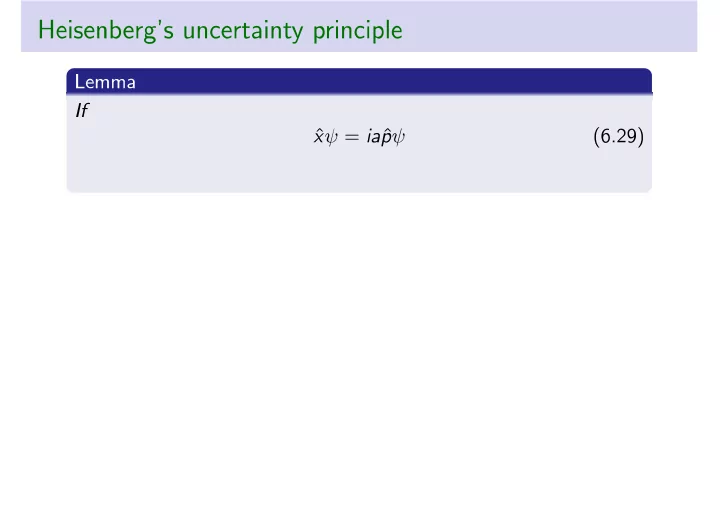
Correction: the condition (6.29) holds for any function of this form, regardless of whether b and C are positive. However, it only defines a normalisable wavefunction for positive b and nonzero C.
SLIDE 14
SLIDE 15
SLIDE 16
SLIDE 17
SLIDE 18
SLIDE 19
Gaussian wavepackets are the minimum uncertainty states with <x>=<p>=0. With a bit more algebra one can generalise this to nonzero expectation values.
SLIDE 20
SLIDE 21
SLIDE 22
position space wave function narrowly peaked Fourier expansion in momentum widely spread
SLIDE 23
SLIDE 24
SLIDE 25
SLIDE 26
SLIDE 27
SLIDE 28
SLIDE 29
SLIDE 30
SLIDE 31
SLIDE 32
SLIDE 33
SLIDE 34
SLIDE 35
SLIDE 36
SLIDE 37
SLIDE 38
SLIDE 39
SLIDE 40
SLIDE 41
SLIDE 42
Check this step
SLIDE 43
SLIDE 44
SLIDE 45
SLIDE 46
SLIDE 47
SLIDE 48
SLIDE 49
SLIDE 50
SLIDE 51
SLIDE 52
So the average behaviour predicted by quantum mechanics is consistent with classical mechanics for macroscopic systems. If that were not true, we should be able to detect discrepancies with classical mechanics, even for large objects, without doing complicated interference experiments. For example, if the average energy for some quantum system was not conserved, we should be able to build an energy source or sink by making lots of copies of that system and letting it evolve.
SLIDE 53
Note that Ehrenfest's theorem shows that expectation values follow equations analogous to classical laws, but does not describe the behaviour of uncertainties, which have no real classical analogue. For example, the uncertainty in position typically increases with time:
SLIDE 54
Consider the quantum harmonic oscillator:
SLIDE 55
We get the same equations as those for x,p for the classical harmonic oscillator. (Particular fact about the harmonic oscillator: not true for general potentials.)
SLIDE 56
https://www.youtube.com/watch?v=1fMi1nriS8Q For another interesting example where Ehrenfest's theorem leads to simple equations of motion for the expectation values, consider a linear potential V(x) = Ax
SLIDE 57
SLIDE 58
SLIDE 59
SLIDE 60
SLIDE 61
SLIDE 62
SLIDE 63
SLIDE 64
SLIDE 65
SLIDE 66
SLIDE 67
SLIDE 68
SLIDE 69
SLIDE 70
SLIDE 71
SLIDE 72
SLIDE 73
SLIDE 74
SLIDE 75
SLIDE 76
SLIDE 77
SLIDE 78
SLIDE 79
SLIDE 80
SLIDE 81
SLIDE 82
SLIDE 83
SLIDE 84
SLIDE 85
SLIDE 86
SLIDE 87
SLIDE 88
SLIDE 89
SLIDE 90
SLIDE 91
SLIDE 92
SLIDE 93
SLIDE 94
SLIDE 95
SLIDE 96
SLIDE 97
SLIDE 98
SLIDE 99
SLIDE 100
SLIDE 101 Note: we can also see that there cannot be eigenfunctions with energies other than these values. If there were, we could apply (a)^n to them for arbitrarily large n, without
- btaining the zero function, and so there would be negative energy eigenstates.
With a little more thought we can also show that the eigenspaces must be nondegenerate.