Corso di Motori Aeronautici Mauro Valorani Laurea Magistrale in - - PowerPoint PPT Presentation

corso di motori aeronautici
SMART_READER_LITE
LIVE PREVIEW

Corso di Motori Aeronautici Mauro Valorani Laurea Magistrale in - - PowerPoint PPT Presentation

Corso di Motori Aeronautici Mauro Valorani Laurea Magistrale in Ingegneria Aeronautica (MAER) Sapienza, Universit` a di Roma Anno Accademico 2011-12 FP7 Aero Engine Scenario Sett. 13: Conclusioni 1 FP7 Aero Engine Scenario ERS Strategy


slide-1
SLIDE 1

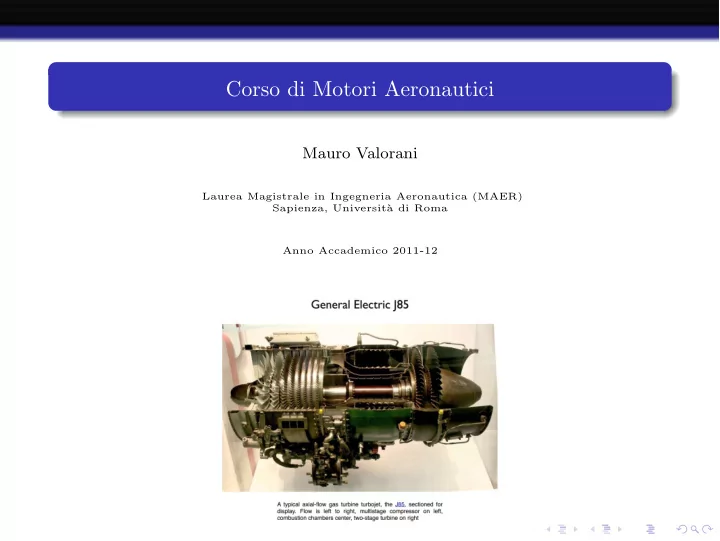
Corso di Motori Aeronautici

Mauro Valorani

Laurea Magistrale in Ingegneria Aeronautica (MAER) Sapienza, Universit` a di Roma Anno Accademico 2011-12
slide-2
SLIDE 2

FP7 Aero Engine Scenario

  • Sett. 13: Conclusioni

1 FP7 Aero Engine Scenario ERS Strategy Targets CO2 & NOX Reduction VITAL Concepts

COUNTER-ROTATING FAN DIRECT DRIVE TURBOFAN GEARED TURBOFAN

NEWAC Core Concepts

SP 1: Whole Engine Integration SP 2: Intecooled Recuperative Core Concept SP 3: Intecooled Core Concept SP 4: Active Core Concept SP 5: Flow Controlled Core Concept SP 6: Innovative Combustor

slide-3
SLIDE 3

FP7 Aero Engine Scenario

  • Lez. 26: Conclusioni
slide-4
SLIDE 4

FP7 Aero Engine Scenario

FP7 Aero Engine Scenario

slide-5
SLIDE 5

FP7 Aero Engine Scenario ERS Strategy

ERS Strategy

FP-5: EEFAE (Efficient and Environmentally Friendly Aero Engine) and SILENCER (Significantly Lower Community Exposure to Aircraft Noise) were in preparation towards the ACARE targets on engine level. The CLEAN (Component Validator for Environmentally-friendly Aero-Engine) demonstrator aimed at the validation of components for the future concepts. FP-6: two integrated projects have been set-up: VITAL focused on technologies for low pressure system improvements to reduce CO2 and noise. New combustor technologies and new engine core configurations will be developed to find a significant and durable reduction of pollution within the NEWAC (NEW Aero engine Core concepts) programme

slide-6
SLIDE 6

FP7 Aero Engine Scenario Targets CO2 & NOX Reduction

Targets CO2 & NOX Reduction

slide-7
SLIDE 7

FP7 Aero Engine Scenario VITAL Concepts

VITAL Concepts

Technologies developed in VITAL will be incorporated in three basic configurations involving the low-pressure section including the fan. The improvements expected from each of these layouts will be evaluated against the requirements of the type of flight (short or long-haul). Three basic architectures are investigated: Direct Drive Turbofan (DDTF), a re-optimized tradeoff between fan and turbine requirements considering the low weight technologies introduced in VITAL. Geared Turbofan (GTF), combining a fan with a reduction gear train, to allow different rotating speeds for the fan, and the booster and turbine. Contra Rotating Turbofan (CRTF), with two fans turning in opposite directions, allowing even lower rotation speeds, since the two fans split the loads involved.

slide-8
SLIDE 8

FP7 Aero Engine Scenario VITAL Concepts

COUNTER-ROTATING FAN

The counter-rotating turbofan (CRTF) concept developed by Snecma is particularly innovative. This layout simply means that there are two independent shafts, rotating in opposite directions. At the other end of the low-pressure section, they are joined to a low-pressure turbine with several stages of counter-rotating blades. For a given aerodynamic load, this configuration will reduce the fan rotating speed by 30 percent or more. This fan concept is a great leap by offering the same performance as a conventional fan it manages the same airflow -, but with slower tip speeds, reducing fan noise. Therefore, engines development would be able to follow a new trend enabling a higher bypass ratio with lower fuel burn. Acoustic tests will be carried out at different speeds, with different blade configurations. Each rotor will have significantly fewer blades than a conventional fan. Tests will be performed on a 1/4-scale model at the Russian research center CIAM (Central Institute of Aviation Motors), already a partner to Snecma on several initiatives.

slide-9
SLIDE 9

FP7 Aero Engine Scenario VITAL Concepts

DIRECT DRIVE TURBOFAN

The Direct Drive Turbofan (DDTF), concept developed by Rolls-Royce, remains

  • n a similar configuration as engines of today, but would contain the increase of

weight of the engine through novel lightweight materials and structures. The targeted high bypass ratio is 10 to 12. As a result of the higher bypass ratio the fan speed and pressure ratio will be reduced. Acoustic and aerodynamic tests of a fan rig will be performed at Anecom in Germany. Designs for low weight and noise LP turbines will be aerodynamically and acoustically tested in Germany, Italy and

  • Spain. Mechanical tests of the novel fan blade, casings and structures will also be

carried out.

slide-10
SLIDE 10

FP7 Aero Engine Scenario VITAL Concepts

GEARED TURBOFAN

The Geared Turbofan (GTF), concept developed by MTU, is also based on a standard technology but targeting higher bypass ratios (12-15). The GTF which revivals through the use of a gear placed on the engine axe, needs that VITAL teams to develop new technologies for compressors and the low-pressure turbine. The GTF evaluations will use the same fan technology as the DDTF, both aerodynamic and mechanical.

slide-11
SLIDE 11

FP7 Aero Engine Scenario NEWAC Core Concepts

NEWAC Core Concepts

slide-12
SLIDE 12

FP7 Aero Engine Scenario NEWAC Core Concepts

NEWAC SP 1: Whole Engine Integration

For all core concepts the requirements and objectives are defined, starting with whole engine performance cycle data. The programme compares, assess and ranks the benefits

  • f the advanced concepts, ensuring consistency of the results and monitoring progress

towards the ACARE technical and economic objectives. The new engine designs will be assessed in typical aircraft applications as indicated in figure 1. Environmental Risk Analysis), previously created in the VITAL programme, in order to compare the environmental and economic impacts of the new designs. Issues to be addressed include performance, weight, engine installation, NOX and CO2 emissions, noise, fuel costs, maintenance cost and aircraft flight path and altitude. The socio-economic model will identify engines with minimum global warming potential and lowest cost of ownership as shown in figure 2.

slide-13
SLIDE 13

FP7 Aero Engine Scenario NEWAC Core Concepts

NEWAC SP 2: Intecooled Recuperative Core Concept

This concept exploits the heat of the engines exhaust gas and maximises the heat pick up capacity of the combustor inlet air by intercooling in front of the HP compressor. EEFAE-CLEAN results showed potential in the optimisation of the recuperator arrangement (innovative duct design, radial compressor in a new design area). Centrifugal HP Compressor Centrifugal compressor efficiency improvement and high hub-tip-ratio Optimisation of radial compressor/ducting interface Radial/axial compressor comparison Recuperator Improved heat exchanger and nozzle arrangement Low loss heat exchanger integration Structural and overall IRA integration aspects Future innovative core configuration Variable core cycle Innovative combustion Contra-rotating core Unconventional heat management

slide-14
SLIDE 14

FP7 Aero Engine Scenario NEWAC Core Concepts

NEWAC SP 3: Intecooled Core Concept

To utilise the CO2 benefits of a high overall pressure ratio cycle for a given NOX level and material technology, an intercooler is included in front of the HP compressor. Two key technologies of the intercooled core concept will be investigated in detail. One key technology is the intercooler and the related ducting, which has to handle the full core mass flow and will be validated by rig tests. Then, specific HPC technologies are needed to react on the increased operability needs due to the added volumes in the compression system (intercooler, ducting) and the high

  • OPR. These HPC technologies will be validated with rig tests.

Intercooler an related ducting Design and test advanced cross-corrugated plate heat exchanger Design and validation of low pressure loss ducts Advanced OGV/diffuser Improved HPC (higher overall pressure ratio) Stability enhancement for intercooled core operability needs Improved blading and secondary flow path Improved tip clearance design

slide-15
SLIDE 15

FP7 Aero Engine Scenario NEWAC Core Concepts

NEWAC SP 4: Active Core Concept

Active systems offer the possibility to adapt the core engine to each operating condition

  • f the mission and, therefore, the potential to optimise component and cycle behaviour.

The active cooling air cooling system will be investigated for reduced cooling air

  • consumption. To increase the effiency and the operability, the HP compressor will be

equipped with a active clearance control system for the rear stages and a active surge control system for the front stages. Active clearance control system (rear stages) Improved tip clearance with active clearance control system (thermal or mechanical) Comparison with alternative technologies for tip clearance improvement Active surge control (front stages) Development of an active surge control with air injection Comparison to the passive alternative multi stage casing treatment Active air cooling Gerneral concept Air cooler and control system Combustor case cooling air flow path HPC rear cone cooling

slide-16
SLIDE 16

FP7 Aero Engine Scenario NEWAC Core Concepts

NEWAC SP 5: Flow Controlled Core Concept

High BPR direct driven turbofan engines require a compact HP compressor with very high PR, which has to compensate for the low booster PR. Flow control technologies are investigated in NEWAC, which help in the specific field of very high aerodynamic loaded HPC to strongly increase efficiency and stall margin. Tip flow control and advanced aero Advanced casing concepts (Casing treatment, casing aspiration, tip injection) 3D optimised aerodynamic Stall active control integration Aspiration concept on blade profiles Aspiration concept on blade profiles Evaluation and optimisation of aspiration technology on stator vane/hubs or blade Identification of potential benefits Rub management

slide-17
SLIDE 17

FP7 Aero Engine Scenario NEWAC Core Concepts

NEWAC SP 6: Innovative Combustor

All promising approaches for significant NOX emission reduction are on the basis of lean premixing combustion technology. Lean combustion technology operates with an excess of air to significantly lower flame temperatures and consequently significantly reduce NOX formation. The optimisation of homogeneous fuel-air mixtures is the key to achieve lower flame temperatures and hence lower thermal NOX formation. However, this homogenisation has a strongly adverse effect on combustion lean stability, drastically narrowing the operating and stability range. Low NOX technology is difficult to scale to various engine sizes. As a consequence, depending on the overall pressure ratio of the particular engine application, different injector and combustor technologies have to be considered.