+ = + cos( c ) a cos a sin = + f ( ) a - - PDF document

cos c a cos a sin f a cos a sin 1
SMART_READER_LITE
LIVE PREVIEW

+ = + cos( c ) a cos a sin = + f ( ) a - - PDF document

Announcements Fourier Transform Send email to the TA for the mailing list Analytic geometry gives a coordinate aster@ umiacs . umd . edu system for describing geometric objects. For problem set 1: turn in written answers to Fourier


slide-1
SLIDE 1

1

Announcements

  • Send email to the TA for the mailing list

aster@umiacs.umd.edu

  • For problem set 1: turn in written answers to

problems 2 and 3.

  • Everything printed, plus source code emailed

to the TA.

  • “What kind of geometric object?”, eg., circle,

line, ….

  • It is possible that the first problem set is kind
  • f hard. Start early.

Fourier Transform

  • Analytic geometry gives a coordinate

system for describing geometric objects.

  • Fourier transform gives a coordinate

system for functions.

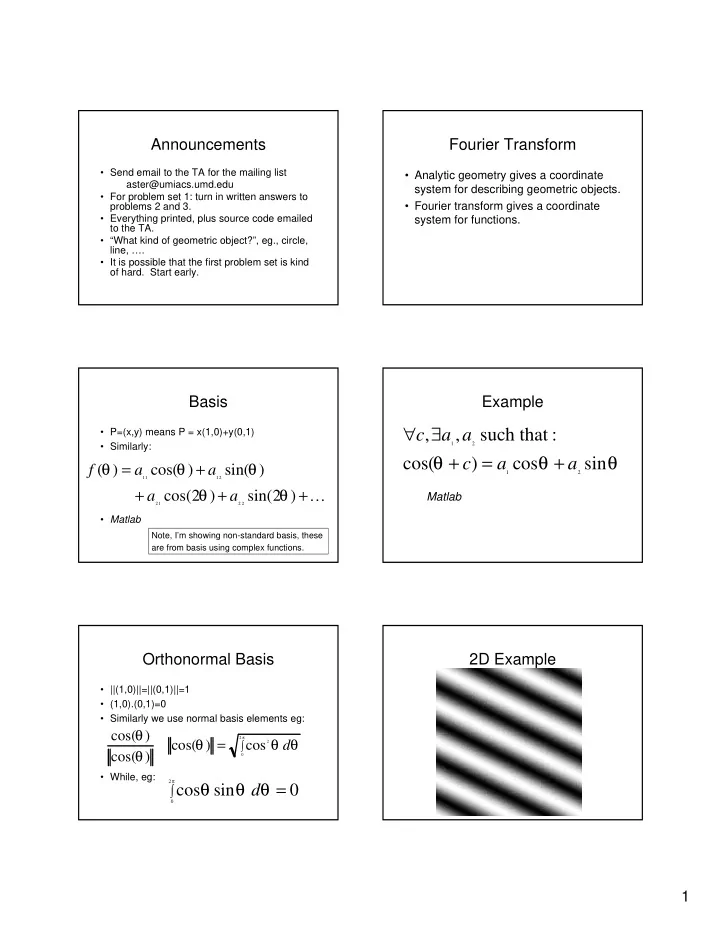
Basis

  • P=(x,y) means P = x(1,0)+y(0,1)
  • Similarly:
  • Matlab

+ + + + = ) 2 sin( ) 2 cos( ) sin( ) cos( ) (

2 2 1 2 2 1 1 1

θ θ θ θ θ a a a a f

Note, I’m showing non-standard basis, these are from basis using complex functions.

Example

θ θ θ sin cos ) cos( : such that , ,

2 1 2 1

a a c a a c + = + ∃ ∀

Matlab

Orthonormal Basis

  • ||(1,0)||=||(0,1)||=1
  • (1,0).(0,1)=0
  • Similarly we use normal basis elements eg:
  • While, eg:

=

π

θ θ θ θ θ

2 2

cos ) cos( ) cos( ) cos( d

=

π

θ θ θ

2

sin cos d

2D Example

slide-2
SLIDE 2

2

Remember Convolution

1/9.(10x1 + 11x1 + 10x1 + 9x1 + 10x1 + 11x1 + 10x1 + 9x1 + 10x1) = 1/9.( 90) = 10 10

11 10

9 10

11

10 9 10 1 10 10 2 9 9 9 9 9 9 1

99

10 10

11

1 1

11 11 11 11

10 10 I 1 1 1 1 1 1 1 1 1 F X X X X 10 X X X X X X X X X X X X X X X X

1/9 O

Convolution Theorem

G F T g f *

1 −

= ⊗

  • F,G are transform of f,g

That is, F contains coefficients, when we write f as linear combinations of harmonic basis.

Examples

? ) 3 cos 1 . 2 cos 2 . (cos ? cos ? 2 cos cos ? cos cos = ⊗ + + = ⊗ = ⊗ = ⊗ f f θ θ θ θ θ θ θ θ

Examples

  • Transform of

box filter is sinc.

  • Transform of

Gaussian is Gaussian.

(Trucco and Verri)

slide-3
SLIDE 3

3

Implications

  • Smoothing means removing high
  • frequencies. This is one definition of

scale.

  • Sinc function explains artifacts.
  • Need smoothing before subsampling to

avoid aliasing.

Example: Smoothing by Averaging Smoothing with a Gaussian Sampling Boundary Detection - Edges

  • Boundaries of objects

– Usually different materials/orientations, intensity changes.

slide-4
SLIDE 4

4

We also get: Boundaries of surfaces Boundaries of materials properties

Boundaries of lighting

Edge is Where Change Occurs

  • Change is measured by derivative in 1D
  • Biggest change, derivative has

maximum magnitude

  • Or 2nd derivative is zero.

Noisy Step Edge

  • Gradient is high everywhere.
  • Must smooth before taking gradient.

Optimal Edge Detection: Canny

  • Assume:

– Linear filtering – Additive iid Gaussian noise

  • Edge detector should have:

– Good Detection. Filter responds to edge, not noise. – Good Localization: detected edge near true edge. – Single Response: one per edge.

slide-5
SLIDE 5

5

Optimal Edge Detection: Canny (continued)

  • Optimal Detector is approximately

Derivative of Gaussian.

  • Detection/Localization trade-off

– More smoothing improves detection – And hurts localization.

  • This is what you might guess from

(detect change) + (remove noise)

So, 1D Edge Detection has steps:

  • 1. Filter out noise: convolve with

Gaussian

  • 2. Take a derivative: convolve with

[-1 0 1]

  • 3. Find the peak.
  • Matlab
  • We can combine 1 and 2.
  • Matlab
slide-6
SLIDE 6

This document was created with Win2PDF available at http://www.daneprairie.com. The unregistered version of Win2PDF is for evaluation or non-commercial use only.