
SLIDE 1
Cosmology for Everyone
- Dr. Steven Ball
Professor of Physics LeTourneau University
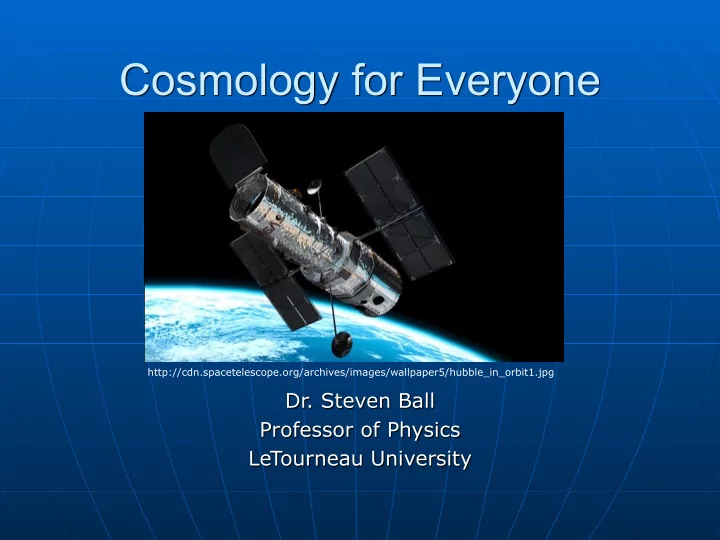
http://cdn.spacetelescope.org/archives/images/wallpaper5/hubble_in_orbit1.jpg
Cosmology for Everyone - - PowerPoint PPT Presentation
Cosmology for Everyone http://cdn.spacetelescope.org/archives/images/wallpaper5/hubble_in_orbit1.jpg Dr. Steven Ball Professor of Physics LeTourneau University Hubble Telescope eXtreme Deep Field Modern Cosmology Begins Albert Einstein
Professor of Physics LeTourneau University
http://cdn.spacetelescope.org/archives/images/wallpaper5/hubble_in_orbit1.jpg
Hubble Telescope eXtreme Deep Field
■
Albert Einstein (1879-1955)
■
Special Relativity (1905)
■
General Relativity (1915): matter-energy <=> space-time
■
Contrast to Newtonian Gravity,
induced by matter
www.universetoday.com/56612/einsteins-general- relativity-tested-again-much-more-stringently/ www.science4all.org/wp-content/uploads/2013/05/Gravity.jpg
Philosophical Bias to expect static cosmos (unchanging) Had to modify equations to yield static cosmos solution
■
Alexander Friedmann (1888-1925)
■
Solved Einstein’s Field Equations (correcting algebraic mistake and eliminating cosmological constant)
■
Predicted expanding universe from 3 solutions: open (expands forever), closed (will collapse), and flat
Size of universe Time
en.wikipedia.org/wiki/File:Aleksandr_Fridman.png
■
Astronomers Harlow Shapley vs. Heber Curtis
■
Are the spiral nebulae part of the Milky Way Galaxy or island universes far beyond the Milky Way?
■
Inconclusive debate due to lack of observational evidence.
en.wikipedia.org/wiki/File:Andromeda_Galaxy_(with_h-alpha).jpg
■
Edwin Hubble (1889-1953)
■
Using Mt. Wilson Observatory 100 inch reflector telescope (1920)
■
By 1925 confirmed that the Andromeda nebula lies far beyond the Milky Way and is also a vast galaxy of stars
■
There are billions of galaxies stretching out in space billions of light years away from us.
■
By 1929 confirmed that the further a galaxy is from us, the faster it recedes from us.
www.tumblr.com/search/mount+wilson+observatory
■
Expansion of Universe seen in slight change in wavelengths of spectral lines in receding galaxies (redshift z = Δλ/λ)
■
Hubble’s Law: Recesion Velocity = Constant times Distance (v = H d) Using present data we now know Ho = 72±1 km/s/Mpc. Age of the universe is then (assuming constant expansion) T = d/v = 1/Ho = 13.6 billion yrs
From Filippenko & Riess, Phys.Rept. 307 (1998) 31-44 en.wikipedia.org/wiki/File:Redshift.png
■
George Gamow (1904-1968)
■
Used physics to extrapolate universe back in time to when it was very small and exceedingly hot and dense! (1948)
■
Proposed that Hydrogen and Helium were synthesized during the first few minutes of “Big Bang” expansion, but could not account for heavier elements!
■
With Ralph Alpher & Robert Herman predicted hot radiation background then at 10 mill K, released when temp drops to 3000 K, eventually cools to only 5 K with continued expansion today.
www.aip.org/history/cosmology/ideas/ images-ideas/gamow-b1.jpg
Big Bang
■
Fred Hoyle (1915-2001)
■
Denounced “Big Bang” (1949)
Offered Steady-State Theory of Cosmology – continuous creation
en.wikipedia.org/wiki/File:Fred_Hoyle.jpg
■
Discovered by accident by Bell Lab scientists Arno Penzias and Robert Wilson (1965)
map.gsfc.nasa.gov/media/ContentMedia/990045b.jpg map.gsfc.nasa.gov/media/ContentMedia/990015b.jpg
Proved Hot Origin of Universe!
■ Solution: Brief Inflationary
■ Predicts Slight Non-Uniformity of
astronomy.swin.eud.au/cms/imagedb/albums/userpics/bigbang2.jpg web.mit.edu/physics/images/faculty/ guth_alan.jpg
■
Galaxy Formation implies radiation background could not be entirely uniform – hotter spots needed to initiate it
■
Original Expectations: variation in T / T = 0.001
■
With Cold Dark Matter present (another discussion) revised expections: variation in T / T = 0.00001
■
Cosmic Background Explorer (COBE 1992)
en.wikipedia.org/wiki/File:COBE_cmb_fluctuations.gif upload.wikimedia.org/wikipedia/commons/thumb/ a/af/Cobe_vision1.jpg/230px-Cobe_vision1.jpg
Rather than slowing down (decelerating) the universe is expanding faster today than in the past! “Dark Energy”
http:// From Conley, et al ApJS (2011), 192, 1 http://www.physast.uga.edu/~rls/1020/ch22/22-18.jpg
2 Teams: Supernova Cosmology Project and High Z Supernova Search Team find unexpected result: expansion increasing!
Dark Energy now dominates Energy Density of Universe, implying universe will continue expanding faster & faster!
http://daedalus.as.arizona.edu/~gwalth/Astr170B1/Lectures/images/22_18_Figure-Anno.jpg
http://map.gsfc.nasa.gov/media/101080/101080_7yrFullSky_WMAP_320W.jpg
http://map.gsfc.nasa.gov/media/070950/070950b.jpg
■ Total Mass-Energy Density is precisely the
■ Establishes Age of Universe: 13.7 billion years
http://csp.res.in/ICSP-WEB/Docs/Pop_cd/Material/Quiz/cosmos/wmap-findgeometrysmg.gif
■
Dark Ages end after around 400 million years, when large halos of dark matter spawn growth of stars and galaxies
upload.wikimedia.org/wikipedia/commons/thumb/6/6f/CMB_Timeline300_no_WMAP.jpg/350px-CMB_Timeline300_no_WMAP.jpg
■ Does the vast scale of our cosmos
■ Are we just a cosmic “accident”? ■ Or does the vast and elegant universe
■ Can an ancient religious faith in a