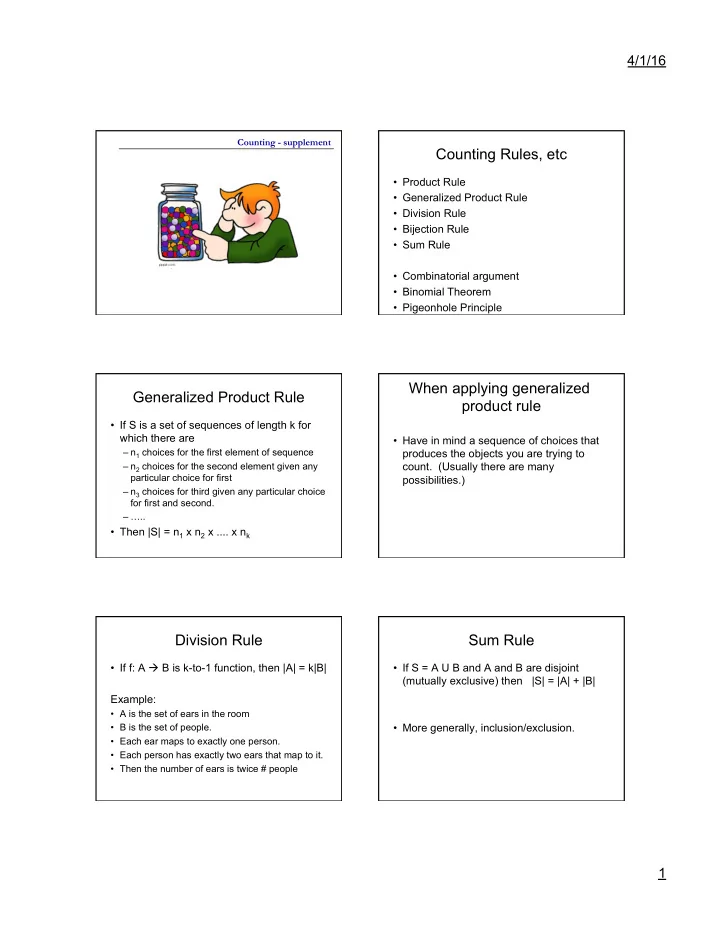
Counting Rules, etc Product Rule Generalized Product Rule Division - - PDF document

counting rules etc
SMART_READER_LITE
LIVE PREVIEW

Counting Rules, etc Product Rule Generalized Product Rule Division - - PDF document

4/1/16 Counting - supplement Counting Rules, etc Product Rule Generalized Product Rule Division Rule Bijection Rule Sum Rule Combinatorial argument Binomial Theorem Pigeonhole Principle When applying generalized


slide-1
SLIDE 1

4/1/16 1

Counting - supplement

Counting Rules, etc

  • Product Rule
  • Generalized Product Rule
  • Division Rule
  • Bijection Rule
  • Sum Rule
  • Combinatorial argument
  • Binomial Theorem
  • Pigeonhole Principle

Generalized Product Rule

  • If S is a set of sequences of length k for

which there are

– n1 choices for the first element of sequence – n2 choices for the second element given any particular choice for first – n3 choices for third given any particular choice for first and second. – …..

  • Then |S| = n1 x n2 x .... x nk

When applying generalized product rule

  • Have in mind a sequence of choices that

produces the objects you are trying to

  • count. (Usually there are many

possibilities.)

Division Rule

  • If f: A à B is k-to-1 function, then |A| = k|B|

Example:

  • A is the set of ears in the room
  • B is the set of people.
  • Each ear maps to exactly one person.
  • Each person has exactly two ears that map to it.
  • Then the number of ears is twice # people

Sum Rule

  • If S = A U B and A and B are disjoint

(mutually exclusive) then |S| = |A| + |B|

  • More generally, inclusion/exclusion.
slide-2
SLIDE 2

4/1/16 2

Combinatorial argument

Let S be a set of objects.

  • Show how to count a set in one way à N
  • Show how to count a set in another way à

M Conclude that N = M

Solving Pigeonhole Principle Problems

  • What are the pigeons?
  • What are the pigeonholes?
  • What is the rule for assigning a pigeon to a

pigeonhole?

friending pigeons

There are many people in this room, some of whom are friends, some of whom are not… Prove that some two people have the same number of friends.

counting paths How many ways to walk from 1st and Spring to 5th and Pine only going North and East? Pine Pike Union Spring 1st 2nd 3rd 4th 5th

✓7 3 ◆ = 35

Instead of tracing paths on the grid above, list choices. You walk 7 blocks; at each intersection choose N or E; must choose N exactly 3 times.

counting paths How many ways to walk from 1st and Spring to 5th and Pine only going North and East, if I want to stop at Starbucks on the way? Pine Pike Union Spring 1st 2nd 3rd 4th 5th Other problems

10 people of different heights. How many ways to line up 5 of them? Line up 5 of them in height order?

slide-3
SLIDE 3

4/1/16 3

8 by 8 chessboard

  • How many ways to place a pawn, bishop

and knight so that none are in same row or column?

quick review of cards

  • 52 total cards
  • 13 different ranks:

2,3,4,5,6,7,8,9,10,J,Q,K,A

  • 4 different suits: Hearts, Clubs, Diamonds,

Spades

counting cards

  • How many possible 5 card hands?
  • A “straight” is five consecutive rank cards of

any suit. How many possible straights?

  • How many flushes are there?

✓52 5 ◆ 10 · 45 = 10, 240 4 · ✓13 5 ◆ = 5, 148

more counting cards

  • How many straights that are not flushes?
  • How many flushes that are not straights?

10 · 45 − 10 · 4 = 10, 200 4 · ✓13 5 ◆ − 10 · 4 = 5, 108

the sleuth’s criterion (Rudich) For each object constructed it should be possible to reconstruct the unique sequence of choices that led to it!

✓4 3 ◆ · ✓49 2 ◆

Example: How many ways are there to choose a 5 card hand that contains at least 3 aces?

Choose 3 aces, then choose 2 cards from remaining 49.

the sleuth’s criterion (Rudich) For each object constructed it should be possible to reconstruct the unique sequence of choices that led to it!

✓4 3 ◆ · ✓49 2 ◆

Example: How many ways are there to choose a 5 card hand that contains at least 3 aces?

Choose 3 aces, then choose 2 cards from remaining 49.

✓4 3 ◆ · ✓48 2 ◆ + ✓4 4 ◆ · ✓48 1 ◆

When in doubt break set up into disjoint sets you know how to count!

slide-4
SLIDE 4

4/1/16 4

Lessons

  • Solve the same problem in different ways!
  • If needed, break sets up into disjoint

subsets that you know for sure how to count.

  • Once you specify the sequence of choices

you are making to construct the objects, make sure that given the result, you can tell exactly what choice was made at each step!

Other problems

# of 7 digit numbers (decimal) with at least one repeating digit? (allowed to have leading zeros). # of 3 character password with at least one digit each character either digit 0-9 or letter a-z. 10 36 36 + 36 10 36 + 36 36 10

Rooks on Chessboard

  • Number of ways to place 2 identical rooks
  • n a chessboard so that they don’t share a

row or column.

Doughnuts

  • You go to Top Pot to buy a dozen
  • doughnuts. Your choices today are

– Chocolate – Lemon-filled – Sugar – Glazed – Plain

  • How many ways to choose a dozen

doughnuts when doughnuts of the same type are indistinguishable?

Bijection Rule

  • Count one set by counting another.
  • Example:

– A: all ways to select a dozen doughuts when five varieties are available. – B: all 16 bit sequences with exactly 4 ones

Bijection between A and B

– A: all ways to select a dozen doughuts when five varieties are available. – B: all 16 bit sequences with exactly 4 ones

slide-5
SLIDE 5

4/1/16 5

Mapping from doughnuts to bit strings Buying 2 dozen bagels

  • Choosing from 3 varieties:

– Plain – Garlic – Pumpernickel

  • How many ways to grab 2 dozen if you

want at least 3 of each type and bagels of the same type are indistinguishable.