Country Report of Nepal on Organizing and Managing Literate - - PDF document

country report of nepal on organizing and managing
SMART_READER_LITE
LIVE PREVIEW

Country Report of Nepal on Organizing and Managing Literate - - PDF document

Annex-9 Country report Nepal (1) Country Report of Nepal on Organizing and Managing Literate Environment Presented by: Dinanath Gautam Deputy Director Ministry of Education Non Formal Education Centre, Nepal Nepal at a Glance Map of Nepal


slide-1
SLIDE 1

Country Report of Nepal on Organizing and Managing Literate Environment

Presented by: Dinanath Gautam Deputy Director Ministry of Education Non Formal Education Centre, Nepal

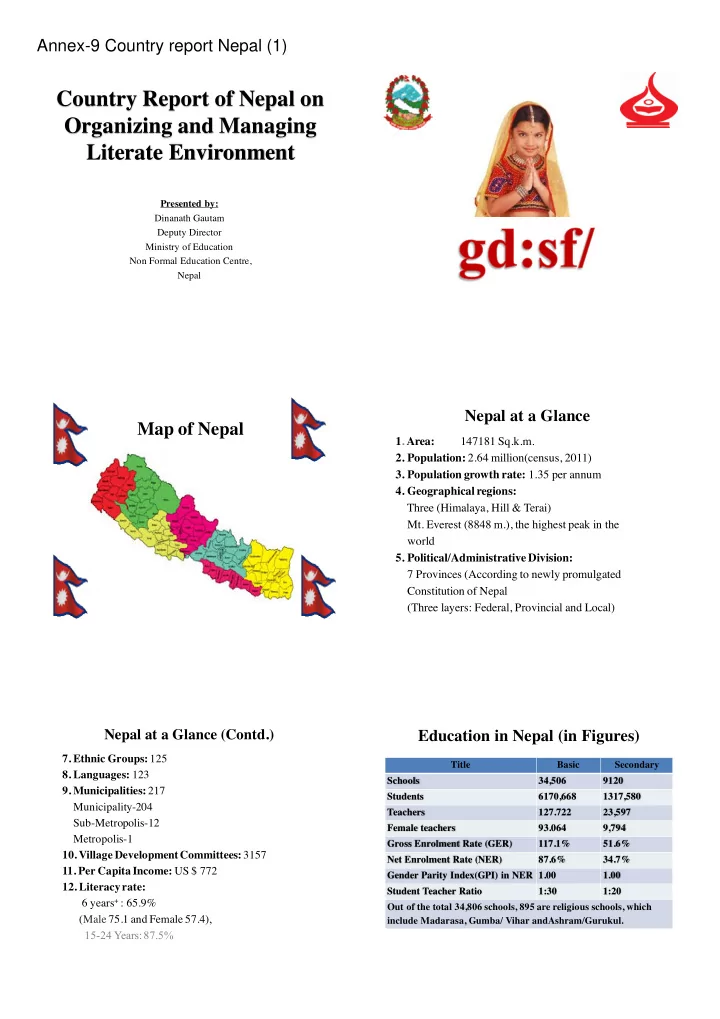
Map of Nepal

Nepal at a Glance

  • 1. Area: 147181 Sq.k.m.
  • 2. Population: 2.64 million(census, 2011)
  • 3. Population growth rate: 1.35 per annum
  • 4. Geographical regions:

Three (Himalaya, Hill & Terai)

  • Mt. Everest (8848 m.), the highest peak in the

world

  • 5. Political/Administrative Division:

7 Provinces (According to newly promulgated Constitution of Nepal (Three layers: Federal, Provincial and Local)

Nepal at a Glance (Contd.)

  • 7. Ethnic Groups: 125
  • 8. Languages: 123
  • 9. Municipalities: 217

Municipality-204 Sub-Metropolis-12 Metropolis-1

  • 10. Village Development Committees: 3157
  • 11. Per Capita Income: US $ 772
  • 12. Literacy rate:

6 years+ : 65.9% (Male 75.1 and Female 57.4), 15-24 Years: 87.5%

Education in Nepal (in Figures)

Title Basic Secondary Schools 34,506 9120 Students 6170,668 1317,580 Teachers 127.722 23,597 Female teachers 93.064 9,794 Gross Enrolment Rate (GER) 117.1% 51.6% Net Enrolment Rate (NER) 87.6% 34.7% Gender Parity Index(GPI) in NER 1.00 1.00 Student Teacher Ratio 1:30 1:20 Out of the total 34,806 schools, 895 are religious schools, which include Madarasa, Gumba/ Vihar andAshram/Gurukul.

Annex-9 Country report Nepal (1)

slide-2
SLIDE 2

2 4 6 8 10 12 14 16 18

2010/11 2011/12 2012/13 2013/14 2014/15 2015/16

17.1 16.6 15.67 15.65 13.92 12.04

Expenses11in1Education1Sector1

Ministry1of1Education

Curriculum1 Development1 Centre1(CDC) NonFFormal1 Education1 Centre1(NFEC)

District1NonFFormal1 Education1CommitteesF 75 NFESection1in1District1 Education1OfficesF75

Community1 Learning1 Centres (CLCs)F2151 Department11of1 Education1(DOE) Regional1 Educational1 Directorate1 (RED)F5 District1Education1 CommitteesF75 District1Education1Offices1 (DEOs)F75 Resource1Centres1(RCs)F10531 including11461Lead1Resource1 Centres1(LRCs) National1 Centre1for1 Educational11 Development1 (NCED) Educational1 Training1 CentresF29 Office1of1the1 Controller1of1 Examination1 (OCE)

Organizational structure of education system

CTEVT

HSEB UGC TSC

Roles/&/responsibilities/of/the/agencies/under/ MoE in/implementation/of/educational/programs/

Agencies1 Roles1&1responsibilities1

Ministry of Education Policy making Department of Education Program design Resource allocation Regional Education Directorates Monitoring Supervision Coordination District Education Offices Program Implementation Administration of day to day educational activities Resource Centres Monitoring, supervision & facilitation of school activities in school clusters Schools Receiver of the services and resources from district & regional agencies Provide educational services to learners

School&Structure&of&Education&&

Age Grade

Types&of&Schooling&System

16 12 Secondary Education (Grades 9-12) 15 11 14 10 13 9 12 8 Basic Education (Grades 1-8) 11 7 10 6 9 5 8 4 7 3 6 2 5 1 4 3 Pre Primary Education /Early Childhood Development

Major Policies in Education

MoE Nepal has formulated educational policies and programs to improve the status of education sector and achieve the goal of equitable access to quality education for all. The government has concentrated its efforts towards socially marginalized and deprived communities by working intensively for establishing more inclusive educational environment. The guidelines, norms and standards have been set to ensure efficient working framework for regional, district and school level.

Major policies in education (Contd.)

Formal education starts from Early Childhood Development (ECD) for 3-4 years’ age group and it is of

  • ne year duration.

Formal school education consists of basic and secondary education. Teachers' training and capacity building activities are carried out by Educational Training Centres (ETC) under National Centre for Educational Development(NCED) and RCs also coordinate and supervise the schools in school clusters. Resource Centres (RCs) under District Education Offices(DEOs).

slide-3
SLIDE 3

Major policies in education (Contd.)

Curriculum Development Centre (CDC), as the CLA under MoE system, develops school level curricula, prepares and approves textbooks and other curricular materials to be used in school education The children and youths who are dropped out of school education are provided with technical education and vocational training (TEVT) of various levels and trades by the technical and vocational schools under Council for Technical Education Vocational Training (CTEVT). The Non Formal Education Policy focuses on decentralisation, empowerment and partnerships with the private sector and I/NGO’s as strategies to achieve goals for adult literacy.

Objectives of Higher Education

Produce high level and internationally competitive skilled workforce capable to contribute to national economic growth and all round development of the country; Produce future leaders for the nation; Generate knowledge through research studies and innovative activities; Contribute to transferring knowledge and technology; Preserve historical and cultural heritage of the country

Educational planning in Nepal

Department of Education is the responsible agency for school level educational planning. Education plans are designed based on bottom up planning approach. School Improvement Plan (SIP), Village Education Plan (VEP), District Education Plan (DEP) are prepared with the involvement of concerned stakeholders at the local level. The CLAs under MoE system are responsible for designing and implementing programmes and monitoring them. Five Regional Education Directorates (REDs) are responsible for monitoring the programmes undertaken by the district level organizations. Seventy five DEOs and 1053 Resource Centres (RCs) at sub district level are the main implementing agencies of the educational policies, plans and programmes at local levels.

Non1Formal1Education1Programs1in1Nepal

Literate/Nepal/Mission/(LINEM)/implemented/for/7/ years/with/the/aim/of/eradicating/illiteracy/from/the/ countryI3/months/basic/literacy/package// Continuous/education/program/Level/1/&/2I 4/months/ integrated/basic/and/post/literacy/program/ Income/generation/(IG)/activities/and/livelihood/skill/ development/programs/in/collaboration/with/providers/

  • f/TE,/VT,/livelihood/skills/development/and/other/

development/partners/ Establishment/and/development/of/CLCs as/the/venue/

  • f/NFE &/Lifelong/learning/in/community/level.////

Non1Formal1Education1Programs1in1Nepal1(Contd.)

Alternative/education/program//for/outIofIschool/ children/including/school/dropIoutsI ! 6/years/condensed/program/for/grade/1I10/ ! Alternative/primary/education/of/3/years/equivalent/ to/grade/1I5/of/formal/education// ! Open/schooling/program/of/2/years/equivalent/to/ grade/6I8/and/1/year/for/grade/9I10 ! School/Outreach/Program/(SOP)/for/school/going/age/ childrenIproviding/1I3/grade/formal/education/in/ NFE modeIGovernment/program/phased/out/but/ CBOs working/in/child/right,/child/education/etc./ carry/out/SOP///

Partnership1with1Development1 Partners1&1CSOs

Basket1fund1for1Implementing1Educational1 ProgramsFDOE Established1NFE Network1for1Partnership1&1 CollaborationFNFEC Responsibility1of1Local1Government1Agencies1 in1Implementing1Formal1and1Non1Formal1 Education11 Mobilization1of11local1NGOs1&1CBOs for1 Literate1Nepal1Mission1(LINEM)1

slide-4
SLIDE 4

Partnership with UNESCO

Support for enhancing the effectiveness of the system for implementing literacy and other NFE programs. Support for Literate Nepal Mission (LINEM) Support to integrate life and livelihood skills in NFE, develop alternative and open education system equivalent to formal education. Support for development of NFE-MIS. Capacity development for implementing Education for All (EFA) program activities.