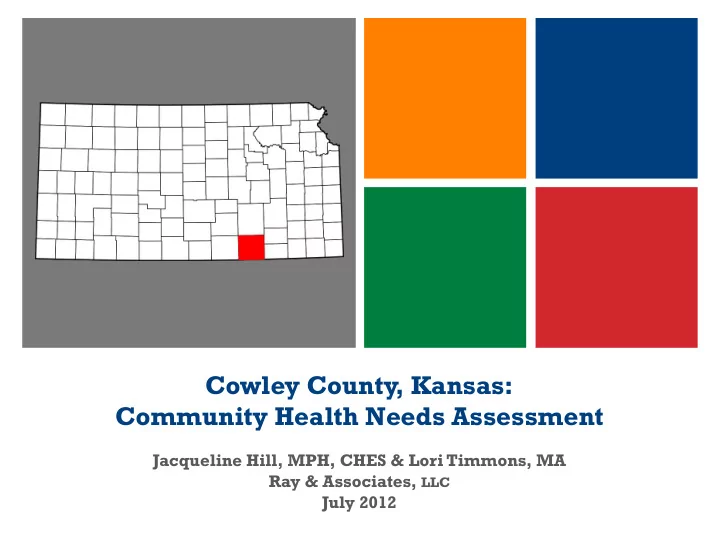
Cowley County, Kansas: Community Health Needs Assessment Jacqueline - - PowerPoint PPT Presentation
Cowley County, Kansas: Community Health Needs Assessment Jacqueline Hill, MPH, CHES & Lori Timmons, MA Ray & Associates, LLC July 2012 Agenda Cowley County Overview Planning Grant Purpose and R&A Role Data Collection
Agenda
- Cowley County Overview
- Planning Grant Purpose and R&A Role
- Data Collection Methods
- Findings
- Summary
Ray & Associates, LLC | July 2012 | 2
Statistic Cowley County State of Kansas Total population1 36,311 2,853,118 Caucasian race1 89.8% 87.4% 65+ years old1 16.1% 13.3% Has bachelor’s degree or higher1 19.5% 29.3% Median household income1 $40,749 $49,424 Lives at or below 200% FPL2 37.6% 14.6% Has children in single-parent households3 33.0% 28.0% Qualifies for free/reduced lunches4 61.0% 47.4%
FPL = federal poverty level; In 2011, FPL = $10,980 for an individual or $22,350 for a family of four.5
Ray & Associates, LLC | July 2012 | 3
Cowley County Population Statistics
0% 4% 8% 12% 16% 20% 2010 2011 2012
Percent of Uninsured Adults3
Cowley County Kansas National Benchmark
Ray & Associates, LLC | July 2012 | 4
Statistic5 National Benchmark Severe Benchmark Cowley County Age-adjusted diabetes rate 6.5% 7.8% 8.0% High blood pressure diagnoses 24.8% 27.7% 35.8% Cigarette use during pregnancy 10.7% 14.3% 26.2% Age-adjusted death rate 870/ 1,000,000 n/a 1,056/ 1,000,000
Ray & Associates, LLC | July 2012 | 5
Cowley County Population Statistics
- Cowley County ranks in the bottom 20% of ranked Kansas counties
- n summary health scores:5
- Health outcomes (82 of 99 counties)
- Health behaviors (86 of 99 counties)
Federal Planning Grant
- Vision 20/20 Strategic Plan
- Planning grant from Health Services Resources
Administration (HRSA) in August 2011
- Purpose of grant is to support development of
community heath centers (CHCs)6
- Before applying for additional federal funding,
Ray & Associates, LLC conducted a needs assessment7 to determine:
- Consumer health care needs
- Resident access to care
- Community receptivity to health center
Ray & Associates, LLC | July 2012 | 6
Data Collection Methods
- Collected quantitative and qualitative data8
- Guided by input from Steering Committee
- Gathered information on perceived health
needs and barriers to care access in county:
- Provider Surveys
- Stakeholder Interviews
- Community Surveys
- Focus Groups
- Used to formally establish priorities and
community support7
Ray & Associates, LLC | July 2012 | 7
Provider Survey
- 20 practice-level telephone surveys performed by nurse
volunteers in April 2012
- Surveys encompassed 58 providers:
- 21 physicians
- 10 physician assistants/nurse practitioners
- 1 midwife
- 12 dentists
- 14 hygienists
Ray & Associates, LLC | July 2012 | 8
Provider Survey Findings
- Appointments for Medicaid patients:
- 20% dedicate specific slots to Medicaid patients
- 65% of providers, 40% of dentists accept Medicaid
- Of those who accept Medicaid patients:
- 30% accept children (ages 0-21)
- 69% have the same wait times as other patients
- 31% have to wait more than 2 weeks for an appointment
- Providers receive daily (40%) and weekly (25%) requests to
accept new Medicaid patients
Ray & Associates, LLC | July 2012 | 9
Provider Survey Findings
- 80% have had to turn patients away:
- 25% for payment issues or being Medicaid patient
- 15% for prescription drug abuse or full schedules
- 45% have patients who have been unable to pay, primarily
because of high deductibles or no insurance
- Provider accommodations for patient payments:
- 15% have a sliding-fee scale for patients
- 25% make payment arrangements with patients
- 80% have difficulty collecting patient payments
Ray & Associates, LLC | July 2012 | 10
Stakeholder Interviews
Ray & Associates, LLC | July 2012 | 11
- 12 semi-structured individual interviews conducted with
key stakeholder representatives in March 2012
- Interviewees included:
- Physicians and hospital administrators
- Education officials and community organization
representatives
- Local business owners and city managers
Common Interview Threads
Ray & Associates, LLC | July 2012 | 12
- Emergency rooms are used a source of primary medical care
- Those with insurance often have high deductibles that
prevent them from seeking care
- Transportation concerns, taking time off work, and low health
literacy levels are barriers to seeking care
- After hours and weekend care would help working families
- Affordable primary care, dental care, mental health, and case
management services are needed
- Agreement that CHC would 1) not be threat to busy provider
community, 2) reduce inappropriate ED use, and 3) provide medical home for under/uninsured
- 2,700 paper surveys printed
- 12 questions
- English or Spanish
- Distributed throughout county
- 1,872 valid surveys returned (69%)
- 1,845 in English (99%)
- 32 web-based surveys
completed (2%)
Short Survey
- Two point-in-time surveys conducted in March/April 2012
- 495 paper surveys printed
- 31 questions
- English or Spanish
- Distributed via volunteers
- 252 valid surveys returned (51%)
- 226 in English (89%)
Long Survey
Ray & Associates, LLC | July 2012 | 13
Community Surveys
Survey Respondent Location (n = 2,214)
Winfield 62% Ark City 27% Burden 2% Udall 3% Other Zip Codes 6%
- 15 total zip codes
- 9 city zip codes (82%)
- 6 partial zip codes (18%)
Ray & Associates, LLC | July 2012 | 14
Community Survey Demographics
- Females (68%) responded
to surveys more often than males (32%)
- Majority of respondents (42%)
were 36-64 years old
- Surveys for those under 18
years of age were typically completed by parents
Ray & Associates, LLC | July 2012 | 15
Gender & Age Race/Ethnicity & Language Family & Household Size Education & Income
Community Survey Demographics
Age Group (n = 2,091)
Under 18 12% 36-64 42% 18-35 29% 65+ 17%
- Majority of respondents were
Caucasian (86%)
- 18% of respondents were of
Hispanic ethnicity
- Respondents reported
primarily speaking English (91%), Spanish (8%), and Laotian (1%) at home
Ray & Associates, LLC | July 2012 | 16
Gender & Age Race/Ethnicity & Language Family & Household Size Education & Income
Community Survey Demographics
Self-Reported Race (n = 227)
Caucasian 86% Other 10% African American 4%
- Respondents’ family sizes
ranged from 1 to 11, with most common family size being 2 people
- Majority of respondents were
married (37%) or single (33%)
Ray & Associates, LLC | July 2012 | 17
Household Status (n = 250)
Married 37% Live-In Partner 13% Single 33% Separated 17% Gender & Age Race/Ethnicity & Language Family & Household Size Education & Income
Community Survey Demographics
- Majority of respondents
finished high school/have GED (37%) or completed some college (38%)
- Most respondents’
households earn less than $2,000 per month (65%)
Ray & Associates, LLC | July 2012 | 18
Monthly Household Income (n = 209)
>$1,000 28% $3,000-3,999 4% $1,000-1,999 37% $2,000-2,999 18% $4,000+ 13% Gender & Age Race/Ethnicity & Language Family & Household Size Education & Income
Community Survey Demographics
Ray & Associates, LLC | July 2012 | 19
Insurance Health Status Providers ER Use Appointments
* Some respondents had both Medicare and Medicaid.
- 74% of respondents had
health insurance and 45% had dental insurance
- 75% of respondents stated
they would use fee-based health and dental clinics
Community Survey Findings
Health Insurance Type (n = 1,859)*
0% 10% 20% 30% 40% 50% Medicaid Medicare Private Insurance No Insurance
Ray & Associates, LLC | July 2012 | 20
Insurance Health Status Providers ER Use Appointments
- Respondents identified the
following needed services to improve their health:
- Family doctor (55%)
- Dentist (51%)
- Eye doctor (43%)
- Women’s doctor (36%)
- Children’s doctor (27%)
Community Survey Findings
Self-Rated Health Status (n = 246)
0% 10% 20% 30% 40% 50% Very Good Good Fair Poor Very Poor
Ray & Associates, LLC | July 2012 | 21
Insurance Health Status Providers ER Use Appointments
- Majority of respondents
(50%) reported going to the doctor only when they are very sick or hurt
- 37% of respondents go to
the doctor for regular check-ups
* Some respondents listed more than one provider location.
Community Survey Findings
Primary Health Providers (n = 252)*
0% 15% 30% 45% 60% 75% Doctor's Office Hospital ER Health Dept None Other Clinic
Ray & Associates, LLC | July 2012 | 22
Insurance Health Status Providers ER Use Appointments
* Some respondents listed more than one reason.
- Cost Concerns:
- out-of-pocket costs (52%)
- expensive medication (36%)
- no health insurance (32%)
- inadequate insurance (20%)
- Appointment Concerns:
- availability of times (24%)
- wait times (11%)
Community Survey Findings
0% 15% 30% 45% 60% Can't Afford Appt Time Don't Know Where Other
Appointment Difficulties*
Immediate Concern (n = 1,343) Regular Check-Up (n = 1,223)
Ray & Associates, LLC | July 2012 | 23
Insurance Health Status Providers ER Use Appointments
- ER use among respondents
varied from 0 to 20 visits last year
- Majority of respondents
(38%) visited the ER 1 or 2 times last year, while 35% had no ER visits
Community Survey Findings
ER Visits in Last 12 Months (n = 232)
0% 10% 20% 30% 40% 1 2 3 4+
Focus Groups
- 8 focus groups conducted by trained researcher in March
2012 with individuals representing:
- Social workers
- School nurses
- Behavioral health clients
- Elderly individuals
- Teachers
- WIC clients
- Laotian community
- Hispanic community
Ray & Associates, LLC | July 2012 | 24
Focus Group Common Threads
- Care seeking behavior:
- Primary locations are family physicians and emergency rooms
- Care is postponed due to costs and appointment times
- Payment difficulties:
- High copays and deductibles (out-of-pocket costs)
- Unpaid past bills
- Earn too much for HealthWave, but can’t afford private insurance
- Income-based fee health and dental clinics:
- Community members want them
- Feel it is reasonable to pay something for care
Ray & Associates, LLC | July 2012 | 25
Focus Group Common Threads
- Ways to improve access to health services:
- Appointment times (evenings, weekends)
- Affordable services
- Transportation
- Assistance finding appropriate services, completing forms
- Bilingual providers (Spanish, Laotian)
- Health care services needed locally:
- Dental
- Vision
- Health education (asthma, diabetes, antibiotics)
Ray & Associates, LLC | July 2012 | 26
- Obstetrics
- Pediatrics
Summary
- Cowley County has:
- Higher than average rates of health care needs,
particularly for chronic conditions
- Lower than average levels of personal resources
(e.g., income, insurance)
- Major barriers to accessing care include:
- Out-of-pocket costs (high deductibles, inadequate
- r no insurance, unpaid bills)
- Appointment availability (wait times, taking time
- ff work during business hours)
- Emergency rooms are utilized as a source of
regular health care
Ray & Associates, LLC | July 2012 | 27
Summary
- Services community wants locally:
- Dental
- Vision
- Assistance finding appropriate services,
completing forms
- Findings demonstrate support for community
health center:
- Health care needs
- Care access barriers
- Community desire and willingness to pay
Ray & Associates, LLC | July 2012 | 28
- Obstetrics
- Pediatrics
References
1.
U.S. Census Bureau. (2012). State and County QuickFacts. Accessed July 2012 from http:// quickfacts.census.gov/qfd/states/20/20035.html.
2.
Cowley County Planning Grant Narrative. (2011). Data accessed July 2012 from Health Services and Resources Administration submission.
3.
Robert Wood Johnson Foundation. (2012). County health rankings and roadmaps. Accessed July 2012 from http://www.countyhealthrankings.org/app/kansas/2012.
4.
Institute for Policy & Social Research. University of Kansas. (2011). Free or Reduced Price Lunch Program Enrollment in Kansas by County. Accessed July 2012 from http://www.ipsr.ku.edu/ksdata/ ksah/education/6ed21.pdf .
5.
Vision 20/20. (2011). Accessible health care: Data for Cowley County, Kansas. Data accessed July 2012 from Health Services and Resources Administration planning grant submission.
6.
Health Services and Resources Administration. (2012). Health center planning grants technical
- assistance. Accessed July 2012 from http://www.hrsa.gov/grants/apply/assistance/planning/.
7.
Centers for Disease Control and Prevention. (2007). General considerations regarding health education and risk reduction activities. Accessed July 2012 from http://www.cdc.gov/hiv/resources/guidelines/ herrg/gen-con_community.htm.
8.
National Institutes of Health. (2010). Best practices for mixed methods research in the health sciences. Accessed July 2012 from http://obssr.od.nih.gov/mixed_methods_research/pdf/ Best_Practices_for_Mixed_Methods_Research.pdf. Ray & Associates, LLC | July 2012 | 29