CPD Lecture 2 1 AGENDA The table below summarises the standards - - PDF document

cpd
SMART_READER_LITE
LIVE PREVIEW

CPD Lecture 2 1 AGENDA The table below summarises the standards - - PDF document

2020/03/30 CPD Lecture 2 1 AGENDA The table below summarises the standards that will be dealt with in this technical update lecture: Standard IFRS 16: Leases IAS 37: Provisions, Contingent Liability and Contingent Assets IAS 10: Events


slide-1
SLIDE 1

2020/03/30 1

CPD

Lecture 2

1

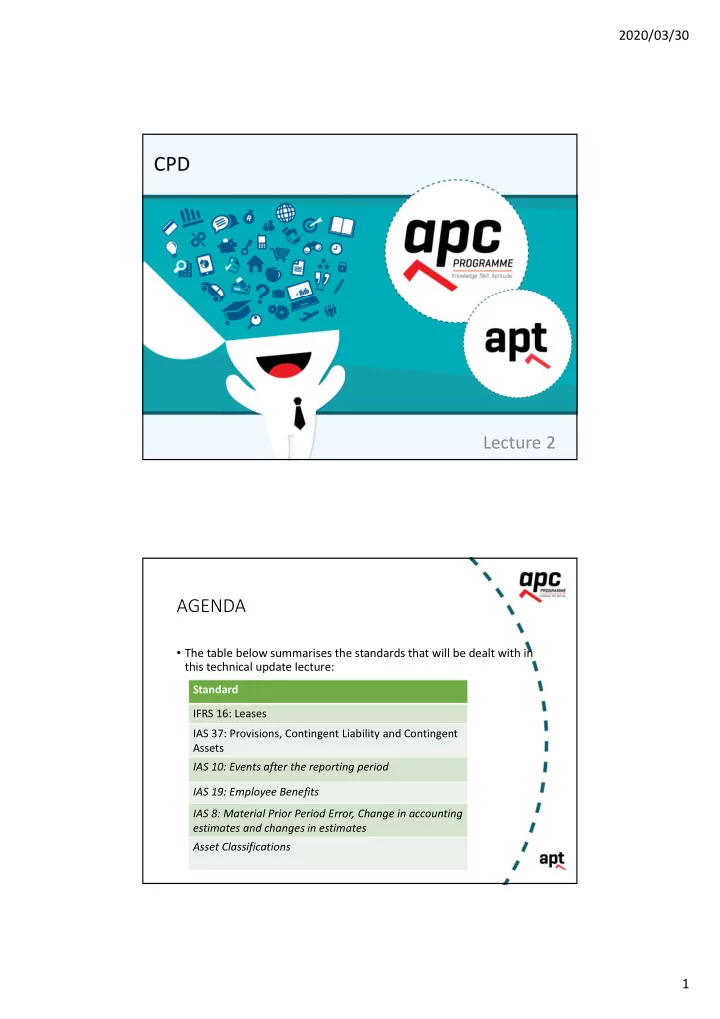
AGENDA

  • The table below summarises the standards that will be dealt with in

this technical update lecture:

Standard IFRS 16: Leases IAS 37: Provisions, Contingent Liability and Contingent Assets IAS 10: Events after the reporting period IAS 19: Employee Benefits IAS 8: Material Prior Period Error, Change in accounting estimates and changes in estimates Asset Classifications

slide-2
SLIDE 2

2020/03/30 2

IFRS 16

Leases

Substance over Form

Buy a printer

  • Dr: Asset
  • Cr: Bank

Lease a printer

  • Dr: Right of

use asset

  • Cr: Lease

Liability Outsource the printing service

  • Dr: Printing

expense

  • Cr: Bank
slide-3
SLIDE 3

2020/03/30 3

Identification of Leases

Leases Identified asset Explicit or Implicit Substantive Substitution Rights Portions of assets Right to control use Benefits Power

Determine how and for what purpose the asset is used

  • The standard gives several examples of

relevant decision-making rights:

  • Right to change what type of output is

produced.

  • Right to change when the output is

produced.

  • Right to change where the output is

produced.

  • Right to change how much of the
  • utput is produced
slide-4
SLIDE 4

2020/03/30 4

Customer controls the right of use of the asset (or portion) Supplier controls the right of use of the asset “LEASE CONTRACT” “SERVICE CONTRACT”

LEASES

  • Recognition and Measurement

Lessee shall recognize a right of use asset and a lease liability Right of use asset is measured as the present value of the lease liability, plus any initial direct costs Initial cost less depreciation and impairment losses and any lease remeasurements Present value of the lease payments discounted at the rate implicit in the lease, if not use the incremental borrowing rate

  • Increase with interest
  • Reduce with the lease

payments

  • Remeasure the carrying

amount for any reassessments

  • r revision
slide-5
SLIDE 5

2020/03/30 5

Interest rate implicit in the lease (App A)

– Rate for the lessor – NB!

PV = Fair

value + Initial direct costs of lessor

I/YR?

FV =

 Residual value

guarantee

PMT =  lease payments PMT =  lease payments

 = “lease pmts”

N = 2 N = 1 N = 0

+ Unguaranteed residual value

“Lease term”

Measuring lease liability: INPUTS

Lease term (= n) Non-cancellable period of a lease plus:

  • Extension periods (if likely to exercise);
  • Termination periods (if likely will not exercised)

Lease payments (= PMT and/or FV) Include:

  • Fixed payments (including in substance fixed payments)
  • Variable ONLY IF / to extent based on observable index or rate (e.g. inflation). Use

base year index/rate and reassess when actual cash flows change due to the change in index/rate.

  • Other amounts if likely to incur: purchase options + termination penalties

(similar to IFRS 15)

  • End of lease payments / guaranteed residual values

Discount rate (= i)

  • Interest rate implicit in agreement OR if not determinable
  • Lessees incremental rate of borrowing (lease specific)
  • App. A

Definitions “Reasonably certain” assessment & “facts and circumstances” B37
slide-6
SLIDE 6

2020/03/30 6

LESSOR ACCOUNTING

Identification Classification Finance lease Criteria Operating lease Finance Lease Operating lease Recognition Lessor recognizes a receivable at the amount equal to the net investment in the lease Lease income shall be recognized on either a straight line basis or another systematic basis Initial Measurement Finance lease measurement Manufacturers and dealer Non-manufactures Straight line lease Initial direct costs are added to the asset Depreciation asset Subsequent Measurement Finance Income is recognized over the term of the lease

  • Why sale and leaseback transactions?

 Cash flow problems

Sale and leaseback

Seller-lessee Buyer-lessor Lease of asset Sale of asset

slide-7
SLIDE 7

2020/03/30 7

  • If the transfer of the asset is a sale

Seller-lessee Buyer-lessor Right-of- use retained Sale of certain rights

❶ Measure right-

  • f-use asset as a

proportion of previous carrying amount ❷ Recognise a gain/loss only on the rights sold ❶ Account for the purchase of the asset ❷ Account for the lease using lessor principles (OL or FL)

Sale and leaseback

  • Measure the right of use asset at the proportion of the

carrying amount that relates to the right of use retained:

  • = Old Carrying amount * Right of use asset/ Fair value of

the asset

  • Calculate the gain on the rights sold:
  • Total gain* (Fair value of asset-right of use asset)/ Fair value
  • f the asset

SALE AND LEASEBACK LESSEE

slide-8
SLIDE 8

2020/03/30 8

  • If the transfer of the asset is NOT a sale for accounting purposes

 BUT ECONOMICALLY  Provision of financing

Seller-lessee Buyer-lessor

Loan repaid through lease payments

No sale All rights retained

Loan provided ❶ Continue to recognise the asset and depreciate accordingly ❷ Recognise a financial liability for the loan and carry at amortised cost ❶Recognise a financial asset for the loan and carry at amortised cost

Sale and leaseback

IAS 37

Provisions, Contingent Liabilities and Contingent Assets

slide-9
SLIDE 9

2020/03/30 9

Structure to IAS 37

  • A provision should be recognised when:
  • The entity has a present obligation
  • From a past event
  • Probable that benefits will flow from

the entity

  • Can be measured reliably
  • 1. Present Obligation

Present obligation is either legal or constructive in nature. Normally very easy to determine if there is a present

  • bligation

If taking into account all available information it is more likely than not that there is a present obligation Consider the opinion of legal experts to determine the existence of the present obligation

slide-10
SLIDE 10

2020/03/30 10

  • 2. Past Events

A provision is recognized as a result of a past obligating event. The event that creates the present obligation and the entity has no realistic alternative but to settle the

  • bligation.

The obligation exists independently of the future actions of the entity (par 19 test! NB!) The entity can do nothing to prevent the payment of the obligation.

  • 3. Probable Outflow

More likely than not that there will be an outflow of economic benefits Number of similar obligations- determine probability considering the class of obligations as a whole

slide-11
SLIDE 11

2020/03/30 11

  • 4. Reliable Estimates

Reliable estimate can be made of the

  • provision. (par 25 – par 26)
  • Best estimate to settle liability at the end of

reporting date (par 36 – par 52)

  • Big population – Expected value (par 39 +

example)

  • Risks and uncertainties (par 42 – par 44)
  • Present value (par 45 – par 47)
  • Future events (par 48 – par 50)
  • Expected disposal of assets (par 51 – par 52)

Last Factors to consider….

Always remember:

  • Contingent liability
  • Reimbursements
  • Onerous contracts
  • Restructuring
slide-12
SLIDE 12

2020/03/30 12

IAS 10: Events After the Reporting Period

Events after the reporting period are those events, favourable and unfavourable, that occur between the end of the reporting period and the date when the financial statements are authorised for issue. Two types of events can be identified:

  • those that provide evidence of conditions that

existed at the end of the reporting period (adjusting events after the reporting period); and

  • those that are indicative of conditions that arose

after the reporting period (non-adjusting events after the reporting period). Structure of IAS 19

Short-term employee benefits Short-term absences Bonus payments Post-employment benefits Defined contribution plans Defined benefit plans Other-long term employee benefits – understand using the principle of a defined benefit liability Termination benefits

24

slide-13
SLIDE 13

2020/03/30 13

IAS 24: Related Parties

Related Parties

Control

  • Person and close family

member

  • Significant Influence
  • Member of key

management personnel

  • Control or joint control

Significant influence

  • Person or close family

member

  • Control or joint control

Member of key management personnel

  • Person or close family

member

  • Control or joint control
slide-14
SLIDE 14

2020/03/30 14

Related Parties

Reporting Entity

Members of the same group Associate or Joint Venture of the reporting entity Joint Ventures of the same entity One entity is a JV and the other an associate of the same third party Post employment benefit plan for the reporting entity or entity related to it Entity is controlled by key management personnel

IAS 8: Accounting Policies, Changes in Accounting Estimates and Errors

slide-15
SLIDE 15

2020/03/30 15

IAS 8 Changes in Accounting Policy

  • 1. Required by S/I
  • 2. Relevant and

Reliable information Changes in accounting estimates New information or New development Material Prior Error Failure to misuse information that was available at date of preparing financial statements

Asset Classification

slide-16
SLIDE 16

2020/03/30 16

IAS 16: Property, plant and equipment Tangible Items Production of goods or services/ rental to

  • thers/ administrative purposes

Longer than 12 months IAS 2: Inventory Sale in ordinary course of business Process of production of such sale or Materials or supplies to be consumed in production process IAS 38: Intangible Asset Identifiable Non-Monetary Asset Without physical substance IAS 40: Investment Property Land and Building Capital Appreciation Rental to others IFRS 5: Non-current asset held for sale Carrying amount will be recovered through sale rather than through continuing use IAS 36: Impairment of Non-Financial Assets Indicator of impairment Compare the carrying amount to the recoverable amount

Thank you for attending Good luck 