CR Technical Parameter List (July, 2012) CR Lattice Parameter - - PDF document

cr technical parameter list july 2012
SMART_READER_LITE
LIVE PREVIEW

CR Technical Parameter List (July, 2012) CR Lattice Parameter - - PDF document

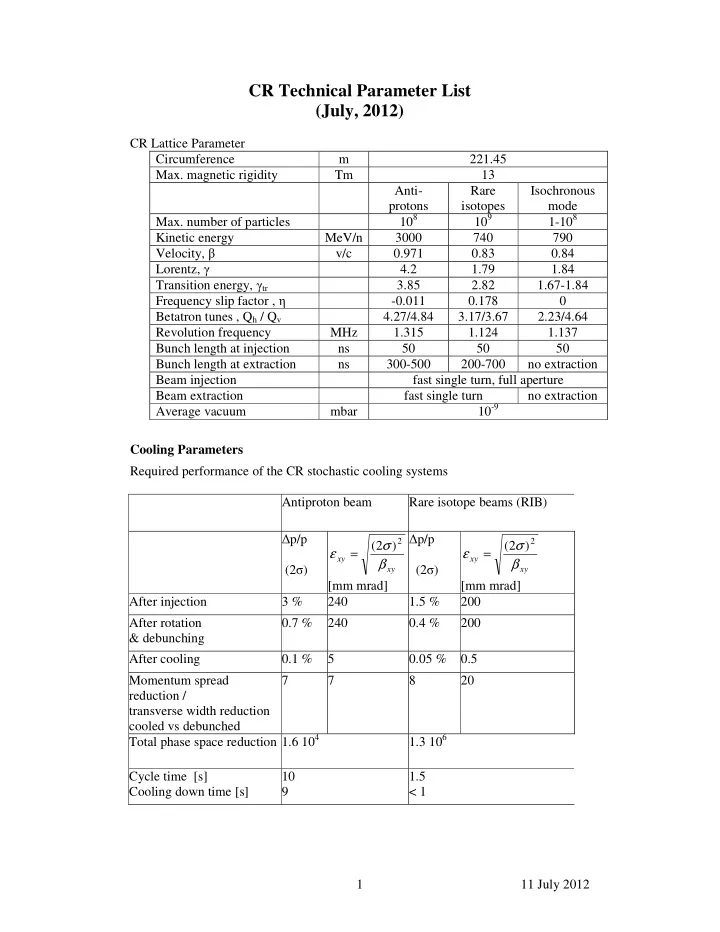
CR Technical Parameter List (July, 2012) CR Lattice Parameter Circumference m 221.45 Max. magnetic rigidity Tm 13 Anti- Rare Isochronous protons isotopes mode 10 8 10 9 1-10 8 Max. number of particles Kinetic energy MeV/n 3000 740


slide-1
SLIDE 1

11 July 2012 1

CR Technical Parameter List (July, 2012)

CR Lattice Parameter Circumference m 221.45

  • Max. magnetic rigidity

Tm 13 Anti- protons Rare isotopes Isochronous mode

  • Max. number of particles

108 109 1-108 Kinetic energy MeV/n 3000 740 790 Velocity, β v/c 0.971 0.83 0.84 Lorentz, γ 4.2 1.79 1.84 Transition energy, γtr 3.85 2.82 1.67-1.84 Frequency slip factor , η

  • 0.011

0.178 Betatron tunes , Qh / Qv 4.27/4.84 3.17/3.67 2.23/4.64 Revolution frequency MHz 1.315 1.124 1.137 Bunch length at injection ns 50 50 50 Bunch length at extraction ns 300-500 200-700 no extraction Beam injection fast single turn, full aperture Beam extraction fast single turn no extraction Average vacuum mbar 10-9 Cooling Parameters Required performance of the CR stochastic cooling systems Antiproton beam Rare isotope beams (RIB) p/p (2σ)

xy xy

β σ ε

2

) 2 ( = [mm mrad] p/p (2σ)

xy xy

β σ ε

2

) 2 ( = [mm mrad] After injection 3 % 240 1.5 % 200 After rotation & debunching 0.7 % 240 0.4 % 200 After cooling 0.1 % 5 0.05 % 0.5 Momentum spread reduction / transverse width reduction cooled vs debunched 7 7 8 20 Total phase space reduction 1.6 104 1.3 106 Cycle time [s] Cooling down time [s] 10 9 1.5 < 1

slide-2
SLIDE 2

11 July 2012 2 2.5.1 System Design General Layout

slide-3
SLIDE 3

11 July 2012 3 Beam envelopes in the antiproton mode for half of the ring Horizontal beam envelope in antiproton (Ex=240 mm mrad, for orbits with momentum deviations dp/p=±2.5%) Vertical beam envelope in antiproton mode (Ey=240 mm mrad)

slide-4
SLIDE 4

11 July 2012 4 Beam envelopes in the RIB mode for half of the ring Horizontal beam envelope in RIB mode (Ex=200 mm mrad, for orbits with momentum deviations dp/p=±1.4%) Vertical beam envelope in RIB mode (Ey=200 mm mrad)

slide-5
SLIDE 5

11 July 2012 5 Beam envelopes in the isochronous mode for half of the ring Horizontal beam envelope in isochronous mode (Ex=100 mm mrad, for orbits with momentum deviations dp/p=±0.4%) Vertical beam envelope in isochronous mode (Ey=100 mm mrad)

slide-6
SLIDE 6

11 July 2012 6 2.5.2 Magnets 2.5.2.1. Dipole Magnets (MH01-MH06) Number of magnets 24 Design H-type Type sector magnet Normal or super conducting normal-conducting Min / Max. field T 1.2 / 1.6 Effective length, L m 2.127 Bending angle deg 15 Bending radius m 8.128 Entrance/Exit edge angle deg Pole gap height mm ±85

  • Max. ramp rate

T/s 0.054 Usable horizontal aperture mm ±190 Usable vertical aperture mm ±70 Integrated tolerable field error ∆BL/BL ±1×10⁻⁴ Tolerable sextupole field, b2 < ±1 x 10⁻⁴ Tolerable octupole field , b3 < ±1 x10⁻⁴ Tolerable decapole field, b4 < ±1 x 10⁻⁴ Magnet to magnet identity 2 x 10⁻⁴ Overall length m 2.69 Overall width m 2.21 Overall height m 1.45 Yoke length m 2.026 Iron weight t 46 Copper weight t 3.308 Overall weight t 49.308 Number of turns per pole 10 x 8 Current at max field A 1396 Average current density A/mm2 3.1 Current density in conductor A/mm2 4.24 Voltage V 88 Inductance per magnet mH 377 Resistance per magnet mΩ 65.55 Power consumption kW 127.7 Temperature drop C 30 Water consumption l/s 0.98 Coil dim. mm ⋅ mm 212 x 170 Conductor insulation mm 0.5 Ground insulation mm 1 Conductor cross section mm.mm 20 x 20 Cooling channel diameter mm 9.5 Fill factor 0.73 Time for polarity change, ramp s 60 The dipole magnet should provide the additional horizontal beam deflection within ±3 mrad by an additional power convertor (see table 2.5.3.6.3)

slide-7
SLIDE 7

11 July 2012 7 2.5.2.2 Quadrupoles 2.5.2.2.1. Wide Quadrupole Magnets* , ** (QS01,QS02,QS04-QS11) Number of magnets 36 Design symmetric quad Type figure of eight Normal or super conducting nc

  • Max. quadrupole gradient, b1

T/m 4.9

  • Min. quadrupole gradient

T/m 0.15

  • Max. octupole field *

T/m2 10

  • Min. octupole field

T/m2 Effective length, L m 1.0 Aperture radius mm 156

  • Max. ramp rate

T/m/s 0.162 Usable horizontal aperture mm ±200 Usable vertical aperture mm ±90 Integrated field error ∆GL/GL ±5×10⁻⁴ (at r = 156 mm ) Tolerable octupole harmonic, b3 < ±5 x 10⁻⁵ Tolerable decapole harmonic, b4 < ±1 x 10⁻⁴ Tolerable dodecapole harmonic, b5 <±3 x 10⁻⁴ Tolerable dodecapole harmonic, b9 <±1 x 10⁻⁴ Magnet to magnet identity 2 x 10⁻³ Overall length m 1.04 Overall width m 1.42 Overall height m 1.42 Iron/copper weight t 9.1 /0.92 Overall weight t 10.02 Number of turns per pole 2 x 8 Current at max field A 3215 Current density A/mm2 5.921 Voltage V 23 Inductance per magnet mH 10.06 Resistance per magnet mΩ 7 Power consumption kW 70.21 Coil copper cross section mm ⋅ mm 25 x 25 Cooling channel diameter. mm 8 Cooling water flow rate l/s 0.43 Cooling water temp. rise

  • C

40 Cooling water pressure drop bar 4.76 Time for polarity change s 60

  • B. Langenbeck GSI-MT-2008-8.1 design (2D) corrected by Kalimov with 3D design

*The octupole field should be provided by an additional coil or winding, which will be powered by a separate power converter (see table 2.5.3.4) **BPM (beam position monitor) should be embedded in quadrupole (table 2.5.6.3)

slide-8
SLIDE 8

11 July 2012 8 2.5.2.2.2. Narrow Quadrupole Magnets (QS03) Number of magnets 4 Design symmetric quad Type figure of eight Normal or super conducting Nc

  • Max. gradient

T/m 8.0

  • Min. gradient

T/m 0.8 Effective length, L m 0.5

  • Max. ramp rate

T/m/s 0.27 Usable horizontal aperture mm ±90 Usable vertical aperture mm ±90 Pole radius mm ±95 Integrated field error ∆GL/GL ±5×10⁻⁴ at r = 90 mm Tolerable octupole harmonic, b3 < ±5 x 10⁻⁵ Tolerable decapole harmonic, b4 < ±1 x 10⁻⁴ Tolerable dodecapole harmonic, b5 <±3 x 10⁻⁴ Tolerable dodecapole harmonic, b9 <±1 x 10⁻⁴ Magnet to magnet identity 2 x 10⁻³ Overall length m 0.55 Overall width m 0.63 Overall height m 0.80 Yoke length m 0.49 Iron/copper weight t 1.1 / 0.26 Overall weight t 1.4 Number of turns per pole 2 x 4 Current at max field A 3790 Current stability ∆I/I 1×10⁻⁴ Voltage V 5.6 Inductance per magnet mH 1.23 Resistance per magnet mΩ 1.5 Power consumption kW 21 Coil copper cross section mm ⋅ mm 24 x 26 Cooling channel diameter. mm 5 Conductor insulation mm 0.5 Ground insulation mm 1 Cooling water flow rate l/s 0.17 Cooling water temp. rise

  • C

30 Cooling water pressure drop bar 2.3 Time for polarity change s 60 Kalimovs 3D design august 2009

slide-9
SLIDE 9

11 July 2012 9 2.5.2.3 Sextupole 2.5.2.3.1 Wide Sextupole Magnets (KS01-KS06) Number of magnets 28 Design symmetric Normal or super conducting nc

  • Max. gradient

T/m2 10.0

  • Min. gradient

T/m2 1.0 Effective length, L m 0.688 Aperture radius mm 210

  • Max. ramp rate

T/m2/s 0.34 Usable horizontal aperture mm ±200 Usable vertical aperture mm ±90 Integrated field error ∆GL/GL ±5×10⁻³ at r =200 mm Tolerable harmonic b4 Tolerable harmonic b6 Tolerable harmonic b8 Tolerable harmonic a4 Tolerable harmonic a6 Magnet to magnet identity 10-2 Overall length m 0.71 Overall width m 0.9 Overall height m 0.9 Yoke length m 0.6 Iron/copper weight t 1.13 / 0.27 Overall weight t 1.4 Number of turns per pole 4 x 8 Current at max field A 385 Voltage V 28 Average current density A/mm2 3.2 Current density in conductor A/mm2 4.4 Field stability ∆I/I 10-3 Inductance per magnet mH 11.7 Resistance per magnet Ω 0.073 Power consumption kW 10.8 Coil copper cross section mm ⋅ mm 10 x 10 Cooling channel diameter. mm 4 Conductor insulation mm 0.5 Cooling water flow rate l/s 0.103 Cooling water temp. rise

  • C

25 Cooling water pressure drop bar 6.7 Time for polarity change s 60 Kalimovs 3D design February 2009

slide-10
SLIDE 10

11 July 2012 10 2.5.2.5 Injection/Extraction 2.5.2.5.1. Injection Septum Magnet (CR04MPI) Name of the magnet Septum IS Number of magnets 1 Design pulsed, curved

  • Max. Field

T 0.85

  • Min. Field

T 0.425 Bending angle mrad 125 Curvature radius, R m 16 Effective path length, L m 2.0 Useable horizontal aperture mm 160 Horizontal width mm 170 Useable vertical gap mm 140 Vertical pole gap height mm 150 Thickness of vacuum chamber (rectangular shape)) mm 5 Septum thickness (including screen and vacuum chamber of 3 mm) mm <20 Integral field quality relative 10-3 Overall length m 2.3 Overall width m 0.381 Overall height m 0.463 Overall weight t 1.96 Current at max. field kA 6.4 Inductance mH 0.95 Resistance mOhm 9.8 Rise/fall time ms 100 Ramp rate T/s 8.5 High field flat top ms 5 Low field flat top ms 5 Cycle length s 1.5 Average power consumption kW 30 -100 ? Number of power supplies 1 Number of magnet in series 1 Maximum current rate kA/s 64 Driving voltage V Maximum voltage to ground V 62.2 Maximum active power kW 398.2 Water pressure bar 2.2 Water flow l/min 25.2 Water flow m/s Water temperature rise deg C 40 Time for polarity change s 60

slide-11
SLIDE 11

11 July 2012 11 2.5.2.5.4 Extraction Septum Magnet (CR02MPE) Name of the magnet Septum ES Number of magnets 1 Design Septum, curved, pulsed

  • Max. Field

T 0.91

  • Min. Field

T 0.45 Bending angle mrad 140 Curvature radius, R m 19 Effective path length, L m 2.0 Useable horizontal aperture mm 70 Horizontal width mm 76 Useable vertical gap mm 50 Vertical pole gap height mm 56 Thickness of Vacuum chamber (rectangular shape) mm 3 Septum thickness (including screen and vacuum chamber of 3 mm) mm <20 Integral field quality relative 10-3 Overall length m 2.3 Overall width m 0.221 Overall height m 0.233 Overall weight t 0.7 Current at max. field kA 6.7 Inductance mH 0.156 Resistance mOhm 3.58 Rise/fall time ms 15 Ramp rate T/s 60.7 High field flat top ms 5 Low field flat top ms 5 Cycle length s 1.5 Average power consumption kW 5 – 30 ? Number of power supplies 1 Number of magnet in series 1 Maximum current rate kA/s 134 Driving voltage V Maximum voltage to ground V 24 Maximum active power kW 160.4 Water pressure atm 2.4 Water flow l/min 10.1 Water flow m/s 11.7 Water temperature rise deg C 40 Time for polarity change s 60

slide-12
SLIDE 12

11 July 2012 12 2.5.2.6 Steering Magnets 2.5.2.6.1 Narrow Horizontal/Vertical Combined Orbit Correctors (KH/KV) Type Normal or super conducting nc Number of magnets 6 Design

  • Max. H/V Field

T 0.13

  • Min. H/V Field

T 0.0 Bending angle mrad ± 3 Effective length, L m 0.3 Usable horizontal aperture mm ± 90 Usable vertical aperture mm ± 90 Horizontal gap height mm ± 100 Vertical pole gap height mm ± 100

  • Max. ramp rate

T/s 0.003 Field quality ± 5 × 10⁻³ Overall length m 0.4 Overall width m Overall height m Overall weight kg Current at max. field A Inductance per magnet mH Resistance per magnet Ohm Power consumption kW Cooling water flow rate l/min Cooling water temp. e-rise K Cooling water pressure drop bar 2.5.2.6.2 Wide Vertical Orbit Correctors (KV) Not foreseen

slide-13
SLIDE 13

11 July 2012 13 2.5.2.6.3. Horizontal orbit correctors in dipoles (KH) Auxiliary coils in the 24 dipole magnets are foreseen. Corrections are provided by 12 additional Power Converters. Type Normal or super conducting nc Number of magnets 12 Design

  • Max. Field

T 2 × 10⁻²

  • Min. Field

T 0.0 Bending angle mrad ± 3 Effective length, L m 2 Usable horizontal aperture mm ± 200 Usable vertical aperture mm ± 70 Vertical pole gap height mm ± 75

  • Max. ramp rate

T/s 6.5 ×10⁻⁴ Field quality ± 5 × 10⁻³ Overall length m 2.3 Overall width m Overall height m Overall weight kg Current at max. field A Inductance per magnet mH Resistance per magnet Ohm Power consumption kW Cooling water flow rate l/min Cooling water temp. e-rise K Cooling water pressure drop bar 2.5.2.6.4 Narrow Horizontal Orbit Correctors (KH) Not foreseen 2.5.2.6.5 Wide Horizontal Orbit Corrector (KH) Not foreseen

slide-14
SLIDE 14

11 July 2012 14 2.5.2.6.6 Vertical orbit correctors in dipoles (KV) Auxiliary coils in the 12 dipole magnets are foreseen. All these correctors are provided by 12 additional Power Converters. Type Normal or super conducting nc Number of magnets 12 Design

  • Max. Field

T 2 ×10⁻²

  • Min. Field

T 0.0 Bending angle mrad ± 3 Effective length, L m 2 Usable horizontal aperture mm ± 200 Usable vertical aperture mm ± 70 Vertical pole gap height mm ± 75

  • Max. ramp rate

T/s 6.5 ×10⁻⁴ Field quality ± 5 × 10⁻³ Overall length m 2.3 Overall width m Overall height m Overall weight kg Current at max. field A Inductance per magnet mH Resistance per magnet Ohm Power consumption kW Cooling water flow rate l/min Cooling water temp. e-rise K Cooling water pressure drop bar

slide-15
SLIDE 15

11 July 2012 15 2.5.3 Power Converters 2.5.3.1 Dipole Magnet Power Converter Number of power converter 1 Number of magnets in series 24

  • Max. current, I

A 1396

  • Max. current ramp

A/s 47 Operating range 70 – 100 % Current instability I (only flat top) for ripple < 10-3 Hz for ripple > 10-3 Hz mA mA < 14 < 3.0 Current instability during ramp* no requirements Rise time s 30 Polarity change (switching at I=0) s 65 (5) Flat top time s ∞

  • Max. driving voltage

V 2160

  • Max. voltage to ground

V

  • Max. active power

kW 3000

  • Max. apparent power

kVA * No beam ramping is foreseen 2.5.3.2. Quadrupole Magnet Power Converter 2.5.3.2.1 Wide Quadrupole Magnet Power Converter Number of power supplies 2 8 Number of magnets in series 2 4 Rated current A 3125 3125

  • Max. current rate

A/s 108 108 Operating range 3 – 100 % Current instability I (only flat top for all ripple frequency) at 100 % of max. filed at 3 % of max field A A < 0.3 < 0.1 < 0.3 < 0.1 Current instability during ramp* no requirements Rise time s 30 30 Polarity change (switching at I=0) s 65 (5) Flat top time s ∞ ∞

  • Max. driving voltage

V 44 88

  • Max. voltage to ground

V 46 92

  • Max. active power

kW 141 282

  • Max. apparent power

kVA * No beam ramping is foreseen

slide-16
SLIDE 16

11 July 2012 16 2.5.3.2.2 Narrow Quadrupole Magnet Power Converter Number of power supplies 1 Number of magnets in series 4 Rated current, I A 3790

  • Max. current rate

A/s 127 Operating range 10 – 100 % Current instability I (only flat top for all ripple frequency) at 100 % of max. filed at 10 % of max. field A A < 0.4 < 0.1 Current instability during ramp* no requirements Rise time s 30 Polarity change (switching at I=0) s 65 (5) Flat top time s ∞

  • Max. driving voltage

V 23

  • Max. voltage to ground

V

  • Max. active power

kW 84

  • Max. apparent power

kVA * No beam ramping is foreseen 2.5.3.3 Sextupole Magnet Power Converters 2.5.3.3.1 Wide Sextupole Magnet Power Converter Number of power supplies 6 Number of magnets in series 4 Rated current, I A ±385

  • Max. current rate

A/s 13 Operating range 10 -100 % Current instability I (only flat top ) at 100 % of max. filed at 3 % of max. field A A < 0.4 < 0.1 Current instability during ramp* No requirements Polarity change (switching at I=0) s 65 (5) Rise time s 30 Flat top time s ∞

  • Max. driving voltage

V ±112

  • Max. voltage to ground

V

  • Max. active power

kW 44

  • Max. apparent power

kVA * No beam ramping is foreseen

slide-17
SLIDE 17

11 July 2012 17 2.5.3.4 Wide Octupole Corrector Power Converter Number of power supplies 4 Number of magnets in series 4 Rated current, I A

  • Max. current rate

A/s Current instability I (only flat top ) at 100 % of max. filed at ? % of max. field A A Current instability during ramp* no requirements Rise time s 30 Flat top time s ∞

  • Max. driving voltage

V

  • Max. voltage to ground

V

  • Max. active power

kW

  • Max. apparent power

kVA * No beam ramping is foreseen

slide-18
SLIDE 18

11 July 2012 18 2.5.3.5 Injection/Extraction Septum Magnets 2.5.3.5.1 Injection (IS) Power Converter Number of power supplies 1 Number of magnets in series 1 Rated current kA

  • Max. current rate

kA/s

  • Max. relative deviation (ripple)

10-4 Rise time ms 100 Current instability during ramp* no requirements Flat top time ms

  • Max. driving voltage

V ±

  • Max. voltage to ground

V ±

  • Max. active power

kW

  • Max. apparent power

kVA * No beam ramping is foreseen 2.5.3.5.4 Extraction Septum (ES) Power Converter Number of power supplies 1 Number of magnets in series 1 Rated current kA

  • Max. current rate

A/s

  • Max. relative deviation (ripple)

10-4 Rise time ms 15 Current instability during ramp* no requirements Flat top time ms 5

  • Max. driving voltage

V ±

  • Max. voltage to ground

V ±

  • Max. active power

kW

  • Max. apparent power

kVA * No beam ramping is foreseen

slide-19
SLIDE 19

11 July 2012 19 2.5.3.6 Steering Magnets 2.5.3.6.1 Narrow Horizontal and Vertical Corrector Magnet Power Converters Number of power supplies 12 Number of magnets in series 1 Type bipolar Rated current A

  • Max. current rate

A/s Rise time s 30 Flat top time s ∞

  • Max. driving voltage

V

  • Max. active power

kW

  • Max. apparent power

kVA 2.5.3.6.2 Wide Vertical and Horizontal Corrector Magnet Power Converters Not foreseen 2.5.3.6.3 Power Converter for Horizontal Correction by Dipole Magnet Number of power supplies 12 Number of magnets in series 1 Type bipolar Rated current A

  • Max. current rate

A/s Rise time s 30 Flat top time s ∞

  • Max. driving voltage

V

  • Max. active power

kW

  • Max. apparent power

kVA 2.5.3.6.4 Power Converter for Vertical Correction by Dipole Magnet Number of power supplies 12 Number of magnets in series 1 Type bipolar Rated current A

  • Max. current rate

A/s Rise time s 30 Flat top time s ∞

  • Max. driving voltage

V

  • Max. active power

kW

  • Max. apparent power

kVA

slide-20
SLIDE 20

11 July 2012 20 2.5.4 RF Systems Bunch Rotation RF system (BB-R1 – BB-R3) Type magnetic-alloy Number of cavities 5 Frequency range MHz 1.12 – 1.4

  • Max. total gap voltage per cavity

kV 40

  • Min. total gap voltage

kV 0.05 Accuracy of gap voltage ±50 V below 1 kV, ±5% above 1 kV Harmonic purity of gap signal at

  • max. voltage

dB < -25 Repetition rate Pulse duration Time between pulsed and cw

  • peration mode

Total time available for RF manipulation per cycle Hz µs µs µs 0.1 – 1 500 – 1000 400 200 – 400 Overall length m 5 Overall transverse size (radius) m Aperture (radius) of beam pipe mm 150 Maximum duty cycle 5 × 10⁻⁴ BW of amplitude control loop kHz >50 BW of phase control loop kHz Accuracy of phase with respect to reference signal ±6° Power kW Q value Shunt impedance

  • Max. allowable impedance

seen by beam kΩ 15 (30) Beam currents collective effects & beam loading negligible in situ bakeable beam pipe not foreseen Mains power accel. Hall Mains power supply room kW kW Air cooling accel. Hall Air cooling supply room kW kW Water cooling accel. Hall kW l/min Tube: 2 x Thales TH555A per cavity

slide-21
SLIDE 21

11 July 2012 21 2.5.5 Kicker magnets 2.5.5.1 Extraction Kicker Magnet (MK-E)* Type of magnet

  • Window frame

bipolar

  • No. of units
  • 2
  • No. of modules per unit
  • 3

Kick angle per unit mrad ±5 Magnet length per module m 0.45

  • Eff. magnet length per module

m 0.61 Magnet length per unit m 1.35 Overall length m 1.85 Kicker rise/fall time ns 200 Flat top length ns 500-800 Kick variation of flat top % < 2 Horizontal aperture (for beam) mm 180 Overall horizontal aperture mm 290 Vertical aperture (for beam) mm 150 Overall vertical aperture mm 160

  • Max. load voltage per module

kV 70 Characteristic impedance Ω 5.7 Magnetic field in gap mT 48.225 Magnetic field in ferrite mT 116.543 Magnet inductance per module µH 1.389 Load current kA 6.14 Current overshoot % 2.0 Ferrite mass per unit kg 471 Power (pulse) MW 214.0 Polarity change ms <300

*These kickers must be used also for injection together in combination with the

injection kicker magnets.

slide-22
SLIDE 22

11 July 2012 22 2.5.5.2 Injection Kicker Magnet (MK-I) Type of magnet

  • Window frame

mono-polar

  • No. of units
  • 2
  • No. of modules per unit
  • 3

Kick angle per unit mrad ±5 Magnet length per module m 0.45

  • Eff. Magnet length per module

m 0.61 Magnet length per unit m 1.35 Overall length m 1.85 Kicker rise/fall time ns 200 Flat top length ns 500-800 Kick variation of flat top % < 2 Horizontal aperture (for beam) mm 280 Overall horizontal aperture mm 290 Vertical aperture (for beam) mm 150 Overall vertical aperture mm 160

  • Max. load voltage per module

kV 70 Characteristic impedance Ω 5.7 Magnetic field in gap mT 48.225 Magnetic field in ferrite mT 116.543 Magnet inductance per module µH 1.389 Load current kA 6.14 Current overshoot % 2.0 Ferrite mass per unit kg 471 Power (pulse) MW 214.0 Polarity change min 1

slide-23
SLIDE 23

11 July 2012 23 2.5.6 Diagnostics 2.5.6.1 DC-Transformer (CR04DT) DC-Transformer Number of elements 1 Overall length mm 600 Horizontal aperture mm 400 Vertical aperture mm 180 dc-current A 1 - 17000 RMS resolution @ 0.1 s µA 4 Zero point stability µA/24h 4 Zero point temperature drift µA/K ~10 Bandwidth (-3 dB) kHz 10 Remark At present only one model is commercially available, but with an insufficient resolution of 30 µArms in 1 kHz bandwidth 2.5.6.2 Pulse Current Transformer (CR01DT) Pulse Current Transformer Number of elements 1 Overall length mm 400 Horizontal aperture mm 300 Vertical aperture mm 180 Acceptable peak current A ~1 Resolution, full bandwidth µApp 30 Bandwidth (-3 dB) kHz 3 – 600000 2.5.6.2.1 Cryogenic Current Comparator (CCC). Not applicable

slide-24
SLIDE 24

11 July 2012 24 2.5.6.3 Beam Position Monitor (DX01 – DX05) Beam Position Monitor (wide) (embedded in quadrupole magnet) Number of elements 18 Overall length mm 1000 Horizontal aperture mm 400 Vertical aperture mm 180 Pick-up bandwidth MHz 0.5-100

  • Hor. resolution @ readout rate

mm 0.1 @ 100 Hz Absolute accuracy mm 4 Absolute accuracy (using k- modulation) mm 0.8

  • Min. bunched beam current for

given resolution µARMS 10

  • Max. bunched beam current

A 3 Output rate for closed-orbit feedback Hz 100 2.5.6.4. Beam Position Monitor (narrow) , Not applicable 2.5.6.5 Schottky pick-up (CR01DXS) Schottky pick-up Number of elements 1 Overall length mm 1000 Horizontal aperture mm 400* Vertical aperture mm 180 Bandwidth MHz 5-100 Frequency resolution 2×10

  • 7

Absolute frequency value 2×10

  • 7

Tune measurement resolution 10

  • 5

Intensity range charges 10

3

  • 10

11

* Horizontal aperture must be 400 mm to have space for injected beam.

slide-25
SLIDE 25

11 July 2012 25 2.5.6.6 Tune measurements (CR01DH) Exciter + BPM Number of elements 1 Overall length mm 2 × 600 Horizontal aperture mm 400 Vertical aperture mm 180 rf frequency range MHz 5-100 BTF Measurement Frequency resolution 2×10

  • 7

Absolute frequency value 2×10

  • 7

Tune measurement resolution 10

  • 5

Intensity range charges 10

5

  • 10

11

2.5.6.7 Ionization Profile Monitor (CR04DG-R) Ionization Profile Monitor (Ion type) Number of elements 1 Overall length mm 1000 Horizontal aperture mm 400 Vertical aperture mm 180 Beam radius mm 0.1-200 Spatial resolution mm 0.1 Time Resolution ms 0.1 Repetition rate frames/s ~50 Intensity particles 10

4

  • 10

11

Detection area mm2 100×40 2.5.6.8 Fast Current Transformer (CR01DT1) Fast Current Transformer Number of elements 1 Overall length mm 500 Horizontal aperture mm 180 Vertical aperture mm 180 Acceptable peak current A ~1 Resolution, full bandwidth µApp 30 Bandwidth (-3 dB) kHz 3 – 600000

slide-26
SLIDE 26

11 July 2012 26 2.5.6.9 Beam Loss Monitor (DL) Beam-loss Monitors Number of elements 8 Installation space (tripod outside vacuum) mm 600 Active volume mm3 20×20×150 Scintillator BC400 2.5.6.10 Horizontal Scraper (DS-H) Horizontal Scraper Number of elements 8 Overall length mm 400 Horizontal aperture mm 400 ? Vertical aperture mm 180 Stroke mm 300 Scraper wedge thickness mm 30 2.5.6.11 Vertical Scraper (DS-V) Vertical Scraper Number of elements 4 Overall length mm 400 Horizontal aperture mm 400 ? Vertical aperture mm 180 Stroke mm 300 Scraper wedge thickness mm 30

slide-27
SLIDE 27

11 July 2012 27 2.5.6.12 First turn diagnostics 2.5.6.12.1 SEM Grids (DE) SEM Grid Number of elements 2 × 2 (hor. / vert.) Overall length mm 450 (for 2 planes) Horizontal aperture mm 180 Vertical aperture mm 180 Detection width mm 32 – 140 ? Number of wires 2 × 32 Wire spacing mm 1 - 2 2.5.6.12.2 Scintillation Screen (DF-S) Scintillation Screen Number of elements 2 Overall length mm 350 Horizontal aperture mm 180 Vertical aperture mm 180 Scintillating material YAG:Ce, Chromox Scintillator diameter mm 180 ? Spatial resolution mm 0.1 2.5.6.12.3 Beam Stopper (b.stopper) Beam stopper Number of elements 2 Overall length mm 350 Horizontal aperture mm 180 Vertical aperture mm 180 Stroke mm 300 Stopper diameter mm 150

slide-28
SLIDE 28

11 July 2012 28 2.5.7 Vacuum 2.5.7.1 Vacuum pumps Pump type Number Pumping speed [l/s] comments Pumping station roughing 2 500 +10m3 TMP+dry forepump Ion Getter Pumps 40 500 DN160CF Ti sublimation pumps 40 2000 DN160CF

Comment: Number and Type of Pumps unsure, because of space constraints. Possibly change from Sputter Ion Pump and Ti sublimation pumps to Sputter Ion/NEG combination pumps.

2.5.7.2 Vacuum chambers Num ber Length [m] Aperture [mm×mm] wall thickness [mm] Shape Dipole (MH) 24 2.625 380×140 10 rectangular 150 bent Wide quadrupole1 10 1.307 400×180 8

  • ctagonal

straight Wide Quadrupole + Wide Vert. Orbit Corrector2 4 2.098 400 x 180 8

  • ctagonal

straight Wide Quadrupole + Wide Sextupole3 4 2.399 400 x 180 8

  • ctagonal

straight Wide Quadrupole + Wide Sextupole4 8 2.298 400 x 180 8

  • ctagonal

straight Wide Vert. Orbit Corrector + Wide Quadrupole + Wide Sextupole5 4 2.821 400 x 180 8

  • ctagonal

straight Wide Vert. Orbit Corrector + Wide Sextupole+ Wide Quadrupole + Wide Sextupole6 2 3.603 400 x 180 8

  • ctagonal

straight Wide Quadrupole + Wide Sextupole + Wide Vert. Orbit Corrector7 4 2.293 400 x 180 8

  • ctagonal

straight Narrow quadrupole8 4 0.747 180×180 2 round straight Narrow vertical Correctors9 4 0.4 180×180 2 round straight Narrow horizontal correctors 10 3 0.4 200×180 5

  • ctagonal

straight

slide-29
SLIDE 29

11 July 2012 29 Wide horizontal Correctors11 1 0.4 400 × 180 8

  • ctagonal

straight RF-cavity (RF) 5 2 160×160 2 round straight Stochastic cooling Pick-ups tanks12 4 2.2 800×800 15 round straight Stochastic cooling Kickes13 3 2.12 800×800 15 round straight Injection Kicker Magnet Vacuum Tanks14 2 1.85 800 x 800 15 round straight Extraction Kicker Magnet Vacuum Tanks15 2 1.849 800 x 800 15 round straight Injection septum16 1 2.3? 162 x 160 5 (3 at septum coil ) rectangular bent Extraction septum17 1 2.3? 70 x 60 3 rectangular bent

1 CR04QS04, CR04QS02, CR01QS01, CR01QS02, CR01QS04, CR02QS04, CR02QS02, CR02QS01,

CR03QS02, CR03QS04

2 CR01QS05+CR01KV2; CR02KV2+CR02QS05; CR03QS05+CR03KV2; CR04KV2+CR04QS05

3 CR01QS06+CR01KS1; CR02KS1+CR02QS06; CR03QS06+CR03KS1; CR04KS1+CR04QS06 4CR01QS08+CR01KS3; CR01QS10+CR01KS5; CR02KS5+CR02QS10; CR02KS3+CR02QS08;

CR03QS08+CR03KS3; CR03QS10+CR03KS5; CR04KS5+CR04QS10; CR04KS3+CR04QS08

5CR01KV4+CR01QS09+CR01KS4; CR02KS4+CR02QS09+CR02KV4; CR03KV4+CR03QS09+

CR03KS4; CR04KS4+CR04QS09+CR04KV4

6CR01KV5+CR01KS6+CR01QS11+CR02KS6; CR03KV5+CR03KS6+CR03QS11+CR04KS6 7CR01QS07+CR01KS2+CR01KV3; CR02KV3+CR02KS2+CR03QS07; CR03QS07+CR03KS2+

CR03KV3; CR04KV3+CR04KS2+CR04QS07

8CR04QS03, CR01QS03, CR02QS03, CR03QS03 9CR01KV1, CR02KV1, CR03KV1, CR04KV1 10CR01KH1, CR02KH1, CR03KH1 11CR04KH1 12CR03BK1P, CR03BK2PH, CR03BK3PV, CR03BK4PP 13CR04BK1KV, CR04BK2KH, CR01BK1K 14CR04MK1, CR01MK1 15CR01MK1E, CR01MK2E 16CR04MPI 17CR02MPE

Comment: There is no design for the vacuum chambers up to now. The numbers given above are only a first estimation and can change during the further detail planning. In addition the BPMs have to be included into some of the wide quadrupole chambers. The type of flanges to be used has to be discussed.
slide-30
SLIDE 30

11 July 2012 30 2.5.7.3 Vacuum Valves number type dimension Installation length (mm) Valve for Roughing 8 all-metal DN160CF not in beam direction Gate Valve * 8 all-metal DN450 275 Fast Valve ** 2 DN160CF 250 * Flange type to be defined ** Number unsure, because of space constraints

slide-31
SLIDE 31

11 July 2012 31 2.5.8 Particle Sources Not applicable

slide-32
SLIDE 32

11 July 2012 32 2.5.9 Electron Cooling Not applicable

slide-33
SLIDE 33

11 July 2012 33 2.5.10 Stochastic Cooling 2.5.10.1.Stochastic Cooling paths and their purpose in the CR Systems in frequency band 1-2 GHz Pickup Kicker Antip rotons Rare isotopes Method CR03BK2PH CR04BK2KH horizo ntal horizontal, final stage betatron cooling, difference pickup CR03BK3PV CR04BK1KV vertica l vertical, final stage betatron cooling, difference pickup CR03BK2PH + CR03BK3PV CR04BK2KH+ CR04BK1KV longitu dinal longitudinal, final stage Notch filter method: sum pickup CR03BK4PP CR04BK2KH

  • horizontal

& longitudinal, first stage Palmer method: difference pickup at high dispersion CR03BK4PP CR04BK1KV

  • vertical,

first stage betatron cooling, difference pickup

slide-34
SLIDE 34

11 July 2012 34 CR 68 lattice with stochastic cooling systems in the frequency band 1-2 GHz. 1-2 GHz: Pbar 3D cooling, RIB 3D cooling final stage; CR03BK2PH, CR03BK3PV, CR04BK2KH, CR04BK1KV. 1-2 GHz: RIB 3D cooling first stage; Palmer pickup CR03BK4PP, kickers CR04BK2KH, CR04BK1KV.

slide-35
SLIDE 35

11 July 2012 35 2.5.10.2. System parameters 4.8 kW, preliminary estimation Frequency range (bandwidth) GHz 1-2 Pickups for antiprotons & RIB final stage

  • No. of pickup tanks

2

  • No. of slotline electrodes per tank

128 (2 x 64) Electrodes at temperature K 30 Moving (plunging) electrodes Yes Max/Min electrode aperture (in horizontal and vertical planes) mm ±80/±10 Electrode moving in (plunging) time Any Electrode opening time at end of cycle ms 200

  • No. of linear motor drives per tank

8

  • No. of cryoheads per tank

2 Palmer pickup for RIB first stage ( not yet designed )

  • No. of tanks

1

  • No. of slotline electrodes per tank

Electrodes at temperature Moving (plunging) electrodes, vertical Electrode position horizontal w.r.t beam axis Electrode aperture vertical

  • No. of linear motor drives per tank
  • No. of cryoheads per tank

Kickers

  • No. of kicker tanks

2

  • No. of slotline electrodes per tank

128 (2 x 64) Electrodes at temperature K 300 Moving (plunging) electrodes No moving Electrode aperture horizontal/vertical mm ± 70 Cryogenic low-noise preamplifiers Option1

  • No. of preamplifiers per pickup tank

16 Preamplifier at temperature K 80 Preamplifier inside UHV No Option 2

  • No. of preamplifiers per pickup tank

128 Preamplifier at temperature K 30 Preamplifier inside UHV Yes Low-noise preamplifiers for Palmer pickup (not yet designed)

  • No. of preamplifiers per pickup tank

Preamplifier at temperature Preamplifier inside UHV

slide-36
SLIDE 36

11 July 2012 36 Notch filter Type

  • ptical

Required depth of notches inside band 1-2 GHz dB

> 30

Combiner boards at pick-ups (designed for velocity β=097 (pbars)) β - switch Velocity matching of pick-up signal for β=0.83 (rare ions) Power amplifiers Total installed rf power * kW 4.8

  • No. of 150 W power amplifier units

32 *preliminary estimation,to be determined by detailed coooling simulations for antiprotons + estimations for the initial Palmer cooling of RIB 2.5.10.3.Specification parameters for the 150 W power amplifier unit Frequency band, lower limit GHz 1 Frequency band, upper limit GHz 2

  • utput power at each output port

dBm 51.8 2-signal 3rd order interception point at each output port dBm 62.8 Minimum amplification dB 32 Maximum amplification dB 52 Variation of amplification inside the frequency band, 10 dB below 1 dB compression dB ±1 Variation of phase inside the frequency band, 10 dB below 1 dB compression degrees ±10 Variation of amplification inside the frequency band, At the 1 dB compression point dB ±1.5 Variation of phase inside the frequency band, at the 1 dB compression point degrees ±15 Variation of amplification among any of each amplifiers of series production, 10 dB below 1 dB compression dB ±1 Deviation from phase linearity among any of each amplifiers of series production, 10 dB below 1 dB compression degrees ±10 Total electric length ns <20 Noise figure dB 5 Input VSWR <1.6 Output VSWR <1.6 Minimum tolerable load impedance Ω Maximum tolerable load impedance Ω ∞ EMC screening dB >80 Maximum loss power dissipated to air W 75