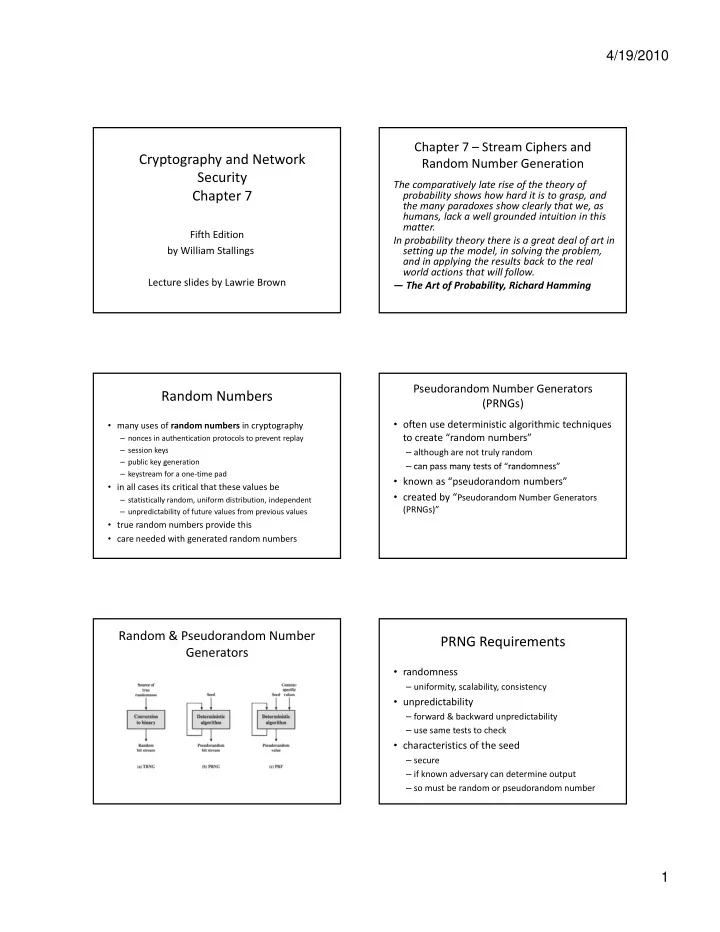

SLIDE 1
4/19/2010 1
Cryptography and Network Security Chapter 7
Fifth Edition by William Stallings Lecture slides by Lawrie Brown
Chapter 7 – Stream Ciphers and Random Number Generation
The comparatively late rise of the theory of probability shows how hard it is to grasp, and the many paradoxes show clearly that we, as humans, lack a well grounded intuition in this , g matter. In probability theory there is a great deal of art in setting up the model, in solving the problem, and in applying the results back to the real world actions that will follow. — The Art of Probability, Richard Hamming
Random Numbers
- many uses of random numbers in cryptography
– nonces in authentication protocols to prevent replay – session keys – public key generation p y g – keystream for a one‐time pad
- in all cases its critical that these values be
– statistically random, uniform distribution, independent – unpredictability of future values from previous values
- true random numbers provide this
- care needed with generated random numbers
Pseudorandom Number Generators (PRNGs)
- often use deterministic algorithmic techniques
to create “random numbers”
– although are not truly random can pass many tests of “randomness” – can pass many tests of randomness
- known as “pseudorandom numbers”
- created by “Pseudorandom Number Generators
(PRNGs)”
Random & Pseudorandom Number Generators
PRNG Requirements
- randomness
– uniformity, scalability, consistency
- unpredictability
– forward & backward unpredictability – use same tests to check
- characteristics of the seed