CS 486/686 Lecture 9 Probabilities has occurred, it would surely be - - PDF document

cs 486 686 lecture 9 probabilities has occurred it would
SMART_READER_LITE
LIVE PREVIEW

CS 486/686 Lecture 9 Probabilities has occurred, it would surely be - - PDF document

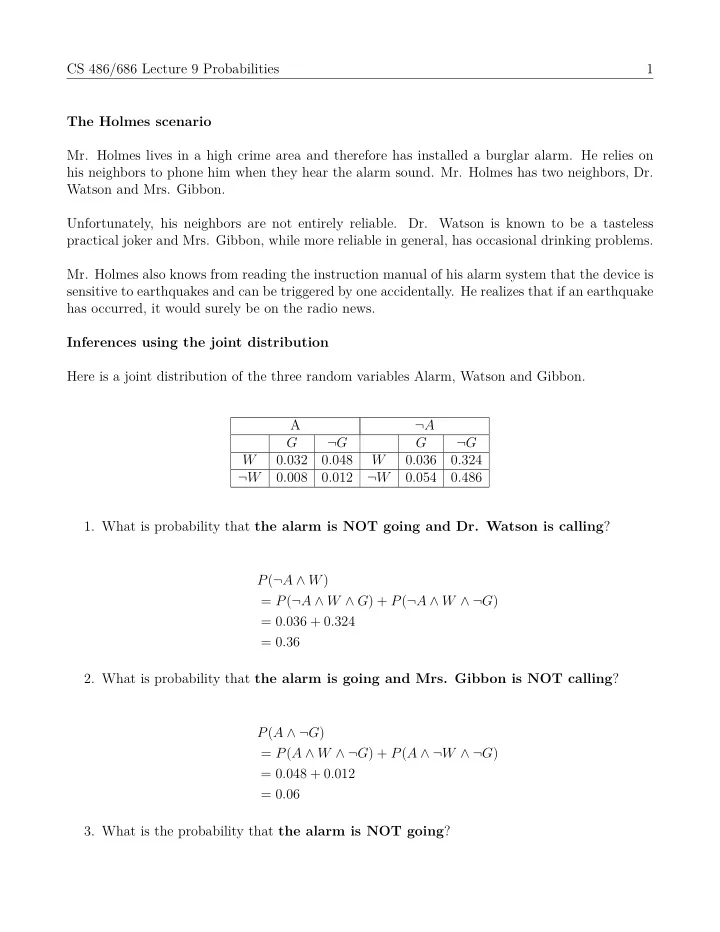
CS 486/686 Lecture 9 Probabilities has occurred, it would surely be on the radio news. 2. What is probability that the alarm is going and Mrs. Gibbon is NOT calling ? 1. What is probability that the alarm is NOT going and Dr. Watson is calling ? 1


slide-1
SLIDE 1

CS 486/686 Lecture 9 Probabilities 1 The Holmes scenario

  • Mr. Holmes lives in a high crime area and therefore has installed a burglar alarm. He relies on

his neighbors to phone him when they hear the alarm sound. Mr. Holmes has two neighbors, Dr. Watson and Mrs. Gibbon. Unfortunately, his neighbors are not entirely reliable. Dr. Watson is known to be a tasteless practical joker and Mrs. Gibbon, while more reliable in general, has occasional drinking problems.

  • Mr. Holmes also knows from reading the instruction manual of his alarm system that the device is

sensitive to earthquakes and can be triggered by one accidentally. He realizes that if an earthquake has occurred, it would surely be on the radio news. Inferences using the joint distribution Here is a joint distribution of the three random variables Alarm, Watson and Gibbon. A ¬A G ¬G G ¬G W 0.032 0.048 W 0.036 0.324 ¬W 0.008 0.012 ¬W 0.054 0.486

  • 1. What is probability that the alarm is NOT going and Dr. Watson is calling?

P(¬A ∧ W) = P(¬A ∧ W ∧ G) + P(¬A ∧ W ∧ ¬G) = 0.036 + 0.324 = 0.36

  • 2. What is probability that the alarm is going and Mrs. Gibbon is NOT calling?

P(A ∧ ¬G) = P(A ∧ W ∧ ¬G) + P(A ∧ ¬W ∧ ¬G) = 0.048 + 0.012 = 0.06

  • 3. What is the probability that the alarm is NOT going?
slide-2
SLIDE 2

CS 486/686 Lecture 9 Probabilities 2 P(¬A) = P(¬A ∧ W ∧ G) + P(¬A ∧ ¬W ∧ G) + P(¬A ∧ negW ∧ ¬G) + P(¬A ∧ W ∧ ¬G) = 0.036 + 0.054 + 0.486 + 0.324 = 0.9

  • 4. What is probability that Dr. Watson is calling given that the alarm is NOT going?

P(W|¬A) = P(W ∧ ¬A)/P(¬A) = 0.36/0.9 = 0.4

  • 5. What is probability that Mrs. Gibbon is NOT calling given that the alarm is going?

P(¬G ∧ A) = P(A ∧ W ∧ ¬G) + P(A ∧ ¬W ∧ ¬G) = 0.048 + 0.012 = 0.06 P(¬G|A) = P(¬G ∧ A)/P(A) = 0.06/0.1 = 0.6 Inferences using the prior and conditional probabilities The prior probabilities: P(A) = 0.1 P(W) = 0.45 P(G) = 0.12 The conditional probabilities P(W|A) = 0.9 P(W|¬A) = 0.4 P(G|A) = 0.3 P(G|¬A) = 0.1 P(W|A ∧ G) = 0.9 P(W|A ∧ ¬G) = 0.9 P(W|¬A ∧ G) = 0.4 P(W|¬A ∧ ¬G) = 0.4 P(G|A ∧ W) = 0.3 P(G|A ∧ ¬W) = 0.3 P(G|¬A ∧ W) = 0.1 P(G|¬A ∧ ¬W) = 0.1

slide-3
SLIDE 3

CS 486/686 Lecture 9 Probabilities 3

  • 1. What is probability that the alarm is going, Dr. Watson is calling and Mrs. Gibbon

is NOT calling? P(¬G|A ∧ W) = 1 − P(G|A ∧ W) = 1 − 0.3 = 0.7 P(A ∧ W ∧ ¬G) = P(A) ∗ P(W|A) ∗ P(¬G|A ∧ W) = 0.1 ∗ 0.9 ∗ 0.7 = 0.063

  • 2. What is probability that the alarm is NOT going, Dr. Watson is NOT calling and
  • Mrs. Gibbon is NOT calling?

P(¬A ∧ ¬W ∧ ¬G) = P(¬A) ∗ P(¬W|¬A) ∗ P(¬G|¬A ∧ ¬W) = 0.9 ∗ 0.6 ∗ 0.9 = 0.486

  • 3. What is the probability that the alarm is NOT going given that Dr.

Watson is calling? P(¬A|W) = P(¬A ∧ W) P(W) = P(¬A)P(W|¬A) P(W) = P(¬A)P(W|¬A) P(¬A)P(W|¬A) + P(A)P(W|A) = 0.9 ∗ 0.4 0.9 ∗ 0.4 + 0.1 ∗ 0.9 = 0.36/0.45 = 0.8

  • 4. What is the probability that the alarm is going given that Mrs.

Gibbon is NOT calling?

slide-4
SLIDE 4

CS 486/686 Lecture 9 Probabilities 4 P(¬G|A) = 1 − P(G|A) = 1 − 0.3 = 0.7 P(A|¬G) = P(A ∧ ¬G) P(¬G) = P(A)P(¬G|A) P(A)P(¬G|A) + P(¬A)P(¬G|¬A) = 0.1 ∗ 0.7 0.1 ∗ 0.7 + 0.9 ∗ 0.9 = 0.07/0.88 = 0.080

slide-5
SLIDE 5

CS 486/686 Lecture 9 Probabilities 5 Unconditional and Conditional Independence Example 1: Burglary, Alarm and Watson Burglary Alarm Watson P(B) = 0.1 P(A|B) = 0.9 P(A|¬B) = 0.1 P(W|B ∧ A) = 0.8 P(W|¬B ∧ A) = 0.8 P(W|B ∧ ¬A) = 0.4 P(W|¬B ∧ ¬A) = 0.4

  • 1. Is Burglary independent of Watson?

No. Burglary is not independent of Watson. The probability of a Burglary afgects the probability of the alarm going ofg, which in turn afgects the probability of Watson calling. If the probability of a Burglary increases, then the probability of the alarm going ofg increases, and the probability of Watson calling will increase as well. If the probability of Watson calling increases, it must be that the probability that the alarm going ofg has increased, which means that the probability of a Burglary must have increased as well. Since the probabilities of Burglary and Watson afgect each other, they are not independent. To show this formally, it is suffjcient to show that P(B) ̸= P(B|W). P(B) = 0.1 P(B ∧ W) = P(B ∧ A ∧ W) + P(B ∧ ¬A ∧ W) = P(B)P(A|B)P(W|A ∧ B) + P(B)P(¬A|B)P(W|¬A ∧ B) = 0.1 ∗ 0.9 ∗ 0.8 + 0.1 ∗ 0.1 ∗ 0.4 = 0.076 P(¬B ∧ W) = P(¬B)P(A|¬B)P(W|A ∧ ¬B) + P(¬B)P(¬A|¬B)P(W|¬A ∧ ¬B) = 0.9 ∗ 0.1 ∗ 0.8 + 0.9 ∗ 0.9 ∗ 0.4 = 0.396 P(W) = P(B ∧ W) + P(¬B ∧ W) = 0.076 + 0.396 = 0.472 P(B|W) = P(B ∧ W)/P(W) = 0.076/0.472 ≈ 0.161

slide-6
SLIDE 6

CS 486/686 Lecture 9 Probabilities 6

  • 2. Is Burglary conditionally independent of Watson given Alarm?
  • Yes. Burglary and Watson could only afgect each other through Alarm. If we know whether

the alarm is going ofg or not, then Burglary and Watson cannot afgect each other in any way. To prove this mathematically, we need to show that all the following equations hold. P(B|A ∧ W) = P(B|A ∧ ¬W) = P(B|A) P(¬B|A ∧ W) = P(¬B|A ∧ ¬W) = P(¬B|A) P(B|¬A ∧ W) = P(B|¬A ∧ ¬W) = P(B|¬A) P(¬B|¬A ∧ W) = P(¬B|¬A ∧ ¬W) = P(¬B|¬A)

slide-7
SLIDE 7

CS 486/686 Lecture 9 Probabilities 7 Example 2: Alarm, Watson, and Gibbon Alarm Watson Gibbon P(A) = 0.1 P(W|A) = 0.8 P(W|¬A) = 0.4 P(G|W ∧ A) = 0.4 P(G|¬W ∧ A) = 0.4 P(G|W ∧ ¬A) = 0.1 P(G|¬W ∧ ¬A) = 0.1

  • 1. Is Watson independent of Gibbon?
  • No. Watson is not independent of Gibbon. If Watson is more likely to call, then this must

mean that the alarm is more likely to go ofg, which means that Gibbon is more likely to call as well. Therefore, changing the probability of Watson calling also changes the probability

  • f Gibbon calling. Watson and Gibbon afgect each other because they are both caused by

the alarm going ofg. To show this formally, we can show that P(G) ̸= P(G|W), as follows. P(G ∧ W) = P(A ∧ W ∧ G) + P(¬A ∧ W ∧ G) = 0.1 ∗ 0.8 ∗ 0.4 + 0.9 ∗ 0.4 ∗ 0.1 = 0.068 P(G ∧ ¬W) = P(A ∧ ¬W ∧ G) + P(¬A ∧ ¬W ∧ G) = 0.1 ∗ 0.2 ∗ 0.4 + 0.9 ∗ 0.6 ∗ 0.1 = 0.062 P(G) = P(G ∧ W) + P(G ∧ ¬W) = 0.068 + 0.062 = 0.13 P(W) = P(A)P(W|A) + P(¬A)P(W|¬A) = 0.1 ∗ 0.8 + 0.9 ∗ 0.4 = 0.44 P(G|W) = P(G ∧ W)/P(W) = 0.068/0.44 ≈ 0.155 You can see that, if we know that Watson is calling, then we believe that the probability of Gibbon calling increased from 0.13 to 0.155.

slide-8
SLIDE 8

CS 486/686 Lecture 9 Probabilities 8

  • 2. Is Watson independent of Gibbon given Alarm?

Yes, Watson and Gibbon are conditionally independent given Alarm. The only way for Watson and Gibbon to afgect each other is through Alarm. If we know whether the alarm is going ofg or not, then knowing whether Watson is calling does not afgect our belief of whether Gibbon is calling. To prove this formally, we need to verify all the following equations. P(W|G ∧ A) = P(W|¬G ∧ A) = P(W|A) P(¬W|G ∧ A) = P(¬W|¬G ∧ A) = P(¬W|A) P(W|G ∧ ¬A) = P(W|¬G ∧ ¬A) = P(W|¬A) P(¬W|G ∧ ¬A) = P(¬W|¬G ∧ ¬A) = P(¬W|¬A) This is one calculation. P(G|W ∧ A) = 0.4 P(G ∧ A) = P(G ∧ W ∧ A) + P(G ∧ ¬W ∧ A) = 0.1 ∗ 0.8 ∗ 0.4 + 0.1 ∗ 0.2 ∗ 0.4 = 0.04 P(G|A) = P(G ∧ A)/P(A) = 0.04/0.1 = 0.4

slide-9
SLIDE 9

CS 486/686 Lecture 9 Probabilities 9 Example 3: Earthquake, Burglary and Alarm Alarm Earthquake Burglary P(E) = 0.1 P(B|E) = 0.2 P(B|¬E) = 0.2 P(A|B ∧ E) = 0.9 P(A|¬B ∧ E) = 0.2 P(A|B ∧ ¬E) = 0.8 P(A|¬B ∧ ¬E) = 0.1

  • 1. Is Earthquake independent of Burglary?
  • Yes. Earthquake is independent of Burglary (assuming that looting is not more common

during an earthquake.) To show this formally, we need to verify all of the following equations: P(E|B) = P(E|¬B) = P(E) P(¬E|B) = P(¬E|¬B) = P(¬E)

slide-10
SLIDE 10

CS 486/686 Lecture 9 Probabilities 10

  • 2. Is Earthquake conditionally independent of Burglary given Alarm?

No, Earthquake is not conditionally independent of Burglary given Alarm. If an earthquake is happening, then it is less likely that the alarm going ofg is caused by a burglary. P(E|B ∧ A) ̸= P(E|¬B ∧ A) P(E ∧ B ∧ A) = P(E)P(B|E)P(A|B ∧ E) = 0.1 ∗ 0.2 ∗ 0.9 = 0.018 P(¬E ∧ B ∧ A) = 0.9 ∗ 0.2 ∗ 0.8 = 0.144 P(B ∧ A) = P(E ∧ B ∧ A) + P(¬E ∧ B ∧ A) = 0.018 + 0.144 = 0.162 P(E|B ∧ A) = P(E ∧ B ∧ A)/P(B ∧ A) = 0.018/0.162 ≈ 0.11 P(E ∧ ¬B ∧ A) = P(E)P(¬B|E)P(A|¬B ∧ E) = 0.1 ∗ 0.8 ∗ 0.2 = 0.016 P(¬E ∧ ¬B ∧ A) = 0.9 ∗ 0.8 ∗ 0.1 = 0.072 P(¬B ∧ A) = P(E ∧ ¬B ∧ A) + P(¬E ∧ ¬B ∧ A) = 0.016 + 0.072 = 0.088 P(E|¬B ∧ A) = P(E ∧ ¬B ∧ A)/P(B ∧ A) = 0.016/0.088 ≈ 0.182 Knowing that the alarm is going ofg, if a burglary is happening, then it is less likely that an earthquake is happening.