CS 6354: Homework 1 Post-Mortem / MIPS R10000 MIPS R10000: Stages - - PowerPoint PPT Presentation

cs 6354 homework 1 post mortem mips r10000 mips r10000
SMART_READER_LITE
LIVE PREVIEW

CS 6354: Homework 1 Post-Mortem / MIPS R10000 MIPS R10000: Stages - - PowerPoint PPT Presentation

CS 6354: Homework 1 Post-Mortem / MIPS R10000 MIPS R10000: Stages 2 both dont store values actually in register fjle MIPS R10000: Weird names 1 Kanter, Intels Haswell CPU Microarchitecture Supplementary readings: Homework 1


slide-1
SLIDE 1

CS 6354: Homework 1 Post-Mortem / MIPS R10000

26 September 2016

1

To read more…

This day’s paper:

Yeager, “The MIPS R10000 Superscalar microprocessor”

Also discussed:

Homework 1 on caches

Supplementary readings:

Kanter, “Intel’s Haswell CPU Microarchitecture”

1

MIPS R10000: Weird names

instruction queue ≈ (shared) reservation station active list ≈ reorder bufger both don’t store values — actually in register fjle

2

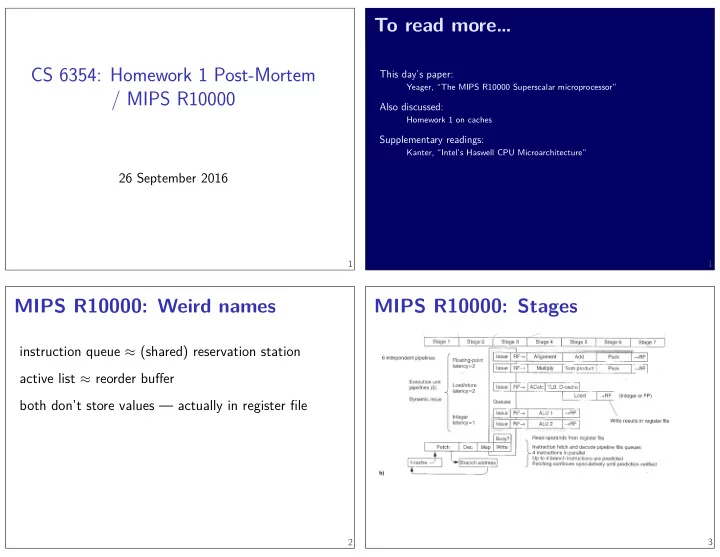
MIPS R10000: Stages

3

slide-2
SLIDE 2

MIPS R10000: Register Renaming/Queues

4

MIPS R10000: Register Renaming

explicit register map data structure

5

MIPS R10000: Instruction Queue

6

MIPS R10000: Instruction Queue v. Reservation Station

shared register fjle queue only tracks register numbers metadata: branch mask — for branch mispredicts ready bits — local copy of busy bits pointer to active list (ROB)

7

slide-3
SLIDE 3

MIPS R10000: Functional Units

8

Moving load/stores around

program order desired (fast) order store X load Z store Y store X load Z store Y

what if X == Z or Y == Z?

9

MIPS R10000: Memory requests

16 entry address queue kept in program order tracks dependencies (overlapping memory accesses) special-case for two accesses to same cache set match cache accesses against all loads load to store forwarding

10

MIPS R10000: Synchronization

execute memory accesses in order … in case other processors are listening treat like exception if other processors are listening

11

slide-4
SLIDE 4

LL/SC atomic increment

retry: // $t0 ← value ll $t0, value // $t0 < $t0 + 1 addi $t0, $t0, 1 // value ← $t0 if memory unchanged // $t0 ← 1 if stored, 0 otherwise sc $t0, value // if sc unsuccessful, goto retry beqz $t0, retry nop // (delay slot)

12

MIPS R10000: Weird Tricks

predecoding in instruction cache — opcode preprocessed instruction cache specialized for unaligned accesses within a block multibanked data cache — half the sets in one cache, half in another

13

core storage (approx sizes)

data — approx 8KB

register fjles — 8192 bits

metadata — approx 4KB

register map tables — 390 bits free list — 192 bits active list — 672 bits busy bits: — 128 bits instruction queues — 1600 bits address queue — 1232 bits

14

SGI’s workload

graphics lots of fmoating point big images

15

slide-5
SLIDE 5

evolution of modern processors

MIPS R10000 (1996) Intel Haswell (2013) fetch/cycle 4 instructions 5 instructions reorder bufger 32 entry 192 entry instruction queue 16 int + 16 FP + 16 mem 60 unifjed execute/cycle 2 int + 2 FP 2 int/FP + 2 int memory/cycle 1 load or store 2 load + 1 store

  • perand width

32 bit 32 bit to 256 bit L1 cache 32K I, 32K D 32K I, 32K D L2 cache

  • fg-chip

256K L3 cache none 1+MB L1 TLB 64 entry 64 entry D, 64 entry I L2 TLB none 1024 entry predecoding in I-cache micro-op cache branch pred. local, 512 entry ??? cores/package 1 2–18 threads/core 1 2

16

Micro-ops

complex instruction encodings don’t allow pre-decode trick complex insturctions can’t go to a single functional unit trick: split into micro-ops extra decoding step Intel Haswell: cache for micro-ops

17

Homework 1: Rubric

140 points total: For each thing benchmarked:

5 points: benchmark description, including how to read results 5 points: raw results and code are included, match description, interpreted plausibly

10 points: tested system described, report parts clear

18

Homework 1: General Concerns: Benchmarking Discipline

how consistent are your measurements? is that really an increase? be honest

19

slide-6
SLIDE 6

Homework 1: General Concerns: Latency v. Bandwidth

bandwidths much better than latencies (everywhere) memory system relies on overlapping many memory accesses measuring sizes? better to measure latency better to avoid prefetching — e.g. random access pattern, pointer chasing

20

Next Time: SMT

multiple threads on one core later: multiple processors/cores

21

Defjnition: Thread

stream of program execution

  • wn registers
  • wn program counter (current instruction pointer)

may or may not share memory appears to execute at same time as other threads

22

Multithreading

thread_one_func(int offset) { for (int i = 0; i < N / 2; ++i) sum1 += array[offset + i]; } thread_two_func() { for (int i = N / 2; i < N; ++i) sum2 += array[i]; } compute_sum() { thread_one = thread_create(thread_one_func); thread_two = thread_create(thread_two_func); wait_for_thread(thread_one); wait_for_thread(thread_two); sum = sum1 + sum2; }

23

slide-7
SLIDE 7

Difgerent Parallelism

instruction-level parallelism

sequential sequence of instructions not actually sequential transparent to programmer

next up: thread-level parallelism

multiple sequential sequences of instructions run in parallel (apparently) exposed to programmer

later: vectorization

sequential sequence of instructions that each does multiple copies of the same thing exposed to programmer

24

Flynn’s Taxonomy

Single instruction Multiple instruction Single data serial ??? Multiple data vectors threads

25