SLIDE 1 CS 70: Discrete Math and Probability.
More. Principle of Induction. P(0)∧(∀n ∈ N)P(n) = ⇒ P(n +1) Is P(0) true? Is P(1) true? P(0) = ⇒ P(1) So yes. Is P(2) true? P(1) = ⇒ P(2) So yes. .... ∀n ∈ NP(n)
Last time
P(n) = “3|(n3 −n)”. P(0). 0 divisible by 3! Proved: P(n) = ⇒ P(n +1) for all n. P(n) = “Any n line map that can be properly two colored.” P(1) - by example. P(n) = ⇒ P(n +1) Procedure to extend coloring from n line map to n +1 line map. Note: In some sense, one could argue this only proved P(n) for n ≥ 1.
- Fine. Where to start is a detail that depends on problems.
Any natural number n ≥ 14, can be written as 4y +5z for natural numbers x,y. Start induction at 14.
Strenthening Induction Hypothesis.
Theorem: The sum of the first n odd numbers is a perfect square. Theorem: The sum of the first n odd numbers is n2. kth odd number is 2(k −1)+1. Base Case 1 (first odd number) is 12. Induction Hypothesis Sum of first k odds is perfect square a2 = k2. Induction Step
- 1. The (k +1)st odd number is 2k +1.
- 2. Sum of the first k +1 odds is
a2 +2k +1 = k2 +2k +1 ????
... P(k+1)!
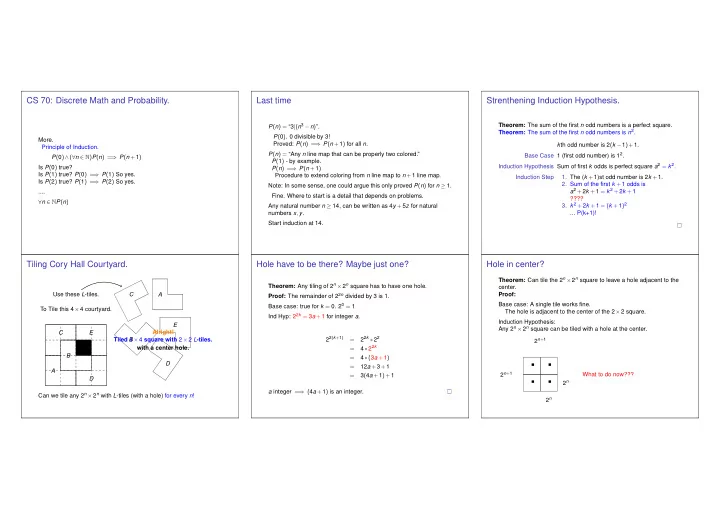
Tiling Cory Hall Courtyard.
Use these L-tiles. A A B B C C D D E E To Tile this 4×4 courtyard. Alright! Tiled 4×4 square with 2×2 L-tiles. with a center hole. Can we tile any 2n ×2n with L-tiles (with a hole) for every n!
Hole have to be there? Maybe just one?
Theorem: Any tiling of 2n ×2n square has to have one hole. Proof: The remainder of 22n divided by 3 is 1. Base case: true for k = 0. 20 = 1 Ind Hyp: 22k = 3a+1 for integer a. 22(k+1) = 22k ∗22 = 4∗22k = 4∗(3a+1) = 12a+3+1 = 3(4a+1)+1 a integer = ⇒ (4a+1) is an integer.
Hole in center?
Theorem: Can tile the 2n ×2n square to leave a hole adjacent to the center. Proof: Base case: A single tile works fine. The hole is adjacent to the center of the 2×2 square. Induction Hypothesis: Any 2n ×2n square can be tiled with a hole at the center. 2n 2n 2n+1 2n+1 What to do now???
SLIDE 2
Hole can be anywhere!
Theorem: Can tile the 2n ×2n to leave a hole adjacent anywhere. Better theorem ...better induction hypothesis! Base case: Sure. A tile is fine. Flipping the orientation can leave hole anywhere. Induction Hypothesis: “Any 2n ×2n square can be tiled with a hole anywhere.” Consider 2n+1 ×2n+1 square. Use induction hypothesis in each. Use L-tile and ... we are done.
Strong Induction.
Theorem: Every natural number n > 1 can be written as a (possibly trivial) product of primes. Definition: A prime n has exactly 2 factors 1 and n. Base Case: n = 2. Induction Step: P(n) = “n can be written as a product of primes. “ Either n +1 is a prime or n +1 = a·b where 1 < a,b < n +1. P(n) says nothing about a, b! Strong Induction Principle: If P(0) and (∀k ∈ N)((P(0)∧...∧P(k)) = ⇒ P(k +1)), then (∀k ∈ N)(P(k)). P(0) = ⇒ P(1) = ⇒ P(2) = ⇒ P(3) = ⇒ ··· Strong induction hypothesis: “a and b are products of primes” = ⇒ “n +1 = a·b = (factorization of a)(factorization of b)” n +1 can be written as the product of the prime factors!
Induction = ⇒ Strong Induction.
Let Q(k) = P(0)∧P(1)···P(k). By the induction principle: “If Q(0), and (∀k ∈ N)(Q(k) = ⇒ Q(k +1)) then (∀k ∈ N)(Q(k))” Also, Q(0) ≡ P(0) , and (∀k ∈ N)(Q(k)) ≡ (∀k ∈ N)(P(k)) (∀k ∈ N)(Q(k) = ⇒ Q(k +1)) ≡ (∀k ∈ N)((P(0)···∧P(k)) = ⇒ (P(0)···P(k)∧P(k +1))) ≡ (∀k ∈ N)((P(0)···∧P(k)) = ⇒ P(k +1)) Strong Induction Principle: If P(0) and (∀k ∈ N)((P(0)∧...∧P(k)) = ⇒ P(k +1)), then (∀k ∈ N)(P(k)).
Well Ordering Principle and Induction.
If (∀n)P(n) is not true, then (∃n)¬P(n). Consider smallest m, with ¬P(m), m ≥ 0 P(m −1) = ⇒ P(m) must be false (assuming P(0) holds.) This is a restatement of the induction principle! I.e., ¬(∀n)P(n) = ⇒ ((∃n)¬(P(n −1) = ⇒ P(n)). (Contrapositive of Induction principle (assuming P(0)) It assumes that there is a smallest m where P(m) does not hold. The Well ordering principle states that for any subset of the natural numbers there is a smallest element. Smallest may not be what you expect: the well ordering principal holds for rationals but with different ordering!! E.g. Reduced form “smallest” representiaoin of rational number a/b.
Well ordering principle.
Thm: All natural numbers are interesting. 0 is interesting... Let n be the first uninteresting number. But n −1 is interesting and n is uninteresting, so this is the first uninteresting number. But this is interesting! Thus, there is no smallest uninteresting natural number. Thus: All natural numbers are interesting.
Tournaments have short cycles
Def: A round robin tournament on n players: every player p plays every other player q, and either p → q (p beats q) or q → p (q beats p.) Def: A cycle: a sequence of p1,...,pk, pi → pi+1 and pk → p1. A B C D Theorem: Any tournament that has a cycle has a cycle of length 3.
SLIDE 3 Tournament has a cycle of length 3 if at all.
Assume the the smallest cycle is of length k. Case 1: Of length 3. Done. Case 2: Of length larger than 3. p1 p2 p3 p4 ··· ··· ··· ··· ··· pk “p3 → p1” = ⇒ 3 cycle Contradiction. “p1 → p3” = ⇒ k −1 length cycle! Contradiction!
Tournaments have long paths.
Def: A round robin tournament on n players: every player p plays every other player q, and either p → q (p beats q) or q → q (q beats q.) Def: A Hamiltonian path: a sequence p1,...,pn, (∀i,0 ≤ i < n) pi → pi+1.
2 1
···
7
Base: True for two vertices.
1 2
(Also for one, but two is more fun as base case!) Tournament on n +1 people, Remove arbitrary person → yield tournament on n −1 people. By induction hypothesis: There is a sequence p1,...,pn contains all the people where pi → pi+1 a b
···
c W a b
···
c M If p is big winner, put at beginning. Big loser at end. If neither, find first place i, where p beats pi. p1,...,pi−1,p,pi,...pn is hamiltonion path.
Horses of the same color...
Theorem: All horses have the same color. Base Case: P(1) - trivially true. New Base Case: P(2): there are two horses with same color. Induction Hypothesis: P(k) - Any k horses have the same color. Induction step P(k +1)? First k have same color by P(k). 1,2,3,...,k,k +1 1,2 Second k have same color by P(k). 1,2,3,...,k,k +1 1,2 A horse in the middle in common! 1,2,3,...,k,k +1 1,2 All k must have the same color. 1,2,3,...,k,k +1 No horse in common! How about P(1) = ⇒ P(2)? Fix base case. ...Still doesn’t work!! (There are two horses is ≡ For all two horses!!!) Of course it doesn’t work. As we will see, it is more subtle to catch errors in proofs of correct theorems!!
Strong Induction and Recursion.
Thm: For every natural number n ≥ 12, n = 4x +5y. Instead of proof, let’s write some code! def find-x-y(n): if (n==12) return (3,0) elif (n==13): return(2,1) elif (n==14): return(1,2) elif (n==15): return(0,3) else: (x’,y’) = find-x-y(n-4) return(x’+1,y’) Base cases: P(12) , P(13) , P(14) , P(15). Yes. Strong Induction step: Recursive call is correct: P(n −4) = ⇒ P(n). n −4 = 4x′ +5y′ = ⇒ n = 4(x′ +1)+5(y′) Slight differences: showed for all n ≥ 16 that ∧n−1
i=4 P(i) =
⇒ P(n).
Sad Islanders...
Island with 100 possibly blue-eyed and green-eyed inhabitants. Any islander who knows they have green eyes must kill themselves that day. No islander knows there own eye color, but knows everyone elses. All islanders have green eyes! First rule of island: Don’t talk about eye color! Visitor: “I see someone has green eyes.” Result: On day 100, they all kill themselves. Why?
They know induction.
Thm: If n villagers with green eyes they kill themselves on day n. Proof: Base: n = 1. Person with green eyes kills themselves on day 1. Induction hypothesis: If n people with green eyes, they would pass away on day n. Induction step: On day n +1, a green eyed person sees n people with green eyes. But they didn’t kill themselves. So there must be n +1 people with green eyes. One of them, is me. Sad. Wait! Visitor added no information.
SLIDE 4 Common Knowledge.
Using knowledge about what other people’s knowledge! On day 1, everyone knows everyone sees more than zero. On day 2, everyone knows everyone sees more than one. . . . On day 99, no one sees 98 and everyone knows everyone else does not see 97... On day 100, ...uh oh! Another example: Emperor’s new clothes! No one knows other people see that he has no clothes. Until kid points it out.
Summary: principle of induction.
Today: More induction. (P(0)∧((∀k ∈ N)(P(k) = ⇒ P(k +1)))) = ⇒ (∀n ∈ N)(P(n)) Statement to prove: P(n) for n starting from n0 Base Case: Prove P(n0).
- Ind. Step: Prove. For all values, n ≥ n0, P(n) =
⇒ P(n +1). Statement is proven! Strong Induction: (P(0)∧((∀n ∈ N)(P(n)) = ⇒ P(n +1)))) = ⇒ (∀n ∈ N)(P(n)) Also Today: strengthened induction hypothesis. Strengthen theorem statement. Sum of first n odds is n2. Hole anywhere. Not same as strong induction. E.g., used in product of primes proof. Induction ≡ Recursion.
Summary: principle of induction.
(P(0)∧((∀n ∈ N)(P(n) = ⇒ P(n +1)))) = ⇒ (∀n ∈ N)(P(n)) Variations: Strong Induction. (P(0)∧((∀k ∈ N)(P(k) = ⇒ P(k +1)))) = ⇒ (∀n ∈ N)(P(n)) Start at relevant place. (P(1)∧((∀n ∈ N)((n ≥ 1)∧P(n)) = ⇒ P(n +1)))) = ⇒ (∀n ∈ N)((n ≥ 1) = ⇒ P(n)) Well Ordering Principle: prove no smallest counterexample. Statement to prove: P(n) for n starting from n0 Base Case: Prove P(n0).
- Ind. Step: Prove. For all values, n ≥ n0, P(n) =
⇒ P(n +1). Statement is proven!