CS156: The Calculus of @pre 0 u < | a | Computation @post rv - - PowerPoint PPT Presentation

cs156 the calculus of
SMART_READER_LITE
LIVE PREVIEW

CS156: The Calculus of @pre 0 u < | a | Computation @post rv - - PowerPoint PPT Presentation

Program A: LinearSearch with function specification CS156: The Calculus of @pre 0 u < | a | Computation @post rv i . i u a [ i ] = e bool LinearSearch( int [] a , int , int u , int e ) { Zohar Manna for @


slide-1
SLIDE 1

CS156: The Calculus of Computation

Zohar Manna Chapter 5: Program Correctness: Mechanics

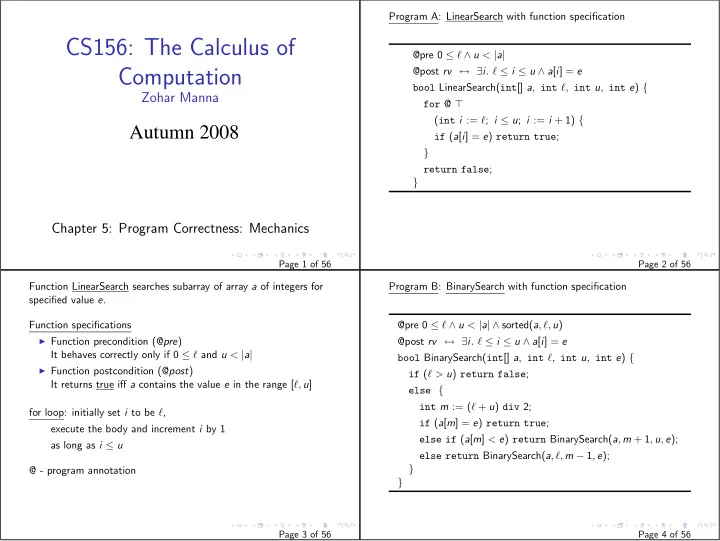
Page 1 of 56 Program A: LinearSearch with function specification @pre 0 ≤ ℓ ∧ u < |a| @post rv ↔ ∃i. ℓ ≤ i ≤ u ∧ a[i] = e bool LinearSearch(int[] a, int ℓ, int u, int e) { for @ ⊤ (int i := ℓ; i ≤ u; i := i + 1) { if (a[i] = e) return true; } return false; } Page 2 of 56 Function LinearSearch searches subarray of array a of integers for specified value e. Function specifications

◮ Function precondition (@pre)

It behaves correctly only if 0 ≤ ℓ and u < |a|

◮ Function postcondition (@post)

It returns true iff a contains the value e in the range [ℓ, u] for loop: initially set i to be ℓ, execute the body and increment i by 1 as long as i ≤ u @ - program annotation Page 3 of 56 Program B: BinarySearch with function specification @pre 0 ≤ ℓ ∧ u < |a| ∧ sorted(a, ℓ, u) @post rv ↔ ∃i. ℓ ≤ i ≤ u ∧ a[i] = e bool BinarySearch(int[] a, int ℓ, int u, int e) { if (ℓ > u) return false; else { int m := (ℓ + u) div 2; if (a[m] = e) return true; else if (a[m] < e) return BinarySearch(a, m + 1, u, e); else return BinarySearch(a, ℓ, m − 1, e); } } Page 4 of 56

Autumn 2008

slide-2
SLIDE 2

The recursive function BinarySearch searches sorted subarray a of integers for specified value e. sorted: weakly increasing order, i.e. sorted(a, ℓ, u) ⇔ ∀i, j. ℓ ≤ i ≤ j ≤ u → a[i] ≤ a[j] Defined in the combined theory of integers and arrays, TZ∪A Function specifications

◮ Function precondition (@pre)

It behaves correctly only if 0 ≤ ℓ and u < |a| and sorted(a, ℓ, u).

◮ Function postcondition (@post)

It returns true iff a contains the value e in the range [ℓ, u] Page 5 of 56

Program C: BubbleSort with function specification @pre ⊤ @post sorted(rv, 0, |rv| − 1) int[] BubbleSort(int[] a0) { int[] a := a0; for @ ⊤ (int i := |a| − 1; i > 0; i := i − 1) { for @ ⊤ (int j := 0; j < i; j := j + 1) { if (a[j] > a[j + 1]) { int t := a[j]; a[j] := a[j + 1]; a[j + 1] := t; } } } return a; }

Page 6 of 56 Function BubbleSort sorts integer array a

a: unsorted sorted

largest by “bubbling” the largest element of the left unsorted region of a toward the sorted region on the right. Each iteration of the outer loop expands the sorted region by one cell.1 Function specification

◮ Function postcondition (@post):

BubbleSort returns array rv sorted on the range [0, |rv| − 1].

1Except the last iteration, which expands the sorted region by two cells, so

that an entire array of length n is sorted in n − 1 iterations. Page 7 of 56

Sample execution of BubbleSort

2 3 4 1 2 5 6 j i 2 3 4 1 2 5 6 j i 2 3 4 1 2 5 6 j i 2 3 1 4 2 5 6 j i 2 3 1 2 4 5 6 j, i 2 3 1 2 4 5 6 j i

Page 8 of 56

slide-3
SLIDE 3

Program Annotation

◮ Function Specifications

function precondition (@pre) function postcondition (@post)

◮ Runtime Assertions

e.g., @ 0 ≤ j < |a| ∧ 0 ≤ j + 1 < |a| a[j] := a[j + 1]

◮ Loop Invariants

e.g., @ L : ℓ ≤ i ∧ ∀j. ℓ ≤ j < i → a[j] = e The L : gives a name to the formula, just like the F : we’ve used in other formulae. Page 9 of 56 Program A: LinearSearch with runtime assertions @pre 0 ≤ ℓ ∧ u < |a| @post rv ↔ ∃i. ℓ ≤ i ≤ u ∧ a[i] = e bool LinearSearch(int[] a, int ℓ, int u, int e) { for @ L : ⊤ (int i := ℓ; i ≤ u; i := i + 1) { @ 0 ≤ i < |a|; if (a[i] = e) return true; } return false; } Page 10 of 56

Program B: BinarySearch with runtime assertions @pre 0 ≤ ℓ ∧ u < |a| ∧ sorted(a, ℓ, u) @post rv ↔ ∃i. ℓ ≤ i ≤ u ∧ a[i] = e bool BinarySearch(int[] a, int ℓ, int u, int e) { if (ℓ > u) return false; else { @ 2 = 0; int m := (ℓ + u) div 2; @ 0 ≤ m < |a|; if (a[m] = e) return true; else { @ 0 ≤ m < |a|; if (a[m] < e) return BinarySearch(a, m + 1, u, e); else return BinarySearch(a, ℓ, m − 1, e); } } }

Page 11 of 56

Program C: BubbleSort with runtime assertions @pre ⊤ @post sorted(rv, 0, |rv| − 1) int[] BubbleSort(int[] a0) { int[] a := a0; for @ L1 : ⊤ (int i := |a| − 1; i > 0; i := i − 1) { for @ L2 : ⊤ (int j := 0; j < i; j := j + 1) { @ 0 ≤ j < |a| ∧ 0 ≤ j + 1 < |a|; if (a[j] > a[j + 1]) { int t := a[j]; a[j] := a[j + 1]; a[j + 1] := t; } } } return a; }

Page 12 of 56

slide-4
SLIDE 4

Loop Invariants

while @ F cond { body }

◮ apply body as long as cond holds ◮ assertion F holds at the beginning of every iteration

evaluated before cond is checked for @ F (init; cond; incr) {body} init; while @ F cond { body; incr } Page 13 of 56 Program A: LinearSearch with loop invariants @pre 0 ≤ ℓ ∧ u < |a| @post rv ↔ ∃j. ℓ ≤ j ≤ u ∧ a[j] = e bool LinearSearch(int[] a, int ℓ, int u, int e) { for @L : ℓ ≤ i ∧ (∀j. ℓ ≤ j < i → a[j] = e) (int i := ℓ; i ≤ u; i := i + 1) { if (a[i] = e) return true; } return false; } Page 14 of 56

Proving Partial Correctness

A function is partially correct if when the function’s precondition is satisfied on entry, its postcondition is satisfied when the function halts/exits.

◮ A function + annotation is reduced to finite set of

verification conditions (VCs), FOL formulae

◮ If all VCs are T-valid, then the function obeys its specification

(partially correct) Page 15 of 56 Basic Paths: Loops To handle loops, we break the function into basic paths @ ← precondition or loop invariant sequence of instructions (with no loop invariants) @ ← loop invariant, runtime assertion, or postcondition Page 16 of 56

slide-5
SLIDE 5

Program A: LinearSearch I

Basic Paths of LinearSearch (1) @pre 0 ≤ ℓ ∧ u < |a| i := ℓ; @L : ℓ ≤ i ∧ ∀j. ℓ ≤ j < i → a[j] = e (2) @L : ℓ ≤ i ∧ ∀j. ℓ ≤ j < i → a[j] = e assume i ≤ u; assume a[i] = e; rv := true; @post rv ↔ ∃j. ℓ ≤ j ≤ u ∧ a[j] = e Page 17 of 56

Program A: LinearSearch II

(3) @L : ℓ ≤ i ∧ ∀j. ℓ ≤ j < i → a[j] = e assume i ≤ u; assume a[i] = e; i := i + 1; @L : ℓ ≤ i ∧ ∀j. ℓ ≤ j < i → a[j] = e (4) @L : ℓ ≤ i ∧ ∀j. ℓ ≤ j < i → a[j] = e assume i > u; rv := false; @post rv ↔ ∃j. ℓ ≤ j ≤ u ∧ a[j] = e Page 18 of 56 Visualization of basic paths of LinearSearch @pre L @post (1) (3) (2),(4) Page 19 of 56 Program C: BubbleSort with loop invariants @pre ⊤ @post sorted(rv, 0, |rv| − 1) int[] BubbleSort(int[] a0) { int[] a := a0; for @L1 :    −1 ≤ i < |a| ∧partitioned(a, 0, i, i + 1, |a| − 1) ∧sorted(a, i, |a| − 1)    (int i := |a| − 1; i > 0; i := i − 1) { Page 20 of 56

slide-6
SLIDE 6

for @L2 :      1 ≤ i < |a| ∧ 0 ≤ j ≤ i ∧partitioned(a, 0, i, i + 1, |a| − 1) ∧partitioned(a, 0, j − 1, j, j) ∧sorted(a, i, |a| − 1)      (int j := 0; j < i; j := j + 1) { if (a[j] > a[j + 1]) { int t := a[j]; a[j] := a[j + 1]; a[j + 1] := t; } } } return a; } Page 21 of 56

Partition partitioned(a, ℓ1, u1, ℓ2, u2) ⇔ ∀i, j. ℓ1 ≤ i ≤ u1 < ℓ2 ≤ j ≤ u2 → a[i] ≤ a[j] in TZ ∪ TA. That is, each element of a in the range [ℓ1, u1] is ≤ each element in the range [ℓ2, u2]. Basic Paths of BubbleSort (1) @pre ⊤ a := a0; i := |a| − 1; @L1 :

  • −1 ≤ i < |a| ∧ partitioned(a, 0, i, i + 1, |a| − 1)

∧ sorted(a, i, |a| − 1)

  • Page 22 of 56

(2) @L1 :

  • −1 ≤ i < |a| ∧ partitioned(a, 0, i, i + 1, |a| − 1)

∧ sorted(a, i, |a| − 1)

  • assume i > 0;

j := 0; @L2 :

  • 1 ≤ i < |a| ∧ 0 ≤ j ≤ i ∧ partitioned(a, 0, i, i + 1, |a| − 1)

∧ partitioned(a, 0, j − 1, j, j) ∧ sorted(a, i, |a| − 1)

  • Page 23 of 56

(3) @L2 :

  • 1 ≤ i < |a| ∧ 0 ≤ j ≤ i ∧ partitioned(a, 0, i, i + 1, |a| − 1)

∧ partitioned(a, 0, j − 1, j, j) ∧ sorted(a, i, |a| − 1)

  • assume j < i;

assume a[j] > a[j + 1]; t := a[j]; a[j] := a[j + 1]; a[j + 1] := t; j := j + 1; @L2 :

  • 1 ≤ i < |a| ∧ 0 ≤ j ≤ i ∧ partitioned(a, 0, i, i + 1, |a| − 1)

∧ partitioned(a, 0, j − 1, j, j) ∧ sorted(a, i, |a| − 1)

  • Page 24 of 56
slide-7
SLIDE 7

(4) @L2 :

  • 1 ≤ i < |a| ∧ 0 ≤ j ≤ i ∧ partitioned(a, 0, i, i + 1, |a| − 1)

∧ partitioned(a, 0, j − 1, j, j) ∧ sorted(a, i, |a| − 1)

  • assume j < i;

assume a[j] ≤ a[j + 1]; j := j + 1; @L2 :

  • 1 ≤ i < |a| ∧ 0 ≤ j ≤ i ∧ partitioned(a, 0, i, i + 1, |a| − 1)

∧ partitioned(a, 0, j − 1, j, j) ∧ sorted(a, i, |a| − 1)

  • Page 25 of 56

(5) @L2 :

  • 1 ≤ i < |a| ∧ 0 ≤ j ≤ i ∧ partitioned(a, 0, i, i + 1, |a| − 1)

∧ partitioned(a, 0, j − 1, j, j) ∧ sorted(a, i, |a| − 1)

  • assume j ≥ i;

i := i − 1; @L1 :

  • −1 ≤ i < |a| ∧ partitioned(a, 0, i, i + 1, |a| − 1)

∧ sorted(a, i, |a| − 1)

  • Page 26 of 56

(6) @L1 :

  • −1 ≤ i < |a| ∧ partitioned(a, 0, i, i + 1, |a| − 1)

∧ sorted(a, i, |a| − 1)

  • assume i ≤ 0;

rv := a; @post sorted(rv, 0, |rv| − 1) Visualization of basic paths of BubbleSort @pre L1 @post L2 (1) (2) (6) (5) (3), (4) Page 27 of 56

Basic Paths: Function Calls

◮ Loops produce unbounded number of paths

loop invariants cut loops to produce finite number of basic paths

◮ Reursive calls produce unbounded number of paths

function specifications cut function calls In BinarySearch @pre 0 ≤ ℓ ∧ u < |a| ∧ sorted(a, ℓ, u) . . . F[a, ℓ, u, e] . . . @R1 : 0 ≤ m + 1 ∧ u < |a| ∧ sorted(a, m + 1, u) . . . F[a, m + 1, u, e] return BinarySearch(a, m + 1, u, e) . . . @R2 : 0 ≤ ℓ ∧ m − 1 < |a| ∧ sorted(a, ℓ, m − 1) . . . F[a, ℓ, m − 1, e] return BinarySearch(a, ℓ, m − 1, e) Page 28 of 56

slide-8
SLIDE 8

Program B: BinarySearch with function call assertions @pre 0 ≤ ℓ ∧ u < |a| ∧ sorted(a, ℓ, u) @post rv ↔ ∃i. ℓ ≤ i ≤ u ∧ a[i] = e bool BinarySearch(int[] a, int ℓ, int u, int e) { if (ℓ > u) return false; else { int m := (ℓ + u) div 2; if (a[m] = e) return true; else if (a[m] < e) { @R1 : 0 ≤ m + 1 ∧ u < |a| ∧ sorted(a, m + 1, u); return BinarySearch(a, m + 1, u, e); } else { @R2 : 0 ≤ ℓ ∧ m − 1 < |a| ∧ sorted(a, ℓ, m − 1); return BinarySearch(a, ℓ, m − 1, e); } } } Page 29 of 56

(1) @pre 0 ≤ ℓ ∧ u < |a| ∧ sorted(a, ℓ, u) assume ℓ > u; rv := false; @post rv ↔ ∃i. ℓ ≤ i ≤ u ∧ a[i] = e (2) @pre 0 ≤ ℓ ∧ u < |a| ∧ sorted(a, ℓ, u) assume ℓ ≤ u; m := (ℓ + u) div 2; assume a[m] = e; rv := true; @post rv ↔ ∃i. ℓ ≤ i ≤ u ∧ a[i] = e Page 30 of 56 (3) @pre 0 ≤ ℓ ∧ u < |a| ∧ sorted(a, ℓ, u) assume ℓ ≤ u; m := (ℓ + u) div 2; assume a[m] = e; assume a[m] < e; @R1 : 0 ≤ m + 1 ∧ u < |a| ∧ sorted(a, m + 1, u) Page 31 of 56 (5) @pre 0 ≤ ℓ ∧ u < |a| ∧ sorted(a, ℓ, u) assume ℓ ≤ u; m := (ℓ + u) div 2; assume a[m] = e; assume a[m] ≥ e; @R2 : 0 ≤ ℓ ∧ m − 1 < |a| ∧ sorted(a, ℓ, m − 1) Page 32 of 56

slide-9
SLIDE 9

(4) @pre 0 ≤ ℓ ∧ u < |a| ∧ sorted(a, ℓ, u) assume ℓ ≤ u; m := (ℓ + u) div 2; assume a[m] = e; assume a[m] < e; assume v1 ↔ ∃i. m + 1 ≤ i ≤ u ∧ a[i] = e; rv := v1; @post rv ↔ ∃i. ℓ ≤ i ≤ u ∧ a[i] = e Page 33 of 56 (6) @pre 0 ≤ ℓ ∧ u < |a| ∧ sorted(a, ℓ, u) assume ℓ ≤ u; m := (ℓ + u) div 2; assume a[m] = e; assume a[m] ≥ e; assume v2 ↔ ∃i. ℓ ≤ i ≤ m − 1 ∧ a[i] = e; rv := v2; @post rv ↔ ∃i. ℓ ≤ i ≤ u ∧ a[i] = e Page 34 of 56 @pre R1 R2 @post (3), (4) (1) (2) (5), (6) (4) (6) Figure: Visualization of basic paths of BinarySearch Page 35 of 56

Program States

Program counter pc holds current location of control State s of P assignment of values to all variables (proper types) of P Example: s :

  • pc → L1, a → [2; 0; 1],

i → 2, j → 0, t → 2, rv → [ ]

  • is a state of BubbleSort.

Reachable state s of P a state that can be reached during some computation of P Example: s :

  • pc → L1, a → [0; 1; 2],

i → 1, j → 1, t → 2

  • is a reachable state of BubbleSort.

Page 36 of 56

slide-10
SLIDE 10

Weakest Precondition wp(F, S)

For FOL formula F, program statement S, s | = wp(F, S) iff statement S is executed on state s to produce state s′, and s′ | = F:

  • s

wp(F, S)

  • s′

F S

◮ wp(F, assume c) ⇔ c → F ◮ wp(F[v], v := e) ⇔ F[e] ◮ For S1; . . . ; Sn,

wp(F, S1; . . . ; Sn) ⇔ wp(wp(F, Sn), S1; . . . ; Sn−1) Page 37 of 56

Verification Conditions

Verification Condition of basic path @ F S1; . . . Sn; @ G is F → wp(G, S1; . . . ; Sn) Also denoted by {F}S1; . . . ; Sn{G} That is, for every state s, if s | = F then s′ | = G (after the path S1; S2; . . . ; Sn is executed) Page 38 of 56 Example: Basic path (1) @ F : x ≥ 0 S1 : x := x + 1; @ G : x ≥ 1 The VC is F → wp(G, S1). That is, wp(G, S1) ⇔ wp(x ≥ 1, x := x + 1) ⇔ (x ≥ 1){x → x + 1} ⇔ x + 1 ≥ 1 ⇔ x ≥ 0 Therefore the VC of path (1) is x ≥ 0 → x ≥ 0 , which is TZ-valid. Page 39 of 56

Example: Basic path (2) of LinearSearch (2) @L : F : ℓ ≤ i ∧ ∀j. ℓ ≤ j < i → a[j] = e S1 : assume i ≤ u; S2 : assume a[i] = e; S3 : rv := true; @post G : rv ↔ ∃j. ℓ ≤ j ≤ u ∧ a[j] = e The VC is F → wp(G, S1; S2; S3). That is, wp(G, S1; S2; S3) ⇔ wp(wp(rv ↔ ∃j. ℓ ≤ j ≤ u ∧ a[j] = e, rv := true), S1; S2) ⇔ wp(true ↔ ∃j. ℓ ≤ j ≤ u ∧ a[j] = e, S1; S2) ⇔ wp(∃j. ℓ ≤ j ≤ u ∧ a[j] = e, S1; S2) ⇔ wp(wp(∃j. ℓ ≤ j ≤ u ∧ a[j] = e, assume a[i] = e), S1) ⇔ wp(a[i] = e → ∃j. ℓ ≤ j ≤ u ∧ a[j] = e, S1) ⇔ wp(a[i] = e → ∃j. ℓ ≤ j ≤ u ∧ a[j] = e, assume i ≤ u) ⇔ i ≤ u → (a[i] = e → ∃j. ℓ ≤ j ≤ u ∧ a[j] = e) Page 40 of 56

slide-11
SLIDE 11

Therefore the VC of path (2) is ℓ ≤ i ∧ (∀j. ℓ ≤ j < i → a[j] = e) → (i ≤ u → (a[i] = e → ∃j. ℓ ≤ j ≤ u ∧ a[j] = e)) (1)

  • r, equivalently,

ℓ ≤ i ∧ (∀j. ℓ ≤ j < i → a[j] = e) ∧ i ≤ u ∧ a[i] = e → ∃j. ℓ ≤ j ≤ u ∧ a[j] = e (2) according to the equivalence F1 ∧ F2 → (F3 → (F4 → F5)) ⇔ (F1 ∧ F2 ∧ F3 ∧ F4) → F5 . This formula (2) is (TZ ∪ TA)-valid. Page 41 of 56

P-invariant and P-inductive I

Consider program P with function f s.t. function precondition Fpre and initial location L0. A P-computation is a sequence of states s0, s1, s2, . . . such that

◮ s0[pc] = L0 and s0 |

= Fpre, and

◮ for each i, si+1 is the result of executing the instruction at

si[pc] on state si. where si[pc] = value of pc given by state si. Page 42 of 56

P-invariant and P-inductive II

A formula F annotating location L of program P is P-invariant if for all P-computations s0, s1, s2, . . . and for each index i, si[pc] = L ⇒ si | = F Annotations of P are P-invariant iff each annotation of P is P-invariant at its location. Not Implementable: checking if F is P-invariant requires an infinite number of P-computations in general. Annotations of P are P-inductive iff all VCs generated from the basic paths of program P are T-valid P-inductive ⇒ P-invariant In Practice: we check if the annotations are P-inductive. Page 43 of 56

Theorem (Verification Conditions)

If for every basic path @L1 : F S1; . . . Sn; @Lj : G

  • f program P, the verification condition

{F}S1; . . . ; Sn{G} is T-valid, then the annotations are P-inductive, and therefore P-invariant. Partial Correctness: For program P, if there is a P-invariant annotation, then P is partially correct. Page 44 of 56

slide-12
SLIDE 12

Total Correctness

Total Correctness = Partial Correctness + Termination For every input that satisfies Fpre, the program eventually halts and produces output that satisfies Fpost. Proving function termination:

◮ Choose set W with well-founded relation ≺

Usually set of n-tuples of natural numbers with the lexicographic extension <n

◮ Find function δ (ranking function)

mapping program states → W such that δ decreases according to ≺ along every basic path. Since ≺ is well-founded, there cannot exist an infinite sequence of program states. The program must terminate. Page 45 of 56 Showing decrease of ranking function For basic path with ranking function @ F ↓ δ[x] ... ranking function S1; . . . Sk; ↓ κ[x] ... ranking function We must prove that the value of κ ∈ W after executing S1; · · · ; Sn is less than the value of δ ∈ W before executing the statements Thus, we show the verification condition F → wp(κ ≺ δ[x0], S1; · · · ; Sk){x0 → x} . Page 46 of 56 Example: BubbleSort — loops Choose (N2, <2) as well-founded set @pre ⊤ @post ⊤ int[] BubbleSort(int[] a0) { int[] a := a0; for @L1 : i + 1 ≥ 0 ↓ (i + 1, i + 1) . . . ranking function δ1 (int i := |a| − 1; i > 0; i := i − 1) { Page 47 of 56 for @L2 : i + 1 ≥ 0 ∧ i − j ≥ 0 ↓ (i + 1, i − j) . . . ranking function δ2 (int j := 0; j < i; j := j + 1) { if (a[j] > a[j + 1]) { int t := a[j]; a[j] := a[j + 1]; a[j + 1] := t; } } } return a; } Page 48 of 56

slide-13
SLIDE 13

We have to prove

◮ loop invariants are inductive (we don’t show here) ◮ function decreases along each basic path.

The relevant basic paths: (1) @L1 : i + 1 ≥ 0 ↓L1 : (i + 1, i + 1) assume i > 0; j := 0; ↓L2 : (i + 1, i − j) Path (1): i + 1 ≥ 0 ∧ i > 0 → (i + 1, i − 0) <2 (i + 1, i + 1) Page 49 of 56 (2, 3) @L2 : i + 1 ≥ 0 ∧ i − j ≥ 0 ↓L2 : (i + 1, i − j) assume j < i; · · · j := j + 1; ↓L2 : (i + 1, i − j) Paths (2) and (3): i + 1 ≥ 0 ∧ i − j ≥ 0 ∧ j < i → (i + 1, i − (j + 1)) <2 (i + 1, i − j) Page 50 of 56 (4) @L2 : i + 1 ≥ 0 ∧ i − j ≥ 0 ↓L2 : (i + 1, i − j) assume j ≥ i; i := i − 1; ↓L1 : (i + 1, i + 1) Path (4): i +1 ≥ 0∧i −j ≥ 0∧j ≥ i → ((i −1)+1, (i −1)+1) <2 (i +1, i −j) All VCs are valid. Hence, BubbleSort always halts. TODO arrows Page 51 of 56

Construction of last VC

The verification condition for Path (4) is generated as follows: wp((i + 1, i + 1) <2 (i0 + 1, i0 − j0), assume j ≥ i; i := i − 1) ⇔ wp(((i − 1) + 1, (i − 1) + 1) <2 (i0 + 1, i0 − j0), assume j ≥ i) ⇔ j ≥ i → (i, i) <2 (i0 + 1, i0 − j0) Replace back (i0, j0) → (i, j): j ≥ i → (i, i) <2 (i + 1, i − j), producing the VC i + 1 ≥ 0 ∧ i − j ≥ 0 ∧ j ≥ i → (i, i) <2 (i + 1, i − j). Page 52 of 56

slide-14
SLIDE 14

Example: Binary Search — recursive calls Choose (N, <) as well-founded set and ranking function δ : u − ℓ + 1 @pre u − ℓ + 1 ≥ 0 @post ⊤ ↓ u − ℓ + 1 . . . ranking function δ bool BinarySearch(int[] a, int ℓ, int u, int e) { if (ℓ > u) return false; else { int m := (ℓ + u) div 2; if (a[m] = e) return true; else if (a[m] < e) return @R1 : u − (m + 1) + 1 ≥ 0 BinarySearch(a, m + 1, u, e); else return @R2 : (m − 1) − ℓ + 1 ≥ 0 BinarySearch(a, ℓ, m − 1, e); } }

Page 53 of 56

Show @R1 and @R2 are P-invariant

Show decrease in u − ℓ + 1: (1) @pre u − ℓ + 1 ≥ 0 ↓ u − ℓ + 1 assume ℓ ≤ u; m := (ℓ + u) div 2; assume a[m] = e; assume a[m] < e; ↓ u − (m + 1) + 1 Verification condition: u − ℓ + 1 ≥ 0 ∧ ℓ ≤ u ∧ · · · → u − (((ℓ + u) div 2) + 1) + 1 < u − ℓ + 1 Page 54 of 56 Show decrease in u − ℓ + 1: (2) @pre u − ℓ + 1 ≥ 0 ↓ u − ℓ + 1 assume ℓ ≤ u; m := (ℓ + u) div 2; assume a[m] = e; assume a[m] ≥ e; ↓ (m − 1) − ℓ + 1 Verification condition: u − ℓ + 1 ≥ 0 ∧ ℓ ≤ u ∧ · · · → (((ℓ + u) div 2) − 1) − ℓ + 1 < u − ℓ + 1 Page 55 of 56 Note: two other basic paths (. . . return false and . . . return true) are irrelevant to the termination argument (recursion ends at each). Both VCs are TZ-valid. Thus BinarySearch halts on all input in which ℓ is initially at most u + 1. Page 56 of 56