CS475 / CM 375 Lecture 18: Nov 10, 2011 QR Method with Shifts Google - - PDF document

cs475 cm 375 lecture 18 nov 10 2011
SMART_READER_LITE
LIVE PREVIEW

CS475 / CM 375 Lecture 18: Nov 10, 2011 QR Method with Shifts Google - - PDF document

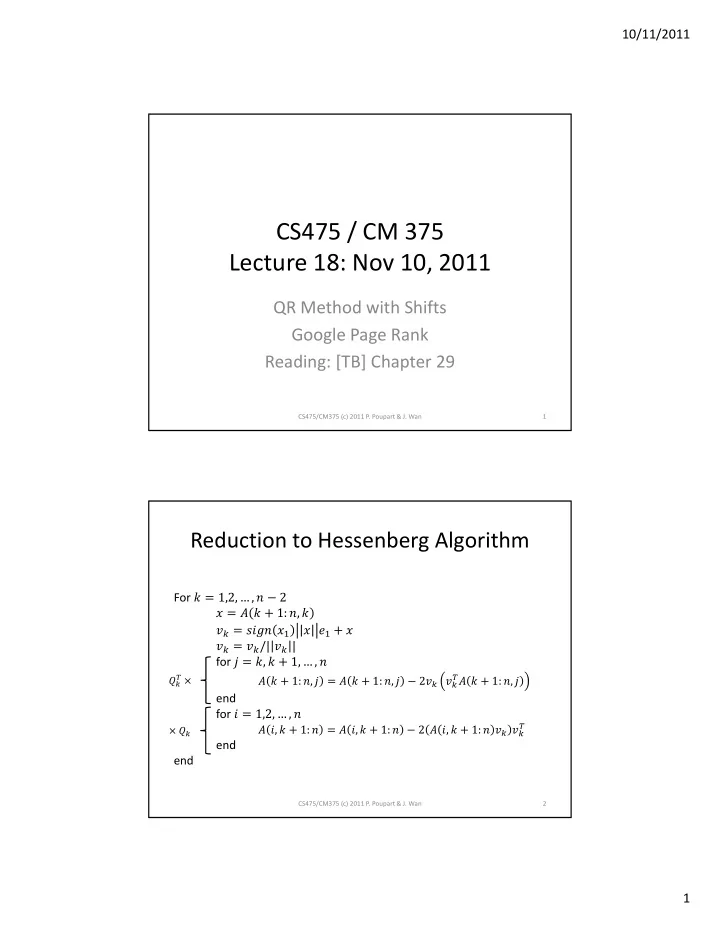
10/11/2011 CS475 / CM 375 Lecture 18: Nov 10, 2011 QR Method with Shifts Google Page Rank Reading: [TB] Chapter 29 CS475/CM375 (c) 2011 P. Poupart & J. Wan 1 Reduction to Hessenberg Algorithm For 1,2, , 2


slide-1
SLIDE 1

10/11/2011 1

CS475 / CM 375 Lecture 18: Nov 10, 2011

QR Method with Shifts Google Page Rank Reading: [TB] Chapter 29

CS475/CM375 (c) 2011 P. Poupart & J. Wan 1

Reduction to Hessenberg Algorithm

For 1,2, … , 2 1: , /| | for , 1, … ,

1: , 1: , 2

1: ,

end for 1,2, … ,

, 1: , 1: 2 , 1:

  • end

end

  • CS475/CM375 (c) 2011 P. Poupart & J. Wan

2

slide-2
SLIDE 2

10/11/2011 2

Symmetric Case

  • If , then

is also symmetric

  • A symmetric Hessenberg matrix ⟶ tridiagonal

matrix

  • Two‐phase process:

CS475/CM375 (c) 2011 P. Poupart & J. Wan 3

Shift QR Algorithm

  • QR algorithm is both simultaneous iteration and

simultaneous inverse iteration

– Can apply shift technique

  • Algorithm (Shifted QR)

For 1,2, … Pick a shift ← (QR factorization) End

CS475/CM375 (c) 2011 P. Poupart & J. Wan 4

slide-3
SLIDE 3

10/11/2011 3

Shift QR Algorithm

  • Similar to regular QR, we can show that
  • where …
  • Derivation:

CS475/CM375 (c) 2011 P. Poupart & J. Wan 5

Shift QR Algorithm

  • We can also show that

  • Derivation:

CS475/CM375 (c) 2011 P. Poupart & J. Wan 6

slide-4
SLIDE 4

10/11/2011 4

Shift QR Algorithm

  • Continued derivation:
  • If the shifts are good eigenvalue estimates, the last

column of converges quickly to an eigenvector.

CS475/CM375 (c) 2011 P. Poupart & J. Wan 7

Rayleigh quotient shift

  • To estimate the eigenvalue corresponding to the

eigenvector approximated by the last column of :

  • Equivalent to applying RQI on

– i.e., QR algo has cubic convergence to that eigenvector

  • Note:
  • ∴ comes for free!

CS475/CM375 (c) 2011 P. Poupart & J. Wan 8

slide-5
SLIDE 5

10/11/2011 5

Google PageRank

  • Problem: give a ranking, PageRank, to all webpages.
  • Idea: surfing the web is like a random walk

 a Markov chain or Markov process.

– PageRank = the limiting probability that an infinitely dedicated random surfer visits any particular page. – A page has high rank if other pages with high rank link to it.

CS475/CM375 (c) 2011 P. Poupart & J. Wan 9

Google PageRank

  • Example:

CS475/CM375 (c) 2011 P. Poupart & J. Wan 10

slide-6
SLIDE 6

10/11/2011 6

Google PageRank

  • Define connectivity matrix by

1 if ∃ a link from page to

  • therwise
  • The column of shows the links on the page.

CS475/CM375 (c) 2011 P. Poupart & J. Wan 11

Google PageRank

  • Let prob. that the random walk follows a link

and 1 prob. that an arbitrary page is chosen

– Typically 0.85

  • Define
  • 1
  • to be the prob. of jumping from page to page

CS475/CM375 (c) 2011 P. Poupart & J. Wan 12

slide-7
SLIDE 7

10/11/2011 7

Google PageRank

  • Properties of A:

– Entries between 0 and 1: 0 1 – Columns sum to 1: ∑

  • 1
  • ∑ 1
  • 1 1
  • By Ferron‐Frobenius theorem, a matrix with the

above properties admits a vector such that

i.e., is the eigenvector corresponding to eigenvalue 1

CS475/CM375 (c) 2011 P. Poupart & J. Wan 13

Google PageRank

  • Normalize such that ∑
  • 1. Then is the state

vector of the Markov chain & is Google’s PageRank!

  • The elements of are all positive and less than 1.
  • In our example,

CS475/CM375 (c) 2011 P. Poupart & J. Wan 14

slide-8
SLIDE 8

10/11/2011 8

Google PageRank

  • To compute PageRank:

– Setup – Compute largest eigenvector by:

CS475/CM375 (c) 2011 P. Poupart & J. Wan 15