
Maria Hybinette, UGA
1
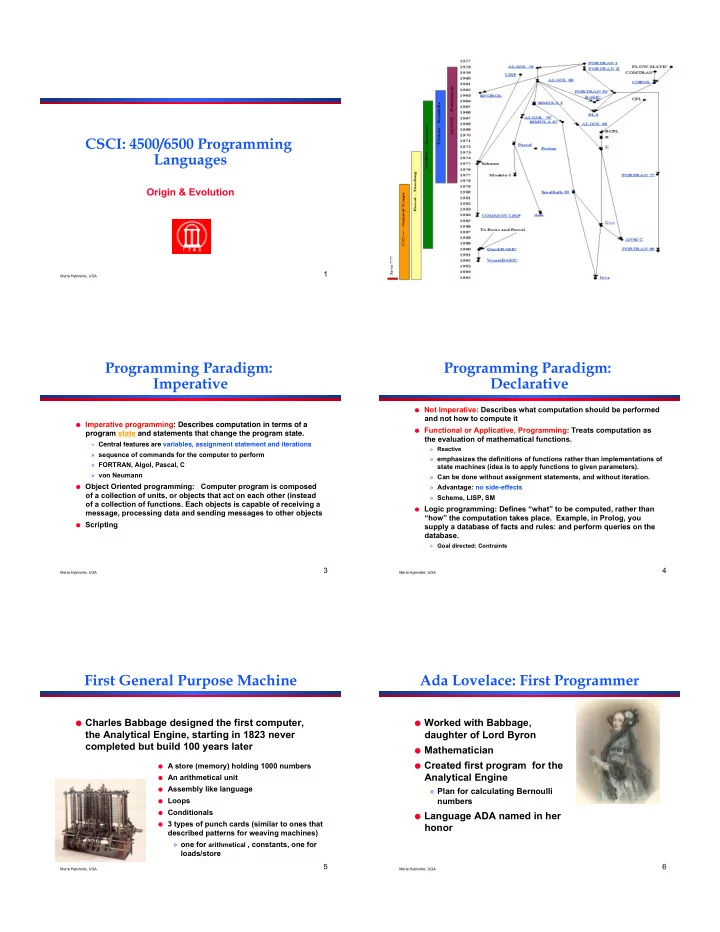
CSCI: 4500/6500 Programming Languages
Origin & Evolution
Maria Hybinette, UGA
3
Programming Paradigm: Imperative
Imperative programming: Describes computation in terms of a
program state and statements that change the program state.
» Central features are variables, assignment statement and iterations » sequence of commands for the computer to perform » FORTRAN, Algol, Pascal, C » von Neumann
Object Oriented programming: Computer program is composed
- f a collection of units, or objects that act on each other (instead
- f a collection of functions. Each objects is capable of receiving a
message, processing data and sending messages to other objects
Scripting
Maria Hybinette, UGA
4
Programming Paradigm: Declarative
Not Imperative: Describes what computation should be performed
and not how to compute it
Functional or Applicative, Programming: Treats computation as
the evaluation of mathematical functions.
» Reactive
» emphasizes the definitions of functions rather than implementations of state machines (idea is to apply functions to given parameters). » Can be done without assignment statements, and without iteration. » Advantage: no side-effects » Scheme, LISP, SM
Logic programming: Defines “what” to be computed, rather than
“how” the computation takes place. Example, in Prolog, you supply a database of facts and rules: and perform queries on the database.
» Goal directed: Contraints
Maria Hybinette, UGA
5
First General Purpose Machine
Charles Babbage designed the first computer,
the Analytical Engine, starting in 1823 never completed but build 100 years later
A store (memory) holding 1000 numbers An arithmetical unit Assembly like language Loops Conditionals 3 types of punch cards (similar to ones that
described patterns for weaving machines) » one for arithmetical , constants, one for loads/store
Maria Hybinette, UGA