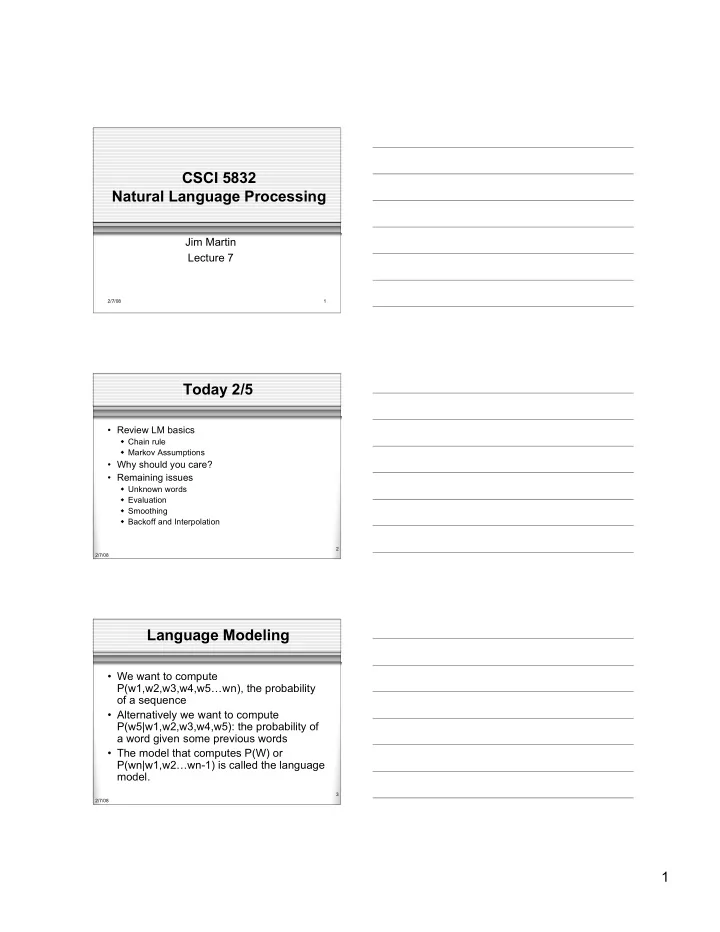
CSCI 5832 Natural Language Processing Jim Martin Lecture 7 2/7/08 - - PDF document

csci 5832 natural language processing
SMART_READER_LITE
LIVE PREVIEW

CSCI 5832 Natural Language Processing Jim Martin Lecture 7 2/7/08 - - PDF document

CSCI 5832 Natural Language Processing Jim Martin Lecture 7 2/7/08 1 Today 2/5 Review LM basics Chain rule Markov Assumptions Why should you care? Remaining issues Unknown words Evaluation Smoothing


slide-1
SLIDE 1

1

2/7/08 1

CSCI 5832 Natural Language Processing

Jim Martin Lecture 7

2/7/08 2

Today 2/5

  • Review LM basics

 Chain rule  Markov Assumptions

  • Why should you care?
  • Remaining issues

 Unknown words  Evaluation  Smoothing  Backoff and Interpolation

2/7/08 3

Language Modeling

  • We want to compute

P(w1,w2,w3,w4,w5…wn), the probability

  • f a sequence
  • Alternatively we want to compute

P(w5|w1,w2,w3,w4,w5): the probability of a word given some previous words

  • The model that computes P(W) or

P(wn|w1,w2…wn-1) is called the language model.

slide-2
SLIDE 2

2

2/7/08 4

Computing P(W)

  • How to compute this joint probability:

 P(“the”,”other”,”day”,”I”,”was”,”walking”,”along” ,”and”,”saw”,”a”,”lizard”)

  • Intuition: let’s rely on the Chain Rule of

Probability

2/7/08 5

The Chain Rule

  • Recall the definition of conditional probabilities
  • Rewriting:
  • More generally
  • P(A,B,C,D) = P(A)P(B|A)P(C|A,B)P(D|A,B,C)
  • In general
  • P(x1,x2,x3,…xn) =

P(x1)P(x2|x1)P(x3|x1,x2)…P(xn|x1…xn-1)

2/7/08 6

The Chain Rule

  • P(“the big red dog was”)=
  • P(the)*P(big|the)*P(red|the big)*P(dog|the big

red)*P(was|the big red dog)

slide-3
SLIDE 3

3

2/7/08 7

Very Easy Estimate

  • How to estimate?

 P(the | its water is so transparent that)

P(the | its water is so transparent that) = Count(its water is so transparent that the) _______________________________ Count(its water is so transparent that)

2/7/08 8

Very Easy Estimate

  • According to Google those counts are 5/9.

 Unfortunately... 2 of those are to these slides... So its really  3/7

2/7/08 9

Unfortunately

  • There are a lot of possible sentences
  • In general, we’ll never be able to get

enough data to compute the statistics for those long prefixes

  • P(lizard|the,other,day,I,was,walking,along,a

nd, saw,a)

slide-4
SLIDE 4

4

2/7/08 10

Markov Assumption

  • Make the simplifying assumption

 P(lizard|the,other,day,I,was,walking,along,and ,saw,a) = P(lizard|a)

  • Or maybe

 P(lizard|the,other,day,I,was,walking,along,and ,saw,a) = P(lizard|saw,a)

  • Or maybe... You get the idea.

2/7/08 11

So for each component in the product replace with the approximation (assuming a prefix of N) Bigram version

Markov Assumption

2/7/08 12

Estimating bigram probabilities

  • The Maximum Likelihood Estimate
slide-5
SLIDE 5

5

2/7/08 13

An example

  • <s> I am Sam </s>
  • <s> Sam I am </s>
  • <s> I do not like green eggs and ham </s>

2/7/08 14

Maximum Likelihood Estimates

  • The maximum likelihood estimate of some parameter of

a model M from a training set T

 Is the estimate that maximizes the likelihood of the training set T given the model M

  • Suppose the word Chinese occurs 400 times in a corpus
  • f a million words (Brown corpus)
  • What is the probability that a random word from some
  • ther text from the same distribution will be “Chinese”
  • MLE estimate is 400/1000000 = .004

 This may be a bad estimate for some other corpus

  • But it is the estimate that makes it most likely that

“Chinese” will occur 400 times in a million word corpus.

2/7/08 15

Berkeley Restaurant Project Sentences

  • can you tell me about any good cantonese

restaurants close by

  • mid priced thai food is what i’m looking for
  • tell me about chez panisse
  • can you give me a listing of the kinds of food that

are available

  • i’m looking for a good place to eat breakfast
  • when is caffe venezia open during the day
slide-6
SLIDE 6

6

2/7/08 16

Raw Bigram Counts

  • Out of 9222 sentences: Count(col | row)

2/7/08 17

Raw Bigram Probabilities

  • Normalize by unigrams:
  • Result:

2/7/08 18

Bigram Estimates of Sentence Probabilities

  • P(<s> I want english food </s>) =

p(i|<s>) x p(want|I) x p(english|want) x p(food|english) x p(</s>|food) =.000031

slide-7
SLIDE 7

7

2/7/08 19

Kinds of knowledge?

  • P(english|want) = .0011
  • P(chinese|want) = .0065
  • P(to|want) = .66
  • P(eat | to) = .28
  • P(food | to) = 0
  • P(want | spend) = 0
  • P (i | <s>) = .25
  • World

knowledge

  • Syntax
  • Discourse

2/7/08 20

The Shannon Visualization Method

  • Generate random sentences:
  • Choose a random bigram <s>, w according to its probability
  • Now choose a random bigram (w, x) according to its probability
  • And so on until we choose </s>
  • Then string the words together
  • <s> I

I want want to to eat eat Chinese Chinese food food </s>

2/7/08 21

Shakespeare

slide-8
SLIDE 8

8

2/7/08 22

Shakespeare as corpus

  • N=884,647 tokens, V=29,066
  • Shakespeare produced 300,000 bigram types
  • ut of V2= 844 million possible bigrams: so,

99.96% of the possible bigrams were never seen (have zero entries in the table)

  • Quadrigrams worse: What's coming out looks

like Shakespeare because it is Shakespeare

2/7/08 23

The Wall Street Journal is Not Shakespeare

2/7/08 24

Why?

  • Why would anyone want the probability of

a sequence of words?

  • Typically because of
slide-9
SLIDE 9

9

2/7/08 25

Unknown words: Open versus closed vocabulary tasks

  • If we know all the words in advanced

 Vocabulary V is fixed  Closed vocabulary task

  • Often we don’t know this

 Out Of Vocabulary = OOV words  Open vocabulary task

  • Instead: create an unknown word token <UNK>

 Training of <UNK> probabilities

  • Create a fixed lexicon L of size V
  • At text normalization phase, any training word not in L changed to <UNK>
  • Now we train its probabilities like a normal word

 At decoding time

  • If text input: Use UNK probabilities for any word not in training

2/7/08 26

Evaluation

  • We train parameters of our model on a training

set.

  • How do we evaluate how well our model works?
  • We look at the models performance on some new

data

  • This is what happens in the real world; we want to

know how our model performs on data we haven’t seen

  • So a test set. A dataset which is different than our

training set

2/7/08 27

Evaluating N-gram models

  • Best evaluation for an N-gram

Put model A in a speech recognizer Run recognition, get word error rate (WER) for A Put model B in speech recognition, get word error rate for B Compare WER for A and B Extrinsic evaluation

slide-10
SLIDE 10

10

2/7/08 28

Difficulty of extrinsic (in-vivo) evaluation of N-gram models

  • Extrinsic evaluation

 This is really time-consuming  Can take days to run an experiment

  • So

 As a temporary solution, in order to run experiments  To evaluate N-grams we often use an intrinsic evaluation, an approximation called perplexity  But perplexity is a poor approximation unless the test data looks just like the training data  So is generally only useful in pilot experiments (generally is not sufficient to publish)  But is helpful to think about.

2/7/08 29

Perplexity

  • Perplexity is the probability of the test

set (assigned by the language model), normalized by the number of words:

  • Chain rule:
  • For bigrams:
  • Minimizing perplexity is the same as maximizing

probability

 The best language model is one that best predicts an unseen test set

2/7/08 30

A Different Perplexity Intuition

  • How hard is the task of recognizing digits

‘0,1,2,3,4,5,6,7,8,9’: pretty easy

  • How hard is recognizing (30,000) names at Microsoft.

Hard: perplexity = 30,000

  • Perplexity is the weighted equivalent branching factor

provided by your model

Slide from Josh Goodman

slide-11
SLIDE 11

11

2/7/08 31

Lower perplexity = better model

  • Training 38 million words, test 1.5 million

words, WSJ

2/7/08 32

Lesson 1: the perils of

  • verfitting
  • N-grams only work well for word prediction

if the test corpus looks like the training corpus

 In real life, it often doesn’t  We need to train robust models, adapt to test set, etc

2/7/08 33

Lesson 2: zeros or not?

  • Zipf’s Law:

 A small number of events occur with high frequency  A large number of events occur with low frequency  You can quickly collect statistics on the high frequency events  You might have to wait an arbitrarily long time to get valid statistics on low frequency events

  • Result:

 Our estimates are sparse! no counts at all for the vast bulk of things we want to estimate!  Some of the zeroes in the table are really zeros But others are simply low frequency events you haven't seen yet. After all, ANYTHING CAN HAPPEN!  How to address?

  • Answer:

 Estimate the likelihood of unseen N-grams!

slide-12
SLIDE 12

12

2/7/08 34

Smoothing is like Robin Hood: Steal from the rich and give to the poor (in probability mass)

2/7/08 35

Laplace smoothing

  • Also called add-one smoothing
  • Just add one to all the counts!
  • Very simple
  • MLE estimate:
  • Laplace estimate:
  • Reconstructed counts:

2/7/08 36

Laplace smoothed bigram counts

slide-13
SLIDE 13

13

2/7/08 37

Laplace-smoothed bigrams

2/7/08 38

Reconstituted counts

2/7/08 39

Big Changes to Counts

  • C(count to) went from 608 to 238!
  • P(to|want) from .66 to .26!
  • Discount d= c*/c

 d for “chinese food” =.10!!! A 10x reduction  So in general, Laplace is a blunt instrument  Could use more fine-grained method (add-k)

  • Despite its flaws Laplace (add-k) is however still used to

smooth other probabilistic models in NLP, especially

 For pilot studies  in domains where the number of zeros isn’t so huge.

slide-14
SLIDE 14

14

2/7/08 40

Better Discounting Methods

  • Intuition used by many smoothing

algorithms

 Good-Turing  Kneser-Ney  Witten-Bell

  • Is to use the count of things we’ve seen
  • nce to help estimate the count of things

we’ve never seen

2/7/08 41

Good-Turing

  • Imagine you are fishing

 There are 8 species: carp, perch, whitefish, trout, salmon, eel, catfish, bass

  • You have caught

 10 carp, 3 perch, 2 whitefish, 1 trout, 1 salmon, 1 eel = 18 fish (tokens) = 6 species (types)

  • How likely is it that you’ll next see another trout?

2/7/08 42

Good-Turing

  • Now how likely is it that next species is

new (i.e. catfish or bass)

3/18

There were 18 distinct events... 3 of those represent singleton species

slide-15
SLIDE 15

15

2/7/08 43

Good-Turing

  • But that 3/18s isn’t represented in our

probability mass. Certainly not the one we used for estimating another trout.

2/7/08 44

Good-Turing Intuition

  • Notation: Nx is the frequency-of-frequency-x

 So N10=1, N1=3, etc

  • To estimate total number of unseen species

 Use number of species (words) we’ve seen once  c0* =c1 p0 = N1/N

  • All other estimates are adjusted (down) to give

probabilities for unseen

Slide from Josh Goodman

2/7/08 45

Good-Turing Intuition

  • Notation: Nx is the frequency-of-frequency-x

 So N10=1, N1=3, etc

  • To estimate total number of unseen species

 Use number of species (words) we’ve seen once  c0

* =c1 p0 = N1/N

p0=N1/N=3/18

  • All other estimates are adjusted (down) to give

probabilities for unseen

P(eel) = c*(1) = (1+1) 1/ 3 = 2/3 Slide from Josh Goodman

slide-16
SLIDE 16

16

2/7/08 46

Bigram frequencies of frequencies and GT re-estimates

2/7/08 47

Backoff and Interpolation

  • Another really useful source of knowledge
  • If we are estimating:

 trigram p(z|xy)  but c(xyz) is zero

  • Use info from:

 Bigram p(z|y)

  • Or even:

 Unigram p(z)

  • How to combine the trigram/bigram/unigram

info?

2/7/08 48

Backoff versus interpolation

  • Backoff: use trigram if you have it,
  • therwise bigram, otherwise unigram
  • Interpolation: mix all three
slide-17
SLIDE 17

17

2/7/08 49

Interpolation

  • Simple interpolation
  • Lambdas conditional on context:

2/7/08 50

How to set the lambdas?

  • Use a held-out corpus
  • Choose lambdas which maximize the

probability of some held-out data

 I.e. fix the N-gram probabilities  Then search for lambda values  That when plugged into previous equation  Give largest probability for held-out set  Can use EM to do this search

2/7/08 51

GT smoothed bigram probs

slide-18
SLIDE 18

18

2/7/08 52

OOV words: <UNK> word

  • Out Of Vocabulary = OOV words
  • We don’t use GT smoothing for these

 Because GT assumes we know the number of unseen events

  • Instead: create an unknown word token <UNK>

 Training of <UNK> probabilities

  • Create a fixed lexicon L of size V
  • At text normalization phase, any training word not in L changed to

<UNK>

  • Now we train its probabilities like a normal word

 At decoding time

  • If text input: Use UNK probabilities for any word not in training

2/7/08 53

Practical Issues

  • We do everything in log space

 Avoid underflow  (also adding is faster than multiplying)

2/7/08 54

Language Modeling Toolkits

  • SRILM
  • CMU-Cambridge LM Toolkit
slide-19
SLIDE 19

19

2/7/08 55

Google N-Gram Release

2/7/08 56

Google N-Gram Release

  • serve as the incoming 92
  • serve as the incubator 99
  • serve as the independent 794
  • serve as the index 223
  • serve as the indication 72
  • serve as the indicator 120
  • serve as the indicators 45
  • serve as the indispensable 111
  • serve as the indispensible 40
  • serve as the individual 234

2/7/08 57

Summary

  • Probability

 Basic probability  Conditional probability  Bayes Rule

  • Language Modeling (N-grams)

 N-gram Intro  The Chain Rule

  • Perplexity

 Smoothing:

  • Add-1
  • Good-Turing
slide-20
SLIDE 20

20

2/7/08 58

Next Time

  • On to Chapter 5