CSE 105Theory of Computability Fall, 2006 Lecture 16November 14 - - PDF document

cse 105 theory of computability
SMART_READER_LITE
LIVE PREVIEW

CSE 105Theory of Computability Fall, 2006 Lecture 16November 14 - - PDF document

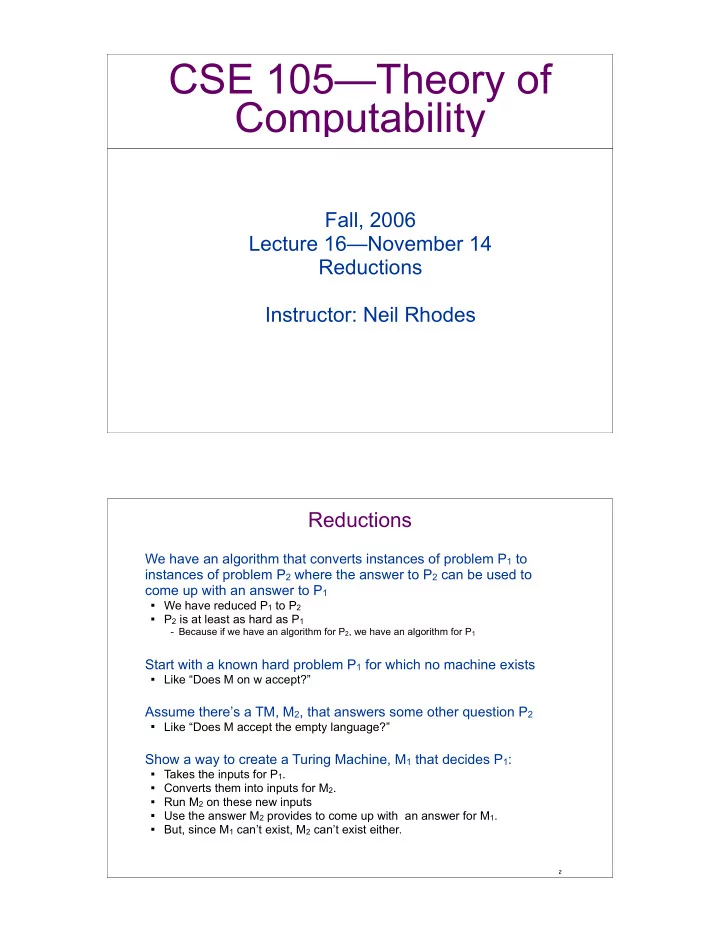
CSE 105Theory of Computability Fall, 2006 Lecture 16November 14 Reductions Instructor: Neil Rhodes Reductions We have an algorithm that converts instances of problem P 1 to instances of problem P 2 where the answer to P 2 can be used to


slide-1
SLIDE 1

CSE 105—Theory of Computability

Fall, 2006 Lecture 16—November 14 Reductions Instructor: Neil Rhodes Reductions

We have an algorithm that converts instances of problem P1 to instances of problem P2 where the answer to P2 can be used to come up with an answer to P1

We have reduced P1 to P2 P2 is at least as hard as P1

– Because if we have an algorithm for P2, we have an algorithm for P1

Start with a known hard problem P1 for which no machine exists

Like “Does M on w accept?”

Assume there’s a TM, M2, that answers some other question P2

Like “Does M accept the empty language?”

Show a way to create a Turing Machine, M1 that decides P1:

Takes the inputs for P1. Converts them into inputs for M2. Run M2 on these new inputs Use the answer M2 provides to come up with an answer for M1. But, since M1 can’t exist, M2 can’t exist either.

2

slide-2
SLIDE 2

Reduction redux

We reduce one language to another language

Not one machine to another machine

When we reduce A to B:

We know we can’t decide A We’re showing we can’t decide B

When we reduce A to B

Assume we have a decider for B, M Create a machine M’ that takes input for A M’ gets to call the decider for B M’ must decide A Since A is undecidable, no decider for B can exist

3

Reducing ATM to halting problem

Halting problem:

Given M on w, does M halt (accept or reject)? HALTTM = {(M, w)| M is a TM and M halts on input w}

Assume there exists machine MHalt that decides the halting problem Create M’ = “On input <M, w>, an encoding of TM M and string w:

Call MHalt on <M,w>

– If rejects, reject – If accepts, simulate M on w and when it halts, accept or reject appropriately”

M’ decides ATM={<M, w>| M is a TM and M accepts input w}

But this is undecidable! So, MHalt doesn’t exist Therefore, Halting problem is undecidable

4

slide-3
SLIDE 3

EMPTYTM={<M> | M is a TM and M accepts the empty language}

Is EMPTYTM decidable? Is EMPTYTMC recursively enumerable?

5

REGULARTM={<M> | M is a TM and M accepts a regular language}

Is REGULARTM decidable?

6

slide-4
SLIDE 4

CFTM={<M> | M is a TM and M accepts a context-free language}

Is CFTM decidable?

7

EQTM={<M1, M2> | M1,M2 are TM and M1, M2 accept the same language}

Is EQTM decidable?

8

slide-5
SLIDE 5

Linear Bounded Automaton

Turing machines that can’t read/write outside the input

ALBA = {<M, w>| M is an LBA such that M(w) accepts} ALBA is decidable

9

Linear-Bounded Automaton

ELBA is undecidable

If decidable, here’s algorithm for ATM

10

slide-6
SLIDE 6

Does a CFG G generate all strings?

ALLCFG={G|G is a CFG and L(G)=*}

Given M and w, construct G such that

– G accepts all strings except accepting computation history for M on w

11