SLIDE 1 CSE 311: Foundations of Computing
Fall 2013
Lecture 24: NFAs, regular expressions, and NFA→DFA
highlights
- FSMs with output at states
- State minimization
2 1 3 1 3 2 2 1 3 2 3 3 2 1 2 3 1 S0 [1] S2 [1] S4 [1] S1 [0] S3 [0] S5 [0] 1 2 1 3 1 3 2
2
3 1,2 S0 [1] S2 [1] S1 [0] S3 [0] 1,3
highlights
s0 s2
s3
s1
1 1 1 0,1
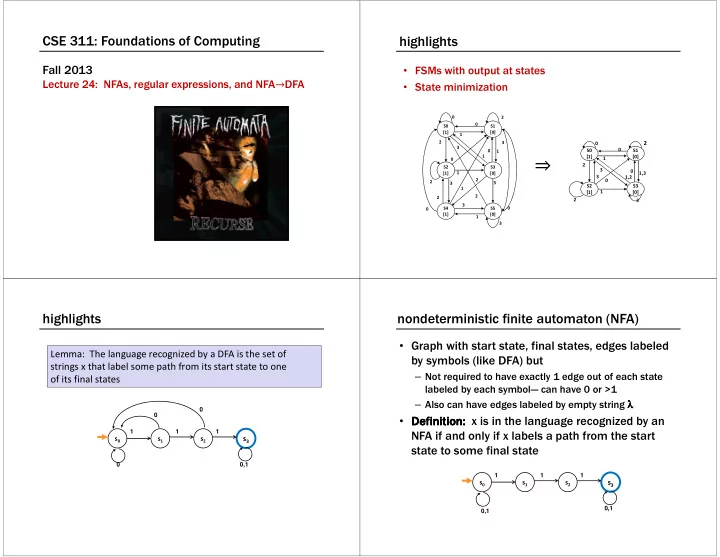
Lemma: The language recognized by a DFA is the set of strings x that label some path from its start state to one
nondeterministic finite automaton (NFA)
- Graph with start state, final states, edges labeled
by symbols (like DFA) but
– Not required to have exactly 1 edge out of each state labeled by each symbol--- can have 0 or >1 – Also can have edges labeled by empty string λ λ λ λ
Definition: Definition: Definition: x is in the language recognized by an NFA if and only if x labels a path from the start state to some final state
s0 s2
s3
s1
1 1 1 0,1 0,1
SLIDE 2 three ways of thinking about NFAs
- Outside observer: Is there a path labeled by x from
the start state to some final state?
- Perfect guesser: The NFA has input x and whenever
there is a choice of what to do it magically guesses a good one (if one exists)
- Parallel exploration: The NFA computation runs all
possible computations on x step-by-step at the same time in parallel
Theorem: Theorem: Theorem: Theorem: For any set of strings (language) described by a regular expression, there is an NFA that recognizes . Proof idea: Structural induction based on the recursive definition of regular expressions...
Note: One can also find a regular expression to describe the language recognized by any NFA but we won’t prove that fact
NFAs and regular expressions regular expressions over Σ
– ∅ ∅ ∅ ∅, λ λ λ λ are regular expressions – a a a a is a regular expression for any a ∈ Σ
– If A A A A and B B B B are regular expressions then so are: (A ∪ B) (AB) A*
basis
∅ ∅ ∅:
λ λ λ:
a a a:
SLIDE 3 basis
∅ ∅ ∅:
λ λ λ:
a a a:
a
inductive hypothesis
- Suppose that for some regular expressions
and there exist NFAs
and such
that
recognizes the language given by
and recognizes the language given by
Case (A ∪ B):
Case (A ∪ B):
λ λ λ λ λ λ λ
SLIDE 4 inductive step Case (AB):
Case (AB):
λ λ λ λ λ λ λ λ
Case A*
Case A*
NA
λ λ λ λ λ λ λ λ λ λ λ λ
SLIDE 5
build an NFA for (01 ∪1)*0 solution
(01 ∪ ∪ ∪ ∪1)*0
λ λ λ λ λ λ λ λ λ λ λ λ λ λ λ λ 1 1 λ λ λ λ λ λ λ λ λ λ λ λ λ λ λ λ λ λ λ λ
NFAs and DFAs
Every DFA is is is is an NFA – DFAs have requirements that NFAs don’t have Can NFAs recognize more languages?
NFAs and DFAs
Every DFA is is is is an NFA – DFAs have requirements that NFAs don’t have Can NFAs recognize more languages? No!
Theorem: Theorem: Theorem: Theorem: For every NFA there is a DFA that recognizes exactly the same language
SLIDE 6 conversion of NFAs to a DFAs
– The DFA keeps track of ALL the states that the part of the input string read so far can reach in the NFA – There will be one state in the DFA for each subset of states of the NFA that can be reached by some string
conversion of NFAs to a DFAs New start state for DFA
– The set of all states reachable from the start state of the NFA using only edges labeled λ λ λ λ
a,b,e,f f e b a
λ λ λ λ λ λ λ λ λ λ λ λ NFA DFA
conversion of NFAs to a DFAs
For each state of the DFA corresponding to a set S of states of the NFA and each symbol s s s s
– Add an edge labeled s s s s to state corresponding to T, the set of states of the NFA reached by
starting from some state in S, then following one edge labeled by s, and then following some number of edges labeled by λ
– T will be ∅ ∅ ∅ ∅ if no edges from S labeled s s s s exist
f e b
λ λ λ λ λ λ λ λ
c d g
λ λ λ λ 1 1 1 1
b,e,f c,d,e,g
1
conversion of NFAs to a DFAs Final states for the DFA
– All states whose set contain some final state of the NFA
a,b,c,e c e b a
NFA DFA
SLIDE 7
example: NFA to DFA
c a
b
λ λ λ λ 0,1 1 NFA DFA
example: NFA to DFA
c a
b
λ λ λ λ 0,1 1 NFA
a,b
DFA
example: NFA to DFA
c a
b
λ λ λ λ 0,1 1 NFA
a,b
DFA
c
1
example: NFA to DFA
c a
b
λ λ λ λ 0,1 1 NFA
a,b
DFA
c
1
b b,c
1
SLIDE 8
example: NFA to DFA
c a
b
λ λ λ λ 0,1 1 NFA
a,b
DFA
c
1
b b,c
1
∅ ∅ ∅ ∅
1
example: NFA to DFA
c a
b
λ λ λ λ 0,1 1 NFA
a,b
DFA
c
1
b b,c
1
∅ ∅ ∅ ∅
1 0,1
example: NFA to DFA
c a
b
λ λ λ λ 0,1 1 NFA
a,b
DFA
c
1
b b,c
1
a,b,c ∅ ∅ ∅ ∅
1 0,1 1
example: NFA to DFA
c a
b
λ λ λ λ 0,1 1 NFA
a,b
DFA
c
1
b b,c
1
a,b,c ∅ ∅ ∅ ∅
1 0,1 1 1
SLIDE 9 exponential blow-up in simulating nondeterminism
- In general the DFA might need a state for every
subset of states of the NFA
– Power set of the set of states of the NFA – n-state NFA yields DFA with at most 2n states – We saw an example where roughly 2n is necessary
Is the nth char from the end a 1?
- The famous “P=NP?” question asks whether a
similar blow-up is always necessary to get rid
- f nondeterminism for polynomial-time
algorithms