CSE 401: Introduction to Compiler Construction Course Outline - - PDF document

cse 401 introduction to compiler construction course
SMART_READER_LITE
LIVE PREVIEW

CSE 401: Introduction to Compiler Construction Course Outline - - PDF document

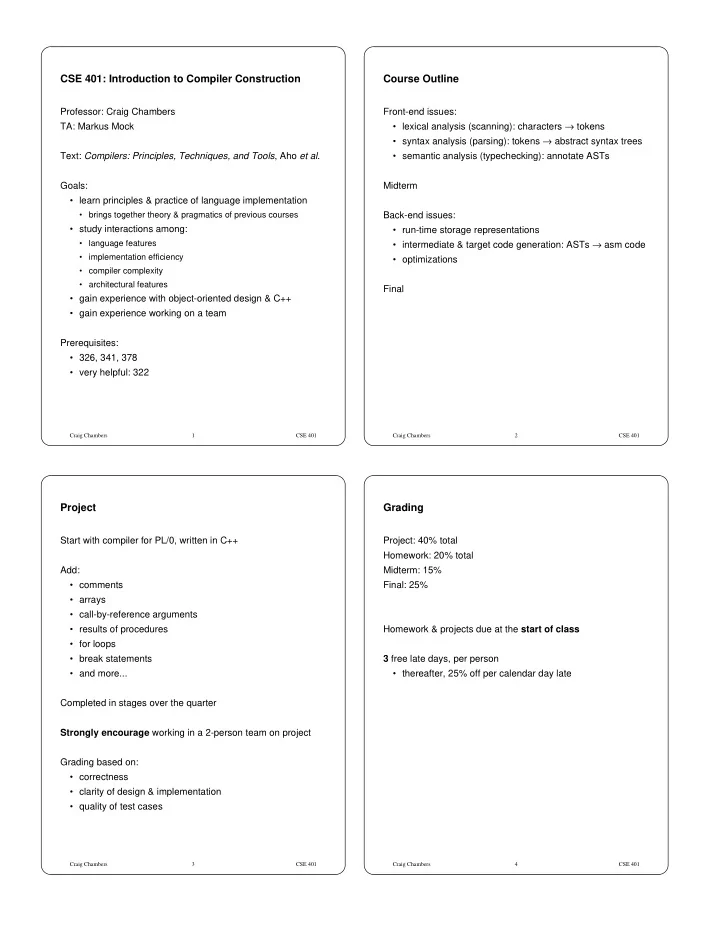
CSE 401: Introduction to Compiler Construction Course Outline Professor: Craig Chambers Front-end issues: lexical analysis (scanning): characters tokens TA: Markus Mock syntax analysis (parsing): tokens abstract syntax trees


slide-1
SLIDE 1

Craig Chambers 1 CSE 401

CSE 401: Introduction to Compiler Construction

Professor: Craig Chambers TA: Markus Mock Text: Compilers: Principles, Techniques, and Tools, Aho et al. Goals:

  • learn principles & practice of language implementation
  • brings together theory & pragmatics of previous courses
  • study interactions among:
  • language features
  • implementation efficiency
  • compiler complexity
  • architectural features
  • gain experience with object-oriented design & C++
  • gain experience working on a team

Prerequisites:

  • 326, 341, 378
  • very helpful: 322

Craig Chambers 2 CSE 401

Course Outline

Front-end issues:

  • lexical analysis (scanning): characters → tokens
  • syntax analysis (parsing): tokens → abstract syntax trees
  • semantic analysis (typechecking): annotate ASTs

Midterm Back-end issues:

  • run-time storage representations
  • intermediate & target code generation: ASTs → asm code
  • optimizations

Final

Craig Chambers 3 CSE 401

Project

Start with compiler for PL/0, written in C++ Add:

  • comments
  • arrays
  • call-by-reference arguments
  • results of procedures
  • for loops
  • break statements
  • and more...

Completed in stages over the quarter Strongly encourage working in a 2-person team on project Grading based on:

  • correctness
  • clarity of design & implementation
  • quality of test cases

Craig Chambers 4 CSE 401

Grading

Project: 40% total Homework: 20% total Midterm: 15% Final: 25% Homework & projects due at the start of class 3 free late days, per person

  • thereafter, 25% off per calendar day late
slide-2
SLIDE 2

Craig Chambers 5 CSE 401

An example compilation

Sample PL/0 program: squares.0 module main; var x:int, result:int; procedure square(n:int); begin result := n * n; end square; begin x := input; while x <> 0 do square(x);

  • utput := result;

x := input; end; end main.

Craig Chambers 6 CSE 401

First step: lexical analysis

“Scanning”, “tokenizing” Read in characters, clump into tokens

  • strip out whitespace in the process

Craig Chambers 7 CSE 401

Specifying tokens: regular expressions

Example: Ident ::= Letter AlphaNum* Integer ::= Digit+ AlphaNum ::= Letter | Digit Letter ::= 'a' | ... | 'z' | 'A' | ... | 'Z' Digit ::= '0' | ... | '9'

Craig Chambers 8 CSE 401

Second step: syntax analysis

“Parsing” Read in tokens, turn into a tree based on syntactic structure

slide-3
SLIDE 3

Craig Chambers 9 CSE 401

Specifying syntax: context-free grammars

EBNF is a popular notation for CFG’s Example: Stmt ::= AsgnStmt | IfStmt | ... AsgnStmt ::= LValue := Expr ; LValue ::= Id IfStmt ::= if Test then Stmt [else Stmt] ; Test ::= Expr = Expr | Expr < Expr | ... Expr ::= Term + Term | Term - Term | Term Term ::= Factor * Factor | ... | Factor Factor ::= - Factor | Id | Int | ( Expr ) EBNF specifies concrete syntax of language Parser usually constructs tree representing abstract syntax of language

Craig Chambers 10 CSE 401

Third step: semantic analysis

“Name resolution and typechecking” Given AST:

  • figure out what declaration each name refers to
  • perform static consistency checks

Key data structure: symbol table

  • maps names to info about name derived from declaration

Semantic analysis steps:

  • 1. Process each scope, top down
  • 2. Process declarations in each scope into symbol table for

scope

  • 3. Process body of each scope in context of symbol table

Craig Chambers 11 CSE 401

Fourth step: storage layout

Given symbol tables, determine how & where variables will be stored at run-time What representation for each kind of data? How much space does each variable require? In what kind of memory should it be placed?

  • static, global memory
  • stack memory
  • heap memory

Where in that kind of memory should it be placed?

  • e.g. what stack offset

Craig Chambers 12 CSE 401

Fifth step: intermediate & target code generation

Given annotated AST & symbol tables, produce target code Often done as three steps:

  • produce machine-independent low-level representation of

program (intermediate representation)

  • perform machine-independent optimizations of IR (optional)
  • translate IR into machine-specific target instructions
  • instruction selection
  • register allocation
slide-4
SLIDE 4

Craig Chambers 13 CSE 401

The bigger picture

Compilers are translators Characterized by

  • input language
  • target language
  • degree of “understanding”

Craig Chambers 14 CSE 401

Compilers vs. interpreters

Compilers implement languages by translation Interpreters implement languages directly Embody different trade-offs among:

  • execution speed of program
  • start-up overhead, turn-around time
  • ease of implementation
  • programming environment facilities
  • conceptual difficulty

Craig Chambers 15 CSE 401

Engineering issues

Portability

  • ideal: multiple front-ends & back-ends

sharing intermediate language Sequencing phases of compilation

  • stream-based
  • syntax-directed

Multiple passes?

Craig Chambers 16 CSE 401

Lexical Analysis / Scanning

Purpose: turn character stream (input program) into token stream

  • parser turns token stream into syntax tree

Token: group of characters forming basic, atomic chunk of syntax Whitespace: characters between tokens that are ignored

slide-5
SLIDE 5

Craig Chambers 17 CSE 401

Separate lexical and syntax analysis

Separation of concerns / good design

  • scanner:
  • handle grouping chars into tokens
  • ignoring whitespace
  • handling I/O, machine dependencies
  • parser:
  • handle grouping tokens into syntax trees

Restricted nature of scanning allows faster implementation

  • scanning is time-consuming in many compilers

Craig Chambers 18 CSE 401

Language design issues

Most languages today are “free-form”

  • layout doesn’t matter
  • use whitespace to separate tokens, if needed

Alternatives:

  • Fortran, Algol 68: whitespace ignored
  • Haskell: use layout to imply grouping

Most languages today have “reserved words”

  • can’t be used as identifiers

Alternative: PL/I: have “keywords”

  • keywords treated specially only in certain contexts,
  • therwise just idents

Most languages separate scanning and parsing Alternative: C++: type vs. ident

  • parser wants scanner to distinguish types from vars
  • scanner doesn’t know how things declared

Craig Chambers 19 CSE 401

Lexemes, tokens, and patterns

Lexeme: group of characters that form a token Token: class of lexemes that match a pattern Pattern: description of string of characters Token may have attributes, if more than one lexeme in token Needs of parser determine how lexemes grouped into tokens

Craig Chambers 20 CSE 401

Regular expressions

Notation for specifying patterns of lexemes in a token Regular expressions:

  • powerful enough to do this
  • simple enough to be implemented efficiently
  • equivalent to finite state machines
slide-6
SLIDE 6

Craig Chambers 21 CSE 401

Syntax of regular expressions

Defined inductively

  • base cases:

the empty string (ε) a symbol from the alphabet (x)

  • inductive cases:

sequence of two RE’s: E1E2 either of two RE’s: E1|E2 Kleene closure (zero or more occurrences) of a RE: E* Notes:

  • can use parens for grouping
  • precedence: * highest, sequence, | lowest
  • whitespace insignificant

Craig Chambers 22 CSE 401

Notational conveniences

E+ means 1 or more occurrences of E Ek means k occurrences of E [E] means 0 or 1 occurrence of E (optional E) {E} means E* not(x) means any character in the alphabet but x not(E) means any string of characters in the alphabet but those matching E E1-E2 means any string matching E1 except those matching E2

Craig Chambers 23 CSE 401

Naming regular expressions

Can assign names to regular expressions Can use the name of a RE in the definition of another RE Examples: letter ::= a | b | ... | z digit ::= 0 | 1 | ... | 9 alphanum ::= letter | digit EBNF-like notation for RE’s Can reduce named RE’s to plain RE by “macro expansion”

  • no recursive definitions allowed

Craig Chambers 24 CSE 401

Using regular expressions to specify tokens

Identifiers ident ::= letter (letter | digit)* Integer constants integer ::= digit+ sign ::= + | - signed_int ::= [sign] integer Real number constants real ::= signed_int [fraction] [exponent] fraction ::= . digit+ exponent ::= (E|e) signed_int

slide-7
SLIDE 7

Craig Chambers 25 CSE 401

String and character constants string ::= " char* " character ::= ' char ' char ::= not("|'|\) | escape escape ::= \("|'|\|n|r|t|v|b|a) Whitespace whitespace ::= <space> | <tab> | <newline> | comment comment ::= /* not(*/) */

Craig Chambers 26 CSE 401

Regular expressions for PL/0 lexical structure

Program ::= (Token | White)* Token ::= Id | Integer | Keyword | Operator | Punct Punct ::= ; | : | . | , | ( | ) Keyword ::= module | procedure | begin | end | const | var | if | then | while | do | input | output | odd | int Operator ::= := | * | / | + | - | = | <> | <= | < | >= | > Integer ::= Digit+ Id ::= Letter AlphaNum* AlphaNum ::= Letter | Digit Digit ::= 0 | ... | 9 Letter ::= a | ... | z | A | ... | Z White ::= <space> | <tab> | <newline>

Craig Chambers 27 CSE 401

Building scanners from RE patterns

Convert RE specification into deterministic finite state machine

  • by eye
  • mechanically by way of

nondeterministic finite state machine Convert DFA into scanner implementation

  • by hand into collection of procedures
  • mechanically into table-driven scanner

Craig Chambers 28 CSE 401

Finite State Machines/Automata

An FSA has:

  • a set of states
  • one marked the initial state
  • some marked final states
  • a set of transitions from state to state
  • each transition labelled with a symbol from the alphabet or ε

Operate by reading symbols and taking transitions, beginning with the start state

  • if no transition with a matching label is found, reject

When done with input, accept if in final state, reject otherwise

/ / * * not(*) * not(*,/)

slide-8
SLIDE 8

Craig Chambers 29 CSE 401

Determinism

FSA can be deterministic or nondeterministic Deterministic: always know which way to go

  • at most 1 arc leaving a state with particular symbol
  • no ε arcs

Nondeterministic: may need to explore multiple paths Example: RE’s map to NFA’s easily Can write code from DFA easily

1 1 1

Craig Chambers 30 CSE 401

Converting DFAs to code

Option 1: implement scanner using procedures

  • one procedure for each token
  • each procedure reads characters
  • choices implemented using case statements

Pros

  • straightforward to write by hand
  • fast

Cons (if written by hand)

  • more work than using a tool
  • may have subtle differences from spec

Craig Chambers 31 CSE 401

Option 2: implement table-driven scanner

  • rows: states of DFA
  • columns: input characters
  • entries: action
  • go to new state
  • accept token, go to start state
  • error

Pros

  • convenient for automatic generation (e.g. lex)

Cons

  • table lookups slower than direct code
  • awkward to build by hand

Craig Chambers 32 CSE 401

Automatic construction of scanners

Approach: 1) Convert RE into NFA 2) Convert NFA into DFA 3) Convert DFA into table-driven code

slide-9
SLIDE 9

Craig Chambers 33 CSE 401

RE ⇒ NFA

Define by cases ε x E1 E2 E1 | E2 E *

Craig Chambers 34 CSE 401

NFA ⇒ DFA

Problem: NFA can “choose” among alternative paths, while DFA must have only one path Solution: subset construction of DFA

  • each state in DFA represents set of states in NFA, all that

the NFA might be in during its traversal

Craig Chambers 35 CSE 401

Subset construction algorithm

Given NFA with states and transitions

  • label all NFA states uniquely

Create start state of DFA

  • label it with the set of NFA states that can be reached by

ε transitions (i.e. without consuming any input) Process the start state To process a DFA state S with label {s1,..,sN}: For each symbol s in the alphabet:

  • compute the set T of NFA states reached from any of the

NFA states s1,..,sN by a s transition followed by any number of ε transitions

  • if T not empty:
  • if a DFA state has T as a label, add a transition labeled s from S

to T

  • otherwise create a new DFA state labeled T, add a transition

labeled s from S to T, and process T

A DFA state is final iff at least one of the NFA states in its label is final

Craig Chambers 36 CSE 401

Syntax Analysis/Parsing

Purpose: stream of tokens ⇒ abstract syntax tree (AST) AST:

  • captures hierarchical structure of input program
  • primary representation of program, for rest of compiler
slide-10
SLIDE 10

Craig Chambers 37 CSE 401

Context-free grammars (CFG’s)

Syntax specified using CFG’s

  • RE’s not powerful enough
  • context-sensitive grammars (CSG’s), general grammars

(GG’s) too powerful CFG’s: convenient compromise

  • capture important structural characteristics
  • some properties checked later during semantic analysis

Notation for CFG’s: Extended Backus Normal (Naur) Form (EBNF)

Craig Chambers 38 CSE 401

EBNF description of PL/0 syntax

Program ::= module Id ; Block Id . Block ::= DeclList begin StmtList end DeclList ::= { Decl ; } Decl ::= ConstDecl | ProcDecl | VarDecl ConstDecl ::= const ConstDeclItem { , ConstDeclItem } ConstDeclItem::=Id : Type = ConstExpr ConstExpr ::= Id | Integer VarDecl ::= var VarDeclItem { , VarDeclItem } VarDeclItem::= Id : Type ProcDecl ::= procedure Id ( [ FormalDecl {, FormalDecl } ] ) ; Block Id FormalDecl ::= Id : Type Type ::= int StmtList ::= { Stmt ; } Stmt ::= CallStmt | AssignStmt | OutStmt | IfStmt | WhileStmt CallStmt ::= Id ( [ Exprs ] ) AssignStmt ::= LValue := Expr LValue ::= Id OutStmt ::=

  • utput := Expr

IfStmt ::= if Test then StmtList end WhileStmt ::= while Test do StmtList end Test ::=

  • dd Sum | Sum Relop Sum

Relop ::= <= | <> | < | >= | > | = Exprs ::= Expr { , Expr } Expr ::= Sum Sum ::= Term { (+ | -) Term } Term ::= Factor { (* | /) Factor } Factor ::=

  • Factor | LValue | Integer | input | ( Expr )

Craig Chambers 39 CSE 401

Transition Diagrams

“Railroad diagrams”

  • another more graphical notation for CFG’s
  • look like FSA’s, where arcs can be labelled with

nonterminals as well as terminals

Craig Chambers 40 CSE 401

Derivations and Parse Trees

Derivation: sequence of expansion steps, beginning with start symbol, leading to a string of terminals Parsing: inverse of derivation

  • given target string of terminals (a.k.a. tokens),

want to recover nonterminals representing structure Can represent derivation as a parse tree

  • concrete syntax tree
  • abstract syntax tree (AST)
slide-11
SLIDE 11

Craig Chambers 41 CSE 401

Example grammar

E ::= E Op E | - E | ( E ) | id Op ::= + | - | * | /

Craig Chambers 42 CSE 401

Ambiguity

Some grammars are ambiguous:

  • multiple different parse trees with same final string

Structure of parse tree captures much of meaning of program; ambiguity ⇒ multiple possible meanings for same program

Craig Chambers 43 CSE 401

Designing a grammar

Concerns:

  • accuracy
  • readability, clarity
  • unambiguity
  • limitations of CFG’s
  • ability to be parsed by particular parsing algorithm
  • top-down parser ⇒ LL(k) grammar
  • bottom-up parser ⇒ LR(k) grammar

Craig Chambers 44 CSE 401

Famous ambiguities: “dangling else”

Stmt ::= ... | if Expr then Stmt | if Expr then Stmt else Stmt “if e1 then if e2 then s1 else s2”

slide-12
SLIDE 12

Craig Chambers 45 CSE 401

Resolving the ambiguity

Option 1: add a meta-rule e.g. “else associates with closest previous if”

  • works, keeps original grammar intact
  • ad hoc and informal

Craig Chambers 46 CSE 401

Option 2: rewrite the grammar to resolve ambiguity explicitly Stmt ::= MatchedStmt | UnmatchedStmt MatchedStmt ::= ... | if Expr then MatchedStmt else MatchedStmt UnmatchedStmt ::= if Expr then Stmt | if Expr then MatchedStmt else UnmatchedStmt

  • formal, no additional rules beyond syntax
  • sometimes obscures original grammar

Craig Chambers 47 CSE 401

Option 3: redesign the language to remove the ambiguity Stmt ::= ... | if Expr then Stmt end | if Expr then Stmt else Stmt end

  • formal, clear, elegant
  • allows StmtList in then and else branch,

no begin/end needed

  • extra end required for every if

Craig Chambers 48 CSE 401

Another famous ambiguity: expressions

E ::= E Op E | - E | ( E ) | id Op ::= + | - | * | / “a + b * c”

slide-13
SLIDE 13

Craig Chambers 49 CSE 401

Resolving the ambiguity

Option 1: add some meta-rules, e.g. precedence and associativity rules Example: E ::= E Op E | - E | E ! | ( E ) | id Op ::= + | - | * | / | ^ | = | < | and | or

  • perator

precedence associativity postfix ! highest left prefix - right ^ right *, / left +, - left =, < none and left

  • r

lowest left

Craig Chambers 50 CSE 401

Option 2: modify the grammar to explicitly resolve the ambiguity Strategy:

  • create a nonterminal for each precedence level
  • expr is lowest precedence nonterminal,

each nonterminal can be rewritten with higher precedence operator, highest precedence operator includes atomic exprs

  • at each precedence level, use:
  • left recursion for left-associative operators
  • right recursion for right-associative operators
  • no recursion for non-associative operators

Craig Chambers 51 CSE 401

AST’s

Abstract syntax trees represent only important aspects of concrete syntax trees

  • no need for “signposts” like ( ), ;, do, end
  • rest of compiler only cares about abstract structure
  • can regenerate concrete syntax tree from AST when

needed

Craig Chambers 52 CSE 401

AST extensions in project

Expressions:

  • true and false constants
  • array index expression
  • fn call expression
  • and, or operators
  • tests are expressions
  • constant expressions

Statements:

  • for stmt
  • break stmt
  • return stmt
  • if stmt with else
  • array assignment stmt (similar to array index expr...)

Declarations:

  • procedures with result type
  • var parameters

Types:

  • array type
slide-14
SLIDE 14

Craig Chambers 53 CSE 401

Parsing algorithms

Given grammar, want to parse input programs

  • check legality
  • produce AST representing structure
  • be efficient

Kinds of parsing algorithms:

  • top-down
  • bottom-up

Craig Chambers 54 CSE 401

Top-down parsing

Build parse tree for input program from the top (start symbol) down to leaves (terminals)

  • leftmost derivation

Basic issue:

  • when replacing a nonterminal with some r.h.s.,

how to pick which r.h.s.? E.g. Stmt ::= Call | Assign | If | While Call ::= Id Assign ::= Id := Expr If ::= if Test then Stmts end | if Test then Stmts else Stmts end While ::= while Test do Stmts end Solution: look at input tokens to help decide

Craig Chambers 55 CSE 401

Predictive parsing

Predictive parser: top-down parser that can select correct rhs looking at at most k input tokens (the lookahead) Efficient:

  • no backtracking needed
  • linear time to parse

Implementation of predictive parsers:

  • table-driven parser
  • PDA: like table-driven FSA, plus stack to do recursive FSA calls
  • recursive descent parser
  • each nonterminal parsed by a procedure
  • call other procedures to parse sub-nonterminals, recursively

Craig Chambers 56 CSE 401

LL(k) grammars

Can construct predictive parser automatically/easily if grammar is LL(k)

  • Left-to-right scan of input, Leftmost derivation
  • k tokens of lookahead needed, ≥ 1

Some restrictions:

  • no ambiguity
  • no common prefixes of length ≥ k:

S ::= if Test then Ss end | if Test then Ss else Ss end | ...

  • no left recursion:

E ::= E Op E | ...

  • a few others

Restrictions guarantee that, given k input tokens, can always select correct rhs to expand nonterminal

slide-15
SLIDE 15

Craig Chambers 57 CSE 401

Eliminating common prefixes

Can left factor common prefixes to eliminate them

  • create new nonterminal for common prefix and/or

different suffixes Before: If ::= if Test then Stmts end | if Test then Stmts else Stmts end After: If ::= if Test then Stmts IfCont IfCont ::= end | else Stmts end Grammar a bit uglier Easy to do by hand in recursive-descent parser

Craig Chambers 58 CSE 401

Eliminating left recursion

Can rewrite grammar to eliminate left recursion Before: E ::= E + T | T T ::= T * F | F F ::= id | ... After: E ::= T { + T } T ::= F { * F } F ::= id | ... Perhaps more readable after

  • algorithm in book produces unsugared & ugly output

Easy to implement in hand-written recursive descent, too

Craig Chambers 59 CSE 401

Table-driven predictive parser

Can automatically convert grammar into PREDICT table PREDICT(nonterminal, input-sym) ⇒ production

  • selects the right production to take given a nonterminal to

expand and the next token of the input E.g. stmt ::= if expr then stmt else stmt | while expr do stmt | begin stmts end stmts ::= stmt ; stmts | ε expr ::= id PREDICT

if then else while do begin end id ;

stmt 1 2 3 stmts 1 1 1 2 expr 1

Craig Chambers 60 CSE 401

Constructing PREDICT table

Compute FIRST for each r.h.s.

  • FIRST(RHS) =

{all tokens that can appear first in a derivation of RHS} Compute FOLLOW for each nonterminal

  • FOLLOW(X) =

{all tokens that can appear after a derivation of X} FIRST and FOLLOW computed mutually recursively FIRST ⇒ PREDICT FIRST FOLLOW S ::= if E then S else S | while E do S | begin Ss end Ss ::= S ; Ss | ε E ::= id

slide-16
SLIDE 16

Craig Chambers 61 CSE 401

Another example

Sugared: E ::= T { (+|-) T } T ::= F { (*|/) F } F ::= - F | id | ( E ) Unsugared: E ::= T E’ E’ ::= (+|-) T E’ | ε T ::= F T’ T’ ::= (*|/) F T’ | ε F ::= - F | id | ( E ) FIRST FOLLOW E ::= T E’ E’ ::= (+|-) T E’ | ε T ::= F T’ T’ ::= (*|/) F T’ | ε F ::= - F | id | ( E )

Craig Chambers 62 CSE 401

PREDICT and LL(1)

If PREDICT table has at most one entry in each cell, then grammar is LL(1)

  • always exactly one right choice

⇒ fast to parse and easy to implement

  • LL(1) ⇒ each column labelled by 1 token

Can have multiple entries in each cell

  • e.g. if common prefixes or left recursion or ambiguity
  • can patch table by hand, if know “right” answer
  • or use more powerful parsing techniques

Craig Chambers 63 CSE 401

Recursive descent parsers

Write subroutine for each non-terminal

  • each subroutine first selects correct r.h.s. by peeking at

input tokens

  • then consume r.h.s.
  • if terminal symbol, verify that it’s next & then advance
  • if nonterminal, call corresponding subroutine
  • construct & return AST representing r.h.s.

PL/0 parser is recursive descent PL/0 scanner routines:

  • Token* Get();
  • Token* Peek();
  • Token* Read(SYMBOL expected_kind);
  • bool CondRead(SYMBOL expected_kind);

Craig Chambers 64 CSE 401

Example

Stmt ::= Assign | If Assign ::= id := Expr ; If ::= if Expr then Stmt [else Stmt] end ;

Stmt* Parser::ParseStmt() { Token* t = scanner->Peek(); switch (t->kind()) { case IDENT: return ParseAssignStmt(); case IF: return ParseIfStmt(); default: Plzero->syntaxError(“expecting a stmt”); } }

slide-17
SLIDE 17

Craig Chambers 65 CSE 401

Example, continued

If ::= if Expr then Stmt [else Stmt] end ;

IfStmt* Parser::ParseIfStmt() { scanner->Read(IF); Expr* test = ParseExpr(); scanner->Read(THEN); Stmt* then_stmt = ParseStmt(); Stmt* else_stmt; if (scanner->CondRead(ELSE)) { else_stmt = ParseStmt(); } else { else_stmt = NULL; } scanner->Read(SEMICOLON); return new IfStmt(test, then_stmt, else_stmt); }

Craig Chambers 66 CSE 401

Example, continued

Sum ::= Term { (+ | -) Term }

Expr* Parser::ParseSum() { Expr* expr = ParseTerm(); for (;;) { Token* t = scanner->Peek(); if (t->kind() == PLUS || t->kind() == MINUS) { scanner->Get(); // skip over operator Expr* arg = ParseTerm(); expr = new BinOp(t->kind(), expr, arg); } else { break; } } return expr; }

Craig Chambers 67 CSE 401

Yacc

yacc: “yet another compiler-compiler” Input: grammar, possibly augmented with action code Output: C functions to parse grammar and perform actions LALR(1) parser generator

  • practical bottom-up parser
  • more powerful than LL(1)

yacc++, bison, byacc are modern updates of yacc

Craig Chambers 68 CSE 401

Yacc input grammar

Examples: assignstmt: IDENT GETS expr ; ifstmt: IF test THEN stmts END | IF test THEN stmts ELSE stmts END ; expr: term | expr '+' term | expr '-' term ; factor: '-' factor | IDENT | INTEGER | INPUT | '(' expr ')' ;

slide-18
SLIDE 18

Craig Chambers 69 CSE 401

Yacc with actions

Examples:

assignstmt: IDENT GETS expr { $$ = new AssignStmt($1, $3); } ; ifstmt: IF test THEN stmtlist END { $$ = new IfStmt($2, $4); } | IF test THEN stmts ELSE stmts END { $$ = new IfElseStmt($2, $4, $6); } ; expr: term { $$ = $1; } | expr '+' term { $$ = new BinOp(PLUS, $1, $3); } | expr '-' term { $$ = new BinOp(MINUS, $1, $3); } ; factor: '-' factor { $$ = new UnOp(MINUS, $2); } | IDENT { $$ = new VarRef($1); } | INTEGER { $$ = new IntLiteral($1); } | INPUT { $$ = new InputExpr; } | '(' expr ')' { $$ = $2; } ;

Craig Chambers 70 CSE 401

Error handling

How to handle syntax error? Option 1: quit compilation + easy

  • inconvenient for programmer

Option 2: error recovery + try to catch as many errors as possible on one compile

  • avoid streams of spurious errors

Option 3: error correction + fix syntax errors as part of compilation

  • hard!!

Craig Chambers 71 CSE 401

Panic mode error recovery

When find a syntax error, skip tokens until reach a “landmark”

  • landmarks in PL/0: end, ;, ), then, do, ...
  • once a landmark is found, will have gotten back on track

In top-down parser, maintain set of landmark tokens as recursive descent proceeds

  • landmarks selected from terminals later in production
  • as parsing proceeds, set of landmarks will change,

depending on the parsing context

Craig Chambers 72 CSE 401

Example of error recovery

Grammar augmented with landmark sets program ::= stmt{EOF} stmt ::= if expr{then} then stmt | while expr{do} do stmt | begin stmts{end} end stmts ::= stmt{;} ; stmts | ε expr ::= id | ( expr{)} ) Sample input if x then begin while ( ...

slide-19
SLIDE 19

Craig Chambers 73 CSE 401

Semantic Analysis/Checking

Final part of analysis half of compilation

  • lexical analysis
  • syntactic analysis
  • semantic analysis

Afterwards comes synthesis half of compilation Purposes:

  • perform final checking of legality of input program,

“missed” by lexical and syntactic checking

  • type checking, break stmt in loop, ...
  • “understand” program well enough to do synthesis
  • e.g. relate assignments to & references of particular variable

Craig Chambers 74 CSE 401

Symbol tables

Key data structure during semantic analysis, code generation Stores info about names used in program

  • declarations add entries to symbol table
  • uses of name look up corresponding symbol table entry

to do checking, understanding

Craig Chambers 75 CSE 401

Symbol table interface in PL/0

class SymTabScope { public: SymTabScope(SymTabScope* enclosingScope); void enter(SymTabEntry* newSymbol); SymTabEntry* lookup(char* name); SymTabEntry* lookup(char* name, SymTabScope*& retScope); // space allocation routines: void allocateSpace(); int allocateLocal(); int allocateFormal(); ... };

Craig Chambers 76 CSE 401

Symbol table entries

class SymTabEntry { public: char* name(); Type* type(); virtual bool isConstant(); virtual bool isVariable(); virtual bool isFormal(); virtual bool isProcedure(); // space allocation routine: virtual void allocateSpace(SymTabScope* s); // constants only: virtual int value(); // variables only: virtual int offset(SymTabScope* s); ... }; class VarSTE : public SymTabEntry { ... }; class FormalSTE: public VarSTE { ... }; class ConstSTE : public SymTabEntry { ... }; class ProcSTE : public SymTabEntry { ... };

slide-20
SLIDE 20

Craig Chambers 77 CSE 401

Implementation strategies

Abstraction: mapping from names to info How to implement a map? Option 1: linked list of key/value pairs

  • requires only keys that can be compared for equality
  • enter time: O(1)
  • lookup time: O(n) (n entries in table)
  • space cost: O(n)

Option 2: sorted binary search tree

  • requires keys that can be ordered
  • enter time: O(log n) expected, O(n) worst case
  • lookup time: O(log n) expected, O(n) worst case
  • space cost: O(n)

Craig Chambers 78 CSE 401

Option 3: hash table

  • requires keys that can be hashed well
  • requires good guess of size of table (k)
  • enter time: O(1) expected, O(n) worst case
  • lookup time: O(1) expected, O(n) worst case
  • space cost: O(k + n)

Summary:

  • use hash tables for big mappings,

binary tree or linked list for small mappings

  • ideal: self-reorganizing data structure

Craig Chambers 79 CSE 401

Nested scopes

How to handle nested scopes? procedure foo(x:int, y:int); var z:bool; const y:bool = true; procedure bar(x:array[5] of bool); var y:int; begin ... x[y] := z; end bar; begin ... while z do var z:int, y:int; y := z * x; end;

  • utput := x + y;

end foo;

Craig Chambers 80 CSE 401

Nested scopes

Want references to use closest textually-enclosing declaration

  • static/lexical scoping, block structure

Simple solution: keep stack (linked list) of scopes

  • stack represents static nesting structure of program
  • top of stack = most closely nested

Used in PL/0

  • each SymTabScope points to enclosing SymTabScope

(_parent)

  • maintains “down links,” too (_children)
slide-21
SLIDE 21

Craig Chambers 81 CSE 401

Nested scope operations

When enter new scope during semantic analysis/type-checking:

  • create a new, empty scope
  • push it on top of scope stack

When encounter declaration:

  • add entry to scope on top of stack
  • check for duplicates in that scope only

(allow shadowing of name declared in enclosing scopes) When encounter use:

  • search scopes for declaration, beginning with top of stack
  • can find name in any scope

When exit scope:

  • pop top scope off stack

Craig Chambers 82 CSE 401

Types

Types are abstractions of values that share common properties Type checking uses types to compute whether operations on values will be legal

Craig Chambers 83 CSE 401

Taxonomy of types

Basic/atomic types:

  • int, bool, char, real, string, ...
  • enum(value1, ..., valuen)
  • user-defined types: Stack, SymTabScope, ...

Type constructors:

  • ptr(type)
  • array(index-range, element-type)
  • record(name1:type1, ..., namen:typen)
  • union(type1, ..., typen) or

type1 + ... + typen

  • function(arg-types, result-type) or

arg-type1 × ... × arg-typen → result-type Parameterized types:

  • functions returning types
  • Array<T>
  • HashTable<Key,Value>

Type synonyms

  • give alternative name to existing type

Craig Chambers 84 CSE 401

Representing types in PL/0

class Type { virtual bool same(Type* t); bool different(Type* t) { return !same(t); } ... }; class IntegerType : public Type {...}; class BooleanType : public Type {...}; class ProcedureType : public Type { ... TypeArray* _formalTypes; }; IntegerType* integerType; BooleanType* booleanType;

slide-22
SLIDE 22

Craig Chambers 85 CSE 401

Type checking terminology

Static vs. dynamic typing

  • static: checking done prior to execution (e.g. compile-time)
  • dynamic: checking during execution

Strong vs. weak typing

  • strong: guarantees no illegal operations performed
  • weak: can’t make guarantees

Caveats:

  • hybrids are common
  • mistaken usages are common
  • “untyped,” “typeless” could mean “dynamic” or “weak”

static dynamic strong weak

Craig Chambers 86 CSE 401

Bottom-up type checking

Traverse AST graph from leaves up At each node:

  • recursively typecheck subnodes (if any)
  • check legality of current node, given types of subnodes
  • compute & return result type of current node (if any)

Needs info from enclosing context, too

  • need to know types of variables referenced

⇒ pass down symbol table during traversal

  • legality of e.g. break, return statements

⇒ pass down whether in loop, result type of function

Craig Chambers 87 CSE 401

Type checking in PL/0

Overview:

Type* Expr::typecheck(SymTabScope* s); void Stmt::typecheck(SymTabScope* s); void Decl::typecheck(SymTabScope* s); Type* LValue::typecheck_lvalue(SymTabScope* s); int Expr::resolve_constant(SymTabScope* s); Type* TypeAST::typecheck(SymTabScope* s);

Craig Chambers 88 CSE 401

Type checking expressions

Type* IntegerLiteral::typecheck(SymTabScope* s) { // return result type return integerType; } Type* VarRef::typecheck(SymTabScope* s) { SymTabEntry* ste = s->lookup(_ident); // check for errors if (ste == NULL) { Plzero->typeError(“undeclared var”); } if (! ste->isConstant() && ! ste->isVariable()) { Plzero->typeError(“not a var or const”); } // return result type return ste->type(); }

slide-23
SLIDE 23

Craig Chambers 89 CSE 401

Type* BinOp::typecheck(SymTabScope* s) { // check & compute types of subexpressions Type* left = _left->typecheck(s); Type* right = _right->typecheck(s); // check the types of the operands switch(_op) { case PLUS: case MINUS: ... if ( left->different(integerType) || right->different(integerType)) { Plzero->typeError(“args not ints”); } break; case EQL: case NEQ: if (left->different(right)) { Plzero->typeError(“args not same type”); } break; } // return result type switch (_op) { case PLUS: case MINUS: case MUL: case DIVIDE: return integerType; case EQL: case NEQ: ... return booleanType; } }

Craig Chambers 90 CSE 401

Type checking statements

void AssignStmt::typecheck(SymTabScope* s) { // check & compute types of subexpressions Type* lhs = _lvalue->typecheck_lvalue(s); Type* rhs = _expr->typecheck(s); // check legality of subexpression types if (lhs->different(rhs)) { Plzero->typeError(“lhs and rhs types differ”); } } void IfStmt::typecheck(SymTabScope* s) { // check & compute types of subexpressions Type* test = _test->typecheck(s); // check legality of subexpression types if (test->different(booleanType)) { Plzero->typeError(“test not a boolean”); } // check nested statements for (int i = 0; i < _then_stmts->length(); i++) { _then_stmts->fetch(i)->typecheck(s); } }

Craig Chambers 91 CSE 401

void CallStmt::typecheck(SymTabScope* s) { // check & compute types of subexpressions TypeArray* argTypes = new TypeArray; for (int i = 0; i < _args->length(); i++) { Type* argType = _args->fetch(i)->typecheck(s); argTypes->add(argType); } ProcType* procType = new ProcType(argTypes); // check callee procedure SymTabEntry* ste = s->lookup(_ident); if (ste == NULL) { Plzero->typeError(“undeclared procedure”); } Type* procType2 = ste->type(); // check compatibility of actuals and formals if (procType->different(procType2)) { Plzero->typeError(“wrong arg types”); } }

Craig Chambers 92 CSE 401

Type checking declarations

void VarDecl::typecheck(SymTabScope* s) { for (int i = 0; i < _items->length(); i++) { _items->fetch(i)->typecheck(s); } } void VarDeclItem::typecheck(SymTabScope* s) { Type* t = _type->typecheck(s); VarSTE* entry = new VarSTE(_name, t); s->enter(entry); }

slide-24
SLIDE 24

Craig Chambers 93 CSE 401

void ConstDecl::typecheck(SymTabScope* s) { for (int i = 0; i < _items->length(); i++) { _items->fetch(i)->typecheck(s); } } void ConstDeclItem::typecheck(SymTabScope* s) { Type* t = _type->typecheck(s); // typecheck initializer Type* exprType = _expr->typecheck(s); if (t->different(exprType)) { Plzero->typeError(“init of wrong type”); } // evaluate initializer int value = _expr->resolve_constant(s); ConstSTE* entry = new ConstSTE(_name, t, value); s->enter(entry); }

Craig Chambers 94 CSE 401

void ProcDecl::typecheck(SymTabScope* s) { // create scope for body of procedure SymTabScope* body_scope = new SymTabScope(s); // enter formals into nested scope, // and construct procedure’s type TypeArray* formalTypes = new TypeArray; for (int i = 0; i < _formals->length(); i++) { FormalDecl* formal = _formals->fetch(i); Type* t = formal->typecheck(body_scope); formalTypes->add(t); } ProcType* procType = new ProcType(formalTypes); // add entry for procedure in enclosing scope ProcSTE* entry = new ProcSTE(_name, procType); s->enter(procSTE); // typecheck procedure body last _block->typecheck(body_scope); } void Block::typecheck(SymTabScope* s) { _decls->typecheck(_scope); _stmts->typecheck(_scope); }

Craig Chambers 95 CSE 401

Typechecking records, classes, modules, ...

type R = record begin public x:int; public a:array[10] of bool; private m:char; end record; var r:R; ... r.x ...

Need:

  • represent record type including fields of record
  • represent public vs. private nature of fields
  • name user-defined record types
  • access fields of record values

Craig Chambers 96 CSE 401

An implementation

Represent record type using a symbol table for fields

class RecordType: public Type { ... SymTabScope* _fields; };

Add TypeSTE symbol table entries for user-defined types like R For public vs. private, add boolean flag to SymTabEntry’s To typecheck r.x:

  • typecheck r
  • check it’s a record
  • lookup x in r’s symbol table
  • check that it’s public,
  • r that current scope is nested in record/class/module
  • extract & return type of x
slide-25
SLIDE 25

Craig Chambers 97 CSE 401

Type equivalence

When is one type equal to another?

  • implemented in PL/0 with Type::same function

“Obvious” for atomic types like int, string, user-defined types What about type constructors like arrays? var a1 :array[10] of int; var a2,a3:array[10] of int; var a4 :array[20] of int; var a5 :array[10] of bool;

Craig Chambers 98 CSE 401

Structural vs. name equivalence

Structural equivalence: two types are equal if they have same structure

  • if atomic types, then obvious
  • if type constructors:
  • same constructor
  • recursively, equivalent arguments to constructor
  • implement with recursive implementation of same

Name equivalence: two types are equal if they came from the same textual

  • ccurrence of type constructor
  • implement with pointer equality of Type instances

Rules can be extended to allow type synonyms

Craig Chambers 99 CSE 401

Aside: implementing binary operations

Want to dispatch on two arguments, not just receiver In Cecil, using multi-methods: bool same(Type* t1, Type* t2) { return false; } bool same(IntegerType* t1, IntegerType* t2) { return true; } bool same(ProcType* t1, ProcType* t2) { return same(t1->args, t2->args); }

Craig Chambers 100 CSE 401

In C++, using double dispatching:

class Type { virtual bool sameAsInteger(IntegerType* t) { return false; } virtual bool sameAsProc(ProcType* t) { return false; } }; class IntegerType: public Type { bool same(Type* t) { return t->sameAsInteger(this); } bool sameAsInteger(IntegerType* t) { return true; } } class ProcType: public Type { bool same(Type* t) { return t->sameAsProc(this); } bool sameAsProc(ProcType* t) { return args->same(t->args); } };

slide-26
SLIDE 26

Craig Chambers 101 CSE 401

Type conversions and coercions

In C, can explicitly convert an object of type float to one of type int

  • can represent as unary operator
  • typecheck, codegen normally

In C, can implicitly coerce an object of type int to one of type float

  • system must insert unary conversion operators as part of

type checking

Craig Chambers 102 CSE 401

Implementing a language

Given type-checked AST program representation:

  • might want to run it
  • might want to analyze program properties
  • might want to display aspects of program on screen for user
  • ...

To run program:

  • can interpret AST directly
  • can generate target program that is then run recursively

Tradeoffs:

  • time till program can be executed (turnaround time)
  • speed of executing program
  • simplicity of implementation
  • flexibility of implementation
  • conceptual simplicity

Craig Chambers 103 CSE 401

Interpreters

Create data structures to represent run-time program state

  • values manipulated by program
  • activation record for each called procedure
  • environment to store local variable bindings
  • pointer to calling activation record (dynamic link)
  • pointer to lexically-enclosing activation record/environment

(static link)

EVAL loop executing AST nodes

Craig Chambers 104 CSE 401

Pros and cons of interpretation

+ simple conceptually, easy to implement + fast turnaround time, good programming environments + easy to support fancy language features

  • slow to execute
  • data structure for value vs. direct value
  • variable lookup vs. registers or direct access
  • EVAL overhead vs. direct machine instructions
  • no optimizations across AST nodes
slide-27
SLIDE 27

Craig Chambers 105 CSE 401

Compilation

Divide interpreter run-time into two parts:

  • compile-time
  • run-time

Compile-time does preprocessing

  • perform some computations at compile-time once
  • produce an equivalent program that gets run many times

Only advantage over interpreters: faster running programs

Craig Chambers 106 CSE 401

Compile-time processing

Decide representation of run-time data values Decide where data will be stored

  • registers
  • format of stack frames
  • global memory
  • format of in-memory data structures (e.g. records, arrays)

Generate machine code to do basic operations

  • just like interpreting expression,

except generate code that will evaluate it later Do optimizations across instructions if desired

Craig Chambers 107 CSE 401

Compile time vs. run time

Compile time Run time Procedure Activation record, Stack frame Scope, symbol table Environment, (Contents of stack frame) Variable Memory location, Register Lexically-enclosing scope Static link Calling procedure Dynamic link

Craig Chambers 108 CSE 401

Run-Time Storage Layout

Plan how & where to keep data at run-time Representation of

  • int, bool, ...
  • arrays, records, ...
  • procedures

Placement of

  • global variables
  • local variables
  • formal parameters
  • results
slide-28
SLIDE 28

Craig Chambers 109 CSE 401

Data layout

Determined by type of data

  • scalar data based on machine representation
  • aggregates group these together

Integer: use hardware representation (2,4, and/or 8 bytes of memory, maybe aligned) Bool: e.g. 0 or 1, 1 byte or word Char: 1-2 bytes or word Pointer: use hardware representation (2,4, or 8 bytes, maybe two words if segmented machine)

Craig Chambers 110 CSE 401

Layout of records

Concatenate layout of fields, respecting alignment restrictions r: record b: bool; i: int; m: record b: bool; c: char; end; j: int; end;

Craig Chambers 111 CSE 401

Layout of arrays

Repeat layout of element type, respecting alignment a: array [5] of record i: int; c: char; end; Array length?

Craig Chambers 112 CSE 401

Multi-dimensional arrays

Recursively apply layout rule to subarray first a: array [3] of array[5] of record i: int; c: char; end; Leads to row-major layout Alternative: column-major

slide-29
SLIDE 29

Craig Chambers 113 CSE 401

String representation

String ≈ array of chars

  • can use array layout rule to layout strings

How to determine length of string at run-time?

  • Pascal: strings have statically-determined length
  • C: special terminating character
  • High-level languages: explicit length field

Craig Chambers 114 CSE 401

Storage allocation strategies

Given layout of data structure, where to allocate space for each variable/data structure? Key issue: what is the lifetime (dynamic extent)

  • f a variable/data structure?
  • whole execution of program (global variables)

⇒ static allocation

  • execution of a procedure activation (formals, local vars)

⇒ stack allocation

  • variable (dynamically-allocated data)

⇒ heap allocation

Craig Chambers 115 CSE 401

Parts of run-time memory (UNIX)

Code area

  • read-only machine instruction area
  • shared across processes running same program

Static data area

  • place for read/write variables at fixed location in memory
  • can be initialized, or cleared

Heap

  • place for dynamically allocation/freed data
  • can expand upwards through sbrk system call

Stack

  • place for stack-allocated/freed data
  • expands/contracts downwards automatically

code static data heap stack high addresses low addresses

Craig Chambers 116 CSE 401

Static allocation

Statically-allocate variables/data structures with global lifetime

  • global variables
  • compile-time constant strings, arrays, etc.
  • static local variables in C, all locals in Fortran
  • machine code

Compiler uses symbolic address Linker determines exact address

slide-30
SLIDE 30

Craig Chambers 117 CSE 401

Stack allocation

Stack-allocate variables/data structures with LIFO lifetime

  • last-in first-out (stack discipline):

data structure doesn’t outlive previously allocated data structures on same stack Procedure activation records usually allocated on a stack

  • stack-allocated a.r. called a stack frame
  • frame includes formals, locals, static link of procedure
  • dynamic link = stack frame above

Fast to allocate & deallocate storage Good memory locality

Craig Chambers 118 CSE 401

Problems with stack allocation

Stack allocation works only when can’t have references to stack allocated data after data returns Violated if first-class functions allowed procedure foo(x:int):proctype(int):int; procedure bar(y:int):int; begin return x + y; end bar; begin return bar; end foo; var f:proctype(int):int; var g:proctype(int):int; f := foo(3); g := foo(4);

  • utput := f(5);
  • utput := g(6);

Craig Chambers 119 CSE 401

Violated if pointers to locals allowed procedure foo(x:int):&int; var y:int; begin y := x * 2; return &y; end foo; var z:&int; var w:&int; z := foo(3); w := foo(4);

  • utput := *z;
  • utput := *w;

Craig Chambers 120 CSE 401

Heap allocation

Heap-allocate variables/data structures with unknown lifetime

  • new/malloc to allocate space
  • delete/free/garbage collection to deallocate space

Heap-allocate activation records (environments at least) of first-class functions Relatively expensive to manage Can have dangling references, storage leaks if don’t free right

slide-31
SLIDE 31

Craig Chambers 121 CSE 401

Stack frame layout

Need space for:

  • formals
  • local variables
  • dynamic link (ptr to calling stack frame)
  • static link (ptr to lexically-enclosing stack frame)
  • other run-time data (e.g. return addr, saved registers)

Assign dedicated register(s) to support access to stack frames

  • frame pointer (FP): ptr to beginning of stack frame (fixed)
  • stack pointer (SP): ptr to end of stack (moves)

Craig Chambers 122 CSE 401

PL/0 stack frame layout

..caller’s frame.. static link return address dynamic link high addresses low addresses stack grows down Frame Pointer Stack Pointer formal N formal N-1 formal 1 . . . local N local N-1 local 1 . . . callee’s static link arg N arg N-1 arg 1 . . . saved registers

Craig Chambers 123 CSE 401

Calling conventions

Need to define responsibilities of caller and callee in setting up, tearing down stack frame Only caller can do some things Only callee can do other things Some things could be done by both Need a protocol

Craig Chambers 124 CSE 401

PL/0 calling sequence

Caller:

  • evaluates actual arguments, pushes them on stack
  • in what order?
  • alternative: 1st k arguments in registers
  • pushes static link of callee on stack
  • or in register? before or after stack arguments?
  • executes call instruction
  • return address stored in register by hardware

Callee:

  • saves return address on stack
  • saves caller’s frame pointer (dynamic link) on stack
  • saves any other registers needed by caller
  • allocates space for locals, other data

e.g. sp := sp - size_of_locals - other_data

  • locals stored in what order?
  • sets up new frame pointer

e.g. fp := sp

  • starts running code...
slide-32
SLIDE 32

Craig Chambers 125 CSE 401

PL/0 return sequence

Callee:

  • deallocates space for locals, other data

e.g. sp := sp + size_of_locals + other_data

  • restores caller’s frame pointer from stack
  • restores return address from stack
  • executes return instruction

Caller:

  • deallocates space for callee’s static link, args

e.g. sp := fp

  • continues execution...

Craig Chambers 126 CSE 401

PL/0 storage allocation

void SymTabScope::allocateSpace() { foreach sym sym->allocateSpace(s); foreach child scope child->allocateSpace(); } void STE::allocateSpace(SymTabScope* s) { // do nothing } void VarSTE::allocateSpace(SymTabScope* s) { _offset = s->allocateLocal(); } void FormalSTE::allocateSpace(SymTabScope* s) { _offset = s->allocateFormal(); } int SymTabScope::allocateLocal() { int offset = _localsSize; _localsSize += sizeof(int); // FIX THIS! return offset; } int SymTabScope::allocateFormal() { ... }

Craig Chambers 127 CSE 401

Static linkage

Need to connect stack frame to stack frame holding values of lexically-enclosing variables module M; var x:int; procedure P(y:int); procedure Q(y:int); begin R(x+y); end Q; procedure R(z:int); begin P(x+y+z); end R; begin Q(x+y); end P; begin x := 1; P(2); end M.

Craig Chambers 128 CSE 401

Accessing locals

If in same stack frame: t := *(fp + local_offset) If in lexically-enclosing stack frame: t := *(fp + static_link_offset) t := *(t + local_offset) If farther away: t := *(fp + static_link_offset) t := *(t + static_link_offset) ... t := *(t + static_link_offset) t := *(t + local_offset) Computing static link of callee is similar At compile-time, need to calculate:

  • difference in nesting depth of use and definition
  • offset of local in defining stack frame
slide-33
SLIDE 33

Craig Chambers 129 CSE 401

Parameter passing

When passing arguments, need to support right semantics

  • lead to different representations for passed arguments

and different code to access formals Parameter passing semantics:

  • call-by-value
  • call-by-reference
  • call-by-value-result
  • call-by-result
  • call-by-name
  • call-by-need
  • ...

Craig Chambers 130 CSE 401

Call-by-value

If formal is assigned, doesn’t affect caller’s value var a:int; procedure foo(x:int, y:int); begin x := x + 1; y := y + a; end foo; a := 2; foo(a, a);

  • utput := a;

Implement by passing copy of argument value

  • trivial for ints, bools, etc.
  • inefficient for arrays, records, strings, ...

Lisp, Smalltalk, ML, etc., use call-by-pointer-value

  • “call-by-sharing”
  • pass (copy of) pointer to data, pointer implicit

Craig Chambers 131 CSE 401

Call-by-reference

If formal is assigned, actual value is changed in caller

  • change occurs immediately
  • assumes actual is an lvalue

var a:int; procedure foo(var x:int, var y:int); begin x := x + 1; y := y + a; end foo; a := 2; foo(a, a);

  • utput := a;

Implement by passing pointer to actual

  • efficient for big data structures
  • references to formal must do extra dereference!

If passing big immutable data (e.g. constant string) by value, can implement as call-by-reference

  • can’t assign to data, so can’t tell it’s a pointer

Craig Chambers 132 CSE 401

Call-by-value-result

If formal is assigned, final value copied back to caller when callee returns

  • “copy-in, copy-out”

var a:int; procedure foo(in out x:int, in out y:int); begin x := x + 1; y := y + a; end foo; a := 2; foo(a, a);

  • utput := a;

Implement as call-by-value, with assignment back when procedure returns

  • more efficient for scalars than call-by-reference

Ada: in out either call-by-reference or call-by-value-result

  • compiler can decide which is more efficient
slide-34
SLIDE 34

Craig Chambers 133 CSE 401

Call-by-result

Formals assigned to return extra results; no incoming actual value expected

  • “out parameters”

var a:int; procedure foo(out x:int, out y:int); begin x := 1; y := a + 1; end foo; a := 2; foo(a, a);

  • utput := a;

Implement as in call-by-reference or call-by-value-result, depending on desired semantics

Craig Chambers 134 CSE 401

Generating IR from AST’s

Cases:

  • expressions
  • assignment statements
  • control statements
  • declarations ⇒ already done

Craig Chambers 135 CSE 401

Generating IR for expressions

How:

  • tree walk, bottom up, left to right
  • assign to a new temporary for each result

Pseudo-code: Name IntegerLiteral::codegen(s) { result = new Name; emit(result := _value); return result; } Name BinOp::codegen(s) { Name e1 = _left->codegen(s); Name e2 = _right->codegen(s); result = new Name; emit(result := e1 _op e2); return result; }

Craig Chambers 136 CSE 401

Example

module main; var z:int; procedure p(var q:int); var a: array[5] of array[10] of int; var b: int; begin b := 1 + 2; b := b + z; q := q + 1; b := a[4][8]; end p; begin z := 5; p(z); end main.

slide-35
SLIDE 35

Craig Chambers 137 CSE 401

IR for variable references

Two cases:

  • if want l-value: load address
  • if want r-value: load value @ address

To compute l-value: Name VarRef::codegen_addr(s, int& offset) { ste = s->lookup(_ident, foundScope); if (!ste->isVariable()) ... // fatal error Name base = s->getFPOf(foundScope);

  • ffset = ste->offset();

// base + offset = address of variable return base; }

Craig Chambers 138 CSE 401

To compute r-value: Name LValue::codegen(s) { int offset; Name base = codegen_addr(s, offset); Name dest = new Name; emit(dest := *(base+offset)); return dest; } Shared by all lvalue syntax nodes (vars and arrays) VarRef::codegen handles constants

Craig Chambers 139 CSE 401

IR for assignments

AssignStmt::codegen(s) { // compute address of l.h.s.: int offset; Name base = _lvalue->codegen_addr(s,

  • ffset);

// compute value of r.h.s.: Name result = _expr->codegen(s); // do assignment: emit(*(base + offset) := result); }

Craig Chambers 140 CSE 401

Accessing call-by-reference parameters

Formal parameter is address of actual, not value ⇒ need extra load Reg VarRef::codegen_address(s, int& offset){ ste = s->lookup(_ident, foundScope); // check for errors; defensive programming Name base = s->getFPOf(foundScope);

  • ffset = ste->offset();

// NEW: if (ste->isFormalByRef()) { Name result = new Name; emit(result := *(base + offset);

  • ffset = 0;

} return base; }

slide-36
SLIDE 36

Craig Chambers 141 CSE 401

Calling functions

New: by-ref arguments, return values Name FunCall::codegen(s) { forall arguments, from left to right { if (arg is byValue) { // pass value of argument: name = arg->codegen(s); emit(push name); } else { // pass address of argument (NEW): int offset; base = arg->codegen_addr(s, offset); name = new Name; emit(name := base + offset); emit(push name); } } ...

Craig Chambers 142 CSE 401

... // compute & push static link: s->lookup(_ident, foundScope); Name link = s->getFPOf(foundScope); emit(push link); // generate call: emit(call _ident); // handle result (NEW): Name result = new Name; emit(result := RET0); return result; }

Craig Chambers 143 CSE 401

IR for array accesses

Source code: array_expr[index_expr] Generated IR code: a := <addr of array_expr> i := <value of index_expr>

  • ffset := i * <size of element type>

result := a + offset // address of location = a + offset

Craig Chambers 144 CSE 401

Implementation of array access

Name ArrayRef::codegen_addr(s, int& offset){ // compute address of array: Name base = _array->codegen_addr(s, offset); // compute value of index: Name i = _index->codegen(s); // scale index by elem size to get offset: int esize = _array_type->elem_type()->size(); Name o = new Name; emit(o := i * esize); // compute final base address: Name result = new Name; emit(result := base + o); return result; // + offset! }

slide-37
SLIDE 37

Craig Chambers 145 CSE 401

Control structures

Rewrite control structures using explicit labels and conditional & unconditional branch IR instructions E.g. if statement: if test then stmts1 else stmts2 end; ⇒ t1 := test if t1 = 0 goto _else // conditional branch stmts1 goto _done _else: stmts2 _done:

Craig Chambers 146 CSE 401

Code for if codegen

void IfStmt::codegen(s) { // generate test expr into temp: Name t = _test->codegen(s); // generate conditional branch: Label else_lab = new Label; emit(if t = 0 goto else_lab); // generate then part: _then_stmts->codegen(s); // generate branch over else part: Label done_lab = new Label; emit(goto done_lab); // generate else part, with leading label: emit(else_lab:); _else_stmts->codegen(s); // finish up: emit(done_lab:); }

Craig Chambers 147 CSE 401

while statement

while test do stmts end; ⇒ _loop: t1 := test if t1 = 0 goto _done stmts goto _loop _done:

Craig Chambers 148 CSE 401

Short-circuiting

How to support short-circuit evaluation of and and or Example: if x <> 0 and y / x > 5 then b := y < x; end; Treat as control structure, not as operator: expr1 and expr2 ⇒ result := expr1 if result = 0 goto _done result := expr2 _done:

slide-38
SLIDE 38

Craig Chambers 149 CSE 401

IR codegen for break stmt

... while ... do ... if ... then ... break; end; ... end; ...

Craig Chambers 150 CSE 401

Target Code Generation

Input: intermediate language/representation Intermediate languages:

  • three-address code
  • AST’s + symbol table

Output: target language program Target languages:

  • absolute binary (machine) code
  • relocatable binary code
  • assembly code
  • C

Craig Chambers 151 CSE 401

Task of code generator

Bridge the gap between intermediate code & target code Intermediate code: machine independent Target code: machine dependent Instruction selection

  • for each IR instruction (or sequence),

select target language instruction (or sequence) Register allocation

  • for each IR variable,

select target language register/stack location

Craig Chambers 152 CSE 401

Instruction selection

Given one or more IR instructions, pick “best” sequence of target machine instructions with same semantics “best” = fastest, shortest Difficulty depends on nature of target instruction set

  • CISC: hard
  • lots of alternative instructions with similar semantics
  • lots of tradeoffs among speed, size
  • RISC: easy
  • usually only one way to do something
  • closely resembles IR instructions
  • C: easy, if C appropriate for desired semantics

Correctness a big issue, particularly if codegen complex

slide-39
SLIDE 39

Craig Chambers 153 CSE 401

Example

IR code: t3 := t1 + t2 Target code (MIPS): add $3,$1,$2 Target code (SPARC): add %1,%2,%3 Target code (68k): mov.l d1,d3 add.l d2,d3 1 IR instruction can be several target instructions

Craig Chambers 154 CSE 401

Another example

IR code: t1 := t1 + 1 Target code (MIPS): add $1,$1,1 Target code (SPARC): add %1,1,%1 Target code (68k): add.l #1,d1

  • r

inc.l d1 Can have choices

  • it’s a pain to have choices; requires making decisions

Craig Chambers 155 CSE 401

Yet another example

IR code: // push x onto stack sp := sp - 4 *sp := t1 Target code (MIPS): sub $sp,$sp,4 sw $1,0($30) Target code (SPARC): sub %sp,4,%sp st %1,[%sp] Target code (68k): mov.l d1,-(sp) Several IR code instructions can combine to 1 target instruction ⇒ hard!

Craig Chambers 156 CSE 401

A final example

Source code: a++; // “a” is a global variable IR code: Target code:

slide-40
SLIDE 40

Craig Chambers 157 CSE 401

Instruction selection in PL/0

Do very simple instruction selection, as part of generating code for AST node

  • merged with ICG, because so simple

Interface to target machine: assembler class

  • function for each kind of target instruction
  • hides details of asm format, etc.

Craig Chambers 158 CSE 401

Register allocation

IR uses unlimited temporary variables

  • makes ICG easy

Target machine has fixed resources for representing “locals”

  • MIPS, SPARC: 31 registers,

minus SP, FP, RetAddr, Arg1-4, ...

  • 68k: 16 registers, divided into data and address regs
  • x86: 4(?) general-purpose registers,

plus several special-purpose registers Registers much faster than memory Must use registers in load/store RISC machines Consequences:

  • should/must try to keep values in registers if possible
  • must free registers when no longer needed
  • must be able to handle out-of-registers condition

⇒ spill some registers to home stack locations

  • must interact with instruction selection, on CISCs

⇒ a real pain

Craig Chambers 159 CSE 401

Classes of registers

What registers can the allocator use? Fixed/dedicated registers

  • SP, FP, return address, ...
  • claimed by machine architecture, calling convention, or

internal convention for special purpose

  • not easily available for storing locals

Scratch registers

  • couple of registers kept around for temp values
  • e.g. loading a spilled value from memory in order to operate on it

Allocatable registers

  • remaining registers free for register allocator to exploit

Craig Chambers 160 CSE 401

Classes of variables

What variables can the allocator try to put in registers? Temporary variables: easy to allocate

  • defined & used exactly once, during expression evaluation

⇒ allocator can free up register when used

  • usually not too many in use at one time

⇒ less likely to run out of registers Local variables: hard, but doable

  • need to determine last use of variable in order to free reg
  • can easily run out of registers ⇒

need to make decision about which variables get regs

  • what about assignments to local through pointer?
  • what about debugger?

Global variables: really hard, but doable as a research project

slide-41
SLIDE 41

Craig Chambers 161 CSE 401

Simple register allocator design

Used in PL/0 Keep set of allocated registers as codegen proceeds

  • RegisterBank class in PL/0

During codegen, allocate one from set

  • Reg temp = rb->getNew();
  • side-effects reg bank to record that temp is taken
  • what if no registers available?

When done with register, release it

  • rb->free(temp);
  • side-effects reg bank to record that temp is free

Craig Chambers 162 CSE 401

Some codegen routines

Reg IntLiteral::codegen(Scope* s, RegBank* rb) { Reg dest = rb->getNew(); TheAssembler->loadImmediate(dest, _value); return dest; } Reg BinOp::codegen(Scope* s, RegBank* rb) { Reg r1 = _left->codegen(s, rb); Reg r2 = _right->codegen(s, rb); rb->free(r1); rb->free(r2); Reg dest = rb->getNew(); TheAsm->arith(_op, dest, r1, r2); return dest; } void AssignStmt::codegen(Scope* s, RegBank* rb) { Reg result = _expr->codegen(s, rb); int offset; Reg base = _lvalue->codegen_addr(s, rb, offset); TheAsm->store(result, base, offset); rb->free(base); rb->free(result); }

Craig Chambers 163 CSE 401

An example

Source code: var x; ... x := x + 2 * (x - 1);

Craig Chambers 164 CSE 401

Function call codegen routine

Reg FnCall::codegen(Scope* s, RegBank* rb) { // eval & push arguments foreach arg, right to left { Reg a; if (pass by value) { a = arg->codegen(s, rb); } else { // pass by ref int offset; Reg base = arg->codegen_addr(s, rb, offset); Reg o = rb->getNew(); TheAsm->loadImmediate(o, offset); rb->free(base); rb->free(o); a = rb->getNew(); TheAsm->arith(PLUS, a, base, o); } TheAsm->push(SP, a); rb->free(a); } ...

slide-42
SLIDE 42

Craig Chambers 165 CSE 401

... // eval & push static link Reg link = s->getFPOf(enclosingScope, rb); TheAsm->push(SP, link); rb->free(link); // save any allocated regs across call rb->saveRegs(s); // call TheAsm->call(_ident); // restore saved regs rb->restoreRegs(s); // pop off args & static link TheAsm->popMultiple(SP, (#args+1) * sizeof(int)); // allocate temp reg for result of call Reg dest = rb->getNew(); TheAsm->move(dest, RET0); // return result return dest; }

Craig Chambers 166 CSE 401

Another example

Source code: x := y + 4; z := x * 8;

Craig Chambers 167 CSE 401

Optimizations

Identify inefficiencies in target or intermediate code Replace with equivalent but better sequences “Optimize” overly optimistic

  • “usually improve” better

Scope of study for optimizations:

  • peephole:

look at adjacent instructions

  • local:

look at straight-line sequence of statements

  • global (intraprocedural):

look at whole procedure

  • interprocedural:

look across procedures Larger scope ⇒ better optimization, more complexity

Craig Chambers 168 CSE 401

Peephole optimization

After code generation, look at adjacent instructions (a “peephole” on the code stream)

  • try to replace adjacent instructions with something faster

Example: sw $8, 12($fp) lw $12, 12($fp) ⇒ sw $8, 12($fp) mv $12, $8

slide-43
SLIDE 43

Craig Chambers 169 CSE 401

More examples

On 68k: sub sp, 4, sp mov r1, 0(sp) ⇒ mov r1, -(sp) mov 12(fp), r1 add r1, 1, r1 mov r1, 12(fp) ⇒ inc 12(fp) Do complex instruction selection through peephole optimization

Craig Chambers 170 CSE 401

Peephole optimization of jumps

Eliminate jumps to jumps Eliminate jumps after conditional branches “Adjacent” instructions = “adjacent in control flow” Source code: if a < b then if c < d then

  • - do nothing

else stmt1; end; else stmt2; end;

Craig Chambers 171 CSE 401

Algebraic simplifications

“constant folding”, “strength reduction” x := 3 + 4 x := x + 0 x := x * 1 x := x * 2 x := x * 8 x := x / 8 float x,y; x := (x + y) - y Can be done by peephole optimizer, or by code generator

Craig Chambers 172 CSE 401

Local optimization

Analysis and optimizations within a basic block Basic block: straight-line sequence of statements

  • no control flow into or out of sequence

Better than peephole Not too hard to implement Machine-independent, if done on intermediate code

slide-44
SLIDE 44

Craig Chambers 173 CSE 401

Local constant propagation

If variable assigned a constant, replace downstream uses of the variable with constant Can enable more constant folding Example: const count:int = 10; ... x := count * 5; y := x ^ 3; Unoptimized intermediate code: t1 := 10 t2 := 5 t3 := t1 * t2 x := t3 t4 := x t5 := 3 t6 := exp(t4, t5) y := t6

Craig Chambers 174 CSE 401

Loca dead assignment elimination

Craig Chambers 175 CSE 401

Local common subexpression elimination

Avoid repeating the same calculation Keep track of available expressions Source: ... a[i] + b[i] ... Unoptimized intermediate code: t1 := i t2 := t1 * 4 t3 := t2 + &a t4 := *(fp + t3) t5 := i t6 := t5 * 4 t7 := t6 + &b t8 := *(fp + t7) t9 := t4 + t8

Craig Chambers 176 CSE 401

Intraprocedural (“global”) optimizations

Enlarge scope of analysis to whole procedure

  • more opportunities for optimization
  • have to deal with branches, merges, and loops

Can do constant propagation, common subexpression elimination, etc. at global level Can do new things, e.g. loop optimizations Optimizing compilers usually work at this level

slide-45
SLIDE 45

Craig Chambers 177 CSE 401

Code motion

Goal: move loop-invariant calculations out of loops Can do at source level or at intermediate code level Source: for i := 1 to 10 do a[i] := a[i] + b[j]; z := z + 10000; end; Transformed source: t1 := b[j]; t2 := 10000; for i := 1 to 10 do a[i] := a[i] + t1; z := z + t2; end;

Craig Chambers 178 CSE 401

Code motion at intermediate code level

Source: for i := 1 to 10 do a[i] := b[j]; end; Unoptimized intermediate code: *(fp + &i) := 1 _top: if *(fp + &i) > 10 goto _done t1 := *(fp + &j) t2 := t1 * 4 t3 := fp + t2 t4 := *(t3 + &b) t5 := *(fp + &i) t6 := t5 * 4 t7 := fp + t6 *(t7 + &a) := t4 t9 := *(fp + &i) t10 := t7 + 1 *(fp + &i) := t8 goto _top _done:

Craig Chambers 179 CSE 401

Loop induction variable elimination

For-loop index is induction variable If used only to index arrays, can rewrite with pointers Source: for i := 1 to 10 do a[i] := a[i] + x; end; Transformed source: for p := &a[1] to &a[10] do *p := *p + t; end;

Craig Chambers 180 CSE 401

Global register allocation

Try to allocate local variables to registers If two locals don’t overlap, then give to same register Try to allocate most frequently-used variables to regs first Example: procedure foo(n:int, x:int):int; var sum:int, i:int; begin sum := x; for i := 1 to n do sum := sum + i; end; return sum; end foo;

slide-46
SLIDE 46

Craig Chambers 181 CSE 401

How to do global optimizations?

Represent procedure by a control flow graph Each basic block is a node in graph Branches become edges in graph Example: procedure foo(n:int); var a:array[10] of int; var i:int, j:int; begin j := 10; for i := 0 to 9 do a[i] := a[i] + (n - j * 2); end; end foo;

Craig Chambers 182 CSE 401

Analysis of control flow graphs

To do optimization, first analyze important info, then do transformations Propagate info through graph At branches: copy info along both branches At merges: combine info, being conservative At loops: iterate to fixpoint E.g. global constant propagation: propagate name→constant mappings through graph

Craig Chambers 183 CSE 401

Interprocedural optimizations

Expand scope of analysis to procedures calling each other Can do local, intraprocedural optimizations at larger scope Can do new optimizations, e.g. inlining

Craig Chambers 184 CSE 401

Inlining

Replace procedure call with body of called procedure Source: const pi:real := 3.1415927; proc circle_area(radius:int):int; begin return pi * (radius ^ 2); end circle_area; ... r := 5; ...

  • utput := circle_area(r);

After inlining: const pi:real := 3.1415927; ... r := 5; ...

  • utput := pi * (r ^ 2);
slide-47
SLIDE 47

Craig Chambers 185 CSE 401

Summary

Enlarging scope of analysis yields better results

  • today, most optimizing compilers work at the

global/intraprocedural level Optimizations organized as collections of passes Presence of optimizations makes other parts of compiler (e.g. intermediate and target code generation) easier to write