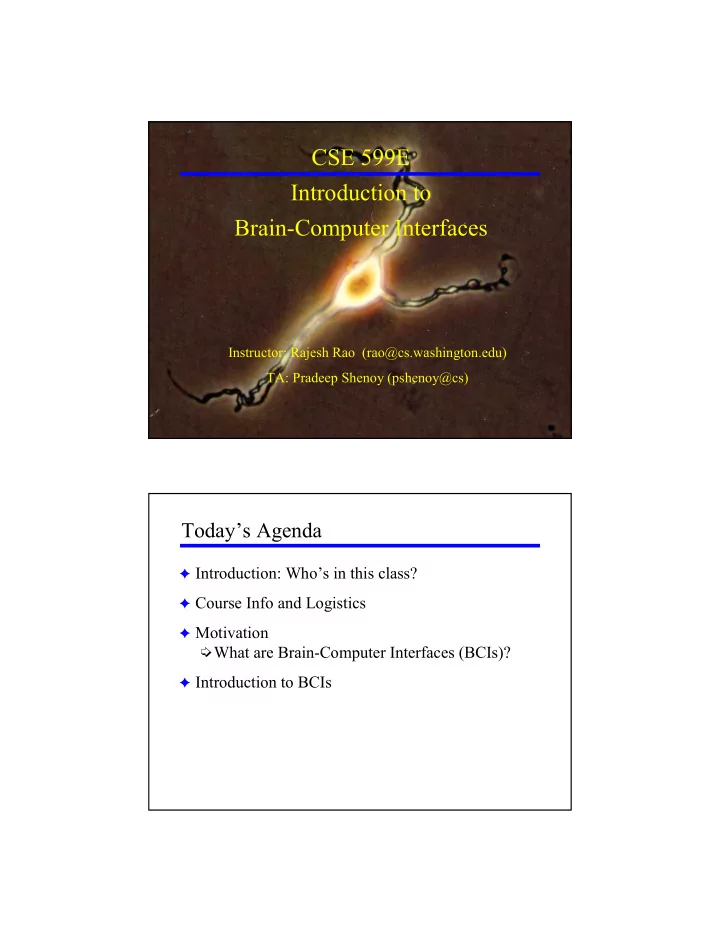
CSE 599E Introduction to Brain-Computer Interfaces Instructor: - - PDF document

▶
cse 599e introduction to brain computer interfaces
SMART_READER_LITE
LIVE PREVIEW

CSE 599E Introduction to Brain-Computer Interfaces Instructor: - - PDF document

CSE 599E Introduction to Brain-Computer Interfaces Instructor: Rajesh Rao (rao@cs.washington.edu) TA: Pradeep Shenoy (pshenoy@cs) Todays Agenda Introduction: Whos in this class? Course Info and Logistics Motivation What


slide-1
SLIDE 1

CSE 599E Introduction to Brain-Computer Interfaces

Instructor: Rajesh Rao (rao@cs.washington.edu) TA: Pradeep Shenoy (pshenoy@cs)

Today’s Agenda

✦ Introduction: Who’s in this class? ✦ Course Info and Logistics ✦ Motivation

What are Brain-Computer Interfaces (BCIs)?

✦ Introduction to BCIs

slide-2
SLIDE 2

Course Information

✦ The course will include:

Lectures (by Raj and Pradeep) Invited speakers:

➧ Eb Fetz (PBIO) on neural control and BCIs ➧ Dieter Fox (CSE) on Particle/Kalman Filtering ➧ Kai Miller (MD/PhD program) on Electrocorticography

Student-led Discussion of Research Papers

✦ Browse class web page for syllabus and schedule:

http://www.cs.washington.edu/education/courses/599e/06sp

✦ Lecture slides will be made available on the website ✦ Add yourself to the mailing list→ see class web page

Workload and Grading

✦ Course grade will be Credit/No Credit (CR/NC) only. ✦ Grade will be based on:

Paper presentations – see list of papers on class website Final group project – literature survey or data analysis Participation in on-line & in-class discussions

➧ On-line blog (discussion board) for discussing assigned

papers, posting/answering questions, etc.

✦ Group Project: Group of 1-3 persons

Survey other BCI topics not covered in course, or Perform analysis of existing BCI data Each group will submit a report and give a presentation in the last class

slide-3
SLIDE 3

Okay, enough logistics – let’s begin…

What are Brain-Computer Interfaces?

What is a Brain-Computer Interface (BCI)?

✦ Current Human-Computer Interaction (HCI): Human

controls virtual or physical objects using muscular activity. Examples:

Mouse (hand/finger movements) Keyboard (finger/hand movements) Joystick (hand/arm movements) Steering wheel, buttons, and pedals (hand/arm/feet/leg movements)

✦ Brain-Computer Interface (BCI): A device that utilizes

brain activity for direct control of physical or virtual objects without using muscular activity or body movements.

slide-4
SLIDE 4

Some Applications

✦ Improved communication and control for paralyzed and

locked-in patients (e.g. stroke, ALS, spinal injury patients)

✦ Applications in health and safety

E.g. Early detection, diagnosis, and treatment of symptoms E.g. Alertness monitoring in critical occupations (e.g. night drivers, pilots, railway “engineers”)

✦ Computer-aided education and learning

E.g. Brain-activity based presentation of material?

✦ Augmented cognition (brain-body actuated control)

E.g. Air Force research using hybrid brain-body interfaces for speeding up responses during flight

✦ Entertainment and Security

E.g. Video games, TV/web browsing for patients,… E.g. Better lie detection devices and “brain fingerprinting”?

BCIs in Sci-Fi

(Johnny Mnemonic, 1995) (Donovan’s Brain, 1953) (The Matrix, 1999)

slide-5
SLIDE 5

BCIs: The Hype

✦ Several commercial “BCI” systems exist

“Interactive Brainwave Visual Analyzer” (IBVA): “…trigger images, sounds, other software or almost any electronically addressable device…” Cyberlink by Brain Actuated Technologies: “…operate computer software and any electrical device directly from the control center - the mind.”

✦ Most are based on a headband with few

sensors (typically 3)

✦ The Catch: Control is more through eye

movements and facial muscle activity than through brain activity

BCIs: More Hype

http://www.brainwavescience.com/

“We use details that the person being tested would have encountered in the course of committing a

  • crime. We can tell by the

brainwave response if…a person has a record of the crime stored in his brain.” “Brain Fingerprinting”

slide-6
SLIDE 6

BCI: What is involved?

From (Nicolelis, 2001)

Signal Acquisition: Current Approaches

✦

Invasive Approaches: Recording Activities of Neurons inside the Brain using Electrodes and Electrode Arrays

➧

Typically only in animals (rats and monkeys) Recording Electrical Activity from the Brain Surface (Electrocorticography or ECog)

➧

In humans (patients scheduled for brain surgery) Implants and Neural Stimulation

➧

In animals and humans (e.g., Parkinson’s patients)

slide-7
SLIDE 7

Signal Acquisition: Current Approaches

✦

Non-Invasive Brain Imaging:

  • 1. fMRI (Functional Magnetic Resonance Imaging): Measures

changes in blood flow due to increased brain activity

➧

Good spatial resolution but too slow for real-time BCI

  • 2. MEG (MagnetoEncephaloGraphy): Measures changes in

magnetic fields due to neural activity

➧

Good spatiotemporal resolution but expensive and cumbersome

  • 3. EEG (ElectroEncephaloGraphy): Measures voltage changes at

the scalp due to neural activity

➧

Good temporal resolution but poor spatial resolution

➧

Inexpensive and therefore most common in current BCIs

Invasive BCIs: Monitoring and Stimulating Neurons

Array of silicon electrodes with platinum-plated tips Extracellular recording

  • f neural spikes

Array is implanted in an area of the cerebral cortex

(Work of Andersen & colleagues, Caltech)

slide-8
SLIDE 8

Invasive BCIs: A Commercial Example

Components of a Cochlear Implant (Electrode array (1) & receiver/stimulator (2) are implanted in the head)

From: http://www.deafblind.com/cochlear.html

  • 1. Microphone
  • 2. Cable
  • 3. Sound

processor

  • 4. Cable
  • 5. FM radio

transmitter

  • 6. Receiver &

Stimulator

  • 7. Electrode array

stimulates auditory nerve fibers in cochlea

  • 8. Auditory nerve

3

  • Has been implanted in over 30,000 hearing-

impaired adults and children

  • Many (but not all) have improved hearing ability

Treatment of Mental Diseases using Implants

(Nicolelis, 2001)

Nerve Cuff Or Drug Delivery

slide-9
SLIDE 9

BCI in a Rat: Rodent Telepathic Control

(Chapin et al., 1999) Lever Water (Reward) Robot Arm Switch to select between BCI/Lever Control Spikes from 2 motor cortex neurons Neural Population Function Recorded activities of 24 motor cortex neurons Electrode Array

BCI in a Rat: Summary

  • Rat presses a lever to move a robotic arm to get reward
  • Neural outputs from rat’s motor cortex train an artificial

neural network to control the robotic arm

  • After training, several rats no longer used their own body

movements but retrieved reward using their neural activity Experiment by Chapin et al., 1999:

slide-10
SLIDE 10

Control of a Robotic Arm by a Monkey

(Wessberg et al., 2000) Spikes from neurons in several cortical areas in two monkeys Experimental Set-Up Hand Position

Neural Robotic Control: Methodology

(Nicolelis, 2001)

slide-11
SLIDE 11

Results from Monkey BCI – 1D Movements

(Wessberg et al., 2000)

Results from Monkey BCI – 3D Movements

(Wessberg et al., 2000)

Hand Movement Sequence: Start Food Tray Mouth

slide-12
SLIDE 12

BCI based on Cortical “Reach” Neurons

“Reach” Area in Parietal Cortex

  • Neural activity predicts intended location of a reach

movement by the monkey

  • Might be easier to translate into robot commands than

raw motor activity as in previous slides

(Work by Andersen and colleagues, Caltech)

Video: Monkey controlling a Robotic Arm

(Work by Schwartz and colleagues, U. Pittsburgh)

http://motorlab.neurobio.pitt.edu/Motorlab/download_movies/download_movies.html

slide-13
SLIDE 13

Non-Invasive BCIs: EEG-based Systems

✦ EEG signals: Acquired from a cap of electrodes that contact

scalp through a gel

Recent progress: Active electrodes and dry electrodes.

✦ Signals are in microvolts range need to be amplified “10-20” arrangement

  • f scalp electrodes

What is EEG?

✦ Voltage fluctuations at the

scalp due to activities of large populations of neurons in the cerebral cortex

✦ Input potentials and activities

  • f neurons get attenuated and

summated due to passage through meninges, cerebrospinal fluid, skull, and scalp.

Electrical activity

EEG Scalp electrode Pyramidal neurons in cerebral cortex

slide-14
SLIDE 14

Types of EEG Waves

Mu waves: Associated with movements or intention to move Alpha waves: Associated with unfocusing attention (relaxation) Beta waves: Associated with alertness and heightened mental activity Delta waves: Associated with deep sleep

(Images from Scientific American, 1996)

7.5-13 Hz > 14 Hz < 3 Hz

Some Achievements of EEG-based BCIs

✦ Typing words by flashing letters (Farwell & Donchin, 1988)

Select a character (out of 36) in 26 seconds with 95% accuracy

✦ Move a cursor towards a target on a screen by training

subjects to control the amplitude of their Mu waves (Wolpaw et al., 1991; Pfurtscheller et al., 1993)

10-29 hits/min and 80-95% accuracy after 12 45-min sessions

✦ Moving a joystick in 1 of 4 directions by classifying EEG

patterns during mental tasks using artificial neural networks (Hiraiwa et al., 1993; Anderson & Sijercic, 1996)

slide-15
SLIDE 15

Example Videos of EEG-Based BCI

(from the Wadsworth Group)

✦ An individual uses the mu rhythm to select from 6 choices in

a target task

✦ An individual spells a word using P300 evoked potentials ✦ BCI2000 in Online Operation: A user spells a word and

selects from icons (mu rhythm control, 64 channel EEG, 160 Hz)

EEG-based Systems: Challenges and Limitations

✦ Electrode placement is cumbersome and set-up time is

typically long (up to ½ hour based on number of electrodes)

✦ Results of training and learning may not be transferable from

  • ne day to the next due to shifts in electrode locations, noisy

contacts with scalp, etc.

✦ Low signal-to-noise ratio and on-line adaptation in subjects

necessitate powerful amplifiers as well as efficient machine learning and signal processing algorithms

✦ Signal attenuation and summation between the brain and the

scalp, together with sparse sampling of activity, limits the range of useful control signals that can be extracted

slide-16
SLIDE 16

BCI Research: Current Problems and Challenges

✦ Signal Acquisition (Hardware): Need better technology to

record activities of several thousands of neurons with high signal-to-noise ratio

Non-Invasive BCIs: Need physicists to discover better methods of brain imaging than EEG/MRI Invasive: Need biocompatible implantable chips for recording and/or stimulating large groups of neurons Need better instrumentation for amplification and telemetry

✦ Signal Processing (Software):

Current approaches use: Fourier analysis, classical neural networks, linear function approximators Need more robust and adaptive algorithms for learning the mapping between brain activity and desired outputs

BCI Research: Moral and Ethical Issues

✦ “Where does the human end and the machine begin?” ✦ Privacy, safety, and health issues with wireless implants

What if someone sends a “virus” to receiver? (“brainwashing”?)

✦ Abuse of technology (in law, war, crime, and terrorism)

E.g. Misuse of “Brain fingerprinting” methods in criminal cases

✦ Societal impacts: The new haves and have-nots

Possession and control of BCIs to augment mental/physical capabilities may significantly alter balance of power in society

(The Matrix) (Terminator 2) (Brazil)

slide-17
SLIDE 17

Conclusions

✦ Significant advances are being made in the development of

both non-invasive and invasive BCIs

✦ Invasive systems in rats and monkeys have allowed these

animals to control robotic arms in real time for simple tasks

✦ The most popular non-invasive systems, based on EEG,

allow reasonably accurate but slow control of cursors and selection of letters

✦ In the rest of the quarter, we will delve into these systems in

more detail:

What are the brain signals and behaviors being used? What are the feature extraction and machine learning methods that underlie these systems? What are their strengths and weaknesses?

Next Class: Lecture by Pradeep on Machine Learning for BCI & Sign-Up for Paper Presentations Don’t forget to browse the class website, look over the papers, and sign up for the mailing list…