CSE 675.02: three aspects of computer design: instruction set - - PowerPoint PPT Presentation

cse 675 02
SMART_READER_LITE
LIVE PREVIEW

CSE 675.02: three aspects of computer design: instruction set - - PowerPoint PPT Presentation

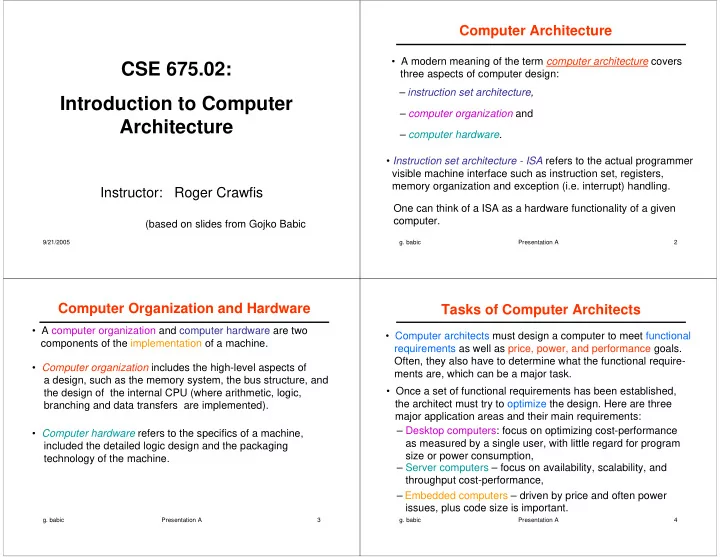
Computer Architecture A modern meaning of the term computer architecture covers CSE 675.02: three aspects of computer design: instruction set architecture, Introduction to Computer computer organization and Architecture


slide-1
SLIDE 1

9/21/2005

Instructor: Roger Crawfis

CSE 675.02: Introduction to Computer Architecture

(based on slides from Gojko Babic

  • g. babic

Presentation A 2

Computer Architecture

  • A modern meaning of the term computer architecture covers

three aspects of computer design: – instruction set architecture, – computer organization and – computer hardware.

  • Instruction set architecture - ISA refers to the actual programmer

visible machine interface such as instruction set, registers, memory organization and exception (i.e. interrupt) handling. One can think of a ISA as a hardware functionality of a given computer.

  • g. babic

Presentation A 3

Computer Organization and Hardware

  • Computer organization includes the high-level aspects of

a design, such as the memory system, the bus structure, and the design of the internal CPU (where arithmetic, logic, branching and data transfers are implemented).

  • Computer hardware refers to the specifics of a machine,

included the detailed logic design and the packaging technology of the machine.

  • A computer organization and computer hardware are two

components of the implementation of a machine.

  • g. babic

Presentation A 4

Tasks of Computer Architects

  • Computer architects must design a computer to meet functional

requirements as well as price, power, and performance goals. Often, they also have to determine what the functional require- ments are, which can be a major task.

  • Once a set of functional requirements has been established,

the architect must try to optimize the design. Here are three major application areas and their main requirements: – Desktop computers: focus on optimizing cost-performance as measured by a single user, with little regard for program size or power consumption, – Server computers – focus on availability, scalability, and throughput cost-performance, – Embedded computers – driven by price and often power issues, plus code size is important.

slide-2
SLIDE 2
  • g. babic

Presentation A 5

Rapid Rate of Improvements

  • Today, less than one thousand dollars purchases a personal

computer that has more performance, more main memory, and more disk storage than a computer bought in 1980 for

  • ne million dollars.
  • For many applications, the highest-performance microcom-

puters of today outperform the supercomputers of less than 10 years ago.

  • This rapid rate of improvement has come from two forces:

– technology used to build computers and – innovations in computer design.

  • g. babic

Presentation A 6

Technology Trends

  • Integrated circuit logic technology – a growth in transistor

count on chip of about 55% per year.

  • Semiconductor RAM – density increases by 40% to 60% per

year, while cycle time has improved very slowly, decreasing by about one-third in 10 years. Cost has decreased at rate about the rate at which density increases.

  • Magnetic disc technology – disk density has been recently

improving more then 100% per year, while prior to 1990 about 30% per year.

  • Network technology – Latency and bandwidth are important,

though recently bandwidth has been primary focus. Internet infrastructure in the U.S. has been doubling in bandwidth every year.

  • g. babic

Presentation A 7

Developments in Computer Design

  • During the first 25 years of electronic computers both forces,

technology and innovations in computer design made major contributions.

  • Then, during the 1970’s, computer designers were largely

dependent upon integrated circuit technology, with roughly 35% growth per year in processor performance.

  • In the last 20 year, the combination of innovations in computer

design and improvements in technology has led sustained growth in performance at an annual rate of over 55%. In this period, the main source of innovations in computer design has come from RISC-style pipelined processors.

8

How CPUs get faster

Scientific American Nov 04

slide-3
SLIDE 3
  • g. babic

Presentation A 9

Growth in Microprocessor Performance

  • g. babic

Presentation A 10

Approaches to Instruction Set Architecture

  • For many years the interaction between ISA and implementat-

ions was believed to be small, and implementation issues were not a major focus in designing instruction set architecture.

  • In the 1980’s, it becomes clear that both the difficulty of

designing processors and performance inefficiency of processors could be increased by instruction set architecture complications.

  • Two main approaches of ISA:

– RISC (Reduced Instruction Set Computer) architecture – CISC (Complex Instruction Set Computer) architecture.

  • g. babic

Presentation A 11

RISC Architecture

After 1985, most computers announced have been of RISC

  • architecture. RISC designers focused on two critical

performance techniques in computer design: – the exploitation of instruction-level parallelism, first through pipelining and later through multiple instruction issue, – the use of cache, first in simple forms and later using sophisticated organizations and optimizations. RISC – Reduced Instruction Set Computer RISC architecture goals are ease of implementation (with emphasis on concepts such as advanced pipelining) and compatibility with highly optimized compilers.

  • g. babic

Presentation A 12

RISC ISA Characteristics

  • All operations on data apply to data in registers and typically

change the entire register;

  • The only operations that affect memory are load and store
  • perations that move data from memory to a register or to

memory from a register, respectively;

  • A small number of memory addressing modes;
  • The instruction formats are few in number with all instructions

typically being one size;

  • Large number of registers;

These simple properties lead to dramatic simplifications in the implementation of advanced pipelining techniques, which is why RISC architecture instruction sets were designed this way.

slide-4
SLIDE 4
  • g. babic

Presentation A 13

CISC Architecture

CISC – Complex (and Powerful) Instruction Set Computer VAX processor was a good example of CISC architecture. For example: accounting for all addressing modes and limiting to byte, word (16 bits) and long (32 bits), there are more than 30,000 versions of integer add in VAX. CISC goals, such as simple compilers and high code density, led to the powerful instructions, powerful addressing modes and efficient instruction encoding. Question: What is today the main example of CISC architecture processor? Answer: Intel IA-32 processors (found in over 90% desktop computers).

IA - 32

  • 1978: The Intel 8086 is announced (16 bit architecture)
  • 1980: The 8087 floating point coprocessor is added
  • 1982: The 80286 increases address space to 24 bits, +instructions
  • 1985: The 80386 extends to 32 bits, new addressing modes
  • 1989-1995: The 80486, Pentium, Pentium Pro add a few instructions

(mostly designed for higher performance)

  • 1997: 57 new “MMX” instructions are added, Pentium II
  • 1999: The Pentium III added another 70 instructions (SSE)
  • 2001: Another 144 instructions (SSE2)
  • 2003: AMD extends the architecture to increase address space to 64 bits,

widens all registers to 64 bits and other changes (AMD64)

  • 2004: Intel capitulates and embraces AMD64 (calls it EM64T) and adds

more media extensions

  • “This history illustrates the impact of the “golden handcuffs” of compatibility

“adding new features as someone might add clothing to a packed bag” “an architecture that is difficult to explain and impossible to love”

Intel IA-32 Processors

  • Since 1995, Pentium processors consist of a front end

processor and a RISC-style processor.

  • The improvements in technology have allowed the latest

Intel IA-32 processors (of CISC architecture) to adopt many innovations first pioneered in the RISC design. A microinstruction is a simple instruction used in sequence to implement a more complex instruction. Microinstructions look very much as RISC instructions.

  • Then, the RISC-style processor executes microinstructions.
  • The front end processor fetches and decodes Intel IA-32

complex instructions and maps them into microinstructions.

  • Intel IA-32 processors, from 80386 processor in early 80’s to

Pentium IV today are of CISC architecture. All Intel IA-32 processors are having as a core the identical instruction set architecture designed in early 1980’s.

  • g. babic

Presentation A 16

What Is This Course About?

In this course we are going to learn basic principles of processor and memory design using functionality of MIPS processor, i.e. we shall design processor-memory system with (a subset of) MIPS instruction set architecture. Somewhere some time ago, I read that MIPS processor is the best-selling RISC processor that powers everything from Nintendo game machines and Cisco networking routers to Silicon Graphics’ high-end servers and supercomputers. What does MIPS stand for? Answer: Microprocessor without Interlocked Pipeline Stages. MIPS processor is one of the first RISC processors.

slide-5
SLIDE 5

Instructions:

  • Language of the Machine
  • We’ll be working with the MIPS instruction set architecture

– similar to other architectures developed since the 1980's – Almost 100 million MIPS processors manufactured in 2002 – used by NEC, Nintendo, Cisco, Silicon Graphics, Sony, …

1400 1300 1200 1100 1000 900 800 700 600 500 400 300 200 100 1998 2000 2001 2002 1999 Other SPARC Hitachi SH PowerPC Motorola 68K MIPS IA-32 ARM

Introduction

  • This course is all about how computers work
  • But what do we mean by a computer?

– Different types: desktop, servers, embedded devices – Different uses: automobiles, graphics, finance, genomics… – Different manufacturers: Intel, Apple, IBM, Microsoft, Sun… – Different underlying technologies and different costs!

  • Analogy: Consider a course on “automotive vehicles”

– Many similarities from vehicle to vehicle (e.g., wheels) – Huge differences from vehicle to vehicle (e.g., gas vs. electric)

  • Best way to learn:

– Focus on a specific instance and learn how it works – While learning general principles and historical perspectives

19

Why learn this stuff?

  • You want to call yourself a “computer scientist”
  • You want to build software people use (need performance)
  • You need to make a purchasing decision or offer “expert” advice
  • Both Hardware and Software affect performance:

– Algorithm determines number of source-level statements – Language/Compiler/Architecture determine machine instructions (Chapter 2 and 3) – Processor/Memory determine how fast instructions are executed (Chapter 5, 6, and 7)

  • Assessing and Understanding Performance in Chapter 4

What is a computer?

  • Components:

– input (mouse, keyboard) – output (display, printer) – memory (disk drives, DRAM, SRAM, CD) – network

  • Our primary focus: the processor (datapath and

control)

– implemented using millions of transistors – Impossible to understand by looking at each transistor – We need...

slide-6
SLIDE 6

Abstraction

  • Delving into the depths

reveals more information

  • An abstraction omits

unneeded detail, helps us cope with complexity What are some of the details that appear in these familiar abstractions?

swap(int v[], int k) {int temp; temp = v[k]; v[k] = v[k+1]; v[k+1] = temp; } swap: muli $2, $5,4 add $2, $4,$2 lw $15, 0($2) lw $16, 4($2) sw $16, 0($2) sw $15, 4($2) jr $31 00000000101000010000000000011000 00000000000110000001100000100001 10001100011000100000000000000000 10001100111100100000000000000100 10101100111100100000000000000000 10101100011000100000000000000100 00000011111000000000000000001000 Assembler Compiler Binary machine language program (for MIPS) Assembly language program (for MIPS) High-level language program (in C)

22

How do computers work?

  • Need to understand abstractions such as:

– Applications software – Systems software – Assembly Language – Machine Language – Architectural Issues: i.e., Caches, Virtual Memory, Pipelining – Sequential logic, finite state machines – Combinational logic, arithmetic circuits – Boolean logic, 1s and 0s – Transistors used to build logic gates (CMOS) – Semiconductors/Silicon used to build transistors – Properties of atoms, electrons, and quantum dynamics

  • So much to learn!

Instruction Set Architecture

  • A very important abstraction

– interface between hardware and low-level software – standardizes instructions, machine language bit patterns, etc. – advantage: different implementations of the same architecture – disadvantage: sometimes prevents using new innovations True or False: Binary compatibility is extraordinarily important?

  • Modern instruction set architectures:

– IA-32, PowerPC, MIPS, SPARC, ARM, and others

Historical Perspective

  • ENIAC built in World War II was the first general purpose computer

– Used for computing artillery firing tables – 80 feet long by 8.5 feet high and several feet wide – Each of the twenty 10 digit registers was 2 feet long – Used 18,000 vacuum tubes – Performed 1900 additions per second

–Since then: Moore’s Law: transistor capacity doubles every 18-24 months

slide-7
SLIDE 7

25

  • The following slides are courtesy of Peter

Shirley, Univ. of Utah.

26

Review: Moore’s Curve

  • 1965 paper: Cramming More Components

Onto Integrated Circuits

  • The number of transistors on a chip

increases exponentially

27

Wait for Moore’s Law for performance?

  • Dec. 2002 Survey of IEEE fellows: how

much longer will Moore’s curve last?

– 31%: less than 5 years (4x improvement) – 52%: 5-10 years (4x-10x improvement) – 17%: more than 10 years

  • Dec 2003 IEEE Spectrum: Moore’s Law

exponent has varied 12-32 months-- lately it has been 22-24 months.

28

Moore: Moore: Keynote ISSCC 2003 Keynote ISSCC 2003

slide-8
SLIDE 8

29

Moore: Moore: Keynote ISSCC 2003 Keynote ISSCC 2003

30

Moore: Moore: Keynote ISSCC 2003 Keynote ISSCC 2003

31

Moore: Moore: Keynote ISSCC 2003 Keynote ISSCC 2003

32

slide-9
SLIDE 9

33

New Moore exponent on speed?

  • Doubling every 4-5 years?
  • Will GPU’s have the same fate?
  • How will Intel keep us hooked?

34

Huge Change Multicore CPUs to desktop

  • IBM 2001, 2004: 2 cores
  • AMD 2005: 2 cores
  • Sun 2004: 2 cores, 2006 8 cores
  • Intel 2005: 2 cores

(source: Nov 2004 Scientific American)

35

Next generation $5000 PC

  • Machrone’s Law

– The computer you want will always cost $5000

  • Many GB of RAM
  • Programmable GPU
  • Multicore 64 bit CPU
  • High resolution screen (4x-8x 1984 screen)

– Apple 2560x1600, IBM big-bertha 3840x2400

  • Not enough for our needs