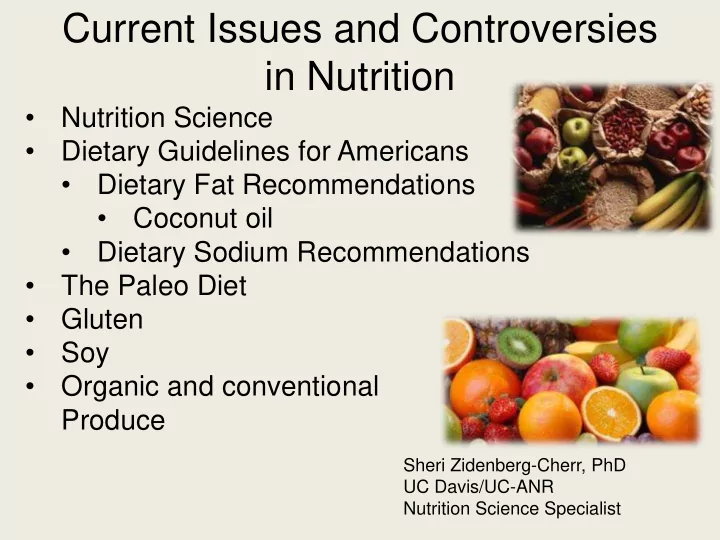
SLIDE 1 Current Issues and Controversies in Nutrition
- Nutrition Science
- Dietary Guidelines for Americans
- Dietary Fat Recommendations
- Coconut oil
- Dietary Sodium Recommendations
- The Paleo Diet
- Gluten
- Soy
- Organic and conventional
Produce
Sheri Zidenberg-Cherr, PhD UC Davis/UC-ANR Nutrition Science Specialist
SLIDE 2 Beyond the Hype
- Nutrition is an inter-disciplinary science
– “Evidence-based” recommendations – Understanding these recommendations can help you identify the hype from those with good scientific evidence
SLIDE 3
Why is there so much variability with respect to individuals’ responses to diet?
SLIDE 4 Why so much variation?
GOAL: Personalized nutrition therapies to maximize genetic potentials, prevent chronic disease and improve treatment
SLIDE 5 Microbiome
- Billions of microorganisms that are on and in us
- Essential for normal functioning
- Differs from person to person, place to place and
- ver time
http://www.scientificamerican.com/article/microbiome-graphic-explore-human-microbiome
SLIDE 6 Personalized Nutrition Recommendations
- Both our genetic make-up, epigenetic factors
and our microbiome influence how we respond to our environment
- GOAL: Personalized nutrition therapies to
maximize genetic, potentials, prevent chronic disease and improve treatment outcomes
SLIDE 7 Slides provided by the USDA Center for Nutrition Policy and Promotion
SLIDE 8
Controversial Issues
SLIDE 9
SLIDE 10
SLIDE 11
- Balance calories with physical activity to
manage weight
- Consume more of certain foods and nutrients
such as fruits, vegetables, whole grains, fat- free and low-fat dairy products and seafood
- Consume fewer foods with sodium (salt),
saturated fats, trans fats, cholesterol, added sugars and refined grains.
Dietary Guidelines for Americans, 2010
2015 DGA Report
SLIDE 12 Role of sodium in the body
- Sodium is responsible for fluid balance and
electric potential
- Sodium is an essential nutrient, but intakes
are rarely low
- Low serum sodium, results in abnormal
mental status, convulsions, headaches, muscle weakness, nausea, vomiting, eventual death
SLIDE 13 Sodium
- Salt = NaCl
- 1 teaspoon salt = 6 gm NaCl
- Approx. 40 % is sodium
- 1 tsp = 2400 mg
SLIDE 14 CVD Risk Factors
Age & Sex
M 45 yr F 55 yr or premature menopause
Family history of premature CHD
Potentially Modifiable Factors
Hypertension (>140/90 mm Hg) Hyperlipidemia ( LDL cholesterol) Low HDL cholesterol (< 40mg/dl) Cigarette smoking Diabetes Life habit risk factors: overwt/obesity,
inactivity, atherogenic diet
SLIDE 15 2010 Dietary Guidelines Foods and Food Components to Reduce
Sodium
- Reduce intake to less than 2300 mg per day
- Further reduce intake to 1500 mg per day for
- Adults ages 51+
- African Americans ages 2+
- People ages 2+ with high blood pressure, diabetes, or
chronic kidney disease
- The 1500 mg recommendation applies to half the total
population (ages 2+) and to the majority of adults
- Immediate, deliberate reduction in sodium content of
foods is needed.
SLIDE 16
SLIDE 17
SLIDE 18 Sodium Restriction in Heart Failure: How Low Should You Go?
American Family Physician 2014
SLIDE 19 JACC: Heart Failure, Vol 4, Issue 1, 2016
SLIDE 20 Salt: What to do?
- Typical US intakes considered high
– American Heart Association recommends to reduce intake to 2,300 mg per day – Dietary Guidelines Report (2015)
Reduce intake to 2,300 mg per day Removed the further reduction to 1,500 mg per day
– Heart Failure Patients
- Be aware of the recent concerns with sodium
restrictions below 2,300 mg per day
SLIDE 21
- No single nutrient lowers blood pressure.
- Dietary nutrients are not ingested in isolation but as
combined constituents of a complete diet and function interactively in the body and in their impact
- n BP regulation.
- Because nutrients express their physiologic actions
through integrated pathways, it is unrealistic to expect a uniform benefit in terms of BP control from modifying the intake of a single nutrient.
Molly E. Reusser, David A. McCarron J Nutr 2006;136(4):1099-102
21
SLIDE 22 Diet and Hypertension
– Dietary Approaches to Stop Hypertension – Heart Healthy diet low in saturated fat, trans fat, cholesterol and sodium
- Low in red meat, sweets and sugar beverages
– Focus on fresh, whole foods including fruits vegetables whole grains
- Includes small levels of lean meat, fatty fish, low-
fat/nonfat dairy
– Adequate Calcium, Potassium, Magnesium
SLIDE 23 Beyond Blood Pressure: New Paradigms in Sodium Intake Reduction and Health Outcomes
- http://scientificsessions.nutrition.org/2014/pr
- gram/beyond-blood-pressure-new-
paradigms-in-sodium-intake-reduction-and- health-outcomes/
SLIDE 24 2016 Omnibus Spending Bill
- Prevents release and implementation of the
Dietary Guidelines unless they are based upon significant scientific agreement and adhere to statutory language
- Delays implementation of whole grains for
schools lunches for one year
- Holds sodium reductions until science justifies
reduction.
SLIDE 25
SLIDE 26 Dietary Guidelines for Americans (2015-2020)
- Eat for health and for the long run
- Start with small changes
- Support healthy choices for everyone
SLIDE 27
SLIDE 28 Dietary Guidelines for Americans (2015-2020)
- Healthy eating patterns limit sodium. Adults
and children ages 14 years and over should limit sodium to less than 2,300 mg per day, and children younger than 14 years should consume even less.
- Use the Nutrition Facts label to check for
sodium, especially in processed foods like pizza, pasta dishes, sauces, and soups.
SLIDE 29 “What exactly is a healthy eating pattern?”
Consists of all foods and drinks that a person consumes over time;
is adaptable to a person’s taste preferences, culture, traditions, and budget; Includes a variety of nutritious foods like vegetables, fruits, grains, low-fat and fat-free dairy, lean meats and
- ther protein foods, and oils; and
Limits saturated fats, trans fats, added sugars, and sodium.
SLIDE 30 Total Dietary Fat
- Primary focus of dietary recommendations
– 20-35% of total calories – Consumption above these ranges is associated with greater intake of energy and saturated fat – Consumption below these ranges associated with higher intake of carbohydrate
SLIDE 31 Nutrition science has moved beyond fat as a macronutrient1
- Role of specific fatty acids
– Saturated fatty acids – Monounsaturated fatty acids – Polyunsaturated fatty acids » Omega 3 » Omega 6 – Trans-fatty acids
- 1AND Position Statement 2014
SLIDE 32
Fatty Acids
SLIDE 33
What Are Omega-3 Fatty Acids?
Alpha-linolenic acid (ALA)(“parent n-3 PUFA”) Eicosapentenoic Acid (EPA) Docosahexenoic Acid (DHA)
SLIDE 34 Inflammation
Host Defenses Against Infectious Agents and Injury Cardiovascular Disease Obesity
Diabetes Some cancers and bowel diseases Arthritis Asthma Neurodegenerative Diseases
SLIDE 35 Omega-3
- Omega-3 tends to reduce inflammatory
response
SLIDE 36
Health Effect of Dietary EPA and DHA (Omega 3 Fats)
Blood Pressure Risk of Cardiovascular Disease Insulin Control in Type 2 Diabetes Symptoms of Rheumatoid Arthritis
SLIDE 37 Dietary Guidelines for Americans, 2010
- New recommendation for seafood intake
- Moderate evidence shows that eating
- --> 8 or more ounces per week
- --> equivalent to 250 mg per day long chain omega
3 fatty acids
- --> associated with reduced cardiac deaths
- Seafood:
– Salmon, anchovies, herring, sardines, Pacific oysters, trout, and Atlantic and Pacific mackerel
DeBusk,Fogarty, Ordovas, Kornman, J AM Diet Assoc. 2005; 105: 589-598.
SLIDE 38 American Heart Association Recommendations: Omega-3 Fatty Acids
(Patients without cardiovascular disease)
- Eat a variety of fish (twice/week)
- Include oils and foods rich in alpha-
linolenic acid (flaxseed, canola and soybean oils; flaxseed and walnuts)
SLIDE 39 AHA Recommendations: Omega-3 Fatty Acids
(Patients with cardiovascular disease)
- Eat about 1 gram long chain fatty acids
(EPA+DHA) per day preferably from fatty fish.
- Capsule form could be considered in
consultation with physician
SLIDE 40 AHA Recommendations: Omega-3 Fatty Acids
Patients who need to lower triglycerides
- Capsule form containing 2-4 grams of EPA
and DHA per day
- Under care of a physician
SLIDE 41 Coconut Oil
“The Tokelauans…in the South Pacific…eat
calories from coconuts and…are in excellent health, with no evidence of heart disease.”
SLIDE 42 Coconut Oil
- Literature inconclusive on medium-chain fatty acids in coconut
- il promoting weight loss
– Coconut oil contains high amounts of saturated fatty acids
- Neither American Heart Association nor the Dietary Guidelines
for Americans 2010 suggest coconut oil is preferable over other saturated fats – Limit intake of all saturated fats; recommend less than 10%
- f calories/day from saturated fats
- Very limited research on benefits of coconut oil
SLIDE 43 Agreement Amid The Fat Debate
- Total fat intake in not as important as type
- f fats
- MUFAs provide a similar but lesser effect
- n LDL and chol ratio than PUFA
- Omega 3 fatty acids are beneficial and
should be included in the diet at least twice weekly
SLIDE 44 Agreement Amid The Fat Debate
- Trans fats are unhealthy and should be
kept to a minimum in the diet
- Food-based dietary guidelines are
essential to help consumers make healthier food choices
- The nutrition science and health
community should be sending a message that encourages calorie balance and eating more healthful fats
SLIDE 45 The Paleo Diet
- Based on claims of “diseases of civilization”
– Difficulty in constructing what early humans were eating
- Diets of early humans depended upon
– How early – Location
- Scientists have discovered traces of seeds and
grains on the teeth of fossilized early humans
- Scientist have discovered remnants of grains on
stone cooking tools
SLIDE 46 The Paleo Diet
- We are not who our ancestors were.
– Microbiome
- Billions of microorganisms that are on and in us
- Essential for normal functioning
- Differs from person to person, place to place and
probably over time
SLIDE 47 The Paleo Diet
- Our food has changed from that of our
ancestors
– Early humans were not eating plants or animals that are close to what we eat today – Ancestors of apples and corn were not desirable – Current beef products, even grass-fed have been modified from its ancestors by breeding
SLIDE 48 The Paleo Diet
- Basic premise: “If it wasn’t on a caveman’s
menu, it shouldn’t be on yours”
– Plenty of meat, poultry, eggs, seafood, vegetables, fruit, honey and nuts – NO grains, beans, dairy foods, refined sugars, caffeine, or alcohol – “eat 20 ounces of meat, poultry or seafood and 12 cups of vegetables and fruit a day”
SLIDE 49 Paleo Diet: No large scale studies evaluating long-term outcomes!!
- Usually lower in calories
because many of the high calorie “snack” foods are eliminated
vegetables
glycemic index/load
- Low in Calcium
- High in fat
- May be difficult to
maintain
and GI Health
Dwyer JT, Melanson KJ, MS US, et al. Dietary Treatment of Obesity. [Updated 2015 Feb 28]. In: De Groot LJ, Beck-Peccoz P, Chrousos G, et al., editors. Endotext [Internet]. South Dartmouth (MA): MDText.com, Inc.; 2000-. Available from: http://www.ncbi.nlm.nih.gov/books/NBK278991/
SLIDE 50 High Fructose Corn Syrup Is No Worse Than 'Real' Sugar
Melanson et. al., Nutrition, Vol 23, pp 103-112 Feb 2007
SLIDE 51 High Fructose Corn Syrup
- Credible experts and scientific societies:
– “There is not a metabolic difference between high fructose corn syrup and sugar” Increased caloric intake, not a single sweetener is the likely cause of obesity
Journal of Nutrition(2009): 139(6):1228S Advances in Nutrition(2013): 4(2):246
SLIDE 52 When reading about studies….
- Experimental design: randomized controlled
studies are the gold standard
- Subjects tested: human subjects
- Levels tested: range of fructose in diet is 5-17%
- f kcals
– Be wary of studies that use excessive fructose levels in humans (25-50% of kcals) and animals (>60% of kcals)
SLIDE 53 Recommendations for Intake of Added Sugars
- American Heart Association
– 9 teaspoons per day for men – 6 teaspoons per day for women – 3 teaspoons per day for children
- Dietary Guidelines for Americans (2010)
– As Solid Fats and Added Sugars (SoFAS)
- 5-15% of total kcals
- Dietary Guidelines for Americans 2015 REPORT
– Added sugars be limited to a maximum of 10% of total kcals (about 12 tsp for most Americans)
The Average American eats 22.2 teaspoons
SLIDE 54
SLIDE 55 Beverages: Coconut Water
“Dissolves kidney stones” “Prevents atherosclerosis” “Enhances immune system” “Prevents glaucoma and cataracts” “Balances blood sugar” “Prevents cancer” “Revives hair growth”
SLIDE 56 Beverages: Coconut Water
- Evidence in the literature
– Norton et al, Int J Exerc Sci: Conference Proceedings, 2013
- Both coconut water and low calorie sports drink effective at
rehydrating exercise participants
– Saat et al, J Physiol Anthropol, 2002
- Coconut water, carbohydrate-electrolyte beverage, and pure
water effective at rehydration during a 2 hour rehydration period following exercise-induced dehydration
- Results indicate coconut water caused less nausea,
fullness, and no stomach upset, as compared to carb- electrolyte beverage and pure water upon rehydration period
– Campbell-Falck et al, Am J Emerg Med, 2000
- Case study: Solomon Island patient was administered
coconut water intravenously for rehydration
SLIDE 57 Gluten and Celiac Disease
- Gluten is a protein found in:
– Wheat – Rye – Barley
SLIDE 58 What is celiac disease?
- An autoimmune disorder
- Exposure to gluten results in damage to
the intestinal lining
- Damage to the lining of the intestine
reduces ability to digest and absorb nutrients
- Treatment consists of completely
eliminating gluten from the diet
SLIDE 59 Gluten-related Disorders
- Celiac Disease
- Wheat Allergy
- Gluten Sensitivity
– Not diagnosed on allergic or autoimmune mechanisms – Subject to risk of placebo effect
SLIDE 60
SLIDE 61 Fermentable, poorly absorbed, short- chain carbohydrates (fermentable,
- ligo-, di-, monosaccharides, and
polyols [FODMAPs])
- No Effects of Gluten in Patients With Self-
Reported Non-Celiac Gluten Sensitivity After Dietary Reduction of Fermentable, Poorly Absorbed, Short-Chain Carbohydrates
http://dx.doi.org/10.1053/j.gastro.2013.04.05 1
SLIDE 62 Gluten-Free Diets
individuals with celiac disease
– Claims of more energy, weight loss, etc – Very little research available to support or disprove claims
SLIDE 63 Downsides to Gluten-Free Diet
– Gluten-free products can be twice as expensive as gluten-containing products
nutrients
– Iron, folate, niacin, zinc, and fiber
- May be higher in calories
SLIDE 64
“Have Your Gluten-Free Candy This Halloween and Eat It Too”
SLIDE 65
Gluten Video
http://www.huffingtonpost.com/2014/05/06/gl uten-free-people-have-no-idea-what-gluten- is_n_5273980.html?ncid=fcbklnkushpmg000000 63
SLIDE 66 Soy Products and Human Health
- Macronutrients (protein and fatty acids)
- Isoflavones
SLIDE 67 Isoflavones
- found only in a limited variety of
foods
- soybean products
- soy ingredients
- legumes
SLIDE 68 Why Should People Eat Soy?
- Regular consumption of plant-
based protein foods may reduce risk for cancer, heart disease, and stroke
- Provide vitamins, minerals,
fiber, flavonoids
SLIDE 69 What the Science Says
– Can potentially reduce CHD through multiple mechanisms – Soy product can replace less healthful choices
– Genistein-rich isoflavone supplements may relieve hot flashes
– Not clear
- Timing? Perhaps when started in adolescence?
– Consumption is safe for women and breast cancer survivors
- Memory and Cognitive Function
– Contradictory
– No effects
Messina, M. Am J Clin Nutr.2014 Messina, M. Fertil Steril 2010
SLIDE 70 Side Effects and Cautions
- Soy is considered safe for most people when
used as a food.
- Minor stomach and bowel problems such as
nausea, bloating, and constipation are possible.
- The safety of long-term use of soy isoflavones
as supplements has not been established.
SLIDE 71 Recommendations for Soy
– "25 grams of soy protein a day, as part of a diet low in saturated fat and cholesterol, may reduce the risk of heart disease. A serving of (name of food) provides ____ grams of soy protein."
SLIDE 72
How to Meet the 25 Grams-A-Day Soy Protein Recommendation
Soy Product Soy Protein 1/4 cup of firm tofu 10 grams 1/2 cup of silken tofu 9 grams 2 soy breakfast links 12 grams 1 soy-based burger 10-12 grams 8 ounces of plain soymilk 7 grams 1 soy protein bar 14 grams 1/2 cup tempeh 16 grams 1/2 cup roasted soy nuts 34 grams 1/2 cup edamame 35 grams
SLIDE 73 Are Organic Foods Safer or Healthier Than Conventional Alternatives?
Annals of Internal Medicine 2012; 157: 348-366
SLIDE 74 Current Organic Legislature
- As of October 2002, all foods with the USDA
- rganic symbol must have at least 95% organic
ingredients.
- Currently, the USDA makes no claims that
- rganic foods are safer or more nutritious than
conventionally produced food.
- This is a complex issue and there is not enough
research to support a national recommendation regarding consumption of organic foods.
SLIDE 75 Why Do Consumers Purchase Organic Foods?
- Some people are concerned about the
effects of conventional farming practices on:
– The environment – Human health – Animal welfare
- Some people believe that organic foods are
tastier or healthier than their conventional alternatives
SLIDE 76 About the Alliance for Food and Farming
Non-profit formed in1989 Organic and conventional farmers. Alliance contributors are farmers of fruits and vegetables; companies that sell, market or ship produce; or
- rganizations representing farmers.
Mission: to deliver credible information to consumers about the safety of fruits and vegetables. The Alliance does not engage in lobbying activities, nor does it accept money or support from the pesticide industry.
SLIDE 77
SLIDE 78
Scientific Basis of the “Dirty Dozen” is Lacking
Risk = Exposure x Toxicity The “Dirty Dozen” list considers exposure, but makes no attempt to address toxicity There are reliable, well-established and accepted methods for assessing the risk of small doses of chemicals. The authors of the “Dirty Dozen” list acknowledge this and clearly state on their website that the list “is not built on a complex assessment of pesticide risks.”
SLIDE 79 Alliance for Food and Farming Expert Panel Conclusions
- Negative messages about food safety is
not promoting consumption of fruits and vegetables.
- The Media/Internet may be increasing our fears about
food safety, and lowering our faith in government
- versight of the safety of our food.
- It is inaccurate to suggest that organic produce is the only
“safe” choice.
- Some consumers feel like they are making inferior
choices when they buy conventionally grown produce.
- The key health message should be – eat your fruits
and vegetables.
SLIDE 80 SafeFruitsandVeggies.com
Promotes all fruits and
vegetables. Provides credible information Developed by experts in nutrition, toxicology, risk assessment and farming. Pesticide Residue Calculator Farmer videos Blog Scientific Reports Facebook, Twitter, YouTube
www.safefruitsandveggies.com
SLIDE 81 Why It’s OK to Eat Fruits and Veggies with Pesticides
Response from Carl K. Winters on bestfoodfacts.org
Protection Agency determines Reference Doses
- f pesticide residue that are
safe to consume
- The EPA only approves the
use of pesticides that pose little to no threat to consumers
SLIDE 82 Why It’s OK to Eat Fruits and Veggies with Pesticides
Response from Carl K. Winters on bestfoodfacts.org
– The amount of the chemical, not the “absence or presence” of it, determines its toxicity – Regardless of organic or conventional growth methods, detected levels of pesticide residue are very low – It is more important to consume a variety
- f fruits and vegetables than limit
consumption due to a potential pesticide risk
SLIDE 83 Organic Advantages
Organic plant foods may have an advantage
- ver conventionally grown foods by:
- Having an increased concentration in:
– Vitamin C – Carotenoids – Polyphenols
SLIDE 84 Organic and Conventional Produce
- Fiber
- Vitamins
- Minerals
- Phytochemicals
Whether grown organically or conventionally, plant foods contain:
SLIDE 85 Are Organic Foods Safer or Healthier Than Conventional Alternatives?
Annals of Internal Medicine 2012; 157: 348-366
- No differences in vitamin or mineral content between conventionally and
- rganically grown fruits and vegetables
- with the exception of phosphorus
- No differences in protein or fat content in milk
from conventionally and organically raised animals
- limited evidence for higher omega 3 fatty acids in milk from organically
raised animals
- Pesticide levels of organic and conventional foods fell within allowable
safety limits
- lower levels of pesticide residues in urine of children consuming
- rganic diets
SLIDE 86 I Encourage You To . . .
www.safefruitsandveggies.com
- Sign up for the newsletter
SLIDE 87 Alkaline Water
– Neutralizes acid in your blood stream – Boosts your metabolism – Helps your body absorb nutrients more effectively – Helps prevent disease – Slows the aging process
– No scientific evidence
Plain water is best
SLIDE 88 88
UC Davis Department of Nutrition Nutrition Information
- http://nutrition.ucdavis.edu
- http://cns.ucdavis.edu
SLIDE 89
Websites with Reliable Nutrition and Health Information
Academy of Nutrition and Dieteticshttp://www.eatright.org National Institutes of Health http://www.nih.gov American Council on Science and Health http://www.acsh.org Food and Drug Administration http://www.fda.gov Centers for Disease Control and Prevention http://www.cdc.gov
SLIDE 90
It is our responsibility as nutrition scientists and educators to act as credible sources of science-based nutrition recommendations. We must work to prevent the attitude: “Just eat whatever the heck you want. One day something’s bad for you, one day it’s good for you. Maybe I’ll get lucky and smoking will be good for me too.”
Concluding Statements
SLIDE 91