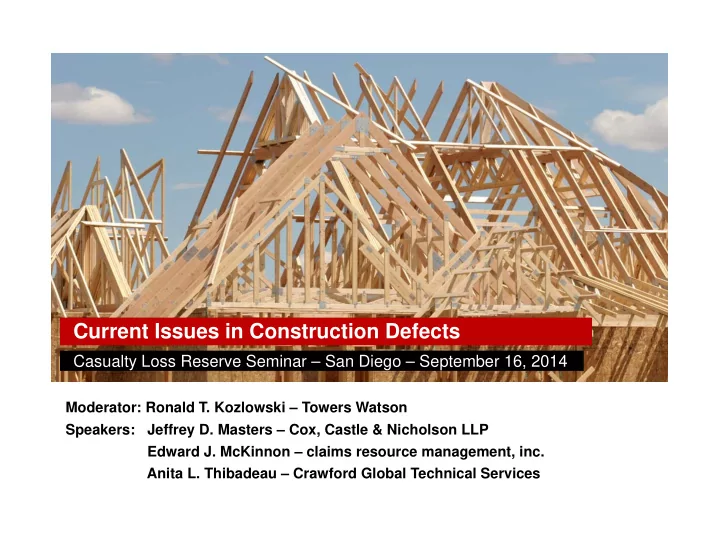
Current Issues in Construction Defects Casualty Loss Reserve Seminar - - PowerPoint PPT Presentation

current issues in construction defects
SMART_READER_LITE
LIVE PREVIEW

Current Issues in Construction Defects Casualty Loss Reserve Seminar - - PowerPoint PPT Presentation

Current Issues in Construction Defects Casualty Loss Reserve Seminar San Diego September 16, 2014 Moderator: Ronald T. Kozlowski Towers Watson Speakers: Jeffrey D. Masters Cox, Castle & Nicholson LLP Edward J. McKinnon


slide-1
SLIDE 1

Moderator: Ronald T. Kozlowski – Towers Watson Speakers: Jeffrey D. Masters – Cox, Castle & Nicholson LLP Edward J. McKinnon – claims resource management, inc. Anita L. Thibadeau – Crawford Global Technical Services

Current Issues in Construction Defects

Casualty Loss Reserve Seminar – San Diego – September 16, 2014

slide-2
SLIDE 2

Disclaimer Any views or opinions presented in this presentation are not necessarily those of the speakers and do not necessarily represent those of their companies. You must not rely upon the information provided as an alternative to legal advice from a professional legal services provider.

1

slide-3
SLIDE 3

Agenda

 Why is construction defect an issue?  Coverage issues  Notice & opportunity to repair laws  Emerging construction defect claims  Wrap-ups

2

slide-4
SLIDE 4

Why is construction defect an issue?

3

slide-5
SLIDE 5

Why is construction defect an issue? Definition of Construction Defect A construction defect is “the failure of the building or any building component to be erected in a reasonably workman-like manner or to perform in the manner intended by the manufacturer or reasonably expected by the buyer, which proximately causes damage to the structure.” — CA State Jury Instructions

4

slide-6
SLIDE 6

What is a construction defect claim?

 Patent defects are defects detectable through reasonable inspection.  An example of a patent defect is a wall that is moldy due to leaking pipes. This is

something that would be expected to be readily detectable.

 In most jurisdictions, the Statute of Limitations for filing suit for patent defects is

generally two to four years.

 Latent defects are defects that are not detectable through reasonable inspection

and are manifested over a period of time.

 An example of a latent defect is the pipes freezing in a house because the

plumbing was not properly insulated. This is something that would be not be expected to be readily detectable.

 The time limit for presenting latent claims is often governed by a state’s Statute

  • f Repose, which begins running on the date that construction is completed.

More time is allowed to submit a claim. The Statute of Repose is generally 6 to 10 years.

 The difference between a Statute of Repose and Statute of Limitations is that a Statute of Limitations

is triggered by a known injury, while a Statute of Repose is triggered by the completion of an act (e.g., building date or completion date).

Patent Defect Latent Defect

5

slide-7
SLIDE 7

Background: It all began in California

 Population growth & building boom

 Demand for housing exceeded supply  Shift in type of residences, population growth, coupled with the price of real estate,

caused the construction market to turn largely to townhomes and condominiums

 Increased production resulted in shortage of workers, cheaper materials, quicker

builds, less supervision

 Relatively unsophisticated construction risk management programs  Aggressive plaintiffs bar getting homeowners associations (HOAs) to sue the

builders for defects arising in multi-unit developments

 Plaintiff attorneys were successful in early suits:

 Successful verdicts were large, highly publicized events, thus encouraging other HOAs

to file lawsuits in hopes of reaching a similar conclusion

 Judicial system sympathetic and awards several large verdicts to homeowners

6

slide-8
SLIDE 8

 Great number of multi-family units (condos, townhomes) led to large cases

Lawyers’ focus on HOAs:

 Unlike decades ago, homebuyers expect perfection  Potential personal liability of condo board members if board does not sue

 Begins to spread to other states

7

Background: It all began in California

slide-9
SLIDE 9

Construction defect claims spread to other states

8

slide-10
SLIDE 10

Can you enlighten us on some of the major coverage issues?

9

slide-11
SLIDE 11

Montrose Chemical Corp vs. Superior Court (Canadian Universal Insurance Company)

 1993 California Supreme Court Decision  Established that insurer has a duty to defend insured in case involving the discharge of

hazardous substances

Montrose Chemical Corp vs. Admiral Insurance

 July 1995 California Supreme Court Decision  Pollution liability coverage case that determined that a continuous (coverage) trigger

applied during the time that the pollution occurred, effectively triggering all policies in force during that time period

 The California Supreme Court rejected insurer’s defense of “Known Loss” and “loss in

progress” doctrine

 The Montrose Decision, while providing some clarity on the issue of coverage allocation,

caused frequencies to increase dramatically because multiple insurers were named on virtually every lawsuit filed. At the same time, severities generally decreased because each insurer was deemed only partially involved

 Post-Montrose, the cost and complexity of California construction defect clams increased

significantly

10

Montrose Decisions

slide-12
SLIDE 12

 The “trigger spread” approach to allocation refers to the time period of an insured’s exposure, and

recognizes the tendency of courts to allocate losses “horizontally”, meaning that carriers are required to respond to latent claims on a pro rata or shared basis

 By spreading losses to all polices in force from commencement of construction to manifestation, the

insured’s available coverage is maximized

 Primary insurers are more exposed to losses . Reinsurers are less exposed  Due to Montrose, claims can trigger any policy between the date of project completion or the date of third-

party damage and the date of remediation. Insurers may not code claims consistently:

 Record a claim in every policy effective between completion and remediation  Record entire claim in policy period where project was completed or first effective policy thereafter. As policy limits

are extinguished open up new claim on next policy

 Record expense on only one policy or multiple

500,000 1,000,000 1,500,000 2,000,000 2,500,000 3,000,000 1990 1991 1992 1993 1994

Pre-Montrose

Primary Coverage Reinsurance Coverage

500,000 1,000,000 1,500,000 2,000,000 2,500,000 3,000,000 1990 1991 1992 1993 1994

Post-Montrose

Primary Coverage Reinsurance Coverage

Montrose Decision: Allocation of a $3 Million Claim

11

slide-13
SLIDE 13

Construction Defect as an Occurrence

 The standard commercial general liability policy provides coverage for damages

because of “property damage” that is caused by an “occurrence”

 The interpretation of “occurrence” often varies widely from one jurisdiction to the

next and the debate over whether damage caused by construction defect constitute an “occurrence” continues

 “Occurrence” means an accident, including continuous or repeated exposure to

substantially the same general harmful conditions

12

slide-14
SLIDE 14

Construction Defect as an Occurrence

 Opinion 1: Defective construction work and resulting damage are not covered

under liability insurance policies because neither was the result of an “accident”

 Example: KY

 Opinion 2: If the defective work causes property damage or bodily injury, it

constitutes an “occurrence”

 Example: VA, AL, CT, OH, NY, IL, WI, ME, SC, CA, CO

 Opinion 3: Faulty workmanship might constitute an “occurrence” if the faulty

work was unexpected and not intended by the insured and the property damage was not expected or intended

 Example: ND, GA, IN, MT

13

slide-15
SLIDE 15

Prior Completed Ops and Other Montrose Exclusions

14

 Damage to your work / product  Montrose exclusions and similar exclusions  Exclusions vary widely

 Prior completed ops  Pre-existing injury or damage  “First manifestation” requirement  Other

slide-16
SLIDE 16

Additional Insured (“AI”) Endorsements

 An AI endorsement amends subcontractor’s policy so that it covers the general

contractor for work performed on the contractor’s behalf by the sub

 With additional insured status, general contractors look to the subcontractor’s

insurer for defense and indemnification. General contractors want to be protected financially from lawsuits resulting from the subcontractors’ work

 Residential CD claims and suits often name numerous parties as defendants,

including: general contractors, subcontractors, manufacturers of building components and material distributors

15

slide-17
SLIDE 17

AI Endorsements

 Allocation of defense costs: since each policy is obligated to answer, most

courts require cost-sharing by equal shares; some courts allow sharing on a pro-rata basis

 2004 — ISO revised standard additional insured endorsements to require at

least some fault on the part of the NAMED insured for the additional insured’s coverage to apply: “caused, in whole or in part, by” the named insured

 General movement by insurers to tightening AI coverage  Dozens of different AI endorsements and schedules

16

slide-18
SLIDE 18

California Construction Indemnity Changes

 Historically, for both residential and commercial projects, California owners and

builders could pass liability to downstream parties - the general contractor, subcontractors, and suppliers via Type 1 indemnity clauses. Type 1 clauses afforded significant protection for indemnitees

 AB 2738 (effective 2009): owners, developers, and general contractors could

no longer obtain Type 1 indemnity from subcontractors on residential projects as to construction defect claims. Instead, subcontractors’ construction defect indemnity obligations were limited to claims arising out of the subcontractors’ respective scopes of work

 SB 474 (effective 1/11/13) put further limitations on contractual indemnities.

Commercial projects are now included

 As a consequence, commercial owners will use more owner controlled

insurance programs (OCIPs) and commercial contractors will use more contractor controlled insurance programs (CCIPs).

17

slide-19
SLIDE 19

 SB 474 may result in more disputes and litigation since the legislation bars

indemnification of an owner to the extent of the active negligence of the owner.

 What qualifies as the owner’s “active negligence”?

18

California Construction Indemnity Changes

slide-20
SLIDE 20

Additional Policy Exclusions & Modifications

 “Your own work”  Faulty workmanship  Exterior insulation and finish system (EIFS) exclusions  Fire-retardant heated wood  Polyethylene piping  Mold exclusions  Sunset provisions  Residential construction exclusions  Continuous & progressive provisions

19

slide-21
SLIDE 21

What is a Notice and Opportunity to Repair Law?

20

slide-22
SLIDE 22

Notice & Opportunity to Repair (“NOR”) Legislation

 Notice And Opportunity Laws provide that the homeowner must give notice and

the builder must be given the right to make an offer of repair. Failure to comply can prevent homeowner from moving forward with litigation

 28 states have NOR Statutes and 3 have quasi NOR Statutes

 Calderon Act (1995) - California

 HOA must provide notice of a claim to the builder and to members

  • f association before filing a lawsuit

 Written notice to the builder against whom the claim will be made,

including a list of defects

 Final result is that filing of lawsuits was delayed, increasing

lag time

 Widely viewed as ineffective

 SB 800 (2002) - California

 Established statutory functionality standards defining actionable defects  Mandatory pre-lawsuit process  Has it been effective? Mixed reviews

21

slide-23
SLIDE 23

Notice & Opportunity to Repair Legislation (as of 2011)

22

slide-24
SLIDE 24

Are NOR Statutes effective?

23

 Effectiveness depend s upon the perspective from which they are being

evaluated

 More complaints about NOR Statutes than there are compliments

 Short time frames for builders to respond, leaving little time for inspections

and insurance companies to respond, especially if construction is older and documentation hard to find

 Inability to obtain a release for repairs made – hampers a builder’s

incentive to consider making repairs

 Because litigation has not begun, difficult to get appropriate involvement

and attention of insurance carriers

 Handling of attorney’s fees  Once attorneys involved, NOR laws are ineffective in reducing litigation

slide-25
SLIDE 25

Can you chat about some of the emerging construction defect trends?

24

slide-26
SLIDE 26

Chinese Drywall

 Chinese Drywall

 After Hurricane Katrina, thousands of homes in the U.S. were constructed or renovated

with “Chinese drywall”, mainly in Florida and Louisiana

 This Chinese drywall contained high levels of sulfur, which emits a noxious smell and

corrodes piping and wiring. It also causes health problems including nosebleeds, headaches and respiratory ailments.

 661,877 wallboards imported, tens of thousand of homes are seeking compensation  Total number of incident reports: 4043

 Lawsuits against Knauf Plasterboard

 Knauf has created a fund to pay for repairing properties in Florida, Mississippi,

Louisiana and Alabama

 99% of claims related to Knauf were reviewed and settled in 2012

 Taishan Gypsum

 Taishan is a state-owned company which claims the US has no jurisdiction it

Taishan

 Ignored court rulings  Issue over whether an actual distributer in the US

25

slide-27
SLIDE 27

Chinese Drywall Affected States

26

slide-28
SLIDE 28

Chinese Drywall

 Lawsuits

 Re: Chinese-Manufactured Drywall Products Liability Litigation, MDL

2047 (2009)

  • The allegedly defective nature of Chinese drywall has resulted in a flood of lawsuits

in recent years, and builders and construction companies have set aside reserves to pay for these claims.

 TravCo Insurance Company v. Larry Ward (2012)

  • In most Chinese drywall insurance coverage cases, starting with TravCo Insurance

Company v. Larry Ward (2012), the sulfuric acid produced by the drywall is considered “pollution” and most CGL policies do not cover these claims due to their pollution exclusion clause

27

slide-29
SLIDE 29

Other Emerging Issues

 Chinese piping  Yellow brass  Systems defects

 HVAC  Other

 Commercial CD claims

28

slide-30
SLIDE 30

Are wrap-ups working effectively?

29

slide-31
SLIDE 31

Wrap-Ups

 What are the drivers for wrap-ups?  Are wrap-ups working?

30

slide-32
SLIDE 32

Questions?

Associate photo here

31

Ronald T. Kozlowski Towers Watson 415.733.4453 ron.kozlowski@towerswatson.com Edward J. McKinnon claims resource management, inc. (661) 265-6400 ed@crmi.com Anita L. Thibadeau Crawford Global Technical Services 714.989.5070 Anita_Thibadeau@us.crawco.com Jeffrey D. Masters Cox, Castle & Nicholson LLP 310.284.2239 jmasters@coxcastle.com

Associate photo here Associate photo here Associate photo here