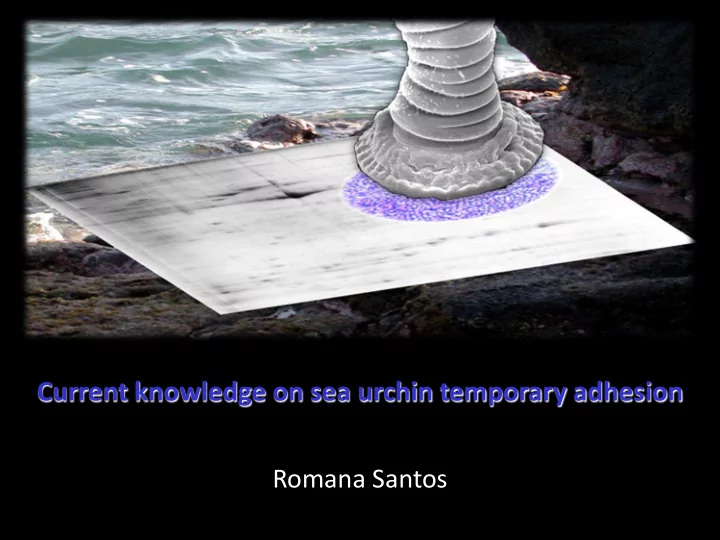
SLIDE 1
Current knowledge on sea urchin temporary adhesion
Romana Santos
SLIDE 2
2003 Research period Evolutionary Biomaterials Group Max-Planck, Germany Stanislav Gorb Dagmar Voigt
My own adhesion network
1999-2000 Master thesis Laboratory Marine Biology UMH, Belgium Patrick Flammang 2001-2005 PhD thesis Laboratory Marine Biology UMH, Belgium Patrick Flammang Elise Hennebert Pierre Becker 2006-2009 Pos-doc researcher Mass Spectrometry Lab ITQB, Portugal Ana Coelho 2009-2013 Assistant researcher Biomedical and Oral Sciences Research Unit - UICOB Faculty of Dentistry, Portugal Manuela Lopes Marise Almeida
SLIDE 3 Sea urchin temporary adhesion
W4 Fabrication
adhesives and their evaluation W1 Chemical characterization and synthesis of adhesives W3 Mechanical testing and theory W2 Structural characterization
synthetic adhesives
SLIDE 4
Sea urchins have: (1) specialized adhesive organs, the oral tube feet
Sea urchin temporary adhesion Structural characterization
mobility resistence contact adhesion stem disc
SLIDE 5
Sea urchins have: (2) temporary adhesion => attachment / detachment cycles (1) specialized adhesive organs, the oral tube feet adhesive epidermis
Sea urchin temporary adhesion Structural characterization
SLIDE 6
Sea urchins have: (2) temporary adhesion => attachment / detachment cycles adhesive epidermis (1) specialized adhesive organs, the oral tube feet duo-gland adhesive system
Sea urchin temporary adhesion Structural characterization
SLIDE 7 Sea urchins have: (2) temporary adhesion => attachment / detachment cycles duo-gland adhesive system (1) specialized adhesive organs, the oral tube feet
HYDRODYNAMISM subtidal subtidal-intertidal soft hard medium-high low DEPTH SUBSTRATE
adhesive cells adhesive granules
∅ 300-700 nm diversity of ultrastructure released for attachment
Sea urchin temporary adhesion Structural characterization
SLIDE 8 Sea urchins have: (2) temporary adhesion => attachment / detachment cycles duo-gland adhesive system (1) specialized adhesive organs, the oral tube feet de -adhesive cells
HYDRODYNAMISM subtidal subtidal-intertidal soft hard medium-high low DEPTH SUBSTRATE
de - adhesive granules
150x200 nm constant ultrastructure released for detachment
Sea urchin temporary adhesion Structural characterization
SLIDE 9 Sea urchins have: (3) adhesive secretion remains on the substrate as a footprint
footprint
Sea urchin temporary adhesion Structural characterization
(2) temporary adhesion => attachment / detachment cycles (1) specialized adhesive organs, the oral tube feet
SLIDE 10
100-300 nm in thickness sponge-like hydrated structure Sea urchin temporary adhesion Structural characterization
Sea urchins have: (3) adhesive secretion remains on the substrate as a footprint (2) temporary adhesion => attachment / detachment cycles (1) specialized adhesive organs, the oral tube feet
SLIDE 11
Sea urchins have: (1) Tube foot disc tenacities similar to other marine organisms
Sea urchin temporary adhesion Mechanical testing
sea urchin dynamometer
Disc tenacity force/area of contact
tube foot disc subtrate
SLIDE 12 Sea urchins have: (1) Tube foot disc tenacities similar to other marine organisms
Sea urchin temporary adhesion Mechanical testing
Tenacity (MPa) 0.20 0.29 0.09 Indo-West Pacific Atlantic and Mediterranean Geography Taxonomy
Sphaerechinus granularis Paracentrotus lividus Arbacia lixula Echinometra mathaei Stomopneustes variolaris Heterocentrotus trigonarius Colobocentrotus atratus
subtidal subtidal-intertidal intertidal low very-high medium-high soft hard Depth Hydrodynamism Substrate 0.22 0.21 0.25 0.54
SLIDE 13
Sea urchins have: (1) Tube foot disc tenacities similar to other marine organisms
Sea urchin temporary adhesion Mechanical testing
(2) Tube foot discs perform better on high-energy polar substrates
Smooth substrates Tenacity (MPa) Glass 0.31ab Polymethylmethacrylate 0.34b Polystyrene 0.29ab Polypropylene 0.17a Critical surface area (mJ m-2) 70 39 33 32 Polarity 0.17 0.02
SLIDE 14 Sea urchins have: (1) Tube foot disc tenacities similar to other marine organisms
Sea urchin temporary adhesion Mechanical testing
(2) Tube foot discs perform better on high-energy polar substrates (3) Tube foot discs replicates the substrate roughness, behaving like a visco-elastic material
E1 τ E0
0,5 1 1,5 2 2,5 5 10 15 20 25 30 Time (s) Force (mN) 0,5 1 1,5 2 2,5 20 40 60 80 100 120 Displacement (µm) Force (mN)
SLIDE 15 Sea urchins have: (1) Tube foot disc tenacities similar to other marine organisms
Sea urchin temporary adhesion Mechanical testing
(2) Tube foot discs perform better on high-energy polar substrates (3) Tube foot discs replicates the substrate roughness, behaving like a visco-elastic material
Disc deforms Spreads adhesive in a thin layer
E1 τ E0
SLIDE 16 Sea urchins have: (1) Two sources of adhesive material – extruded and non-extruded
Sea urchin temporary adhesion Biochemical characterization adhesive discs non-extruded adhesive secretions soluble proteins complex mixture
Paracentrotus lividus
footprints extruded adhesive secretions insoluble proteins simpler mixture
SLIDE 17 Sea urchins have: (1) Two sources of adhesive material – extruded and non-extruded
Sea urchin temporary adhesion Biochemical characterization
(2) Footprint material is highly insoluble, being composed of at least 13 proteins
High concentration of denaturing (2% SDS) and reducing agents (0.5M DTT) => noncovalent (hydrophobic and electrostatic interactions) + disulfide bonds 6 proteins identified by MS – actin, tubulin and histone 7 unidentified proteins - 5 de novo generated sequences with no homology with known proteins
45% 6% 2% 3% 44% inorganic residues proteins neutral sugars lipids unknown
SLIDE 18
Sea urchins have: (1) Two sources of adhesive material – extruded and non-extruded
Sea urchin temporary adhesion Biochemical characterization
(2) Footprint material is highly insoluble, being composed of at least 13 proteins
SLIDE 19
Sea urchins have: (1) Two sources of adhesive material – extruded and non-extruded
Sea urchin temporary adhesion Biochemical characterization
(2) Footprint material is highly insoluble, being composed of at least 13 proteins
7 unidentified proteins - 5 de novo generated sequences with no homology with known proteins
SLIDE 20 Sea urchins have: (1) Two sources of adhesive material – extruded and non-extruded
Sea urchin temporary adhesion Biochemical characterization
(2) Footprint material is highly insoluble, being composed of at least 13 proteins (3) Tube feet discs is more soluble but more complex and contains at least 204 unique proteins
Response to stimulus; 5,2% Regulation; 38,2% Metabolic process; 11,5% Localization; 20,1% Interaction with cells/organisms; 8,4% Immune system process; 8,4% Growth ; 3,1% Developmental process; 10,5% Cellular process; 72,3% Other; 41,2%
sliced 40 bands 32 fractions/band
SLIDE 21 Sea urchins have: (1) Two sources of adhesive material – extruded and non-extruded
Sea urchin temporary adhesion Biochemical characterization
(2) Footprint material is highly insoluble, being composed of at least 13 proteins (3) Tube feet discs is more soluble but more complex and contains at least 204 unique proteins
Response to stimulus; 5,2% Regulation; 38,2% Metabolic process; 11,5% Localization; 20,1% Interaction with cells/organisms; 8,4% Immune system process; 8,4% Growth ; 3,1% Developmental process; 10,5% Cellular process; 72,3% Other; 41,2%
More abundant proteins: 15% actins => cellular cytoskeleton 11% histones => nucleosome assembly + antibacterial activity 9% ras-related proteins => signal Transduction + vesicle-mediated protein transport + regulation of exocytosis 8% tubulins => microtubule based- movement + protein polymerization
SLIDE 22 Sea urchins have: (1) Two sources of adhesive material – extruded and non-extruded
Sea urchin temporary adhesion Biochemical characterization
(2) Footprint material is highly insoluble, being composed of at least 13 proteins (3) Tube feet discs is more soluble but more complex and contains at least 204 unique proteins
Other interesting protein groups: Protein biosynthesis (ribossomal protein, eukaryotic
initiation factor, elongation factor 1-alpha and ubiquitin)
Protein folding and glycosylation
(peptidyl- prolyl cis-trans isomerase; protein disulfide-isomerase, dolichyl-diphosphooligosaccharide protein glycosyltransferase )
adhesive protein secretion
Response to stimulus; 5,2% Regulation; 38,2% Metabolic process; 11,5% Localization; 20,1% Interaction with cells/organisms; 8,4% Immune system process; 8,4% Growth ; 3,1% Developmental process; 10,5% Cellular process; 72,3% Other; 41,2%
SLIDE 23 Sea urchins have: (1) Two sources of adhesive material – extruded and non-extruded
Sea urchin temporary adhesion Biochemical characterization
(2) Footprint material is highly insoluble, being composed of at least 13 proteins (3) Tube feet discs is more soluble but more complex and contains at least 204 unique proteins
Other interesting protein groups: Spatial learning (Hippocalcin-like protein 1 ) Visual perception + response to stimulus
(Hemicentin-1 percursor)
Signal transduction (guanine nucleotide-binding
protein ; GTPase Kras; Rab GDP dissociation inhibitor, Ras- related protein, isoform Long of Flotillin-1)
Substrate recognition Triggering of attachment/detachment
Response to stimulus; 5,2% Regulation; 38,2% Metabolic process; 11,5% Localization; 20,1% Interaction with cells/organisms; 8,4% Immune system process; 8,4% Growth ; 3,1% Developmental process; 10,5% Cellular process; 72,3% Other; 41,2%
SLIDE 24 Sea urchins have: (1) Two sources of adhesive material – extruded and non-extruded
Sea urchin temporary adhesion Biochemical characterization
(2) Footprint material is highly insoluble, being composed of at least 13 proteins (3) Tube feet discs is more soluble but more complex and contains at least 204 unique proteins
Other interesting protein groups: Exocytosis (annexin, ras-related proteins ) Release of adhesive/de-adhesive secretions
Response to stimulus; 5,2% Regulation; 38,2% Metabolic process; 11,5% Localization; 20,1% Interaction with cells/organisms; 8,4% Immune system process; 8,4% Growth ; 3,1% Developmental process; 10,5% Cellular process; 72,3% Other; 41,2%
SLIDE 25 Sea urchins have: (1) Two sources of adhesive material – extruded and non-extruded
Sea urchin temporary adhesion Biochemical characterization
(2) Footprint material is highly insoluble, being composed of at least 13 proteins (3) Tube feet discs is more soluble but more complex and contains at least 204 unique proteins
Other interesting protein groups: Cell/substrate adhesion
(nahoda protein, echinonectin, galectin)
Constituents of the adhesive secretions + Unidentified proteins with de novo sequences similar to the ones found in footprints
Response to stimulus; 5,2% Regulation; 38,2% Metabolic process; 11,5% Localization; 20,1% Interaction with cells/organisms; 8,4% Immune system process; 8,4% Growth ; 3,1% Developmental process; 10,5% Cellular process; 72,3% Other; 41,2%
SLIDE 26 Sea urchin temporary adhesion Conclusions
Sea urchin adhesive secretions have: (1) Tenacities between 0.09-0.54 MPa (2) Efficient in substrates with different chemistries => perform better on high-energy polar substrates (3) Tube feet discs have visco-elastic properties to cope with substrate roughness => replicate substrate profile and spread adhesive in a thin layer (4) Footprint material is highly insoluble, being composed of at least 13 proteins => some new or highly modified (5) Tube feet discs is composed of at least 204 unique proteins => involved in protein biosynthesis, folding and glycosylation + sensory perception and response to stimulus + protein exocytosis + cell/substrate adhesion + new
SLIDE 27
Sea urchin temporary adhesion Acknowledgments