Current Status and Future Trends of the Post-Combustion Capture - - PowerPoint PPT Presentation

current status and future trends of the post combustion
SMART_READER_LITE
LIVE PREVIEW

Current Status and Future Trends of the Post-Combustion Capture - - PowerPoint PPT Presentation

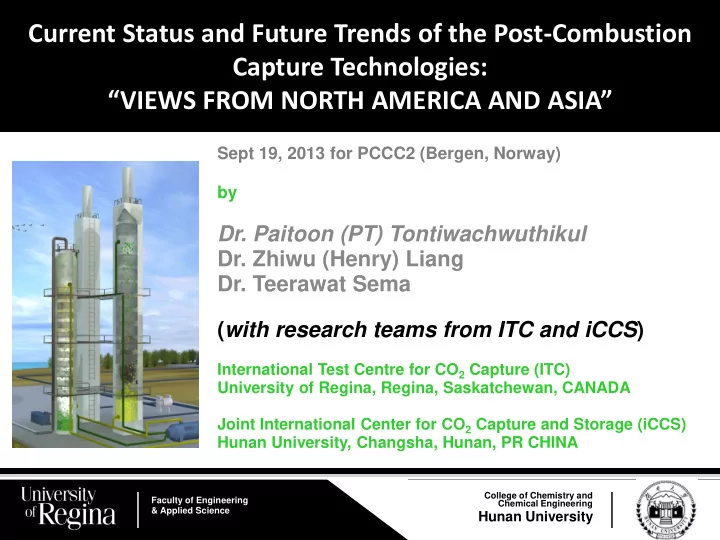
Current Status and Future Trends of the Post-Combustion Capture Technologies: VIEWS FROM NORTH AMERICA AND ASIA Sept 19, 2013 for PCCC2 (Bergen, Norway) by Dr. Paitoon (PT) Tontiwachwuthikul Dr. Zhiwu (Henry) Liang Dr. Teerawat Sema (


slide-1
SLIDE 1

Current Status and Future Trends of the Post-Combustion Capture Technologies: “VIEWS FROM NORTH AMERICA AND ASIA”

Sept 19, 2013 for PCCC2 (Bergen, Norway) by

  • Dr. Paitoon (PT) Tontiwachwuthikul
  • Dr. Zhiwu (Henry) Liang
  • Dr. Teerawat Sema

(with research teams from ITC and iCCS)

International Test Centre for CO2 Capture (ITC) University of Regina, Regina, Saskatchewan, CANADA Joint International Center for CO2 Capture and Storage (iCCS) Hunan University, Changsha, Hunan, PR CHINA

Faculty of Engineering & Applied Science College of Chemistry and Chemical Engineering

Hunan University

slide-2
SLIDE 2

Presentation overview

 Background Post-Combustion Carbon Capture (PCC)  Current status in ASIA (China, Japan, ASEAN)  R&D at iCCS, Hunan University  Current status in North America (USA, AB, SK)  RD&D initiatives by ITC, University of Regina  PAST, PRESENT & FUTURE OF PCC

Faculty of Engineering & Applied Science Faculty of Engineering & Applied Science College of Chemistry and Chemical Engineering

Hunan University

slide-3
SLIDE 3

Key Global Events that Changing CCS

  • Financial Crisis in 2008
  • Tsunami and Nuclear Power Plants at

Fukushima

  • Carbon Intensity Issues about Oil Sands in

North America (e.g. Keystone Pipeline (?)

  • CO2 Concentration has passed 400 ppm level!
slide-4
SLIDE 4

World energy consumption

Faculty of Engineering & Applied Science College of Chemistry and Chemical Engineering

Hunan University

World source of power generation

slide-5
SLIDE 5

Faculty of Engineering & Applied Science College of Chemistry and Chemical Engineering

Hunan University

  • Available for foreseeable

future

  • Affordable for long-term
  • Reliability source of energy
  • Safety to store in a power

plant

“However”

Energy by coal contributes to 42% of the global CO2 emission Energy by COAL

slide-6
SLIDE 6

Faculty of Engineering & Applied Science College of Chemistry and Chemical Engineering

Hunan University

Carbon content per unit of energy generated

slide-7
SLIDE 7

Faculty of Engineering & Applied Science College of Chemistry and Chemical Engineering

Hunan University

Key technologies for reducing global CO2 emissions under Blue Map scenario

slide-8
SLIDE 8

Geographical relationship between sources and storage “opportunities”

Storage prospectivity

Highly prospective sedimentary basins Prospective sedimentary basins Non-prospective sedimentary basins, metamorphic and igneous rock Data quality and availability vary among regions

Prospective areas in sedimentary basins where suitable saline formations, oil or gas fields, or coal beds may be found. Locations for storage in coal beds are only partly included. Prospectivity is a qualitative assessment of the likelihood that a suitable storage location is present in a given area based on the available information. This figure should be taken as a guide only, because it is based on partial data, the quality of which may vary from region to region, and which may change over time and with new information (Courtesy of Geoscience Australia).

slide-9
SLIDE 9

Planned and current locations of geological storage

slide-10
SLIDE 10

Faculty of Engineering & Applied Science College of Chemistry and Chemical Engineering

Hunan University

Post-combustion capture

  • Amine-based
  • Chilled ammonia
  • Catalyst-based
  • Membrane

separation

  • Enzyme-based
  • Relatively,
  • Cheaper
  • Simpler
  • ~5-10 years closer to

deployment

  • Can be used to retrofit

existing conventional coal- fired power plants

Why post-combustion capture with amine

slide-11
SLIDE 11

“VIEWS FROM ASIA and NORTH AMERICA”

slide-12
SLIDE 12

CHINA

slide-13
SLIDE 13

Faculty of Engineering & Applied Science College of Chemistry and Chemical Engineering

Hunan University

  • World’s most populous country
  • World second largest economy
  • World largest contributor to CO2 emission (7,700 Mt = over 25%)
  • Chinese CO2 emission mostly from:
  • ELECTRICITY AND HEAT (50%)
  • Manufacturing/Construction 30%
  • Industrial Processes 10%
  • Governmental Policy on Carbon Capture
  • National Medium and Long-term Science and Technology

Development Plan Towards 2020 (2006-2020)

  • The 12th Five-Year Work Plan on Controlling GHG Emissions

(2011-2015)

  • Promoting Carbon Capture , Utilization and Storage Pilot and

Demonstration (Department of Climate Change) Why CHINA

Global CCS Institute

slide-14
SLIDE 14

Faculty of Engineering & Applied Science College of Chemistry and Chemical Engineering

Hunan University

Present situation of CO2 emission in CHINA

  • World large carbon emitting country

(7.7 billion tons per year)

  • Coal is the main energy source (70.4 %)
  • Mostly used in power generation industry (75% of power

production is from coal). Carbon emission reduction in China is significant

The Guardian

slide-15
SLIDE 15
slide-16
SLIDE 16

Faculty of Engineering & Applied Science College of Chemistry and Chemical Engineering

Hunan University

 Large sources of CO2 (>0.1 MtCO2/year)  Power & Non-power sectors  994 plants  Total emission of 1081 Mt CO2/year  73% Power Generation  27% from Cement, Iron, Steel, Refineries, Chemicals (e.g. ammonia, ethylene, ethylene oxide, hydrogen, etc.)

Why CHINA

Centre for Low Carbon Futures report

slide-17
SLIDE 17

Faculty of Engineering & Applied Science College of Chemistry and Chemical Engineering

Hunan University

Chinese leading companies working on carbon mitigation

  • China Huaneng Group

(Coal business & Electricity)

  • Shaanxi Yanchang Petroleum Group

(Oil & Gas business)

  • CNPC Group

(Oil & Gas business)

  • Sinopec Group

(Oil & Gas business)

slide-18
SLIDE 18

Faculty of Engineering & Applied Science College of Chemistry and Chemical Engineering

Hunan University

China Huaneng Group

  • Largest Power Generator in China
  • First PCC project in China in 2008

(Huaneng Beijing plant)

  • Claim - carbon capture process at 30-35

USD/ton CO2

slide-19
SLIDE 19

Faculty of Engineering & Applied Science College of Chemistry and Chemical Engineering

Hunan University

  • 1, 320 Mw coal-fired power plant
  • 120,000 tons of CO2 a year
  • 30-35 USD/ton CO2 (100 USD for first generation PCC)
  • Claim as succeed in Technical design and Economic aspects
  • High purity of CO2 (99.5%) can be used in FOOD INDUSTRY
  • Unrevealed technical details of plant design & solvent

chemistry

Nature 469, 276-277 (2011)

Case study of The Shidongkou No. 2 Power Plant , Shanghai, China

slide-20
SLIDE 20

Faculty of Engineering & Applied Science College of Chemistry and Chemical Engineering

Hunan University

China National Petroleum Corporation (CNPC)

  • 151 Mt of oil production
  • 93 Gm3 NG production
  • Carbon capture for Natural gas

processing & Clean coal

  • Substituting NG for oil Project
  • @ Inner Mongolia up to 100,000 ton

CO2 capacity demonstration plant (an ultimate aim of 3 Mt)

  • CO2 source: coal gasification

2012 CNPC annual report

slide-21
SLIDE 21

Faculty of Engineering & Applied Science College of Chemistry and Chemical Engineering

Hunan University

China National Petroleum Corporation (CNPC)

CCUS R&D in China 2011

  • Captured CO2 for storage project
  • Up to 100,000 ton CO2/year injection

(2011-2014)

  • CO2 tank car transportation
slide-22
SLIDE 22

Faculty of Engineering & Applied Science College of Chemistry and Chemical Engineering

Hunan University

China Petroleum & Chemical Corporation (SINOPEC)

  • 328 million barrels of oil production
  • 598 bcf NG production
  • Largest refinery in ASIA (221 million ton)
  • Low Carbon Development Strategy
  • Carbon Capture project at Sinopec Shengli

Oil Field, Dongying, Shangdong

  • 14% CO2 flue gas from Shengli Power Plant
  • Currently capture 40,000 ton CO2/year
  • Ultimate aim of million ton CO2 captured

2012 SINOPEC annual report

slide-23
SLIDE 23

Faculty of Engineering & Applied Science College of Chemistry and Chemical Engineering

Hunan University

China Petroleum & Chemical Corporation (SINOPEC)

2012 SINOPEC annual report

  • Captured CO2 (99.5% purity) will be used

for CO2-EOR

  • Transportation
  • Tank car
  • Pipeline (51-100 km)
  • Pre-feasibility studies in 2012/2013
  • Investment decision in 2013/2014
  • Will be launched in 2017
slide-24
SLIDE 24

Faculty of Engineering & Applied Science College of Chemistry and Chemical Engineering

Hunan University

China Petroleum & Chemical Corporation (SINOPEC)

Carbon Capture project at Sinopec Shengli Oil Field

CCUS R&D in China 2011

slide-25
SLIDE 25

Faculty of Engineering & Applied Science College of Chemistry and Chemical Engineering

Hunan University

Shaanxi Yanchang Petroleum Group

2012 Yanchang Petroleum annual report

  • Oil and Gas business
  • E&P, Refinery, petrochemicals
  • 12.6 Mt of crude oil
  • Carbon Capture and Utilization
  • Non-power sector
  • CO2 Capture from Yulin Coal-Chemical

Company in Shaanxi (50,000 ton CO2 per year)

  • CO2 EOR at Yanchang’s Jinbian

Qiaojiawa CO2 injection site

slide-26
SLIDE 26

Faculty of Engineering & Applied Science College of Chemistry and Chemical Engineering

Hunan University

Shaanxi Yanchang Petroleum Group

Centre for Low Carbon Futures report

  • Great Opportunity in Shaanxi (CAPTURE & EOR)
  • China major coal base with highly developed coal-chemical

industry

  • Chemical plants: ammonia, methanol, hydrogen, ethanol,

dimethylether

  • Highly suitable for CO2-EOR
slide-27
SLIDE 27

Faculty of Engineering & Applied Science College of Chemistry and Chemical Engineering

Hunan University

Challenges and Opportunities for PCC in China

  • Rapid China’s economic growth resulting in a largely increase of

CO2 emission  Carbon Capture is CRUCIAL

  • Several demonstration projects are now operating; under

construction and planning

  • Good support from governmental policy/programs
  • Everything is cheap in CHINA, large scale PCC can be deployed
  • China is now in early stage of demonstration phase; need

Technology Improvement and Market Development

  • Social awareness and acceptance are important
  • Commercial gap for profitable PCC
  • PCC + EOR/Coal-to-Liquids
slide-28
SLIDE 28

28

slide-29
SLIDE 29

Faculty of Engineering & Applied Science College of Chemistry and Chemical Engineering

Hunan University

Joint International Center for CO2 Capture and Storage (iCCS) Hunan University, China

slide-30
SLIDE 30

Faculty of Engineering & Applied Science College of Chemistry and Chemical Engineering

Hunan University

PCC in JAPAN

  • World third largest economy (after US and CHINA)
  • 1,258 Mt CO2 was emitted in 2010

(90% from Energy sector)

  • 1997 KYOTO Protocol
  • 2007 COOL EARTH policy by PM Abe

 50% GHGs reduction by 2050

  • March 11, 2011: Nuclear Accidents

 Nuclear Power Stations have been shut down (lost 25-30% electricity capacity)

JEPIC; Global CCS Institute; CCUS R&D in JAPAN by GASSNOVA

slide-31
SLIDE 31

Faculty of Engineering & Applied Science College of Chemistry and Chemical Engineering

Hunan University

PCC in JAPAN

  • Revision of the Energy Master Plan
  • Largely increase in a fossil-fired power generation dependency
  • In order to meet the target, Carbon Capture is crucial
  • KEY Players: MHI, TOSHIBA, HITASHI,RITE,

POWER Industry (TEPCO; KEPCO)

  • Advanced Carbon Capture Technology in JAPAN
  • Presently, 52.5 USD/ton CO2
  • Targets at 25 USD (2015) & 12.5 USD (2020s)

JEPIC; CCUS R&D in JAPAN by GASSNOVA

slide-32
SLIDE 32

CCS in Southeast Asia

Asian Development Bank (ADB); Global CCS Institute

Faculty of Engineering & Applied Science College of Chemistry and Chemical Engineering

Hunan University

  • ASEAN (Brunei, Burma,

Cambodia, Indonesia, Laos, Malaysia, the Philippines, Singapore, Thailand, Vietnam)

  • 600 M people; 2

Trillion GDP

  • Energy demand will

be increased by 76% (2007-2030)

  • Especially; Coal,

Oil&Gas

slide-33
SLIDE 33

CCS in Southeast Asia

Faculty of Engineering & Applied Science College of Chemistry and Chemical Engineering

Hunan University

  • Southeast Asia short term Carbon Capture on Natural Gas

Processing

  • Southeast Asia Medium term Carbon Capture on Coal Fired

Power Plant

  • Asian Development Bank (ADB) initiated Regional capacity

Development Technical Assistant Program (R-CDTA) to promote Clean Coal Technology associated with CCS

  • Focused countries: Indonesia, Malaysia, Thailand, Vietnam
  • Key Partners: China, India, Korea, Europe
  • Due to the increase of electricity/coal consumptions

Asian Development Bank (ADB)

slide-34
SLIDE 34

CCS in Southeast Asia

Faculty of Engineering & Applied Science College of Chemistry and Chemical Engineering

Hunan University

  • Recently, CCS projects are rarely operated; especially for

environmental reason

  • Lacks of Legislations, Regulations, Governmental Support,

Social Awareness

  • Potentially a great area for CCS investments
  • High purity CO2, CO2 conversion, EOR & Storage

Asian Development Bank (ADB)

slide-35
SLIDE 35

Faculty of Engineering & Applied Science College of Chemistry and Chemical Engineering

Hunan University

Present situation of CO2 emission in the USA

  • World third largest population (313 M)
  • World largest economy
  • World second largest carbon emitting country

(5.4 billion tons per year)  18% of world wide emission

  • Mostly from power generation (37%)
  • CO2 mitigation target of 17% (2005-2020)
  • At about 7.5% CO2 emission was reduced (2006-2011)

Congressional Research Service: Carbon Capture and Sequestration: RD&D at the DOE. 2013

slide-36
SLIDE 36

Faculty of Engineering & Applied Science College of Chemistry and Chemical Engineering

Hunan University

US Environmental Policy

  • From US Environmental Protection Agency (EPA), a NEW rule

that limits CO2 emissions to be no more than 1,000 lb CO2/MWhr (issued in MARCH 2012).

  • Option of using 30 yrs average CO2 emissions to meet the

standard.

  • The New RULE (section 111; Clean Air Act) applies for NEW

fossil-fired power plants. But not for existing plants.

  • Those new COAL fired-power plants will DEFINITELY need PCC.
  • According to this policy, PCC in US will be crucial.
  • Natural Gas!

US DOE & Global CCS Institute

slide-37
SLIDE 37

Faculty of Engineering & Applied Science College of Chemistry and Chemical Engineering

Hunan University

US Current PCC Status

  • Over 20 large scale Carbon Capture Projects (> 1 Mt CO2 /yr) in

US.

  • 5 Projects are defined; and will be executed during 2014-2017.
  • 6 Projects are under evaluations; and may be executed during

2015-2018)

  • Great potential for CCUS; over 40% of coal generating sources

located above potential geological sequestration sites.

US DOE & Global CCS Institute

slide-38
SLIDE 38

Faculty of Engineering & Applied Science College of Chemistry and Chemical Engineering

Hunan University

US Current PCC Status

  • Great potential for CCUS; over 40% of coal generating sources

located above potential geological sequestration sites.

  • 5 Projects are defined; and will be executed during 2014-2017.
  • 6 Projects are under evaluations; and may be executed during

2015-2018)

US DOE

slide-39
SLIDE 39

Faculty of Engineering & Applied Science College of Chemistry and Chemical Engineering

Hunan University

CCS in Alberta, Canada

Alberta Energy

  • Alberta has committed total of

1.5 billion CAD for 15 years

  • 170 million CAD for CCS in 2013/2014
  • 2 projects: Alberta Carbon Trunk Line

& Shell Quest

  • Total GHG reduction of 2.76 Mt CO2/year

(in 2016)

  • CO2 will be captured, converted into liquid,

transported, injected for CO2-EOR/storage

  • Alberta’s geology is suitable for CCS
slide-40
SLIDE 40

Alberta Carbon Trunk Line

Alberta Energy

  • 495 million CAD for 15 years

(2011)

  • Carbon Capture from a

Fertilizer Plant & an Oil Sand Bitumen Refinery

  • 240 km pipeline transport
  • For EOR & Storage

Faculty of Engineering & Applied Science College of Chemistry and Chemical Engineering

Hunan University

slide-41
SLIDE 41

Faculty of Engineering & Applied Science College of Chemistry and Chemical Engineering

Hunan University

Shell Quest

Alberta Energy

  • 745 million CAD

for 15 years (2011)

  • 1.2 Mt CO2
  • From Shell’s

Scotford oil sand upgrader & expansion

  • 80 km pipeline

transport

  • For EOR & Storage
slide-42
SLIDE 42

CCUS R&D in Saskatchewan, Canada

  • IEA Weyburn-Midale CO2 Storage and EOR
  • SaskPower BD3
  • ITC
slide-43
SLIDE 43

IEA GHG Weyburn-Midale CO2 Monitoring & Storage Project

Field size

  • 70 square miles

Original oil in place:

  • 1.4 billion barrels

Oil recovery (pre-CO2-EOR):

  • 370 million barrels

Projected CO2 IOR:

  • 155 million barrels

Projected CO2 stored:

  • 30+ million tonnes* (gross)
  • 26+ million tonnes (net)
slide-44
SLIDE 44

Faculty of Engineering & Applied Science College of Chemistry and Chemical Engineering

Hunan University

IEA GHG Programme Large CCS Projects

slide-45
SLIDE 45
slide-46
SLIDE 46

Project location: Williston Basin

Weyburn Field REGINA

Regina Estevan Bismarck

North Dakota Montana Manitoba Saskatchewan

Weyburn Beulah

slide-47
SLIDE 47

Weyburn Pipeline

Faculty of Engineering & Applied Science

slide-48
SLIDE 48

Project Overview

  • The world’s largest, full-scale, in-field CO2 geologic storage

measurement, monitoring, & validation study with CO2 EOR.

  • Launched in 2000
  • 11-year, $85 million (CAD) international project.
  • CO2 captured from Dakota Gasification Plant (320 km pipeline).
  • Alternated CO2-water injection.
  • Injected CO2 is separated from produced oil & water and re-

injected.

  • At the end of EOR, all injected and recycled CO2 is permanently

stored in deep underground.

Faculty of Engineering & Applied Science College of Chemistry and Chemical Engineering

Hunan University

slide-49
SLIDE 49

Key Findings

  • 18,000 incremental barrel of oil per day (BOPD) has been achieved.
  • Geological characteristic of Weyburn oil pool is considered to be

highly suitable for the secure long-term storage of CO2.

  • Soil gas sampling above the injection site found no evidence of

escaped CO2.

  • Estimated storage capacity of 45.15 million tons of CO2.
  • Long-term risk assessment/performance studies confirm the

geological study that CO2 can be store securely in the reservoir.

  • The CO2 storage can be economically satisfied when combined with

EOR.

Faculty of Engineering & Applied Science College of Chemistry and Chemical Engineering

Hunan University

slide-50
SLIDE 50

Weyburn Project Results

Faculty of Engineering & Applied Science College of Chemistry and Chemical Engineering

Hunan University

slide-51
SLIDE 51

Faculty of Engineering & Applied Science College of Chemistry and Chemical Engineering

Hunan University

Life Cycle Analysis (LCA)

Results

Weyburn Oil Field

Capacity (million tonnes) Capacity/barrel of incremental oil (tonnes/barrel)

CO2 purchased

20 0.1538

CO2 recycled

23 0.1769

CO2 injected

43 0.3307

CO2 emitted

1.4 0.0107

CO2 net storage

18.6 0.1430

slide-52
SLIDE 52

Aquistore – Project Objectives (CO2 Storage Demonstration)

Demonstrate Capture, Transportation and Storage of CO2 in saline formation Identify and develop best methods & technologies Involve research institutions, policy makers, industry, and public.

Flow Units Sealing Units Potash Icebox Shale Winnipeg-Deadwood Glacial Till

slide-53
SLIDE 53

Commercial Demonstration of CCS in Saskatchewan Boundary Dam 3 Carbon Capture and Storage Project (BD3)

www.saskpower.com

slide-54
SLIDE 54
slide-55
SLIDE 55
slide-56
SLIDE 56

ESP FURNACE Waste Storage / Sale for Concrete Production AIR HTR

S T A C K

ASH

Steam EOR Grade CO2 Compressor

PERMANENT GEOLOGICAL STORAGE

N2,Water Minor Nox, CO2 Traces: PM, Hg, Z Heat Recovery Loop

115 M W COAL

SO2 Absorber Reboiler CO2 Absorber Reboiler

SO2 Conversion to sulfuric Acid for sale or deep Geological storage as Liquid SO2

slide-57
SLIDE 57

Boundary Dam 3 – SaskPower – Saskatchewan, Canada

  • Boundary Dam Integrated Carbon Capture and Storage

Demonstration Project

  • $1.24-billion partnership involving the Government of

Canada, the Government of Saskatchewan, SaskPower, and private industry

  • In construction and scheduled to begin operation in

2014.

  • 1 million tonnes CO2/year captured at 90% emission

reduction

  • Upgrading the unit’s output to help meet the

additional power demands of the CCS operation.

slide-58
SLIDE 58

International Test Centre for CO2 Capture University of Regina

Faculty of Engineering & Applied Science College of Chemistry and Chemical Engineering

Hunan University

slide-59
SLIDE 59

Carbon Capture R&D at ITC:

  • Solvent Development and Testing
  • Packing, solution, and membrane development and testing
  • Process configurations
  • Corrosion studies
  • Simulation and modeling
  • Artificial Intelligence/knowledge-based process control and monitoring

systems

Faculty of Engineering & Applied Science College of Chemistry and Chemical Engineering

Hunan University

slide-60
SLIDE 60

In-house pilot plant (1 t/d)

Faculty of Engineering & Applied Science College of Chemistry and Chemical Engineering

Hunan University

slide-61
SLIDE 61

Faculty of Engineering & Applied Science College of Chemistry and Chemical Engineering

Hunan University

Production Facilities for Catalysts and H2

slide-62
SLIDE 62

Our Catalytic Research

  • H2 from fossil fuels or bio-based feedstock
  • Reduced energy consumption
  • Feed- and Process-Flexible
  • Zero emissions with fossil fuel + CO2 capture
  • CO2 sink with bio-feedstock + CO2 capture
  • Scalable
  • Not geographically limited

Faculty of Engineering & Applied Science Faculty of Engineering & Applied Science College of Chemistry and Chemical Engineering

Hunan University

slide-63
SLIDE 63

H2 and Catalysis Pilot Plant

Faculty of Engineering & Applied Science

slide-64
SLIDE 64
slide-65
SLIDE 65

Faculty of Engineering & Applied Science College of Chemistry and Chemical Engineering

Hunan University

Carbon Neutral & Carbon Sink Concepts

slide-66
SLIDE 66

Carbon Capture Technologies: Past, Present and Future

  • Conventional solvents

Steam requirement: 1.8 ton steam / ton CO2

  • Currently avialable solvents

Steam requirement: 1.4 – 1.2 ton steam / ton CO2

  • Up and coming solvents

Steam requirement: 1.0 to 0.8 ton steam / ton CO2

  • Game-changer

Steam requirement: ~ 0.5 ton steam / ton CO2

(or less)

Faculty of Engineering & Applied Science College of Chemistry and Chemical Engineering

Hunan University

slide-67
SLIDE 67

Key parameters for PCC

  • Steam efficiency – lower needs, the better
  • Conventional processes ~ 2.0 kg steam / kg of CO2
  • Current advanced processes ~ 1.4 to 1.2
  • Future technologies ~ 1.0 or below ???
  • Solvent losses
  • Emission losses
  • From Regeneration column
  • From Absorption column
  • Degradation losses
  • Thermal
  • Chemical
  • Re-claimer ???
  • Corrosion issues
  • Additives

Faculty of Engineering & Applied Science College of Chemistry and Chemical Engineering

Hunan University

Very Important

slide-68
SLIDE 68

Future ?

  • Technical Issues

Cost optimizations

$50 per ton? $30 per ton? $20 per ton?

Energy minimization

Steam ratio:

 1.0?  0.8?  0.5?

Emission control

 Near “Zero” water used?  Near “Zero” emission?

Etc..

  • Policy issues
  • Collaborations
  • Joint detail cost studies
  • Joint demonstration

projects

  • Political determinations to

move on CCS!

Faculty of Engineering & Applied Science College of Chemistry and Chemical Engineering

Hunan University

slide-69
SLIDE 69

Key Sources of Information

  • GHGT-9: 9th International Conference on Greenhouse Gas Control

Technologies, 16 - 20 November 2008, Washington DC;

  • Symposium on Amines for Post Combustion Capture, Co-hosted by The

Commonwealth Scientific & Industrial Research Organization (CSIRO) and Research Institute of Innovative Technology for the Earth (RITE), 26th May 2009, Kyoto, Japan;

  • 12th MEETING of the INTERNATIONAL POST-COMBUSTION CO2 CAPTURE

NETWORK, 29th September - 1st October 2009, Regina, Canada;

  • 1st France-Canada Carbon Capture and Storage Conference, held in Regina,

Saskatchewan, Canada, on November 16-17, 2009

  • GHGT 10 (Amsterdam),
  • GHGT 11 (Kyoto) in November 2012
  • PCCC1 (UEA) and PCCC2 (Norway)
  • IEA GHG Programs
  • Etc…
slide-70
SLIDE 70
slide-71
SLIDE 71

CCS or CCUS

  • We have come a long way BUT we have a very

long way to go!

  • A lot of small projects and small pilot plants
  • Also … a number of CO2 for EOR projects

planned

  • However, we need many more large CCS

projects to make major impacts.

slide-72
SLIDE 72

Faculty of Engineering & Applied Science College of Chemistry and Chemical Engineering

Hunan University

CO2 Life-cycle Analysis:

“Green oil” from CO2 for EOR application

CO2 Emission: Life- cycle analysis

“ Green” Oil from

  • m CO2

2 –

EOR applicat ion

  • ns

~ 0. 0.5 5 t o 0. 0.75 75 Prim ary oi

  • il prod
  • duct ion
  • n

1.0 .0 ( u ( up t o

  • 50% m or
  • re CO2)

Oil from

  • m Oil Sand

Proj ec ect s s ( or sec secondary

  • i
  • il prod
  • duct ion
  • ns using

st st ea eam ) ~ 1. 1.5 5 t o 2. 2.0 ( u ( up t o

  • 100% m or
  • re CO2)
slide-73
SLIDE 73

Costs

Two ways of expressing costs:

  • Additional electricity costs

– Energy policymaking community

  • CO2 avoidance costs

– Climate policymaking community

Different outcomes: 0.01 - 0.05 US$/kWh

20* - 270 US$/tCO2 avoided (with EOR: 0*– 240 US$/tCO2 avoided)

* low-end: capture-ready, low transport cost, revenues from storage: 360 MtCO2/yr

slide-74
SLIDE 74

CCS component costs

CCS component Cost range Capture from a power plant

15 - 75 US$/tCO2 net captured

Capture from gas processing or ammonia production

5 - 55 US$/tCO2 net captured

Capture from other industrial sources

25 - 115 US$/tCO2 net captured

Transportation

1 - 8 US$/tCO2 transported per 250km

Geological storage

0.5 - 8 US$/tCO2 injected

Ocean storage

5 - 30 US$/tCO2 injected

Mineral carbonation

50 - 100 US$/tCO2 net mineralized

slide-75
SLIDE 75
slide-76
SLIDE 76

Faculty of Engineering & Applied Science School of Chemistry and Chemical Engineering

Thank you

Contact:

  • Dr. Paitoon Tontiwachwuthikul

Paitoon@uregina.ca

  • Dr. Raphael Idem

Raphael.Idem@uregina.ca

  • Dr. Zhiwu Liang

Zwliang@hnu.edu.cn International Test Centre for CO2 Capture Faculty of Engineering and Applied Science University of Regina, SK, CANADA Joint International Center for CO2 Capture and Storage College of Chemistry and Chemical Engineering Hunan University, Changsha, PR CHINA