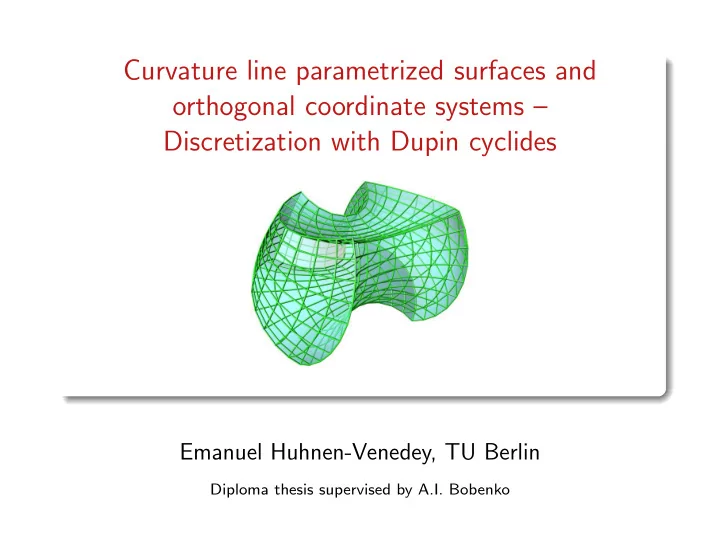
SLIDE 1 Curvature line parametrized surfaces and
- rthogonal coordinate systems –
Discretization with Dupin cyclides
Emanuel Huhnen-Venedey, TU Berlin
Diploma thesis supervised by A.I. Bobenko
SLIDE 2
Structure of the talk
Curvature line parametrized surfaces and their discretization in terms of contact ele- ments Dupin cyclides and patches of them as en- velopes of families of spheres Cyclidic nets as composition of “cyclidic patches”
SLIDE 3
Surfaces composed of contact elements
Definition A contact element in R3 is a 1-parametric family of oriented spheres which all touch in one point, such that their normals coincide. Such spheres are said to be in oriented contact.
↔
We consider surfaces not as collections of points, but as consisting of contact ele- ments.
SLIDE 4 Principal Curvatures of a surface
In a non-umbilic point of a C 2 surface f in R3, the corresponding contact element con- tains two special oriented spheres s1 and s2, called principal curvature spheres. r1 > 0 r2 < 0 These spheres touch f in the principal curvature directions, and the reciprocal values of the signed radii r1, r2 of the principal curvature spheres are the principal curvatures κi = 1
ri , i = 1, 2.
(The principal curvature directions are orthogonal, and the principal curvatures are the minimal/maximal directional curvatures)
SLIDE 5
Curvature line parametrized surfaces
The trajectories of the vector fields of principal curvature directions constitute the network of curvature lines of a surface A parametrization (u1, u2) → f (u1, u2) along curvature lines is called a curvature line parametrization
u = u0 v = v0 (u0, v0)
(u1, u2) are orthogonal coordinates on the surfaces
SLIDE 6
Curvature lines in terms of contact elements
Infinitesimally neighbouring contact elements belong to the same curvature line, iff they share a common sphere s dx s The sphere s is the corresponding principal curvature sphere The normals of the contact elements intersect in the center of s
SLIDE 7 Principal contact element nets
The infinitesimal characterization of curvature lines in terms of contact elements gives a natural discretization of curvature line parametrized surfaces: Definition (Bobenko & Suris 2007) A map f : Z2 →
is called a principal contact element net, if for all u ∈ Z2 the neighbouring contact elements f = f (u) and fi = f (u + ei), i = 1, 2, have a sphere in common. contact elements common spheres curvature spheres) (discrete principal f1 f12 f2 f
SLIDE 8 Principal contact element nets
PCENs unify the formerly known discretizations of curvature line parametrized surfaces as circular nets and conical nets The points contained in a PCEN build a circular net The planes contained in a PCEN build a conical net
[picture by Stefan Sechelmann]
Conversely, every circular/conical net is contained in a 2-parameter family of PCENs PCENs are described by 4D consistent 3D systems (are discrete integrable)
SLIDE 9 Dupin cyclides
Example (Standard tori)
[pictures from ”Mathematische Modelle“, Vieweg 1986]
A Dupin cyclide is the envelope of two 1- parametric families of spheres C1 and C2, where each sphere of the family C1 is in oriented con- tact with each sphere of the family C2. s2 s1 contact element (s1, s2) C1 C2 All curvature lines of Dupin cyclides are circles on the (principal curvature) spheres of the two families (characterizing fact) Parametrizations si : S1 → Ci, ui → si(ui), i = 1, 2, induce a (smooth) curvature line parametrization of the Dupin cyclide
SLIDE 10
Cyclidic patches
Cutting a Dupin cyclide along curvature lines gives a cyclidic patch The boundary curves of a cyclidic patch are circular arcs Vertices of a cyclidic patch are concircular The contact elements at the vertices of such a patch form an elementary quadrilateral of a prin- cipal contact element net!
SLIDE 11
Cyclidic patches for prescribed data
For an elementary quad of a PCEN (i.e. four spheres in oriented contact), there is a 1-parameter family of cyclidic patches For an elementary quad of a circular net (i.e. four concircular points), there is a 3-parameter family of cyclidic patches This freedom may be well encoded using frames sitting in the four circular vertices (frames are reflections of each other)
SLIDE 12
Cyclidic nets - 2D
The construction of cyclidic patches for a circular quad can be used to construct a 3-parameter familiy of C 1 surfaces for a given circular net.
→ ↔
In order to obtain differentiable joins between neighbouring patches, one has to flip vectors in an appropriate way.
SLIDE 13 Triply orthogonal coordinate systems in R3
Example (Cartesian, cylindrical & bispherical coordinates)
[pictures from http://en.wikipedia.org/wiki/Orthogonal coordinates]
Theorem (Dupin) The coordinate surfaces of a triply orthogonal coordinate system intersect along curvature lines Coordinate surfaces are curvature line parametrized surfaces
SLIDE 14 Cyclidic nets - 3D
Use 2D cyclidic nets for the discretization of triply orthogonal coordinate systems as a collection of coordinate surfaces such that surfaces contained in different families intersect each
So again we use frames sitting in vertices of a circular net (now 3D), but this time there is no distinguished normal direction Each vertex is the orthogonal intersection of three different 2D cyclidic nets
SLIDE 15
Cyclidic nets - 3D
For a given 3D circular net, there is a 3-parameter family of 3D cyclidic nets with the circular points as vertices
→ ↔
SLIDE 16
Elementary hexahedron of a 3D cyclidic net
All shown curves are curvature lines of cyclidic patches For each face the vertices are circular ALL intersections of curves in the above picture are orthogonal The shown circular arcs constitute the boundary curves of cyclidic patches covering the interior of the hexahedron
These patches also intersect orthogonally in the interior
SLIDE 17 Definition of cyclidic nets
A map (x, B) : ZN → RN ×
- rthonormal frames B = (n(1), . . . , n(N))
- ,
is called an N-dimensional cyclidic net, if x is a circular net and the frames B, Bi in neighbouring vertices x, xi are related as follows: The (N − 1)-tuples (n(1), . . . , n(i−1), n(i+1), . . . , n(N)) and (n(1)
i
, . . . , n(i−1)
i
, n(i+1)
i
, . . . , n(N)
i
) are reflections of each other in the perpendicular bisecting hyperplane of the line segment [x, xi], whereas the vector n(i)
i
is obtained from n(i) by first reflecting and afterwards changing the orientation.
SLIDE 18
Remarks
The considered frames sitting in vertices of circular nets were already introduced previously for algebraic reasons, in order to prove the C ∞ convergence of circular nets to smooth orthogonal nets (Bobenko, Matthes, Suris 2003). When generalizing to higher dimensions, the data for each cyclidic patch is generically four dimensional But: All the data is contained in a 3-sphere! project stereographically to R3, construct the patch and lift back
SLIDE 19
References
Discrete Differential Geometry. Integrable Structure. Book by A.I. Bobenko and Yu.B. Suris, Graduate Studies in Mathematics, vol. 98, AMS, 2008. jReality: a Java 3D Viewer for Mathematics http://www.jreality.de.