CV complications of HIV Infection? Lessons learned from other - - PowerPoint PPT Presentation

cv complications of hiv infection lessons learned from
SMART_READER_LITE
LIVE PREVIEW

CV complications of HIV Infection? Lessons learned from other - - PowerPoint PPT Presentation

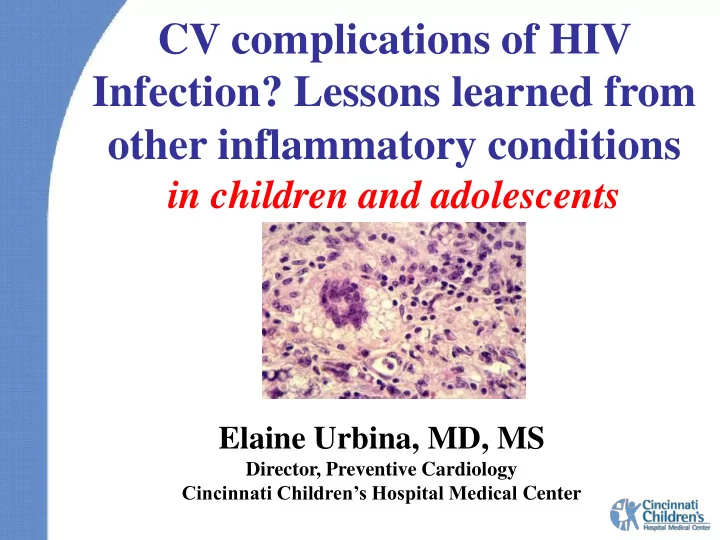
CV complications of HIV Infection? Lessons learned from other inflammatory conditions in children and adolescents Elaine Urbina, MD, MS Director, Preventive Cardiology Cincinnati Childrens Hospital Medical Center Questions: Why should


slide-1
SLIDE 1

CV complications of HIV Infection? Lessons learned from

  • ther inflammatory conditions

in children and adolescents

Elaine Urbina, MD, MS

Director, Preventive Cardiology Cincinnati Children’s Hospital Medical Center

slide-2
SLIDE 2
  • Why should we worry about CVD?
  • How do CV risk factors influence development
  • f CVD across the lifespan?
  • What conditions are associated with chronic

inflammation in youth?

  • What should we measure (lab, CV imaging) to

assess inflammation-related risk?

  • How does HIV affect CV risk specifically?
  • What can we do to improve the outcome?

Questions:

slide-3
SLIDE 3

Why? Should Non-Cardiologists

Care About Atherosclerotic CV Disease?

WHO World Health Statistics 2013; Rosamond Circ 2007; figure = Mozaffarian 2016

  • CVD accounts for 1/3 all cause mortality worldwide
  • Costs billions of dollars
  • Only 1% CVD due to Congenital Heart Disease

Health Care Costs (in billions of dollars)

Total CVD HTN Circulatory Stroke

$108.7 billion

slide-4
SLIDE 4

Time Course for Development

  • f Atherosclerosis:

Aging Begins at Conception

  • Atherosclerosis is a slow process that begins early in life

and is accelerated by adverse levels of CV risk factors such as obesity, HTN, dyslipidemia and insulin resistance.

slide-5
SLIDE 5

Coronary Arteries Sudan 3 stain: Obese Young Smoker with High Cholesterol

5 10 15 20 25 30 35 40

%Involvement .

Aorta Fat streaks Coronary Fat streaks Coronary Plaque 1 2 3+

*P<0.01 for trend, N = 204, 2-39 years; Berenson, NEJM 1998.

But Does Actual

Atherosclerosis Develop in Youth?

  • Longitudinal study of CVRFs starting in Youth
  • Autopsies on subjects who died from external causes
  • Clustering of CV Risk Factors measured in youth leads to
  • Greater fatty streaks & fibrous plaques,
  • Thicker renal arteries
slide-6
SLIDE 6
  • Why should we worry about CVD?
  • How do CV risk factors influence development
  • f CVD across the lifespan?
  • What conditions are associated with chronic

inflammation in youth?

  • What should we measure (lab, CV imaging) to

assess inflammation-related risk?

  • How does HIV affect CV risk specifically?
  • What can we do to improve the outcome?

Questions:

slide-7
SLIDE 7

Measurement of CVRFs

Should Start in Youth

BMI

20 30 40

AGE

5-17 35-45

Bogalusa Children Framingham Adults

Relative Risk

  • f CHD in 8 Yrs

70 25 10

Age = 40, non-smoker, BP, Chol & BMI normal,

?

  • Elevated CVRFs exist in Youth: Levels differ from adults,

change with rapid growth, but CVRFs ‘TRACK’ so are helpful to predict adult levels & CVD.

slide-8
SLIDE 8

Childhood BMI

Predicts Metabolic Syndrome as Adult

Mean f/u 11.6 yrs; Srinivasan Diabetes 2002; N = 745, 8-17 yrs @baseline.

  • Ability to predict diagnosis of Metabolic Syndrome as

Adult increases with increasing Childhood BMI & insulin level.

slide-9
SLIDE 9

Choi 2013 Obes Rev

Obesity Linked to Higher CRP

Across the Lifespan

  • Meta-analysis of 4,633 subjects found correlation

between BMI & CRP was 0.36 in adults & 0.37 in children.

GIRLS ADULTS BOYS

slide-10
SLIDE 10

Leukocytes Link Inflammation

to Ischemic CV Disease

  • New research uncovered unsuspected inflammatory signaling

networks that link the brain, ANS, bone marrow, & spleen to atherosclerotic plaque & infarcting myocardium

slide-11
SLIDE 11
  • >20 prospective studies have shown CRP independently

predicts CVD and 6 cohort studies have confirmed CRP adds incremental value beyond traditional CVRFs.

Inflammation is Associated

With Hard CV Events

Ridker 2004 Circ

slide-12
SLIDE 12
  • Why should we worry about CVD?
  • How do CV risk factors influence development
  • f CVD across the lifespan?
  • What conditions are associated with chronic

inflammation in youth?

  • What should we measure (lab, CV imaging) to

assess inflammation-related risk?

  • How does HIV affect CV risk specifically?
  • What can we do to improve the outcome?

Questions:

slide-13
SLIDE 13
  • OBESITY (especially with related IR)
  • Infections: HIV, peridontitis
  • Rheumatologic conditions: arthritis, SLE
  • GI: IBD, Crohn’s
  • Pulmonary: Asthma
  • Vasculitis: Kawasaki, transplant rejection
  • Diabetes – Types 1 and 2
  • Renal Disease

Conditions Associated with Chronic Inflammation In YOUTH

slide-14
SLIDE 14
  • Why should we worry about CVD?
  • How do CV risk factors influence development
  • f CVD across the lifespan?
  • What conditions are associated with chronic

inflammation in youth?

  • What should we measure (lab, CV imaging) to

assess inflammation-related risk?

  • How does HIV affect CV risk specifically?
  • What can we do to improve the outcome?

Questions:

slide-15
SLIDE 15

Test Relation to CV TOD

WBC No Data ESR FMD (JIA), cIMT (Fam Med Fever , normals) CRP PWV (smoke, IR), IMT (O, T1DM, BP) NEGATIVE: FMD, IMT (FH) IL-6 PWV (APSGN) NEGATIVE: RHI TNF-α No Data SAA cIMT (Fam Med Fever, normals) NEGATIVE: cIMT

What Should We Measure To Evaluate

CV Risk Related to Inflammation?

Inflammatory Markers

slide-16
SLIDE 16

Test Relation to CV TOD

Myeloperoxidase

(leukocyte activation)

NEGATIVE: RHI Adiponectin

(adipocytokine)

cIMT (O, normal) Fibrinogen (clotting) cIMT (FMF, normals) sICAM-1 (leukocyte

adhesion molecule)

cIMT, FMD NEGATIVE: cStiff (O, BP) sVCAM-1 (leukocyte

adhesion molecule)

Correlates with BP NEGATIVE: no correlation with BP P-selectin (leukocyte

adhesion molecule)

cIMT (FH) E-selectin (leukocyte

adhesion molecule)

cIMT (O, BP) NEGATIVE: FMD

What Inflammatory Markers

Should be Measured?

Markers Related to Inflammation

slide-17
SLIDE 17

Non-Invasive Methods

to Assess Atherosclerosis TOD

  • Carotid US (IMT)
  • Arterial stiffness

(PWV)

  • Endothelial function

(FMD)

Internal

Common Bulb

Internal

Stein JASE 2005 & Gepner JASE 2006; Bots Stroke 2003

Femoral Carotid } }

Time 1 Time 2

All predict future CVD

slide-18
SLIDE 18

N=2232, 63 years, 58% women; Mitchell 2010 Circulation; O’leary NEJM 1999; Suzuki 2008 Am Hrt J

  • Higher PWV (stiff) associated with 48% increase in

CVD risk above & beyond traditional CVRFs

  • Higher cIMT predicts Stroke & MI
  • Low FMD associated with greater CV Events in Met

S patients over 6.75 yr f/u.

Why Study Vascular Target Organ Damage? TOD Predicts CV Events

slide-19
SLIDE 19

Intima-Media Thickness

with Arterial Ultrasonography

  • Can Image Common, Bulb, Internal

Carotid or Femoral

  • Use ‘Meyer’s Arc’ for Longitudinal Studies

Bulb Internal

Common Bulb Internal

Stein JASE 2005 & Gepner JASE 2006; Bots Stroke 2003

slide-20
SLIDE 20

Freedman & Urbina, Int J Obese 2003, N=513, P<0.05.

BMI

Men Women

High IMT High IMT BMI 5 5 10 10 15 15 20 20 25 25 30 30 35 35 Low IMT Low IMT

  • cIMT measured in young adults.
  • Those with thicker carotid arteries (solid line) were significantly

more obese as children even after adjustment for Chol & BP.

  • Differences in BMI demonstrated starting around age 10.

Childhood Obesity Leads to

Thicker Carotid as Adult

Age (yrs)

slide-21
SLIDE 21

High Lipids in Childhood

& Increased cIMT as Adult

  • Subjects from BHS, Muscatine, Young Finns, Muscatine &

Childhood Determinants of Adult Health (Australia) combined.

  • Childhood lipids classified as normal, borderline or high based on

both NCEP and NHANES cutpoints

  • Regardless of definition used, high childhood LDL & low HDL

predicted thicker cIMT as adult (age 29-39 years).

Magnussen JACC 09

slide-22
SLIDE 22

Multiple CVRFs in Youth Affect the Adult cIMT Young Finns Study

N=1809; age 3-18, followed 27 years; Juonala 2010 Eur Hrt J; Juonola 2006 ATVB; Hylahava 2008 JintMed

  • Number child CVRFs was associated with 6-year change in adult cIMT

even after adjusted for adult CVRF and genotype.

  • Infrequent fruit and low physical activity were the most powerful in

predicting accelerated progression.

  • CRP & SAA not independent contributors.
slide-23
SLIDE 23

*P<0.05, N=20 KD, 20 Control, age 16.6 years, Noto Pediatrics 2001

  • Significantly thicker and stiffer carotid in Kawasaki Disease

patients despite being matched for BMI, BP, & lipids suggesting a role for inflammation-induced vasculitis.

Abnormalities in Carotid Structure & Function in Kawasaki Disease

* *

slide-24
SLIDE 24

Higher Carotid Intima-Media Thickness in Youth with JRA

0.2 0.3 0.4 0.5

Control JRA cIMT (mm)

N=39 JRA, 27 control, mean 13 yers;l Ilisson 2015 Arthitis Res Ther

  • Subjects with newly diagnosed JRA had higher cIMT

than controls associated with higher myeloperoxidase (MPO) levels.

*

slide-25
SLIDE 25

Higher Carotid Intima-Media Thickness in Youth with Metabolic

Syndrome

0.4 0.6 0.8 1

Normal Obese Met Syndr cIMT (mm)

P<0.01 vs control; Akyol 2013 J Clin Res Ped Endo

  • Progressive increase in carotid IMT from normal to
  • bese to obese youth with metabolic syndrome.

* *

slide-26
SLIDE 26

Weak Relationship Between CRP

& Carotid IMT in Youth

0.3 0.35 0.4 0.45

Low Mid High Femoral IMT (mm)

N= 120, mean 11.7 years, Cayres 2015 J Peds

  • Non significant trend for increased Carotid & Femoral

IMT across hsCRP tertiles.

  • hsCRP correlated to IMT but only in sedentary group.

hsCRP tertile

slide-27
SLIDE 27

Relationship Between CRP & IMT Overshadowed by CVRFs in Youth

N=670; mean age 18 years; *p<0.04; Urbina unpublished data

0.3 0.4 0.5 0.6 cIMT (mm) Common Internal Bulb

CRP <95th% CRP >95th%

* *

  • Subjects with CRP >95th%, had higher CVRFs (BMI, BP, LDL,

glucose, insulin, HbA1c) & thicker cIMT.

  • CRP only remained an independent determinant of carotid

bulb after adjustment for BMI & fasting glucose, but lost significance after adjustment for other CVRFs.

slide-28
SLIDE 28

Effect of Inflammation on cIMT

Increases With Follow-up into Young Adulthood

  • After 4 yrs follow-up, increase in CVRFs (BMI, BP, lipids, insulin,

CRP) & cIMT.

  • CRP change did remain independent determinant of follow-

up bulb after CVRF adjustment. Effect strongest in O &

  • T2DM. Maybe due to longer duration of exposure.

N=154, mean age 17.4 at baseline; Urbina unpublished data & Circulation 2009

slide-29
SLIDE 29

Age BMIz insulin Glucose non-HDL BP cIMT common bulb internal HbA1c FPG SBPz DBPz CRP Sex Race

  • Structure Equation Modeling explains more of the variance in IMT (25-

50%), but also demonstrates that obesity & inflammation only have indirect effects through increases in other CVRFs.

  • Largest direct effect were age , BP, Glucose, non-HDL.

Gao, Urbina Atherosclerosis 2016; N 784, age 10-24 years, 1/3 L, 1/3 O, 1/3 T2DM

Does Inflammation Effect IMT Directly In Adolescents?

slide-30
SLIDE 30

Diabetes Control & Complications /Epid of Diab Intervent Complicat) N=494; Lopes-Virella 2011 Diabetes

  • May need combination of inflammation & other CVRFs.
  • Inflammation induces oxidation of LDL increasing
  • atherogenesis. DCCT/EDIC subjects with obesity & longer

duration of T2DM had higher levels of oxLDL

  • 6x greater Odds for being in highest quartile of cIMT at f/u

with elevated oxLDL even after adjustment for CVRFs.

  • oxLDL better predictor than LDL-C.

Increased cIMT

With Oxidation of LDL

slide-31
SLIDE 31

0.5 0.7 0.9 1.1 1.3 1.5 1.7 Low Mid High

Beta Stiffness (/10) or YEM

(1000 kPa)

*

Reduced Carotid Distensibility

With Increased Inflammation Score

*All P < 0.001; Van Bussel 2012 J Hypertens

  • Composite inflammatory score (CRP, SAA, IL6, IL8, TNF α,

sICAM1) was related to higher carotid stiffness even after adjustment for CVRFs in elderly.

slide-32
SLIDE 32

Pulse Wave Velocity

Higher PWV = Stiffer Vessel

Femoral Carotid } }

Time 1 Time 2

  • Carotid-Femoral distance measured

with caliper

  • Pressure waves recorded at the

carotid & femoral arteries with tonometry, photoplethysmography.

  • Time measured from R on ECG to

foot of pressure wave

  • Calculate PWV = distance

∆t

slide-33
SLIDE 33

Increased PWV

With Acute Post-Strep Glomerulonephritis

900 1100 1300 1500 baPWV (cm/sec) Control APSGN Recovery

*

Yu Pediatr Nephrol 2011

  • 16 children with APSGN were found to have higher baPWV

as compared to controls.

  • Recovery led to normalization of BP and arterial stiffness.

*

slide-34
SLIDE 34

Stiffer Aorta (Higher PWV)

In Children with Inflammatory Connective Tissue Disorders

100 200 300 400 500 600 Thoracic Aorta PWV (cm/sec) Control Connective T

  • Children with Inflammatory Connective Tissue disorders such as

Lupus were also found to have stiffer thoracic aorta despite concurrent treatment with Aspirin

*P<0.02 Marfan & CT > Control; Sander JASH 2003

* *

slide-35
SLIDE 35

5 5.5 6 6.5 7 PWV (m/sec)

Lean Obese Obese IR Severe O T2DM

Higher PWV

In Youth with Obesity & Metabolic Dysfunction

Urbina Diabetologia 2011; Urbina J HTN 2010; Shah & Urbina JCEM 2015; All differ from L.

  • Higher PWV in Obese youth with further increase in

Obese Insulin-Resistant, Severe Obesity and subjects with T2DM.

  • CRP not independent determinant in any of the studies.
slide-36
SLIDE 36

Accelerated Vascular Aging

in Obesity & T2DM

*P for difference among groups in change over 5 years <0.05; unpublished data Urbina 2016.

5.0 5.5 6.0 6.5 7.0 7.5 Baseline Follow-up

Lean Obese T2DM PWV (m/sec)

  • Over 5 years of follow-up, PWV increased only in O &

T2DM subjects.

  • Independent determinants of change in PWV included

measures of adiposity, BP, LDL and glycemic control. CRP did not enter the model.

* *

slide-37
SLIDE 37

Higher PWV in Youth with

T2DM Related to Inflammation

4 5 6 7 8

Normal CRP High CRP PWV (m/sec)

N=98, age 10 to 24 years, Li 2015 JClinResPedEndo

  • Chinese youth with newly diagnosed T2DM who had low

grade inflammation (higher CRP) had higher IMT.

  • hsCRP remained independent determinant after

adjusting for CVRFs.

slide-38
SLIDE 38

Change in PWV

& Inflammation

Alman, unpublished data 2014; p for increase 0.0001

4 4.5 5 5.5 6 6.5 7 7.5 8 8.5 9 Baseline Follow-up PWV m/sec Trunk Arm Leg

  • No association was found between inflammatory markers

and progression of PWV in the arm or leg.

  • Fibrinogen & inflammation composite score were weakly

associated with progression of carotid-femoral PWV (trunk), but associations were attenuated after adjustment for other CVRFs

* * *

slide-39
SLIDE 39

Brachial Flow Mediated Dilation

For Evaluating Endothelial Function

Baseline Maximal

Diameter Post Cuff Deflation Diameter Baseline

  • Image Brachial Artery
  • Inflate cuff to 50 mmHg > SBP for

5 min, then deflate rapidly

  • Record post-deflation images

immediately & at 60, 90 & 120 seconds.

  • Calculate FMD = %change in

diameter

Non-US methods also developed (RHI-PAT, LFD)

slide-40
SLIDE 40
  • Finger cuff placed on index finger of each hand, connected with

tubes to device which is interfaced to PC.

  • Balloon in cuff inflates to sense changes in blood volume at

baseline & after ischemia (cuff inflated 5 minutes like with FMD).

Peripheral Arterial Tonometry

Non-Ultrasound Assessment of Endothelial Function

Itamar, Inc., Caesarea, Israel

RHI = PAT post

  • cclusion / PAT baseline

(normalized to control hand)

slide-41
SLIDE 41

Reduced Endothelial Function

After Kawasaki Disease

N=16 cases, 19 controls; Pinto 2013 Carioil Young

  • Endothelial function measured by Peripheral Artery

Tonometry Reactive Hyperemic Index was lower in young adults who suffered Kawasaki disease as a child.

*

slide-42
SLIDE 42

No Difference in Endothelial Function In Adults with Lupus

N = 58, Aizer 2009 Lupus

  • No differences in FMD or RHI between SLE and

control even in severe SLE with Reynaud’s.

2 4 6 8 10 12 14 FMD RHI Control SLE

slide-43
SLIDE 43

Impaired FMD in Obese Children

Related to Inflammation

N=77 Obese, 15 lean; Kapiotis 2006 ATVB

5 6 7 8 9 10 11 12

Control Obese

%FMD

  • FMD lower in obese youth
  • FMD correlated with higher CRP level in univariate
  • analyses. Did not repeat adjusted for other CVRFs.
slide-44
SLIDE 44

Impaired FMD in Healthy Children

Related to Inflammation

Jarvisalo Art Thromb Vasc Biol 2002, N=79, Age 9-12 years, *P<0.05 between CRP groups.

  • FMD declined with increasing CRP level even in healthy

youth.

  • SD of FMD ranged from 2.6 to 4.4 so much overlap & did

not adjust for other CVRFs.

CRP<0.1 mg/L CRP 0.1-0.7 mg/L CRP>0.7 mg/L

slide-45
SLIDE 45

No Relation of FMD to Inflammation

In Healthy Adolescents

N=55, Urbina unpublished data 2017

  • No relation between CRP & FMD in healthy youth.

CRP mg/L FMD (%)

slide-46
SLIDE 46

Why Does Vascular Dysfunction Matter? Because it Hurts the Heart

slide-47
SLIDE 47

1 2 4 3 5 6 7 10 20 30 40 60 50

Global Arterial Stiffness Index Score LVMI (g/m2.7)

  • Measures of central & peripheral arterial stiffness combined.
  • Global Stiffness Index independently related to LVM Index

even after adjusting for CV risk factors.

  • Subjects with stiff vessels had higher CRP, however CRP not

independent determinant of LVM.

*P <0.0001 slope differs from 0; Urbina J Peds 2011

R2 = 0.52, p<0.0001.

Stiffer Vessels

Cause Thicker Heart

slide-48
SLIDE 48

Madsen, Urbina, unpublished data 2017, *P<0.01

  • Linear decline in Diastolic Function (lower e’/a’) with stiffer

arteries even after adjustment for other CV risk factors.

  • Diastolic function may be a precursor to CHF in adults.
  • CRP was not an independent determinant.

Decreased Diastolic Function

with Increased Arterial Stiffness

Global Stiffness Index

e’/a’ ratio

slide-49
SLIDE 49
  • Why should we worry about CVD?
  • How do CV risk factors influence development
  • f CVD across the lifespan?
  • What conditions are associated with chronic

inflammation in youth?

  • What should we measure (lab, CV imaging) to

assess inflammation-related risk?

  • How does HIV affect CV risk specifically?
  • What can we do to improve the outcome?

Questions:

slide-50
SLIDE 50

N=327, Mangili 2011 Atherosclerosis

  • Higher IMT (& CRP) predicted reduced survival after only 3

years of follow-up in adults with HIV.

  • Death associated with lower CD4 count, higher viral load, &

CRP, but not antiretroviral regimen.

Carotid IMT

Predicts Mortality in Adults with HIV

slide-51
SLIDE 51

Factors Influencing CVD

In HIV

  • Direct: infection or activation of endothelial cells by HIV
  • Indirect: vascular injury due to inflammation & immune

activation, dysregulation of NO.

  • Rx: HAART alters lipid, glucose, and fat metabolism

Mondy 2008 J Cardiometab Syndr

slide-52
SLIDE 52
  • Higher T cell activation was associated with lower carotid

distensibility even after adjustment for age, medications, CVRFs, CD4 count & viral load.

  • Confirmed in later study

N=114 cases, 43 controls; Kaplan 2011 Atherosclerosis; Karim 2014 JAIDS

Decreased Distensibility In Adults

with HIV related to T-cell Activation

slide-53
SLIDE 53
  • Subjects with HIV had higher levels of inflammatory

biomarkers (CRP, TNF alpha, IL-6, MPO, sICAM).

  • Also had higher IMT which correlated with hsCRP.
  • But in multivariable models, only TNFa, MPO & sVCAM

were independent determinants of IMT, not CRP

N= 73 cases, 21 controls; Ross 2009 Clinical Infectious Diseases

Increased IMT & Inflammation

In Adults with HIV

0.8 1 1.2 1.4

Common IMT Internal IMT

IMT (mm)

Controls HIV+ *

slide-54
SLIDE 54
  • Lower Aortic Distensibility in HIV+ infected patients vs controls (worse

if >=40 years) but no difference in c-IMT.

  • Multivariable analyses: HIV infection independently associated with

decreased distensibility & among HIV-infected patients distensibility declined with increasing duration to HAART exposure.

N=155 cases, 124 control; Zomplala 2012 BMC Infect Dis

Decreased Distensibility

In Adults Related to HIV Rx

Aortic Distensibility HAART Duration (months)

Age < 40 years Age >= 40 years

slide-55
SLIDE 55

55

Increased IMT Associated with CD4 Nadir In Children with HIV

Sainz 2014 J Acquir Immune Defic Syndr

  • IMT thicker in youth with HIV even when included

subjects who are virally suppressed.

  • Patients with lower CD4 nadir had higher IMT which

remained significant determinant of IMT after adjustment.

  • No relation b/t IMT & inflammation or immune activation.
slide-56
SLIDE 56
  • Higher IMT in children with HIV.
  • Independent determinants were ART, Adiposity, & CD4

count.

N=83 cases & 83 controls; Giuliano Coronary Art Dis 2008; *P<0.001.

Increased IMT in Children with HIV Related to T-Cell Counts & Rx

0.25 0.3 0.35 0.4 0.45 0.5

Healthy HIV+

IMT (mm)

Healthy HIV+ *

slide-57
SLIDE 57
  • IMT higher in HIV+ vs controls regardless of measurement

site.

  • Predictors: BMI, homocysteine & ART Rx.

N=31 cases, 31 controls; McComsey AIDS 2007; *All P<0.02.

0.3 0.35 0.4 0.45 0.5

RCCA LCCA RICA LICA

IMT (mm)

Healthy HIV + * * * *

Higher IMT

In Children with HIV related to ART Rx

slide-58
SLIDE 58

N=23 cases 19 controls age 17-23 years; Vigano Current HIV Res 2010

  • Higher IMT seen in subjects with HIV associated with male

sex & duration ART Rx but only significant for Non Nucleoside RTI &/or PI + single/double NRTI

Type & Duration of ART Influences IMT In Children with HIV

A = NNRTI B = PI C = NNRTI &/or PI D = C + 1 / 2 NRTIs

D C B A

slide-59
SLIDE 59
  • Although cIMT higher in HIV vs controls, strongest influence

was age.

  • No independent association b/t IMT & any specific

antiretroviral, viral load, CD4 count or CRP.

  • Considerations: small N, only common carotid

N=40 cases, 27 controls; Di Biaggio J Ultrasound Med 2013

Not All Studies Show IMT

Related to HIV Rx

slide-60
SLIDE 60

Not All Studies Show Higher IMT In Children with HIV

  • Though hsCRP was higher in subjects with HIV, no

difference in IMT between groups

  • Predictors of IMT were age, female, hsCRP.
  • Issues: small N, younger age

Parameter Common Internal ß Estimate ß Estimate Age 0.01 Sex

  • 0.63

CRP <0.01 <0.01 R2 0.41 0.35

N=27 cases, 30 controls mean 11 years; Ross McComsey Atherosclerosis 2010

slide-61
SLIDE 61
  • Same group increased N & saw HIV+ had higher baseline

IMT (common & ICA). IMT ∆ over 48 wks was not significantly different between groups but most virally

  • suppressed. Determinants CRP, ART, CD4
  • Further f/u to 144 wks also saw no difference in IMT Δ

N=35 cases, 37 controls, median 10 years; f/u 44 wks Ross Ped Infect Dis J 2010; Ross Antivir Ther 2014

No Difference in Rate of Change in cIMT In Children with HIV

0.5 0.6 0.7 0.8 0.9 1

Common Internal

IMT (mm)

Healthy HIV +

* *

slide-62
SLIDE 62
  • No difference in IMT but carotid stiffness was greater &

FMD lower in HIV.

  • No difference by ART Rx or presence of dyslipidemia.
  • Considerations: small N, only common IMT

N=49 cases, 24 controls; Bonnet AIDS 2004; *P<0.0001 .

Increased Arterial Stiffness

In Children with HIV

0.5 1 1.5 2 2.5 3

Healthy HIV+

IEM x 103

Healthy HIV+ *

slide-63
SLIDE 63
  • PWV higher in HIV +.
  • Associated with ART, SBP, disease severity, Tchol.
  • Considerations: carotid-radial PWV, large SD of

measurement.

N=83 cases, 59 controls; Charikida Antiviral Therapy 2009; * P<0.04 vs control

Increased PWV

In Children with HIV

slide-64
SLIDE 64
  • Matched by CVRFs, subjects with HIV had lower FMD

related to viral load & TNF alpha.

  • Other study found lower FMD with lower nadir CD4 count

N=38 cases, 41 control; Oliviero 2009 Atherosclerosis; Ho 2012 AIDS

Lower Brachial FMD In Adults with

Higher Viral Load or Inflammation

slide-65
SLIDE 65
  • FMD lower by 1.8% for non-Rx and 3.6% for PI.
  • FMD related to CRP & ART exposure, not lipids despite

higher lipid levels in cases.

N=83 cases, 59 controls; Charakida Circ 2005; * and ** P<0.006.

Reduced Endothelial Function

In Children with HIV

slide-66
SLIDE 66
  • Why should we worry about CVD?
  • How do CV risk factors influence development
  • f CVD across the lifespan?
  • What conditions are associated with chronic

inflammation in youth?

  • What should we measure (lab, CV imaging) to

assess inflammation-related risk?

  • How does HIV affect CV risk specifically?
  • What can we do to improve the outcome?

Questions:

slide-67
SLIDE 67

*P< 0.01, N=1474, 4-17 years at baseline, 19-41 years at follow-up; Chen Diabetes Care 2005; Laitinen Circulation 2012; Magnussen JACC 2012.

  • Youth with low levels of CV risk factors in

childhood had lower carotid IMT as an adult.

  • Similar results found in CV Risk in Young Finns
  • Neither had measure of inflammation
  • No. Child CVRF at low level

cIMT (mm)

“Primordial Prevention”

Leads to Lower cIMT in Adulthood

*

slide-68
SLIDE 68
  • 7

Lifetime Fruit & Veg Consumption And PWV as Adult

  • CV Risk in Young Finns Study followed for 27 yrs.
  • Persistently high consumption of fruits or vegetables

associated with lower PWV vs persistently low.

  • No measure of Inflammation.

N=1622, age 3-18 years at baseline; Aatola 2010 Circulation

slide-69
SLIDE 69

*P<0.03; N=1673 31.5 years at baseline, Koskinen 2010 Circulation

Improvementin FMD

with Recovery from Metabolic Syndrome

5 6 7 8 9 10 Recovery Persistent

  • FMD measured in 1673 subjects in the CV Risk in Young

Finns Study

  • After 6 years, recovery group had higher FMD compared

with the control group and better CRP.

* FMD (%)

slide-70
SLIDE 70

N=18, mean 13 years; Roberts 2007 Atherosclerosis, N=15, mean 16 yrs Balagopol 2005 JPeds

“Primary Prevention”

Weight Loss Improves Inflammation in Obese Youth

  • 2 week in-pt low calorie diet, & supervised daily physical

activity dropped BMI, BP, TG & CRP.

  • 3 mo out-pt intensive lifestyle had little drop in BMI but

significant decrease in CRP & IL-6

IL-6 (mg/L)

slide-71
SLIDE 71

Test ∆ w/ Intervention No Change WBC

↑post exercise, No ∆Omega3

CRP

↓ Wt loss No ∆Omega3; No ∆exercise but ↑FMD; giving DHA or Vit E & C no effect on CRP but ↑FMD

IL-6

↑post exercise, No ∆exercise

TNF-α

↓∆Omega3 ↑post exercise; No ∆exercise

SAA

No ∆Omega3

sICAM

No ∆Omega3; No ∆exercise

sVCAM

↓ ∆Omega3 No ∆exercise

APN

↑Wt loss No ∆exercise

Change in Inflammation

Lifestyle & Supplements

slide-72
SLIDE 72

N=29, r=0.41, P=0.03; de Lima Sanches Hypertens Res 2011;34:232-8.

Improvement in HOMA-IR

Leads to Regression of IMT in Obese Adolescents

  • One-year weight loss resulted in improvement in CVRFs &

regression of IMT.

  • Change in HOMA-IR was negatively correlated with change

in cIMT independent of other CVRFs.

slide-73
SLIDE 73

IR Impairs Ability to Regress IMT

With Weight Loss

0.25 0.3 0.35 0.4 0.45

Improved IR IR persisted cIMT (mm) Baseline 1 year

N=66; P < 0.05 *difference from baseline, †Difference by IR status; Sanches Arq Bras Cardiol. 2012;99:892-8.

  • After 1 year Wt loss program, subjects with IR had less

regression of cIMT than insulin sensitive group despite larger drop in BMI in IR group.

* *†

slide-74
SLIDE 74

Improved Brachial FMD

With Exercise in Youth with Metabolic Syndrome

N = 25, 10-11 years, Kelly J Pediatr 2004

  • Obese children randomized to 8 weeks of exercise or control

group.

  • Post intervention there was significant improvement in FMD

despite no change in CRP.

slide-75
SLIDE 75

Greater Improvement in Vascular Function With Both Diet & Exercise

*p<0.002 vs baseline, †p<0.01 vs diet alone, ‡ p< 0.04 greater than 6 mo, N = 82, age 9-11 years; Woo Circ 2004

  • Obese youth randomized to Diet or Diet & Exercise for 1 year.
  • Both groups had significant improvement in WHR, Tchol & FMD.
  • Diet & Exercise saw greater increase in FMD that returned

towards baseline at 1 year if exercise discontinued.

6 6.5 7 7.5 8 FMD (%)

Baseline Diet only Diet + Exercise

*

Pre 1 yr 6 mo Pre 1 yr 6 mo

Continued Training Stopped after 6 months

* *

slide-76
SLIDE 76

Relation Between Exercise Inflammation & Art Stiffness

in Adults with T2DM

  • Adults with T2DM with greater physical activity

(pedometer) had lower BMI, CRP, IL6 & PWV.

*P < 0.007 for trend, N=327; Jennersjo 2012 Diabet Med

6 8 10 12

<5000 5000-7499 7500-9999 >=10000

PWV (m/sec)

slide-77
SLIDE 77

Improvement in PWV with Statins in Inflammatory Joint Disease

  • Adults with Inflammatory Joint Disease (CRP 2 mg/l) Rx

with Rosuvastatin for 18 months.

  • Improved PWV
  • Did not measure inflammation.

N=89, Ikdahl 2016 PLoS ONE

slide-78
SLIDE 78

“Secondary Prevention”

Improvement in FMD With Statins

8 10 12 14 16 Placebo Simvastatin Control

FMD (%)

Baseline Follow-up

  • Treatment of youth with FH with Simvistatin led

to normalization of FMD after 28 weeks.

De Jongh, JACC 2002, N=69, age 9-18 years, *p<0.05 baseline vs follow-up.

slide-79
SLIDE 79

Improvement in Endothelial Function with Vit C After Kawasaki’s

N= 39, P<0.0001 *difference from control, †difference from placebo ; Deng 2003 Ped Inf Dis j

  • FMD in Kawasaki disease patients was significantly lower than

controls.

  • IV Vitamin C significantly increased FMD in KD patients vs

placebo.

  • Other studies found no difference in FMD (Silva J Peds 2001)

5 10 15 Normal Kawasaki KD after Vit C

FMD (%)

* †

slide-80
SLIDE 80
  • Low Vit D associated with lower FMD & RHI even after

adjustment for CVRFs including CRP.

  • No interventional studies have proven Vit D

supplementation will improve endothelial function.

N=554 Al Mheid 2011 JACC

Association of Vitamin D

with Vascular Function

Vitamin D level

slide-81
SLIDE 81
  • Lower progression with viral suppression.
  • Lower progression with nonnucleoside reverse transcriptase

inhibitor versus protease inhibitor exposure was associated with lesser CIMT.

N=389, mean 42 years; Baker 2011 Clin Infect Dis

Less IMT Progression

In Virally Suppressed Adults with HIV

slide-82
SLIDE 82
  • Virally suppressed HIV-infected patients showed similar

arterial stiffness to non-HIV-infected patients

  • No HIV + group without viral suppression.

N= 81 control, 174 cases; Eschieverria 2014 J AcqImmDefS

Normal PWV In Virally-Suppressed

Adults with HIV

5 6 7 8 9 10

Controls HIV+

PWV (m/sec)

Carotid Radial Carotid Femoral

slide-83
SLIDE 83
  • No difference in rate of change in IMT over 2.8 years

among Controls, subjects with HIV on a PI or those not on a PI

  • Predictors of progression were nadir CD4 count & use of

ritonavir

N=134 total, Currier 2007 AIDS

Rate of Change of IMT

May Not Be Affected by HIV Rx

slide-84
SLIDE 84
  • Subjects with HIV but without atherosclerosis (IMT <0.09)

had higher Med Diet Score. Only trend for Controls.

  • No Rx trials proving lack of progression with healthy diet.

* p= 0.04, N= 73 cases, 21 controls; Ross 2009 Clinical Infectious Diseases

Diet May Affect Carotid Atherosclerosis in Adults with HIV

1 2 3 4 5 6

Controls HIV+

Med Diet Score

No Athero Athero +

*

slide-85
SLIDE 85

Lower Carotid IMT With Higher

Vitamin D in Adults with HIV

  • 52% of these adults with HIV had Vitamin D deficiency.
  • Graded increase in cIMT seen across Vit D level even after

adjustment for CVRFs & HIV related factors.

  • No Rx studies to prove supplementation will improve IMT.

N=139, mean 45 years; Choi 2011 Clin Infect Dis

slide-86
SLIDE 86
  • Subjects with HIV Rx with Omega 3 FA 2000 g/day had no

increase in FMD after 24 weeks.

  • Issues: very small N, sub-therapeutic dose of Omega 3

N=17 placebo, 14 Omega 3; Hilerman 2012 AIDS Res Human Retro

No Significant Increase in FMD

With Rx with Omega-3 FA in Men with HIV

1 2 3 4 5

Omega 3 Placebo

Med Diet Score

Baseline Follow-up

slide-87
SLIDE 87

Improved Arterial Cp & HRV

With Exercise in Adults with HIV

  • Subjects with HIV who were fit had greater Arterial

Compliance (lower arterial stiffness) than either subjects with HIV who were unfit or Healthy subjects who were unfit.

Spierer Clin Auton Res 2007; all *P<0.05.

slide-88
SLIDE 88
  • Which inflammatory biomarker to measure
  • Most data available relating CRP to TOD but results not

consistent.

  • Target Organ Damage:
  • CRP has most studies
  • Stronger relation to cIMT & Arterial Stiffness than FMD
  • Few studies show effect independent of other CVRFs
  • Interventions:
  • Exercise, wt loss, diet may help but results inconsistent
  • Supplements not clearly helpful
  • Statins may help
  • Lack of ‘normals’ for intermediate vascular outcomes =

hard to know when to intervene

Summary

slide-89
SLIDE 89
  • Innate biologic variability in methods

(FMD) may contribute to lack of correlation of inflammation & TOD

  • Longer duration/degree of inflammation

may be needed to see effect.

  • May need more advanced statistical

techniques (structure equation modeling) to tease out the independent effects of inflammation (BMI dominates models).

Limitations

slide-90
SLIDE 90

CAD Risk Classification

Minimal Risk

No identifiable risk factors

Very Slight Risk

One risk factor of moderate degree Several risk factors of only mild degree

Slight Risk

One risk factor of advanced degree Several risk factors of moderate degree

Moderate Risk

Two risk factors of advanced degree

Serious Risk

Three or more risk factors of advanced degree

CV disease & Chest Pain, 1993

slide-91
SLIDE 91

Consider Non-Invasive Imaging For Risk Stratification

Carotid Plaque

slide-92
SLIDE 92

Consequences of Ignoring the Problem

Left Ventricular Hypertrophy

http://upload.wikimedia.org/wikipedia/commons/b/ba/Heart_left_ventricular_hypertrophy_sa.jpg

Myocardial Scar

slide-93
SLIDE 93

Que Quest stions ions?