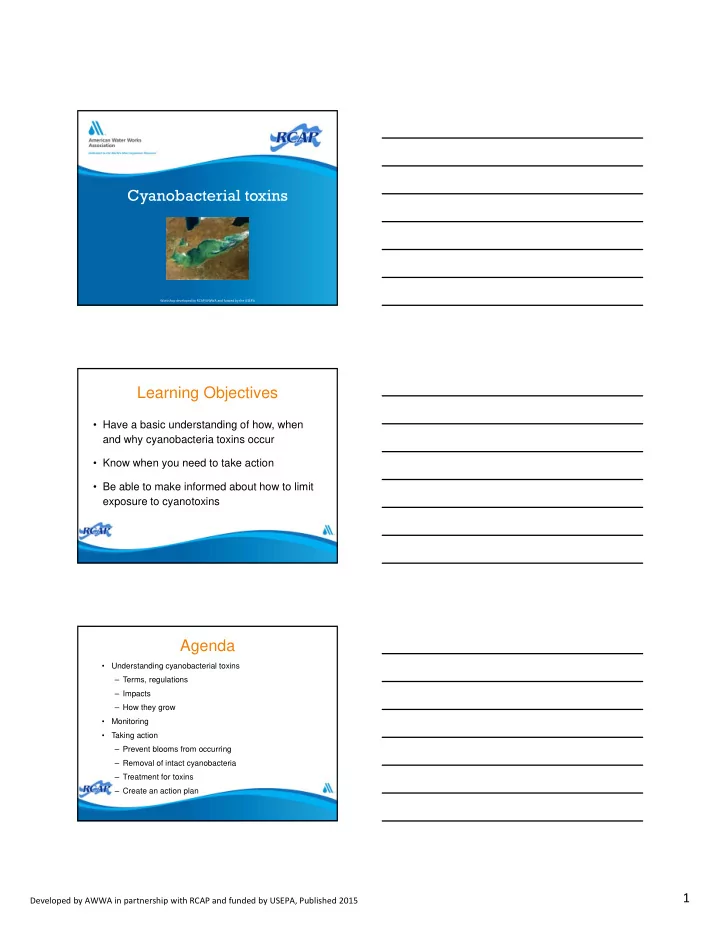
Cyanobacterial toxins Workshop developed by RCAP/AWWA and funded by - - PDF document

cyanobacterial toxins
SMART_READER_LITE
LIVE PREVIEW

Cyanobacterial toxins Workshop developed by RCAP/AWWA and funded by - - PDF document

Cyanobacterial toxins Workshop developed by RCAP/AWWA and funded by the USEPA Learning Objectives Have a basic understanding of how, when and why cyanobacteria toxins occur Know when you need to take action Be able to make informed


slide-1
SLIDE 1

Developed by AWWA in partnership with RCAP and funded by USEPA, Published 2015

1

Workshop developed by RCAP/AWWA and funded by the USEPA

Cyanobacterial toxins Learning Objectives

  • Have a basic understanding of how, when

and why cyanobacteria toxins occur

  • Know when you need to take action
  • Be able to make informed about how to limit

exposure to cyanotoxins

Agenda

  • Understanding cyanobacterial toxins

– Terms, regulations – Impacts – How they grow

  • Monitoring
  • Taking action

– Prevent blooms from occurring – Removal of intact cyanobacteria – Treatment for toxins – Create an action plan

slide-2
SLIDE 2

Developed by AWWA in partnership with RCAP and funded by USEPA, Published 2015

2 Evaluating cyanotoxin contamination risk

A Water Utility Manager’s Guide to Cyanotoxins (2015)

  • Self‐assessment helps

determine risk level

  • Assesses three areas

 source water monitoring  source water quality  cyanobacteria presence during treatment process

Terminology

  • Harmful Algal Blooms (HABs)
  • Cyanobacteria
  • Cyanotoxins

Developed by AWWA in partnership with RCAP and funded by USEPA, Published 2015

Harmful algal blooms (HABs)

  • Rapid increase or accumulation in the

population of algae

  • Can refer to different types of algal bloom

– Cyanobacteria – Green algal – Red tide (marine)

Developed by AWWA in partnership with RCAP and funded by USEPA, Published 2015

slide-3
SLIDE 3

Developed by AWWA in partnership with RCAP and funded by USEPA, Published 2015

3

Cyanobacteria

  • “Blue-green algae”
  • Naturally found in

surface water

  • Can rapidly multiply
  • Can produce dense

mats

www.epa.gov

What are cyanotoxins?

  • Toxins produced by cyanobacteria

– Contained within cyanobacteria cells

  • Usually released into water during cell

rupture or cell death

Classes of toxins

  • Microcystins:
  • Cylindrospermopsin
  • Anatoxins
  • Saxitoxins

Developed by AWWA in partnership with RCAP and funded by USEPA, Published 2015

slide-4
SLIDE 4

Developed by AWWA in partnership with RCAP and funded by USEPA, Published 2015

4

EPA estimates that between 30 to 48 million people using drinking water from lakes and reservoirs may be vulnerable to cyanotoxins

Developed by AWWA in partnership with RCAP and funded by USEPA, Published 2015

EPA Recommendations for Public Water Systems to Manage Cyanotoxins in Drinking Water, 2015

Federal Regulations

  • Safe Drinking Water Act, Clean Water Act

– Currently, no federal regulations address cyanobacteria and their toxins

Federal Regulations (cont.)

  • Contaminant Candidate List (CCL)

– List of potential drinking water contaminants that are currently unregulated (not all- inclusive) – Identifies contaminants in need of additional study to determine whether or not they require regulation under the Safe Drinking Water Act

slide-5
SLIDE 5

Developed by AWWA in partnership with RCAP and funded by USEPA, Published 2015

5 EPA’s Unregulated Contaminant Monitoring Rule 4 (2018 -2020)

  • Covers all systems with populations > 10,000

and 800 randomly selected small systems

  • Lists unregulated contaminants to be

monitored by public water systems

  • Includes 10 cyanotoxins (9 cyanotoxins and 1

cyanotoxin group)

EPA Drinking Water Health Advisories (HAs)

  • Microcystins
  • Cylindrospermopsin

Age Microcystins Cylindrospermopsin Children under 6 years old 0.3 µg/L 0.7 µg/L 6 year old through adults 1.6 µg/L 3.0 µg/L

  • Young children more

susceptible

State guidance values for drinking water

slide-6
SLIDE 6

Developed by AWWA in partnership with RCAP and funded by USEPA, Published 2015

6

Knowledge Checkpoint

The Safe Drinking Water Act (SDWA) and the Clean Water Act regulate contaminant levels for cyanobacteria and cyanotoxins in drinking water. True or False?

Cyanotoxins and human health

  • Can be acute or chronic
  • Liver, nervous system, and gastrointestinal

system impacts

  • Range from a mild skin rash to serious

illness or death

Human exposure to cyanotoxins can occur in several ways

  • Ingesting contaminated

water or fish

  • Skin contact with

contaminated water

  • Inhaling or ingesting

aerosolized toxins

slide-7
SLIDE 7

Developed by AWWA in partnership with RCAP and funded by USEPA, Published 2015

7 Other potential water quality issues

  • Taste and odor issues
  • Increased raw water turbidity
  • Increased disinfection byproduct

precursors

Other impacts of cyanobacteria

  • Adverse ecosystem impacts from hypoxia
  • Drinking and recreational water quality

concerns

  • Economic losses

Challenges for water utilities

  • Increase operational costs
  • Develop and implement cost effective methods to

reduce blooms in source waters

  • Prevent, predict, analyze, monitor, and treat

toxins

  • Determine how to communicate risk to the public
slide-8
SLIDE 8

Developed by AWWA in partnership with RCAP and funded by USEPA, Published 2015

8

Knowledge Checkpoint

Describe some of the negative impacts of cyanobacterial blooms

Cyanobacteria types

  • Most common genera:

Anabaena Microcystis Planktothrix

M57 Algae: Source to Treatment, First Edition

Initial indicators of cyanobacterial bloom

  • Surface water discoloration (a red, green,
  • r brown tint)
  • Thick, mat-like accumulations on the

shoreline and surface

  • Fish kills
slide-9
SLIDE 9

Developed by AWWA in partnership with RCAP and funded by USEPA, Published 2015

9 Early warning signs of a cyanobacteria bloom

  • Increases in algal counts and turbidity
  • Strengthening or weakening of the

thermocline

– i.e. when turnover is beginning to take place

  • Increases in pH

Leading factors causing blooms

  • Excess nutrients (nitrogen and phosphorus)
  • Slow moving surface water
  • Elevated water temperature

Variation in cyanobacteria blooms

  • Does not always mean cyanotoxin issue

– Multiple cyanobacteria strains in a single bloom – Not all cyanobacteria are capable of producing cyanotoxins

slide-10
SLIDE 10

Developed by AWWA in partnership with RCAP and funded by USEPA, Published 2015

10

Discussion Question

  • How would you recognize if a bloom is
  • ccurring? What would you do, who would

you report it to?

Developed by AWWA in partnership with RCAP and funded by USEPA, Published 2015

Knowledge Checkpoint

Which of these is not an early warning indicator for a cyanobacteria bloom?

a. The water turns a red, brown, or green color b. Increases in turbidity c. Increased light penetration d. Fall or spring turnover is about to take place

Source water monitoring

Developed by AWWA in partnership with RCAP and funded by USEPA, Published 2015

slide-11
SLIDE 11

Developed by AWWA in partnership with RCAP and funded by USEPA, Published 2015

11

  • Frequent, detailed, specific
  • Different intake depths/location, if available

Cyanobacteria & Cyanotoxin monitoring

Routine monitoring

  • Visual inspection
  • Cell counts
  • Measure Chlorophyll a

Developed by AWWA in partnership with RCAP and funded by USEPA, Published 2015

Common laboratory methods for cyanotoxins

  • Enzyme–linked immunosorbent assays (ELISA)
  • Screening
  • High performance liquid chromatographic

methods (HPLC) with:

– ultraviolet/photodiode array detectors (UV/PDA) – mass spectrometric (MS, MS/MS)

slide-12
SLIDE 12

Developed by AWWA in partnership with RCAP and funded by USEPA, Published 2015

12 Collecting water samples for toxin analysis

  • Collection

– Store samples in amber containers to minimize exposure to sunlight

  • Quenching

– Quench with sodium thiosulfate or ascorbic acid

  • Chilling

– Place on ice, sample freezing may be appropriate to extend holding times

What can you do?

  • 1. Prevent a bloom from occurring
  • 2. Remove cyanobacteria intact
  • 3. Treat for toxins

Developed by AWWA in partnership with RCAP and funded by USEPA, Published 2015

Effective preventative measures

  • Control anthropogenic influences that

promote blooms (leaching and runoff of excess nutrients)

  • Water column mixing
  • Increasing water flow
  • Adjust depth of water intake
slide-13
SLIDE 13

Developed by AWWA in partnership with RCAP and funded by USEPA, Published 2015

13

Developed by AWWA in partnership with RCAP and funded by USEPA, Published 2015

Treatment Treatment for cyanotoxins

  • The majority of toxins are contained within

cyanobacteria cells. (intracellular)

  • If possible, removal cyanobacteria without

disrupting cells

  • More difficult to remove (extracellular) toxins

in the water

Developed by AWWA in partnership with RCAP and funded by USEPA, Published 2015

Treatment: intracellular cyanotoxins

  • Conventional water treatment

– flocculation, coagulation, sedimentation and filtration

  • Flotation
  • Membranes
  • Preoxidation

– May rupture cyanobacteria cells releasing the cyanotoxin to the water column.

slide-14
SLIDE 14

Developed by AWWA in partnership with RCAP and funded by USEPA, Published 2015

14 Intracellular treatment processes

A Water Utility Manager’s Guide to Cyanotoxins, 2015, AWWA and Water Research Foundation

Treatment: extracellular cyanotoxins

  • Conventional water treatment usually not

effective

  • Activated carbon: powdered (PAC) or

granular (GAC)

  • Chlorination is dependent on cyanotoxin

Extracellular treatment processes

A Water Utility Manager’s Guide to Cyanotoxins, 2015, AWWA and Water Research Foundation

slide-15
SLIDE 15

Developed by AWWA in partnership with RCAP and funded by USEPA, Published 2015

15

A Water Utility Manager’s Guide to Cyanotoxins, 2015, AWWA and Water Research Foundation

Self-assessment: cyanobacteria in the treatment process

  • Monitoring Plan
  • Management and Control Plan
  • Communication plans

Contingency plan Activity: potential cyanotoxin events

The Water Utility Manager’s Guide to Cyanotoxins advises utilities to assess these 3 categories to determine their system’s risk for potential cyanotoxin events:

  • Source water monitoring
  • Source water quality
  • Cyanobacteria present during the treatment process

For each category, provide one or more examples of actions that you can take to reduce risk.

slide-16
SLIDE 16

Developed by AWWA in partnership with RCAP and funded by USEPA, Published 2015

16

AWWA Resources

These resources are available at: https://www.awwa.org/resources-tools/water- knowledge/cyanotoxins.aspx

  • Cyanotoxin Oxidation Calculator - CyanoTOX, Version 2
  • Managing Cyanotoxins in Drinking Water: A Technical

Guidance Manual for Drinking Water Professionals

  • Water Utility Managers Guide To Cyanotoxins
  • Cyanotoxins in US Drinking Water: Occurrence, Case Studies

and State Approaches to Regulation

Water Research Foundation (WRF) Resources

For additional information please see WRF’s video on Understanding Cyanobacteria and Cyanotoxins: https://www.youtube.com/watch?v=S9iyKdHt 5_c&t=5s

Used with permission from the Water Research Foundation, 2018

EPA Cyanotoxin Tools for Public Water Systems

These resources are available at: https://www.epa.gov/ground- water-and-drinking-water/cyanotoxin-tools-public-water-systems

  • Recommendations for Public Water Systems to Manage

Cyanotoxins in Drinking Water

  • Cyanotoxin Management Plan Template and Example Plans
  • Water Treatment Optimization for Cyanotoxins
  • Drinking Water Cyanotoxin Risk Communication Toolbox
slide-17
SLIDE 17

Developed by AWWA in partnership with RCAP and funded by USEPA, Published 2015

17 EPA Cyanotoxin Tools for Public Water Systems (cont.)

These resources are available at: https://www.epa.gov/ground- water-and-drinking-water/cyanotoxin-tools-public-water-systems

  • Cyanobacteria and Cyanotoxins: Information for Drinking

Water Systems Fact Sheet

  • Harmful Algal Blooms and Drinking Water Fact Sheet
  • Possible Funding Sources for Managing Cyanobacterial

Harmful Algal Blooms and Cyanotoxins in Drinking Water