D. All of the texts (except for the Cambridge Companion to Darwin ) - - PDF document

d all of the texts except for the cambridge companion to
SMART_READER_LITE
LIVE PREVIEW

D. All of the texts (except for the Cambridge Companion to Darwin ) - - PDF document

Darwins Origin of Species and Descent of Man Instructor: Robert J. Richards Course Assistants: Marcie Holmes and Tucker McKinney Tuesdays, 3:00 p.m.-5:15 p.m. in Stuart 102 Hist.24905/34905, Phil. 23015/3 3015, CHSS 38400, HiPSS 24901 I.


slide-1
SLIDE 1

1

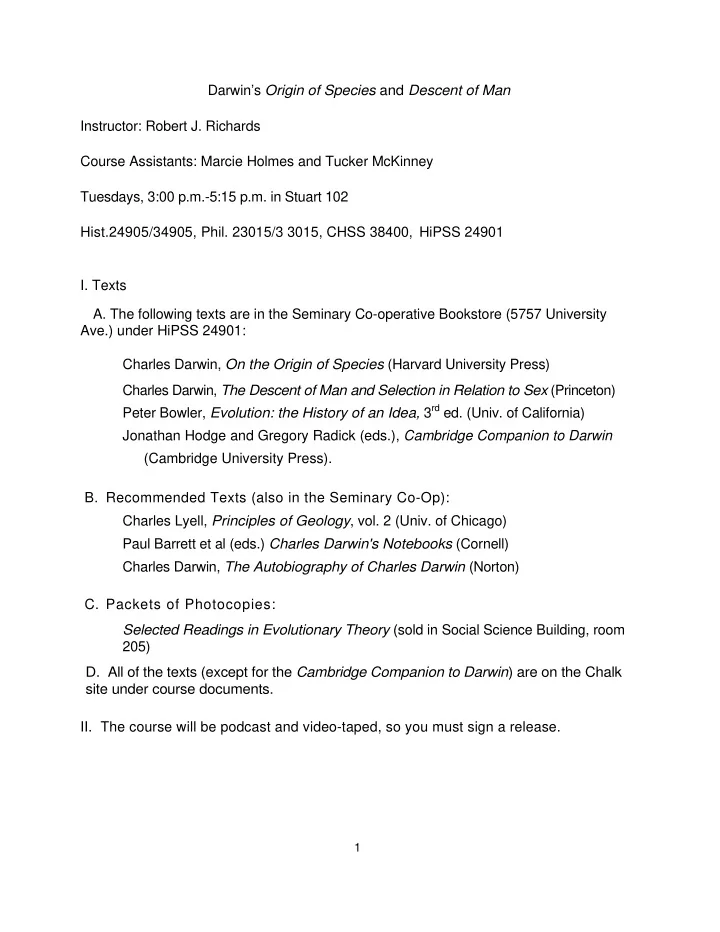
Darwin’s Origin of Species and Descent of Man Instructor: Robert J. Richards Course Assistants: Marcie Holmes and Tucker McKinney Tuesdays, 3:00 p.m.-5:15 p.m. in Stuart 102 Hist.24905/34905, Phil. 23015/3 3015, CHSS 38400, HiPSS 24901

  • I. Texts
  • A. The following texts are in the Seminary Co-operative Bookstore (5757 University

Ave.) under HiPSS 24901: Charles Darwin, On the Origin of Species (Harvard University Press) Charles Darwin, The Descent of Man and Selection in Relation to Sex (Princeton) Peter Bowler, Evolution: the History of an Idea, 3rd ed. (Univ. of California) Jonathan Hodge and Gregory Radick (eds.), Cambridge Companion to Darwin (Cambridge University Press).

  • B. Recommended Texts (also in the Seminary Co-Op):

Charles Lyell, Principles of Geology, vol. 2 (Univ. of Chicago) Paul Barrett et al (eds.) Charles Darwin's Notebooks (Cornell) Charles Darwin, The Autobiography of Charles Darwin (Norton)

  • C. Packets of Photocopies:

Selected Readings in Evolutionary Theory (sold in Social Science Building, room 205)

  • D. All of the texts (except for the Cambridge Companion to Darwin) are on the Chalk

site under course documents.

  • II. The course will be podcast and video-taped, so you must sign a release.
slide-2
SLIDE 2

2

  • III. Requirements:
  • A. You will be responsible for preparing texts assigned for discussion, and it is

imperative that you do so. You will also be responsible for the recommended readings marked with an asterisk. The graduate students should do all of the recommended readings.

  • B. The written requirements for the course.
  • 1. There will be two possible arrangements for meeting the written requirement of

the course, the first for undergraduates and the second for graduate students.

  • a. Several shorter papers:

1) A 5-8 page paper on sections II to IV—due on Monday, Oct. 20. 2) Then a series of two page papers on each of the sections of Darwin’s Origin of Species—due on Oct. 27, Nov. 3, Nov. 10, Nov. 17. 3) A 5-8 page paper on sections IX and X—due on Dec. 5.

  • b. Papers on each of the Origin sections and one longer paper at the end
  • f term.

1) Thus, a series of two page papers on each of the sections of Darwin’s Origin of Species—due on Oct. 24, Nov. 3, Nov. 10, and

  • Nov. 17.

2) One longer paper (about 20 pages or so)—due on Dec. 5.

  • 2. Character of the papers
  • a. The 5-8 page papers can be on any topic found in the relevant sections. It

should be some problem or concept that you isolate, explain, and provide a resolution for. These should deal with the primary literature (texts for discussion), though may be generated by something in the secondary literature (recommended reading).

  • b. In the two-page papers, you should select one of the chapters of the

Origin found in that section and then: 1) Indicate the argument or arguments Darwin is making.

slide-3
SLIDE 3

3

2) Indicate the logical features of the argument and the evidence for the conclusion. 3) Mention the kinds of rhetorical devices he uses. 4) Evaluate the persuasiveness of the argument found in the text.

  • c. The longer paper can be on any topic derived from the course. It

should focus on the primary material for the course, but the argument carried on can and should also deal with the secondary material.

  • d. The 5-8 page papers and the longer paper should be in hard copy,

typed, stapled, and handed in on the date due. Turn them into the secretary in the Fishbein Center (Social Sciences 205). You must also retain a copy of your paper.

  • e. The two-page papers should be sent to the Chalk site (in the drop

box). They should be sent by noon of the Monday prior to class.

  • f. All of your papers must have: 1) your name, 2) the date, and 3) your

status (i.e. grad student or undergrad).

  • IV. General Information:
  • A. Richards: Office: Social Sciences Research 205. Hours: TT: 1:45 p.m.-3:00 p.m.

Phone: 702-8348; fax: 743-8949; home page: http://home.uchicago.edu/~rjr6; email: r-richards@uchicago.edu.

  • B. Holmes: email, meholmes@uchicago.edu
  • C. McKinney: email, tmckinne@uchicago.edu
slide-4
SLIDE 4

4

(Sept. 30)

  • I. Introduction: Darwin’s Biology: From the Origin to the Religious Wars of the late 19th

through the 21st centuries (October 7)

  • II. Early Evolutionists: Erasmus Darwin and Lamarck
  • A. Texts for discussion:
  • 1. Erasmus Darwin, "Generation," Zoonomia (2nd ed., 1796), sect. 39. In

Selected Readings in Evolutionary Theory I.

  • 2. Jean-Baptiste de Lamarck, "Selections from the 'Discours d'overture' of

1800 and from Systeme des animaux san vertebres (1801), trans. in Selected Readings in Evolutionary Theory I.

  • 3. Lamarck, "Of the Influence of the Environment on the Activities and

Habits of Animals," Zoological Philosophy (1809; trans., 1914), trans. H. Elliot, pp. 106-127. In Selected Readings in Evolutionary Theory I.

  • B. Recommended reading:
  • 1. *Bowler, Evolution, chap. 4 (pp. 96-140).

(October 14)

  • III. Darwin’s Voyage of Romantic Adventure
  • A. Texts for discussion (page numbers refer to Darwin’s own pagination, not to

the photocopy):

  • 1. Charles Darwin, The Voyage of the Beagle (1839) preface, chap 1

(pp. 1-7); chap. 8 (200- 212); chap. 19--Galapagos Islands (pp. 453- 478); conclusion (pp. 602-08). In Selected Readings I.

  • 2. Charles Darwin, Beagle Diary (1831-1836), Galapagos Islands, pp.

351-64. In Selected Readings I.

  • 3. Charles Lyell, "Lamarck's Theory," Principles of Geology (1830-33),
  • vol. 2: chap. 2 (pp. 18-35); chap. 10 (158-75); chap 11 (pp. 176-84). In

Selected Readings I.

  • B. Recommend reading:
  • 1. *Phillip Sloan, “The Making of a Philosophical Naturalist,” in Cambridge

Companion, pp. 17-39.

  • 2. Bowler, Evolution, chap. 5 (141-55).
slide-5
SLIDE 5

5

(October 21)

  • IV. The Development of Darwin's Early Views
  • A. Texts for discussion:
  • 1. Charles Darwin, Extracts from Notebooks B, C, D, and E (1837-1839).

In Selected Readings I.

  • 2. Charles Darwin, "Essay" of 1842, in Francis Darwin (ed.), Foundations
  • f the Origin of Species (1909), pp. 1-52. In Selected Readings I.
  • B. Recommended Reading:
  • 1. *Jonathan Hodge, “The Notebook Programmes and Projects of

Darwin’s London Years,” in Cambridge Companion, pp. 40-68.

  • 2. Bowler, Evolution, chaps. 5 (155-1 76).

(October 28)

  • V. Darwin's Origin of Species, 1
  • A. Text for discussion:
  • 1. Charles Darwin, On the Origin of Species, "Introduction" (Darwin's),
  • chaps. 1-2.
  • 2. Charles Darwin, "Variation under Nature," Charles Darwin's Natural

Selection (1856-1858), ed. Staufer, pp. 138-167. In Selected Readings.

  • B. Recommend Reading: *Ernst Mayr, "The Biological Meaning of Species,"

Evolution and the Diversity of Life, chap. 35. In Selected Readings. (November 4)

  • VI. Darwin's Origin of Species, 2
  • A. Text for discussion: Darwin, Origin of Species, chaps. 3-4.
  • B. Recommended reading:
  • 1. *R. Richards, “Darwin’s Theory of Natural Selection and Its Moral

Purpose,” in Cambridge Companion to the Origin of Species, ed. R. Richards and M. Ruse (Cambridge University Press, 2009). In Selected Readings

  • 2. C. K. Waters, “The Arguments in the Origin of Species,” in Cambridge

Companion, pp. 116-42.

slide-6
SLIDE 6

6

(November 11) VII. Darwin's Origin of Species, 3

  • A. Text for discussion:
  • 1. Darwin, Origin of Species, chaps. 6-7
  • 2. The argument from design (19th century version):

a) William Paley, “State of the Argument” and “The Argument Cumulative,” from his Natural Theology (1802), chaps 1 and 6 (pp. 5-8, 43-45). In Selected Readings. b) David Hume, Dialogues Concerning Natural Religion, part 2. In Selected Readings.

  • B. Recommended reading: Bowler, Evolution, chap. 6 (pp. 177-223).

(November 18)

  • VIII. Darwin's Origin of Species, 4
  • A. Text for discussion: Darwin, Origin of Species, chaps. 13-14.
  • B. Recommended reading:
  • 1. *Lynn Nyhart, “Embryology and Morphology in the Origin of

Species,” Cambridge Companion to the Origin of Species. In Selected Readings.

  • 2. J. B. Brooke, “Darwin and Victorian Christianity,” in Cambridge

Companion, pp. 192-213. 3. Elliott Sober, “Metaphysical and Epistemological Issues in Modern Darwinian Theory,” in Cambridge Companion, pp. 267-87. (November 25)

  • IX. Darwin’s Descent of Man
  • A. Text for discussion: Darwin’s Descent of Man, chaps 3 and 5.
  • B. Recommended reading:
  • 1. *R. Richards, “Darwin on Mind, Morals, and Emotions,” in Cambridge

Companion, pp. 92-115.

  • 2. Kim Sterelny, “Darwinian Concepts in the Philosophy of Mind,” in

Cambridge Companion, pp. 288-319.

slide-7
SLIDE 7

7

(December 2)

  • X. The Culture Wars: Religion and the Argument from Design
  • A. Texts for discussion:
  • 1. The Scopes Trial (Mencken’s account and trial transcripts), in Selected

Readings in Evolutionary Theory.

  • 2. Intelligent Design: Michael Behe, “Irreducible Complexity,” in Selected

Readings in Evolutionary Theory.

  • 3. The Neo-Darwinian Response to Intelligent Design: Jerry Coyne, “The

Faith that Dare Not Speak Its Name,” in Selected Readings in Evolutionary Theory.

  • 4. Ken Miller, “The Flagellum Unspun.” In Selected Readings.
  • B. Recommended Reading: Bowler, Evolution, chap 8 (pp. 274-324).