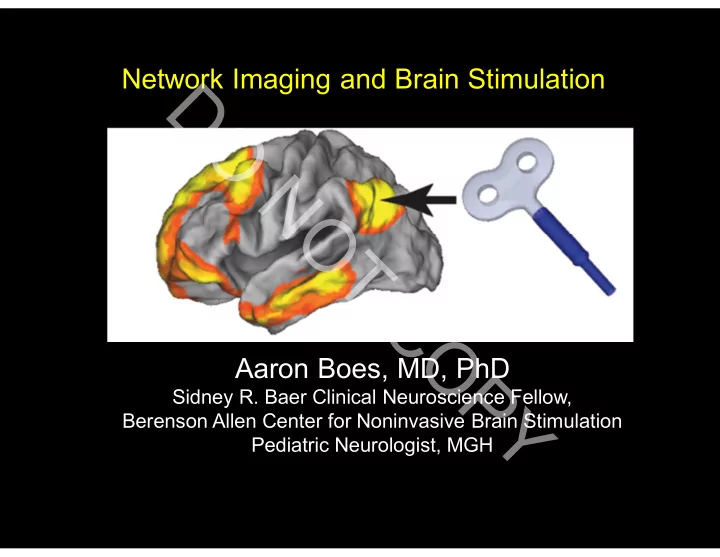
SLIDE 1 Network Imaging and Brain Stimulation Aaron Boes, MD, PhD
Sidney R. Baer Clinical Neuroscience Fellow, Berenson Allen Center for Noninvasive Brain Stimulation Pediatric Neurologist, MGH
D O N O T C O P Y
SLIDE 2
Topics
1) A network model for brain function and dysfunction 1) What can network imaging contribute to brain stimulation? 2) How does brain stimulation modify networks?
D O N O T C O P Y
SLIDE 3
Disclosure: Off-label uses of TMS will be discussed
D O N O T C O P Y
SLIDE 4
Mike Fox contributed several slides
D O N O T C O P Y
SLIDE 5 Please interrupt, ask questions.
D O N O T C O P Y
SLIDE 6
Topics
1) A network model for brain function and dysfunction 1) What can network imaging contribute to brain stimulation? 2) What can brain stimulation contribute to network imaging?
D O N O T C O P Y
SLIDE 7
Historical Background: Localization of function
Paul Broca, 1861
D O N O T C O P Y
SLIDE 8 Localization of functional centers >> Network localization of functions Complex functions arise through interaction among a set of region, each with specialized processing
D O N O T C O P Y
SLIDE 9
Normal functions result from network-level interactions Dysfunction also due to abnormal network activity
D O N O T C O P Y
SLIDE 10
Brain disorders will be treated more effectively by identifying and targeting therapy toward dysfunctional networks.
D O N O T C O P Y
SLIDE 11
Topics
1) A network model for brain function and dysfunction 1) What can network imaging contribute to brain stimulation? 2) What can brain stimulation contribute to network imaging?
D O N O T C O P Y
SLIDE 12 Major types of network imaging
1) Task-based MRI > identify co-active sites 1) Structural connectivity
2) Correlated functional measures
D O N O T C O P Y
SLIDE 13
0.5 1 1.5 2 2.5 3 50 100 150 200 250
Open Open Open Open Closed Closed Closed Closed
Open – Closed =
Classical Neuroimaging
% BOLD Change Time (s)
Fox and Raichle (2007) Nat. Rev. Neuro.
Classical functional imaging design
Slide courtesy of Mike Fox
D O N O T C O P Y
SLIDE 14 Open – Closed =
BOLD Data Is Very “Noisy”
% BOLD Change
Open Open Open Open Closed Closed Closed Closed
0.5 1 1.5 2 2.5 3 50 100 150 200 250
Time (s)
Fox and Raichle (2007) Nat. Rev. Neuro.
In task-based fMRI bold signal has “noise”
Slide courtesy of Mike Fox
D O N O T C O P Y
SLIDE 15
BOLD activity oscillates at rest
D O N O T C O P Y
SLIDE 16 BOLD Data Is Very “Noisy”
% BOLD Change Time (s)
Task-based activations = 1% of brain energy. Majority of energy used to generate spontaneous activity, or “fMRI noise”
Raichle, 2006
D O N O T C O P Y
SLIDE 17
Spontaneous Fluctuations (“Noise”) in the BOLD Signal
Using BOLD ‘noise’ as signal
D O N O T C O P Y
SLIDE 18
0.5 1 1.5 2 50 100 150 200 250 300 Time (sec) % BOLD Change
Spontaneous Fluctuations (“Noise”) in the BOLD Signal
1 5 9 13 17 21 25 29 33 37 41 45 49 53 57 61 65 69 73 77 81 85 89 93 97 101 105 109
Left Motor Cortex Right Motor Cortex
Using BOLD ‘noise’ as signal
Bharat Biswal et al, 1997
D O N O T C O P Y
SLIDE 19 1 5 9 13 17 21 25 29 33 37 41 45 49 53 57 61 65 69 73 77 81 85 89 93 97 101 105 109
Left Motor Cortex Right Motor Cortex
0.5 1 1.5 2 50 100 150 200 250 300 Time (sec) % BOLD Change
Spontaneous Fluctuations are Specifically Correlated
After Bharat Biswal and colleagues (1995) Magnetic Resonance in Medicine
D O N O T C O P Y
SLIDE 20 Z score, fixed effects, N = 10 Fox and Raichle (2007) Nat. Rev. Neuro.
Generation of Resting State Functional Connectivity Maps
0.5 1 1.5 2 50 100 150 200 250 300 Time (sec) % BOLD Change
D O N O T C O P Y
SLIDE 21
0.5 1 1.5 2 50 100 150 200 250 300
Time (sec) % BOLD Change
Seed Region in Pcc MPF
Connectivity of site that is active during rest, inactive during tasks
D O N O T C O P Y
SLIDE 22
0.5 1 1.5 2 50 100 150 200 250 300
Time (sec) % BOLD Change
Seed Region in Pcc MPF
D O N O T C O P Y
SLIDE 23
0.5 1 1.5 2 50 100 150 200 250 300
Time (sec) % BOLD Change
Seed Region in Pcc MPF
Default mode network
D O N O T C O P Y
SLIDE 24
0.5 1 1.5 2 50 100 150 200 250 300
Time (sec) % BOLD Change
Seed Region in Pcc MPF IPS Fox et al. (2005) PNAS
Regions activated by tasks Have negative correlation with default mode network
D O N O T C O P Y
SLIDE 25 Fox et al. (2005) PNAS
Regions activated by tasks Have negative correlation with default mode network
Fox et al. (2005) PNAS
D O N O T C O P Y
SLIDE 26 DTI Network Rs-fcMRI Network
Honey et al. 2009 PNAS
Resting-state functional connectivity networks correspond to known anatomical paths
D O N O T C O P Y
SLIDE 27 Exponential Popularity of Rs-fcMRI
Snyder et al. 2012 Neuroimage
Exponential popularity of rs-fcMRI
D O N O T C O P Y
SLIDE 28
- Understanding disease pathophysiology
- Biomarkers / Diagnosis
- Guiding treatment
Clinical Implications of rs-fcMRI
D O N O T C O P Y
SLIDE 29
- Understanding disease pathophysiology
- Biomarkers / Diagnosis
- Guiding treatment
Clinical Implications of rs-fcMRI
D O N O T C O P Y
SLIDE 30
Sample Case – Using rs-fcMRI to gain insight about clinical problem
D O N O T C O P Y
SLIDE 31
Case
17 yo girl presents with visual hallucinations
D O N O T C O P Y
SLIDE 32 Case
17 yo girl presents with visual hallucinations
- “Eyes were like a zoom lens, going in and out
- f focus”
D O N O T C O P Y
SLIDE 33 Case
17 yo girl presents with visual hallucinations
- “Eyes were like a zoom lens, going in and out
- f focus”
- “Scene being drawn in by crayon”
D O N O T C O P Y
SLIDE 34 Case
17 yo girl presents with visual hallucinations
- “Eyes were like a zoom lens, going in and out
- f focus”
- “Scene being drawn in by crayon”
- Felt as though she was a referee in a soccer
game
D O N O T C O P Y
SLIDE 35 Case 17 yo girl presents with visual hallucinations
- “Eyes were like a zoom lens, going in and out
- f focus”
- “Scene being drawn in by crayon”
- Felt as though she was a referee in a soccer
game
- Reached for jacket and flowers sprouted from it,
then fell over with straight stems, like popsicle sticks
D O N O T C O P Y
SLIDE 36
D O N O T C O P Y
SLIDE 37 Peduncular Hallucinosis (PH)
Predominately visual hallucinations following brainstem
D O N O T C O P Y
SLIDE 38
Peduncular Hallucinosis (PH)
Where do lesions causing peduncular hallucinosis localize to?
D O N O T C O P Y
SLIDE 39
Lesion Overlap Analysis Results NN=98
D O N O T C O P Y
SLIDE 40 Hypothesized mechanism of peduncular hallucinosis
Kazui et al, 2009
Subcortical lesions cause a ‘release’ of visual association cortex (Cogan, 1973; Manford, 1998; Kosslyn, 2001; Kazui, 2009)
D O N O T C O P Y
SLIDE 41
D O N O T C O P Y
SLIDE 42
D O N O T C O P Y
SLIDE 43
Peduncular hallucinosis lesions are anticorrelated to extrastriate visual cortex
NN=98
D O N O T C O P Y
SLIDE 44
Can this approach be used for other lesion syndromes that have been challenging to localize?
NN=98
D O N O T C O P Y
SLIDE 45 Boes et al, in prep
D O N O T C O P Y
SLIDE 46
- Networks associated with focal brain lesions
may serve as targets for repetitive TMS to augment recovery Conclusion: The network effects of focal brain lesions can provide insight about the symptoms
D O N O T C O P Y
SLIDE 47
Full description of clinical implications of rs-fcMRI beyond scope of talk
D O N O T C O P Y
SLIDE 48 Disease/Condition References Findings
Alzheimer’s (Allen et al. 2007; Greicius et al. 2004; Li et al. 2002; Supekar et al. 2008; Wang et al. 2006a; Wang et al. 2007; Wang et al. 2006b) Decreased correlations within the default mode network including hippocampi and decreased anticorrelations between the DMN and TPN PIB positive (Hedden et al. 2009; Sheline et al. 2009) Decreased correlations within the default mode network Mild Cognitive Impairment (Li et al. 2002; Sorg et al. 2007) Decreased correlations within the default mode network and decreased anticorrelations between the DMN and TPN Fronto-Temporal Dementia (Seeley et al. 2007a; Seeley et al. 2008) Decreased correlations within the salience network Healthy Aging (Andrews-Hanna et al. 2007; Damoiseaux et al. 2007) Decreased correlations within the default mode network Multiple Sclerosis (De Luca et al. 2005; Lowe et al. 2002) Decreased correlations within the somatomotor network ALS (Mohammadi et al. 2009) Decreased connectivity in DMN and premotor cortex Depression (Anand et al. 2009; Anand et al. 2005a; b; Bluhm et al. 2009a; Greicius et al. 2007) Variable: Decreased connectivity between dACC and limbic regions (amygdala, medial thalamus, pallidostriatum) increased connectivity within the DMN (esp. subgenual prefrontal cortex), decreased connectivity between DMN and caudate Bipolar (Anand et al. 2009) Decreased corticolimbic connectivity PTSD (Bluhm et al. 2009c) Decreased connectivity in the DMN Schizophrenia (Bluhm et al. 2007; Bluhm et al. 2009b; Jafri et al. 2008; Liang et al. 2006; Liu et al. 2006; Liu et al. 2008; Salvador et al. 2007; Whitfield-Gabrieli et al. 2009; Zhou et al. 2007) Variable: Decreased or increased DMN connectivity Schizophrenia 1 relatives (Whitfield-Gabrieli et al. 2009) Increased connectivity in the DMN ADHD (Cao et al. 2006; Castellanos et al. 2008; Tian et al. 2006; Wang et al. 2008; Zang et al. 2007; Zhu et al. 2008; Zhu et al. 2005) Variable: reduced connectivity within the DMN, reduced anticorrelations, increased connectivity in salience Autism (Cherkassky et al. 2006; Kennedy and Courchesne 2008; Monk et al. 2009; Weng et al. 2009) Decreased connectivity within the DMN (although hippocampus is variable and connectivity may be increased in younger patients) Tourette Syndrome (Church et al. 2009) Delayed maturation of task-control and cingulo-opercular networks Epilepsy (Bettus et al. 2009; Lui et al. 2008; Waites et al. 2006; Zhang et
- al. 2009a; Zhang et al. 2009b)
Variable: decreased connectivity in mult. networks including medial temporal lobe, decreased connectivity in DMN with generalized seizure Blindness (Liu et al. 2007; Yu et al. 2008) decreased connectivity within the visual cortices and between visual cortices and somatosensory, frontal motor and temporal multisensory cortices Chronic Pain (Cauda et al. 2009a; Cauda et al. 2009c; Cauda et al. 2009d; Greicius et al. 2008) Variable: Increased/decreased connectivity within the salience network, decreased connectivity in attention networks Neglect (He et al. 2007) Decreased connectivity within the dorsal and ventral attention networks Vegetative State (Boly et al. 2009; Cauda et al. 2009b) Progressively decreased DMN connectivity with progressive states of impaired consciousness
Fox and Greicius (2010) Frontiers Sys Neurosci
D O N O T C O P Y
SLIDE 49
Topics
1) A network model for brain function and dysfunction 1) What can network imaging contribute to brain stimulation? 2) What can brain stimulation contribute to network imaging?
D O N O T C O P Y
SLIDE 50
TMS propagates trans-synaptically
D O N O T C O P Y
SLIDE 51 Nagib et al. Neurosurg clin 2011
D O N O T C O P Y
SLIDE 52
Cerebral cortex as a portal to the rest of the brain
Cerebral cortex as a portal to connected regions
D O N O T C O P Y
SLIDE 53
- If NIBS propagates transynaptically, then
connectivity is likely to play a critical role in determining the physiological effect
- Rs-fcMRI is a good technique to assess brain
connectivity
- THUS, rs-fcMRI may be able to predict the
impact and guide NIBS
Train of Logic
D O N O T C O P Y
SLIDE 54 Rs-fcMRI to target deep epileptic foci
>
- We know that targeting epileptic foci on the
cerebral cortex with 1 Hz rTMS is effective.
D O N O T C O P Y
SLIDE 55
D O N O T C O P Y
SLIDE 56 Bernard Chuang and Mo Shafi Annals of Neurology, 2015
D O N O T C O P Y
SLIDE 57 Can rs-fcMRI be used to improve rTMS therapy in depression?
>
D O N O T C O P Y
SLIDE 58
FDA approved therapeutic use: High frequency TMS to the DLPFC for medication-refractory depression
D O N O T C O P Y
SLIDE 59 Herwig et al. 2001 BIOL PSYCHIATRY 50:58–61
Targeting TMS in Depression: The 5 cm method
D O N O T C O P Y
SLIDE 60 Targeting TMS in Depression: The 5 cm method
Herwig et al. 2001 BIOL PSYCHIATRY 50:58–61 Only hit the “DLPFC” ~40% of the time
D O N O T C O P Y
SLIDE 61 TMS targets vary in their efficacy
Herbsman et al. 2009
Effective Ineffective
Fitzgerald et al. 2009
42% responders 18% responders
D O N O T C O P Y
SLIDE 62 Could therapeutic effect of rTMS be related to connectivity to deeper structures?
>
D O N O T C O P Y
SLIDE 63 Subgenual anterior cingulate cortex: Abnormal in depression
>
Botteron, 2002 Coryell, 2005 Drevets, 1997 Hirayasa, 1999
D O N O T C O P Y
SLIDE 64
D O N O T C O P Y
SLIDE 65 Subgenual suppression correlates with antidepressant response
Mayberg 2009 J. Clin. Invest.
SSRI Placebo SNRI ECT DBS
Mayberg 2009 J. Clin. Invest.
D O N O T C O P Y
SLIDE 66 Fox et al. 2012 Biol Psych.
D O N O T C O P Y
SLIDE 67
Fitzgerald Target Less Effective 5cm More Effective 5cm
0.00
Subgenual Correlation (r)
P < 0.005
0.00
Subgenual Correlation (r)
P < 5 x 10⁻⁸ vs vs
Effective vs. Ineffective TMS Targets
Fox et al. 2012 Biol Psych.
D O N O T C O P Y
SLIDE 68 Guiding TMS for depression: conclusions
- Effective versus ineffective TMS sites
differ in their functional connectivity, especially with the subgenual cingulate
D O N O T C O P Y
SLIDE 69 rTMS induces structural change in subgenual anterior cingulate.
Boes et al, abstract submitted.
32 patients. 13 responders (>50% reduction in HamD) + 161.8 mm3, standard error +/- 61.1, t = 2.65, p = 0.02 Non-responders:
- 36.0 mm3, standard error +/-
101.1, t = 0.36, p = 0.73
D O N O T C O P Y
SLIDE 70
Should target be individualized?
D O N O T C O P Y
SLIDE 71 Individualized TMS targets for depression
Subgenual Seed Z = 28 X = -4 Z = -10 X = 2 Z = 28 X = -4 R Seed Regions / Seed Maps Group Map Subject 1 Subject 2 15
0.7
15
A B C Fox et al. 2012 Neuroimage
D O N O T C O P Y
SLIDE 72 Day 1 Day 2 Day 1 Subject 1 Subject 2 0.7
A B C Day 2 Subgenual Seed Efficacy- based Seed Map Day 1 Day 2 Day 1 Subject 1 Subject 2 0.7
A B C Day 2
Individual differences in functional connectivity are reproducible across days
Fox et al. 2012 Neuroimage
D O N O T C O P Y
SLIDE 73 Guiding TMS for depression
- Next step:
- Patients without response to rTMS can
trial individualized targeted approach
D O N O T C O P Y
SLIDE 74
Is this approach broadly applicable? Can the effects of rTMS be guided by experience in deep brain stimulation, where effective subcortical nodes are known?
D O N O T C O P Y
SLIDE 75 Disease Invasive (DBS) Noninvasive (TMS, tDCS) Addiction NA DLPFC (laterality unclear) Alzheimer’s Fornix Bilateral DLPFC (+/- parietal, temporal) Anorexia NA, Subgenual L DLPFC Depression Subgenual, VC/VS, NA, MFB, habenula Left DLPFC, R DLPFC Dystonia GPi SMA/ACC, Premotor Epilepsy Thalamus (AN, CM), MTL Active EEG focus Cerebellum Essential Tremor VIM Midline Cerebellum, Lateral Cerebellum, M1 Gait Dysfunction PPN M1 (leg area) Huntington’s GPi SMA Minimally Conscious Thalamus (intralaminar/CL, CM/Pf) R DLPFC, M1 Obsessive Compulsive Disorder VC/VS, NA, ALIC, STN L orbitofrontal, Pre-SMA Pain PAG, Thalamus (VPL/VPM) M1 Parkinson’s STN, GPi M1, SMA Tourette’s Thalamus (CM/Pf), GPi, NA, ALIC SMA
Fox et al. 2014 PNAS
D O N O T C O P Y
SLIDE 76 Fox et al. 2014 PNAS Invasive and Noninvasive Brain Stimulation Sites are Linked Across 14 Diseases
Addiction Alzheimer’s Anorexia Depression Dystonia Essential Tremor Epilepsy Gait Dysfunction Huntington’s Minimally Conscious OCD Pain Parkinson’s Tourette’s Positive Negative Excitatory Target Inhibitory Target
D O N O T C O P Y
SLIDE 77 Invasive and Noninvasive Brain Stimulation Sites are Linked Across 14 Diseases
Addiction Alzheimer’s Anorexia Depression Dystonia Essential Tremor Epilepsy Gait Dysfunction Huntington’s Minimally Conscious OCD Pain Parkinson’s Tourette’s Positive Negative Excitatory Target Inhibitory Target
0.02 0.04 0.06 0.08 0.1 DBS Correlation (r) Best Noninvasive Stimulation Site Random Noninvasive Stimulation Sites
P < 0.005 Fox et al. 2014 PNAS
D O N O T C O P Y
SLIDE 78 Ineffective sites are characterized by an absence of functional connectivity
Parkinson’s Disease Pain Essential Tremor Depression Fox et al. 2014 PNAS
D O N O T C O P Y
SLIDE 79 The sign of the correlation (positive vs negative) relates to the reported utility of excitatory vs inhibitory stimulation
DBS$ Correla+on$ $ (r)$
DBS$ Correla+on$ $ (r)$
**
- B. All Diseases, Best Sites
- C. All
- A. Parkinson’s Disease
Excitatory Inhibitory M1 Benefit No Benefit SMA No Benefit Benefit
Fox et al. 2014 PNAS
D O N O T C O P Y
SLIDE 80 The sign of the correlation (positive vs negative) relates to the reported utility of excitatory vs inhibitory stimulation
DBS$ Correla+on$ $ (r)$
DBS$ Correla+on$ $ (r)$
**
- B. All Diseases, Best Sites
- C. All
- A. Parkinson’s Disease
Excitatory Inhibitory M1 Benefit No Benefit SMA No Benefit Benefit
Fox et al. 2014 PNAS
D O N O T C O P Y
SLIDE 81 Implications…
>
- Network-based rationale for selecting rTMS
targets going forward in clinical trials
D O N O T C O P Y
SLIDE 82
Topics
1) A network model for brain function and dysfunction 1) What can network imaging contribute to brain stimulation? 2) What can brain stimulation contribute to network imaging?
D O N O T C O P Y
SLIDE 83
We can target networks using brain stimulation. What happens to the stimulated networks?
D O N O T C O P Y
SLIDE 84
Modulating the default mode network
D O N O T C O P Y
SLIDE 85 Eldaief et al. 2012 PNAS
D O N O T C O P Y
SLIDE 86
D O N O T C O P Y
SLIDE 87
Changes in connectivity after rTMS to cerebellum
D O N O T C O P Y
SLIDE 88
So we can alter strength of functional connectivity networks. Does it have functional relevance?
D O N O T C O P Y
SLIDE 89
Science, 2014
D O N O T C O P Y
SLIDE 90
D O N O T C O P Y
SLIDE 91
D O N O T C O P Y
SLIDE 92
Note the focality of change – 3 mm away = Nonsignificant changes!
D O N O T C O P Y
SLIDE 93
rTMS-induced functional connectivity correlated with memory performance
D O N O T C O P Y
SLIDE 94
D O N O T C O P Y
SLIDE 95 Review
1) A network model for brain function and dysfunction
- Network localization of function and dysfunction
2) What can network imaging contribute to brain stimulation?
- Target deep epileptic foci
- Potentially improve efficacy of depression treatment
- Potentially improve target selection via DBS connectivity
3) How does brain stimulation modify networks?
- Focal alteration in network connectivity with functional
correlates.
D O N O T C O P Y
SLIDE 96 Review
1) A network model for brain function and dysfunction
- Network localization of function and dysfunction
2) What can network imaging contribute to brain stimulation?
- Target deep epileptic foci
- Potentially improve efficacy of depression treatment
- Potentially improve target selection via DBS connectivity
3) How does brain stimulation modify networks?
- Focal alteration in network connectivity with functional
correlates.
D O N O T C O P Y
SLIDE 97 Review
1) A network model for brain function and dysfunction
- Network localization of function and dysfunction
2) What can network imaging contribute to brain stimulation?
- Target deep epileptic foci
- Potentially improve efficacy of depression treatment
- Potentially improve target selection via DBS connectivity
3) How does brain stimulation modify networks?
- Focal alteration in network connectivity with functional
correlates.
D O N O T C O P Y
SLIDE 98
Questions?
D O N O T C O P Y