Data Curation and Distribution in Support of Cornell Universitys - - PowerPoint PPT Presentation

data curation and distribution in support of cornell
SMART_READER_LITE
LIVE PREVIEW

Data Curation and Distribution in Support of Cornell Universitys - - PowerPoint PPT Presentation

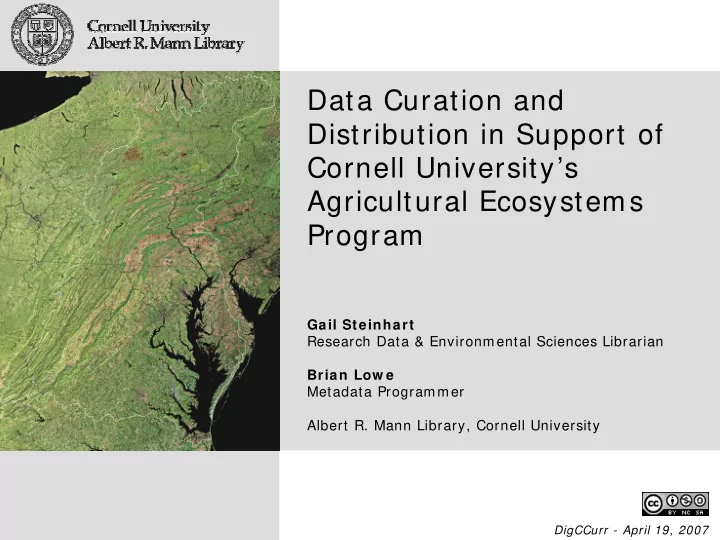
Data Curation and Distribution in Support of Cornell Universitys Agricultural Ecosystems Program Gail Steinhart Research Data & Environmental Sciences Librarian Brian Low e Metadata Programmer Albert R. Mann Library, Cornell


slide-1
SLIDE 1

Gail Steinhart Research Data & Environmental Sciences Librarian Brian Low e Metadata Programmer Albert R. Mann Library, Cornell University

Data Curation and Distribution in Support of Cornell University’s Agricultural Ecosystems Program

DigCCurr - April 19, 2007

slide-2
SLIDE 2

Overview

  • Motivation
  • Strategy
  • What we’ve learned so far
slide-3
SLIDE 3

Motivation

from Michener et al., 1997

slide-4
SLIDE 4

Motivation

slide-5
SLIDE 5

Definitions

Curation The term digital curation is used … for the actions needed to maintain digital research data and

  • ther digital materials over their entire life-cycle

and over time for current and future generations

  • f users. Implicit in this definition are the

processes of digital archiving and preservation but it also includes all the processes needed for good data creation and management, and the capacity to add value to data to generate new sources of information and knowledge.

  • from DCC

We Academic and research libraries, but not alone

slide-6
SLIDE 6

Scientific context

Upper Susquehanna River Basin

  • Susquehanna is largest US

river draining to the Atlantic; largest trib to the bay

  • MOU with Chesapeake Bay

Program commits NYS to water quality goals of Chesapeake Bay Agreement

Chesapeake Bay watershed

  • Largest US estuary
  • Critical fishery, habitat
  • Sensitive to nutrient

pollution

  • Chesapeake Bay

Agreement of 2000

slide-7
SLIDE 7

Collaborators

Cornell departments and units:

  • Animal Science
  • Biological and Environmental Engineering
  • Crop and Soil Science
  • Ecology and Evolutionary Biology
  • Horticulture
  • Natural Resources
  • Mann Library

Other organizations:

  • Cornell Cooperative Extension of Chemung County
  • Institute of Ecosystem Studies
  • Univ. Maryland Center for Environmental Science
  • Univ. Nebraska-Lincoln School of Natural Resources
  • Upper Susquehanna Coalition

Funding: USDA Cooperative State Research, Education,

and Extension Service

slide-8
SLIDE 8

Types of data

Observational:

  • Atmospheric deposition of N
  • Water and soil chemistry
  • Hydrologic measurements
  • Meteorological data
  • Plant tissue chemistry
  • Cs-137 in stream sediments

Experimental:

  • Effects of willow char amendments to agricultural soils
  • Wetland plant species responses to changes in S and P

cycling

  • Changes in ground water chemistry as a result of

chemical amendments

  • N leaching in soils under different cropping systems and

snow cover manipulations

  • Changes in forest and old field chemistry as a result of N

fertilization

Simulation models of nutrient and sediment fluxes

slide-9
SLIDE 9

Strategy

  • Local support for data and metadata preparation
  • Local and/ or discipline-based “publication” of

data, metadata

slide-10
SLIDE 10

Strategy

  • Local support for data and metadata preparation
  • Local and/ or discipline-based “publication” of

data, metadata

slide-11
SLIDE 11

Strategy

  • Local support for data and metadata preparation
  • Local and/ or discipline-based “publication” of

data, metadata

slide-12
SLIDE 12

“Staging repository”

  • Use discipline-specific metadata standards and

tools > > Ecological Metadata Language ( EML) > > Morpho

  • Provide a place to share pre-publication data

within the group > > Metacat

  • Provide training and recommendations on data

and metadata preparation

slide-13
SLIDE 13

Ecological Metadata Language: EML

  • Developed specifically for ecological data (NCEAS,

LTER)

  • Modular and extensible XML-based standard
  • Accommodates information on methods,

geographic coverage, temporal coverage, detailed descriptions of tabular data

  • http: / / knb.ecoinformatics.org/ software/ eml/
  • Comes with tools!
slide-14
SLIDE 14

Morpho

  • Easy to use, platform independent metadata editor.
  • Interacts with Metacat: allows users to upload

metadata and data; allows users to search, view, and export public data and metadata.

slide-15
SLIDE 15

EML record

slide-16
SLIDE 16

“Publication” of data

  • Deposit in institutional repository

> > DSpace

  • Submit metadata (and possibly data) to

discipline-specific repository > > KNB, other?

  • Link from project web portal:

http: / / www.usaep.mannlib.cornell.edu/

slide-17
SLIDE 17

Test case: Historical data

  • Observational data from last 30 years
  • Original format: Quattro Pro workbooks with

multiple pages

  • Various errors (apparent duplicate records,

misaligned columns, out of range values)

  • Missing or ambiguous information (methods, units,

geographic locations)

  • Extensible model?
slide-18
SLIDE 18

Summary – curation skills

  • “Traditional” library and archiving skills (metadata,

preservation, interoperability, appraisal and selection)

  • Understanding of CI
  • Subject area knowledge:
  • Understanding of research practices, tools, and

culture (may be discipline-specific)

  • Awareness of standards and tools related to

data

  • Productive partnerships with researchers (or ability

to develop them)

slide-19
SLIDE 19

Gail Steinhart Research Data & Environmental Sciences Librarian Albert R. Mann Library, Cornell University GSS1@cornell.edu

Thank you