Data Preprocessing Why Data Preprocessing? Chris Williams, School - - PowerPoint PPT Presentation

data preprocessing why data preprocessing
SMART_READER_LITE
LIVE PREVIEW

Data Preprocessing Why Data Preprocessing? Chris Williams, School - - PowerPoint PPT Presentation

Data Preprocessing Why Data Preprocessing? Chris Williams, School of Informatics University of Edinburgh Data in the real world is dirty. It is: Data preparation is a big issue for data mining. Cabena et al (1998) extimate that data


slide-1
SLIDE 1

Data Preprocessing

Chris Williams, School of Informatics University of Edinburgh Data preparation is a big issue for data mining. Cabena et al (1998) extimate that data preparation accounts for 60% of the effort in a data mining application.

  • Data cleaning
  • Data integration and transformation
  • Data reduction

Reading: Han and Kamber, chapter 3

Why Data Preprocessing?

Data in the real world is dirty. It is:

  • incomplete, e.g. lacking attribute values
  • noisy, e.g. containing errors or outliers
  • inconsistent, e.g. containing discrepancies in codes or names

GIGO: need quality data to get quality results

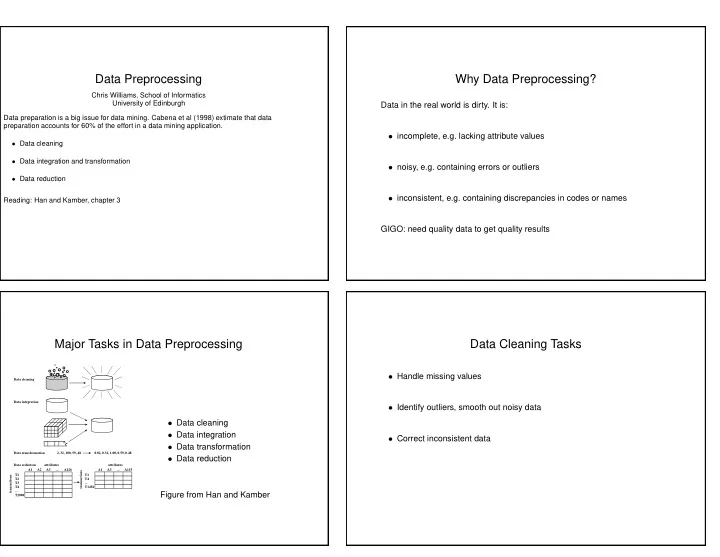
Major Tasks in Data Preprocessing

Data cleaning Data integration Data transformation Data reduction attributes attributes A1 A2 A3 ... A126 2, 32, 100, 59, 48 0.02, 0.32, 1.00, 0.59, 0.48 T1 T2 T3 T4 ... T2000 transactions transactions A1 A3 ... T1 T4 ... T1456 A115

  • Data cleaning
  • Data integration
  • Data transformation
  • Data reduction

Figure from Han and Kamber

Data Cleaning Tasks

  • Handle missing values
  • Identify outliers, smooth out noisy data
  • Correct inconsistent data
slide-2
SLIDE 2
  • Missing Data

What happens if input data is missing? Is it missing at random (MAR) or is there a systematic reason for its absence? Let xm denote those values missing, and xp those values that are present. If MAR, some “solutions” are – Model P(xm|xp) and average (correct, but hard) – Replace data with its mean value (?) – Look for similar (close) input patterns and use them to infer missing values (crude version of density model) – Reference: Statistical Analysis with Missing Data R. J. A. Little, D. B. Rubin, Wiley (1987)

  • Outliers detected by clustering, or combined computer and human inspection

Data Integration

Combines data from multiple sources into a coherent store

  • Entity identification problem: identify real-world entities from multiple data

sources, e.g. A.cust-id ≡ B.cust-num

  • Detecting and resolving data value conflicts: for the same real-world

entity, attribute values are different, e.g. measurement in different units

Data Transformation

  • Normalization, e.g. to zero mean, unit standard deviation

new data = old data − mean std deviation

  • r max-min normalization to [0, 1]

new data = old data − min max − min

  • Normalization useful for e.g. k nearest neighbours, or for neural networks
  • New features constructed, e.g. with PCA or with hand-crafted features

Data Reduction

  • Feature selection: Select a minimum set of features ˜

x from x so that: – P(class|˜ x) closely approximates P(class|x) – The classification accuracy does not significantly decrease

  • Data Compression (lossy)
  • PCA, Canonical variates
  • Sampling: choose a representative subset of the data

– Simple random sampling vs stratified sampling

  • Hierarchical reduction: e.g. country-county-town
slide-3
SLIDE 3

Feature Selection

Usually as part of supervised learning

  • Stepwise strategies
  • (a) Forward selection: Start with no features. Add the one which is the best predictor.

Then add a second one to maximize performance using first feature and new one; and so on until a stopping criterion is satisfied

  • (b) Backwards elimination: Start with all features, delete the one which reduces

performance least, recursively until a stopping criterion is satisfied

  • Forward selection is unable to anticipate interactions
  • Backward selection can suffer from problems of overfitting
  • They are heuristics to avoid considering all subsets of size k of d features

Descriptive Modelling

Chris Williams, School of Informatics University of Edinburgh

Descriptive models are a summary of the data

  • Describing data by probability distributions

– Parametric models – Mixture Models – Non-parametric models – Graphical models

  • Clustering

– Partition-based Clustering Algorithms – Hierarchical Clustering – Probabilistic Clustering using Mixture Models Reading: HMS, chapter 9

Describing data by probability distributions

  • Parametric models, e.g. single multivariate Gaussian
  • Mixture models, e.g. mixture of Gaussians, mixture of Bernoullis
  • Non-parametric models, e.g. kernel density estimation

ˆ f(x) = 1 n

n

  • i=1

Kh(x − xi) Does not provide a good summary of the data, expensive to compute on large datasets

slide-4
SLIDE 4

Probability Distributions: Graphical Models

  • Mixture of Independence Models

6 5 4 3 2 1

X X X X X X C

(also Naive Bayes model)

  • Fitting a given graphical model to data
  • Search over graphical structures

Clustering

Clustering is the partitioning of a data set into groups so that points in one group are similar to each other and are as different as possible from points in other groups

  • Partition-based Clustering Algorithms
  • Hierarchical Clustering
  • Probabilistic Clustering using Mixture Models

Examples

  • Split credit card owners into groups depending on what kinds of purchases they make
  • In biology, can be used to derive plant and animal taxonomies
  • Group documents on the web for information discovery

Defining a partition

  • Clustering algorithm with k groups
  • Mapping c from input example number to group to which it belongs
  • In Rd, assign to group j a cluster centre mj. Choose both c and the mj’s so as to

minimize

n

  • i=1

|xi − mc(i)|2

  • Given c, optimization of the mj’s is easy; mj is just the mean of the data vectors

assigned to class j

  • Optimiztion over c: cannot compute all possible groupings, use the k-means algorithm

to find a local optimum

k-means algorithm

initialize centres m1, . . . , mk while (not terminated) for i = 1, . . . , n calculate |xi − mj|2 for all centres assign datapoint i to the closest centre end for recompute each mj as the mean of the datapoints assigned to it end while

  • This is a batch algo-

rithm.

  • There is also an on-line

version, where the cen- tres are updated after each datapoint is seen

  • Also

k-medoids; find a representative object for each cluster centre

  • Choice of k?
slide-5
SLIDE 5

Hierarchical clustering

for i = 1, . . . , n let Ci = {xi} while there is more than one cluster left do let Ci and Cj be the clusters minimizing the distance D(Ci, Cj) between any two clusters Ci = Ci ∪ Cj remove cluster Cj end

  • Results can be displayed as a dendrogram
  • This is agglomerative clustering; divisive techniques are also possible

15 20 25 30 35 40 45 45 50 55 60 65 70 75 80 1 2 3 4 5 6 7 8 9 10 11 12 13 14 15 16 17

_____________|------> p08 | |______|------> p04 | |------> p09 |--------------------------| _______|----> p02 | | |--------| |----> p12 | |-------------| |-------> p14 | |________|------> p10

  • |

|------> p15 | ________|-----> p03 | |--------------| |-----> p06 | | | ________|-----> |--------------------------| |--------| |-----> | |--------> p11 |______________|-------> p05 |_______|------> p13 |______|-----> p16 |-----> p17

Distance functions for hierarchical clustering

  • Single link (nearest neighbour)

Dsl(Ci, Cj) = min

x,y {d(x, y)|x ∈ Ci, y ∈ Cj}

The distance between the two closest points, one from each cluster. Can lead to “chaining”.

  • Complete link (furthest neighbour)

Dcl(Ci, Cj) = max

x,y {d(x, y)|x ∈ Ci, y ∈ Cj}

  • Centroid measure: distance between clusters is difference between centroids
  • Others possible

Probabilistic Clustering

  • Using finite mixture models, trained with EM
  • Can be extended to deal with outlier by using an extra, broad distribution to “mop up”
  • utliers
  • Can be used to cluster non-vectorial data, e.g. mixtures of Markov models for

sequences

  • Methods for comparing choice of k
  • Disadvantage: parametric assumption for each component
  • Disadvantage: complexity of EM relative to e.g. k-means
slide-6
SLIDE 6

Graphical Models: Causality

  • J. Pearl, Causality, Cambridge UP (2000)
  • To really understand causal structure, we need to predict effect of

interventions

  • Semantics of do(X = 1) in a causal belief network, as opposed to

conditioning on X = 1

  • Example: smoking and lung cancer

Causal Bayesian Networks

A causal Bayesian network is a Bayesian network in which each arc is interpreted as a direct causal in- fluence between a parent node and a child node, relative to the other nodes in the network. (Gregory Cooper, 1999, section 4) Causation = behaviour under inter- ventions X X X X X Season Wet Slippery Rain Sprinkler

3 4 5 1 2

An Algebra of Doing

  • Available: algebra of seeing (observation)

e.g. what is the chance it rained if we see that the grass is wet? P(rain|wet) = P(wet|rain)P(rain)/P(wet)

  • Needed: algebra of doing

e.g. what is the chance it rained if we make the grass wet? P(rain|do(wet)) = P(rain)

Truncated factorization formula

P(x1, . . . , xn|ˆ x

i) = j=i P(xj|paj)

if xi = x

i

if xi = x

i

P(x1, . . . , xn|ˆ x

i) =      P(x1,...,xn) P(x′

i|pai)

if xi = x

i

if xi = x

i

slide-7
SLIDE 7

compare with conditioning P(x1, . . . , xn|x

i) =      P(x1,...,xn) P(x′

i)

if xi = x

i

if xi = x

i

Intervention as surgery on graphs

X X X X X Season Wet Slippery Rain Sprinkler

3 4 5 1 2

= On

Controlling confounding bias

We wish to evaluate the effect of X on Y ; what other factors Z (known as covariates or confounders) do we need to adjust for? Simpson’s “paradox”: an event C increases the probability of E in a population p, but decreases the probability of E in every subpopulation. E.g. UC-Berkeley investigated for sex-bias (1975). Overall, higher rate of admission of males, but every for department there was a slight bias in favour

  • f admitting females.

[Explanation: females applied to more competitive departments where admission rate was low]

  • Another example: administering a drug gives rise to lower rates of

recovery than giving a placebo for both males and females, but overall it can appear better

  • What treatment would you give to a patient coming into your office?

Apparent answer is “if know that patient is male or female, don’t give drug, but if gender is unknown, do!”. This answer is ridiculous!

slide-8
SLIDE 8
  • Correct answer to question will depend not only on observed

probabilities, but also on assumed causal model. Diagrams below can have the same P(C, E, F), but use of combined or gender-specific tables depends on diagram C C F F E E Recovery Recovery Gender Treatment Treatment Blood Pressure use gender-specific table use combined table