Day 1 Finals [15:00:58][INFO] 323 - - PowerPoint PPT Presentation

day 1 finals
SMART_READER_LITE
LIVE PREVIEW

Day 1 Finals [15:00:58][INFO] 323 - - PowerPoint PPT Presentation

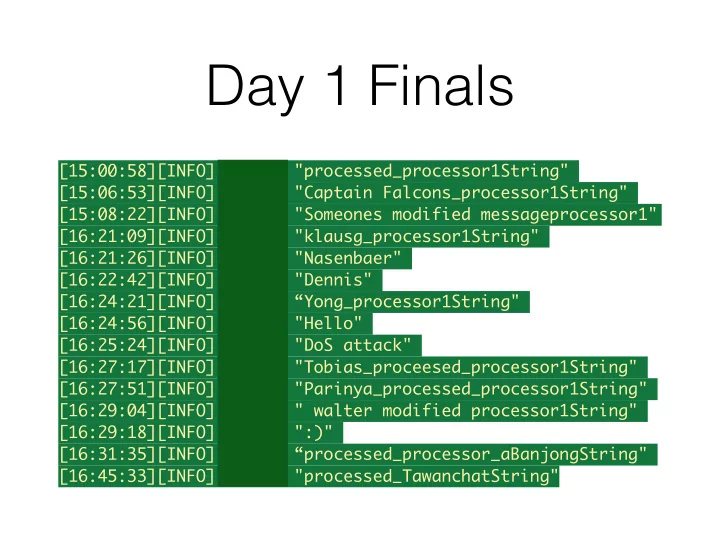
Day 1 Finals [15:00:58][INFO] 323 "processed_processor1String" [15:06:53][INFO] 18 "Captain Falcons_processor1String" [15:08:22][INFO] 1312 "Someones modified messageprocessor1" [16:21:09][INFO] 46


slide-1
SLIDE 1

Day 1 Finals

[15:00:58][INFO] 323 "processed_processor1String" [15:06:53][INFO] 18 "Captain Falcons_processor1String" [15:08:22][INFO] 1312 "Someones modified messageprocessor1" [16:21:09][INFO] 46 "klausg_processor1String" [16:21:26][INFO] 444501 "Nasenbaer" [16:22:42][INFO] 24 "Dennis" [16:24:21][INFO] 111 “Yong_processor1String" [16:24:56][INFO] 34 "Hello" [16:25:24][INFO] 35 "DoS attack" [16:27:17][INFO] 56 "Tobias_proceesed_processor1String" [16:27:51][INFO] 72 "Parinya_processed_processor1String" [16:29:04][INFO] 11 " walter modified processor1String" [16:29:18][INFO] 852501 ":)" [16:31:35][INFO] 40 “processed_processor_aBanjongString" [16:45:33][INFO] 96 "processed_TawanchatString"

slide-2
SLIDE 2

Day 2

  • transport root data (TMessage)
  • multipart message
  • parmq server

panda@panda-workshop:~/workshop/PandaRoot-trunk/$ mv MQ_TMessage MQ_Message panda@panda-workshop:~/workshop/PandaRoot-trunk/$ wget http://web-docs.gsi.de/~karabowi/ thailand/MQ_TMessage.tgz panda@panda-workshop:~/workshop/PandaRoot-trunk/$ tar xvzf MQ_TMessage.tgz

add_subdirectory (MQ_TMessage) to the main CMakeLists.txt do . ./config.sh and make in the pandaroot build directory;

slide-3
SLIDE 3

Day 2. Excercise1

  • create sampler and sink to

send/receive a TMessage with TClonesArray

  • create CMakeLists.txt (library,

executables)

  • create topology consisting of

two devices:

  • sampler1 (binding transport

channel to push on this channel)

  • sink1 (connecting to said

channel to pull from this channel)

sampler sink

sampler

push

sink

pull localhost :5555

slide-4
SLIDE 4

Implement sampler

  • get the TClonesArray from an input root file
  • wrap in the TMessage and send:

TMessage* message = new TMessage(kMESS_OBJECT); message->WriteObject(fObject); FairMQMessagePtr msg(NewMessage(message->Buffer(), message->BufferSize(), [](void* /*data*/, void* object){delete (TMessage*)(object);}, message)); Send(msg, "data");

create a TMessage write TObject (f.e. TClonesArray) to it create a FairMQMessage send it

slide-5
SLIDE 5

Serialization

  • Object in memory
  • Byte stream
  • Object in memory

Object1

0 0 1 0 1 0 1 0 0 1 1 0 1 1 0 1 0 0 1 1

Object1

serialize deserialize

slide-6
SLIDE 6

Check*

  • on the receiver side (sink), you can just convert the message to

string;

  • —> use the existing sink (for string) to print it out;

build$ ../bin/samplerTMessage --id sampler1 --mq-config ~/workshop/PandaRoot_trunk/MQ_samp_sink/options/ MQ1_sampler_sink.json --file-name ~/workshop/PandaRoot_trunk/trunk/macro/run/sim_complete.root --branch-name STTPoint build$ ./bin/mq1-sink --id sink1 --mq-config ~/workshop/PandaRoot_trunk/MQ_samp_sink/options/ MQ1_sampler_sink.json

slide-7
SLIDE 7

Implement sink

  • receive TMessage…

TMessage recMessage(msg->GetData(), msg->GetSize()); TObject* recObject = (TObject*)recMessage.ReadObject(recMessage.GetClass()); LOG(INFO) << "message class is \"" << recMessage.GetClass() << "\" " << "(\"" << recMessage.GetClass()->GetName() << "\" : “ << "\”" << recMessage.GetClass()->GetTitle() << "\")"; LOG(INFO) << "object name is \"" << recObject->GetName() << "\""; if ( strcmp( recMessage.GetClass()->GetName(),"TClonesArray" ) == 0 ) { LOG(INFO) << " the TClonesArray has " << ((TClonesArray*)recObject)->GetEntries() << " entries."; } else { LOG(INFO) << "\"" << recMessage.GetClass()->GetName() << "\" != \"TClonesArray\"";

slide-8
SLIDE 8

PndTMessage

panda@panda-workshop:~/workshop/PandaRoot_trunk/MQ_TMessage/devices$ cat PndTMessage.h #ifndef PNDTMESSAGE_H_ #define PNDTMESSAGE_H_ #include "TMessage.h" class PndTMessage : public TMessage { public: PndTMessage(void* buf, Int_t len); }; #endif /* PNDTMESSAGE_H_ */ panda@panda-workshop:~/workshop/PandaRoot_trunk/MQ_TMessage/devices$ cat PndTMessage.cxx #include "PndTMessage.h" PndTMessage::PndTMessage(void* buf, Int_t len) : TMessage(buf, len) { ResetBit(kIsOwner); } panda@panda-workshop:~/workshop/PandaRoot_trunk/MQ_TMessage/devices$ grep PndTMessage PndMQSinkTMessage.cxx devices/PndMQSinkTMessage.cxx:#include "PndTMessage.h" devices/PndMQSinkTMessage.cxx: PndTMessage recMessage(msg->GetData(), msg->GetSize());

  • workaround for the lack of TMessage’s public constructor:
slide-9
SLIDE 9

Check

build$ ../bin/samplerTMessage --id sampler1 --mq-config ~/workshop/PandaRoot_trunk/MQ_samp_sink/options/ MQ1_sampler_sink.json --file-name ~/workshop/PandaRoot_trunk/trunk/macro/run/sim_complete.root --branch-name STTPoint build$ ./bin/sinkTMessage --id sink1 --mq-config ~/workshop/PandaRoot_trunk/MQ_samp_sink/options/ MQ1_sampler_sink.json

slide-10
SLIDE 10

Processor

  • receives TMessage with input TClonesArray;
  • sends TMessage with output TClonesArray;

build$ ../bin/samplerTMessage --id sampler1 --mq-config ~/workshop/PandaRoot_trunk/MQ_samp_sink/options/ MQ1_samp_proc_sink.json --file-name ~/workshop/PandaRoot_trunk/trunk/macro/run/sim_complete.root --branch-name STTPoint build$ ./bin/sinkTMessage --id sink1 --mq-config ~/workshop/PandaRoot_trunk/MQ_samp_sink/options/ MQ1_samp_proc_sink.json build$ ./bin/processorTMessage --id processor1 --mq-config ~/workshop/PandaRoot_trunk/MQ_samp_sink/options/ MQ1_samp_proc_sink.json build$ ../bin/samplerTMessage --id sampler1 --mq-config ~/workshop/PandaRoot_trunk/MQ_samp_sink/options/ MQ1_samp_proc_sink.json --file-name ~/workshop/PandaRoot_trunk/trunk/macro/run/sim_complete.root --branch-name MVDPoint

slide-11
SLIDE 11

What about the params?

  • the processor needs access to the parameters -> parmq-server
  • access to parmq-server device -> request - reply pattern
  • which parameters to request -> info available in the event header
  • send event header to processor -> use multi-part message

TMessage* messageEH = new TMessage(kMESS_OBJECT); TMessage* messageTCA = new TMessage(kMESS_OBJECT); messageEH ->WriteObject(fEventHeader); messageTCA->WriteObject(fObject); FairMQParts parts; parts.AddPart(NewMessage(messageEH ->Buffer(), messageEH ->BufferSize(), [](void* /*data*/, void* object){delete (TMessage*)(object);}, messageEH )); parts.AddPart(NewMessage(messageTCA->Buffer(), messageTCA->BufferSize(), [](void* /*data*/, void* object){delete (TMessage*)(object);}, messageTCA)); Send(parts, "data");

slide-12
SLIDE 12

What about the params?

  • receive parts:

bool PndMQProcessorTMessage::ProcessData(FairMQParts& parts, int /*index*/) { TObject* tempObjects[10]; for ( int ipart = 0 ; ipart < parts.Size() ; ipart++ ) { PndTMessage tm(parts.At(ipart)->GetData(), parts.At(ipart)->GetSize()); tempObjects[ipart] = (TObject*)tm.ReadObject(tm.GetClass()); if ( strcmp(tempObjects[ipart]->GetName(),"EventHeader.") == 0 ) { fEventHeader = (FairEventHeader*)tempObjects[ipart]; fNewRunId = fEventHeader->GetRunId(); if(fNewRunId!=fCurrentRunId) { fCurrentRunId=fNewRunId; UpdateParameters(); } } else { // do proper things } } }

slide-13
SLIDE 13

What about the params?

  • receive parts:

PndMQProcessorTMessage std::string paramName = thisPar->GetName(); // boost::this_thread::sleep(boost::posix_time::milliseconds(1000)); std::string* reqStr = new std::string(paramName + "," + std::to_string(fCurrentRunId)); LOG(WARN) << "Requesting parameter \"" << paramName << "\" for Run ID " << fCurrentRunId << " (" << thisPar << ")"; std::unique_ptr<FairMQMessage> req(NewMessage(const_cast<char*>(reqStr->c_str()), reqStr->length(), [](void* /*data*/, void *hint) {delete (std::string*)hint}, reqStr)); std::unique_ptr<FairMQMessage> rep(NewMessage()); if (Send(req,fParamChannelName) > 0) { if (Receive(rep,fParamChannelName) > 0) { PndTMessage tm(rep->GetData(), rep->GetSize()); thisPar = (FairParGenericSet*)tm.ReadObject(tm.GetClass()); LOG(WARN) << "Received parameter"<< paramName <<" from the server (" << thisPar << ")"; return thisPar; } } return NULL;

slide-14
SLIDE 14

Binary transport

int numEntries = fInput->GetEntriesFast(); size_t digisSize = numEntries * sizeof(TestDetectorPayload::Digi); fPayload = FairMQMessagePtr(fTransportFactory->CreateMessage(digisSize)); TestDetectorPayload::Digi* digiPayload = static_cast<TestDetectorPayload::Digi*>(fPayload->GetData()); for (int i = 0; i < numEntries; ++i) { FairTestDetectorDigi* digi = static_cast<FairTestDetectorDigi*>(fInput->At(i)); if (!digi) { continue; } new (&digiPayload[i]) TestDetectorPayload::Digi(); digiPayload[i] = TestDetectorPayload::Digi(); digiPayload[i].fX = digi->GetX(); digiPayload[i].fY = digi->GetY(); digiPayload[i].fZ = digi->GetZ(); digiPayload[i].fTimeStamp = digi->GetTimeStamp(); digiPayload[i].fTimeStampError = digi->GetTimeStampError(); }

check how many FairTestDetectorDigi in fInput TClonesArray struct TestDetectorPayload::Digi create empty message with a given size declare an array of TestDetectorPayload::Digi in the place of your message fill the array

more examples in https://github.com/FairRootGroup/FairRoot/tree/dev/examples/advanced/Tutorial3

slide-15
SLIDE 15

boost transport

std::ostringstream oss; TPayloadOut OutputArchive(oss); for (int i = 0; i < fInput->GetEntriesFast(); ++i) { TOut* digi = static_cast<TOut*>(fInput->At(i)); if (!digi) { continue; } fDigiVector.push_back(*digi); } OutputArchive << fDigiVector; std::string* strMsg = new std::string(oss.str()); fPayload=FairMQMessagePtr(NewMessage(const_cast<char*>(strMsg->c_str()), // data strMsg->length(), // size [](void* /*data*/,void* obj){delete static_cast<std::string*>(obj);}, strMsg)); // object that manages the data fDigiVector.clear(); template <class Archive> void serialize(Archive& ar, const unsigned int /*version*/) { ar& boost::serialization::base_object<FairTimeStamp>(*this); ar& fX; ar& fY; ar& fZ; }

  • auto boost serialization, offered thanks to an addition in data classes:
slide-16
SLIDE 16
slide-17
SLIDE 17

Day 3

  • brainstorming
  • how to have one task that could be used both in FairRoot and in FairMQ?
slide-18
SLIDE 18

Day 3. MQ/example9

  • one idea (MQ/example9): implement three functions in a given FairTask:
  • virtual void GetParList(TList* tempList); to allow device to
  • btain list of parameters needed by a task
  • virtual void InitMQ (TList* tempList); to supply the

parameters received by device to the task

  • virtual void ExecMQ (TList* inputList,TList*
  • utputList); to run the Task::Exec on the input data (inside inputList)

and create output data (transferred via outputList)

slide-19
SLIDE 19

Day 3. ***FairDataManager*** ***FairParameterManager***

  • currently we have hundrends of tasks that are running in FairRoot.
  • they communicate with the framework scheleton via FairRootManager and

FairRuntimeDb

  • maybe replace them with:
  • FairDataManager - it should simply be doing job of FairRootManager in
  • FairRoot. In FairMQ, the data received by a device would be put in

FairDataManager, so that it can be accessed in task

  • FairParameterManager - it should simply be doing job of FairRuntimeDb in
  • FairRoot. In FairMQ, the task will obtain the parameters via this

FairParameterManager….