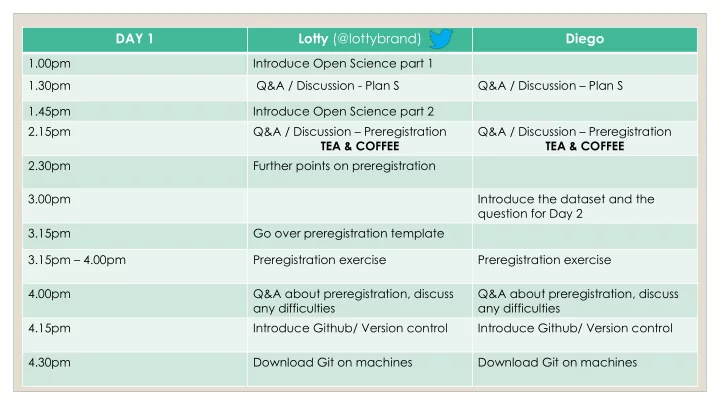
SLIDE 1 DAY 1 Lotty (@lottybrand) Diego
1.00pm Introduce Open Science part 1 1.30pm Q&A / Discussion - Plan S Q&A / Discussion – Plan S 1.45pm Introduce Open Science part 2 2.15pm Q&A / Discussion – Preregistration TEA & COFFEE Q&A / Discussion – Preregistration TEA & COFFEE 2.30pm Further points on preregistration 3.00pm Introduce the dataset and the question for Day 2 3.15pm Go over preregistration template 3.15pm – 4.00pm Preregistration exercise Preregistration exercise 4.00pm Q&A about preregistration, discuss any difficulties Q&A about preregistration, discuss any difficulties 4.15pm Introduce Github/ Version control Introduce Github/ Version control 4.30pm Download Git on machines Download Git on machines
SLIDE 2 DAY 2 Lotty Diego
1.00pm Project structure, version control p. I 2.00pm Q&A / Discussion Q&A / Discussion 2.15pm Version control p. II, GitHub 3.15pm Q&A / Discussion Q&A / Discussion 3.30pm Using remake 4.00pm Writing a reproducible report 4.30pm Q&A / Discussion Q&A / Discussion 4.45pm Wrap-up Wrap-up
SLIDE 3 What is Open Science?
1.Publishing in Open Access Journals 2.Sharing your data with your publication 3.Sharing your analysis script and your data with your publication 4.Practicing transparent and reproducible research from the beginning of the research project to the end (preregistration,
version control, well documented data collection procedures, data processing and analysis scripts, preprints, open peer-review, and making all of this openly available alongside your manuscript and data)
SLIDE 4 Scientific Publishing
- Most of us can only access journal articles through your
university subscription
- Ethical arguments against this: tax payers pay for research,
but can’t access the research themselves
- Also: researchers outside of wealthy academic institutions
can’t afford subscriptions, and other professionals need the info (e.g. doctors!)
- Academic publishers are hugely profiteering, wider profit
margins than Google and Shell
SLIDE 5
SLIDE 6
SLIDE 7
SLIDE 8 Open Access Journals
- Some subset of regular journals, RSOS, Nature
Communications, etc – charge APCs
- Some are ‘free’- Ecology & Evolution, PeerJ,
PLOS Biology – see https://en.m.Wikipedia.org/wiki/List_of_open- access_journals
- Some are entirely free, online only, voluntarily run
– see Meta-Psychology Journal (OJS)
SLIDE 9
Plan S- discuss
SLIDE 10 Plan S - discuss
“potentially undermines the whole research publishing system” – Springer Nature The AAAS, publisher of the journal Science, argued that Plan S "will not support high-quality peer- review, research publication and dissemination… …would disrupt scholarly communications, be a disservice to researchers, and impinge academic freedom" 'If you think that information should be free of charge, go to Wikipedia’ – Spokesperson for Elsevier (Tom Reller)
head of the Scientific Information Provision at the Max Planck Digital Library, told The Scientist that "This will put increased pressure on publishers and on the consciousness
- f individual researchers that an ecosystem change is
possible ..”
SLIDE 11
Share your analysis script
P-hacking HARKing Publication bias à distorted literature à Wasted research time & money à Replication crisis
SLIDE 12 Replication crisis
It ‘began’ in Psychology but the problems are science-wide…
SLIDE 13
Meta-science
Main message: NOT about bad scientists, but bad incentives and a flawed system
A lot of bad practice is maintained by accident, unconsciously following norms... Through the variation, selection, and reproduction of scientific practices…
SLIDE 14 Reproducibility
- Is my supervisor checking this?
- Is the rest of the field checking this?
Now they can (and will)!
- Preregistration and/or Registered Reports
- Using R over SPSS/other point-click software
- Version control and repositories
- Pre-print archives
- Open journals/data/scripts
- (also, Twitter)
SLIDE 15
PREREGISTRATION – Discuss
Time-stamped, open record of your predictions, hypotheses and analysis plan
SLIDE 16
- Stating predictions before data collection (we
do this anyway, right?!)
- Designed to prevents HARKing, p-hacking, other
unconscious QRPs
Preregistration
SLIDE 17 Preregistration vs Registered Reports
§Time-stamped, open record of your predictions, hypotheses and analysis plan §Usually (but not exclusively) before you collect your data §Is not linked to any particular journal ■ Peer-review is conducted on your intro, methods and analysis, before you collect the data ■ This is done with a specific journal who promises to publish your work as long as you follow that peer- reviewed plan
SLIDE 18
Why bother?
§It speeds up your research §Freedom from too many degrees of freedom (and anxiety) §Confidence to explore §Gain reviewers’ trust §Be scoop-proof! §Improve the validity of science ..forever….
SLIDE 19
Speeds up your research!
SLIDE 20
Freedom from degrees of freedom (and anxiety!)
SLIDE 21
Confidence to Explore!
SLIDE 22
Gain reviewers’ trust!
SLIDE 23
Improve validity and trust in science… forever!
SLIDE 24
Let’s talk about impact…
SLIDE 25 Wisdom, not impact
“Some people think that what I should be doing is producing Nature and Science papers. More than one colleague has specifically asked me which “Science/Nature projects” I have planned. That is not what Max Planck Departments are for. High-profile publications may arise, but they should be side effects. We demand wisdom, not professional impact.” Richard McElreath, a director of the Max Planck Institute for Evolutionary Anthropology http://elevanth.org/blog/2018/09/02/golden_eggs/ Hiring decisions:
SLIDE 26 Is anyone actually doing it?
https://www.bitss.org/events /2018am/ Pre-registered…
SLIDE 27 Is anyone actually doing it?
https://www.nature.com/articles/d41586-018-07118-1
SLIDE 28
Is anyone doing it?
SLIDE 29 How do I do it?
- https://psyarxiv.com/wte5z/ <- step by step slideshow
- https://osf.io/prereg/
- www.aspredicted.org
- https://docs.google.com/document/d/1w_3DPN6c-evOfgHBfeVgN-
huBwMRe3EJCzGFG9Tzs54/edit?usp=sharing <- full template
SLIDE 30 Version Control
Benefits your collaborators Benefits other researchers doing similar work Benefits FUTURE YOU
SLIDE 31 How do I do it?
- GitHub
- Can use desktop / Rstudio if command-line too confusing…
- http://swcarpentry.github.io/git-novice/01-basics/index.html
- http://swcarpentry.github.io/git-novice/guide/
- http://nicercode.github.io/2014-02-13-UNSW/lessons/70-version-control/why.html
SLIDE 32
Preprints
SLIDE 33
Open Review
SLIDE 34 Sharing your data?
Should data be owned, bought, sold? Some argue no, as long as the data complies with ethics, is anonymized, was consented, should be open to all. From a scientific perspective- sharing your data allows
- thers to verify your conclusions, make use of it
themselves, not have to repeat collect the same data – collaborate!
SLIDE 35 Scoop Proof!
- You have a jaw-dropping unique idea- Preregister it!
- Someone claims the same idea - point them to your time-stamped
preregistration! If they claim they had the idea first, too bad, they should’ve preregistered it (or, you should’ve!)
- If they preregistered at exactly the same time too, bond over this
coincidence and turn the competition into collaboration
- If they claim they genuinely didn’t see your preregistration (or you
genuinely didn’t see theirs) this is just bad luck and cannot be avoided just like the real life world of people having simultaneous research ideas…. Preregistration doesn’t make this any more likely
SLIDE 36 Other resources:
- Transparency in Ecology and Evolution community: http://www.ecoevotransparency.org/
- List of journals accepting Registered Reports: https://cos.io/rr/
- Metascience conference: https://www.metascience2019.org/program/
- Open Sci Conf: https://www.aimos2019conference.com/program
- Open Science Workshop: https://psyarxiv.com/wte5z/
- https://doi.org/10.1098/rsos.160384 The Natural Selection of Bad Science (Smaldino & McElreath 2016)
- https://journals.sagepub.com/doi/full/10.1177/1745691618767878 – Open Science is Liberating and can foster Creativity
(Frankenhuis & Nettle 2018)
- https://www.pnas.org/content/115/11/2600 The Preregistration Revolution (Nosek et al 2018)
- OSF https://osf.io/
- Preprints https://www.biorxiv.org/
- Publons https://publons.com/researcher/1248054/charlotte-brand/
- Access Lab: https://fo.am/activities/accesslab/
- Julia Rohrer’s open science slides https://osf.io/e4fja
- Open science course course https://osf.io/87arq/
- Munafo manifesto https://www.nature.com/articles/s41562-016-0021
- Dance of the p values https://www.youtube.com/watch?v=5OL1RqHrZQ8
- APC’s http://thetaper.library.virginia.edu/big%20deal/apcs/serials%20crisis/2019/10/07/weekly-big-deal-longread-article-
processing-charge-hyperinflation-and-price-insensitivity-an-open-access-sequel-to-the-serials-crisis.html
SLIDE 37 Other resources… contact me for more! @lottybrand
- https://force2019.sched.com/2019-10-16/overview Force2019
- https://twitter.com/curatescience/status/1183454160068530180 Curate Science
- https://www.norrag.org/democratising-knowledge-a-report-on-the-scholarly-publisher-elsevier-by-dr-jonathan-tennant/ A
report on Elsevier
- https://peerj.com/preprints/27638.pdf research into use of impact factors
- https://osf.io/854zr/ Positive results rate in psychology: registered reports compared to conventional literature (Schijen, Scheel &
Lakens 2019)
- http://www.talyarkoni.org/blog/2018/10/02/no-its-not-the-incentives-its-you/ It’s Not the Incentives, it’s You
- Plea for positivity and preregistration https://lottybrand.wordpress.com/2018/10/05/a-postdocs-plea-for-positivity-
preregistration/
- refuse Elsevier: https://www.talyarkoni.org/blog/2016/12/12/why-i-still-wont-review-for-or-publish-with-elsevier-and-think-you-
shouldnt-either/
- Universities ditch Elsevier: https://www.editage.com/insights/norway-joins-the-ranks-of-germany-and-sweden-cancels-
subscription-with-elsevier, 2) https://scholarlykitchen.sspnet.org/2019/05/06/the-university-of-california-and-elsevier-an- interview-with-jeff-mackie-mason/
- Profiteering publishers: https://www.theguardian.com/science/2017/jun/27/profitable-business-scientific-publishing-bad-for-
science https://www.theguardian.com/commentisfree/2019/mar/04/the-guardian-view-on-academic-publishing-disastrous-capitalism
- Aaron Swartz https://en.wikipedia.org/wiki/Aaron_Swartz
SLIDE 38