Day Day Day Day 1 2 3 Indirect 1 Summarized Descriptive - - PowerPoint PPT Presentation

day day day
SMART_READER_LITE
LIVE PREVIEW

Day Day Day Day 1 2 3 Indirect 1 Summarized Descriptive - - PowerPoint PPT Presentation

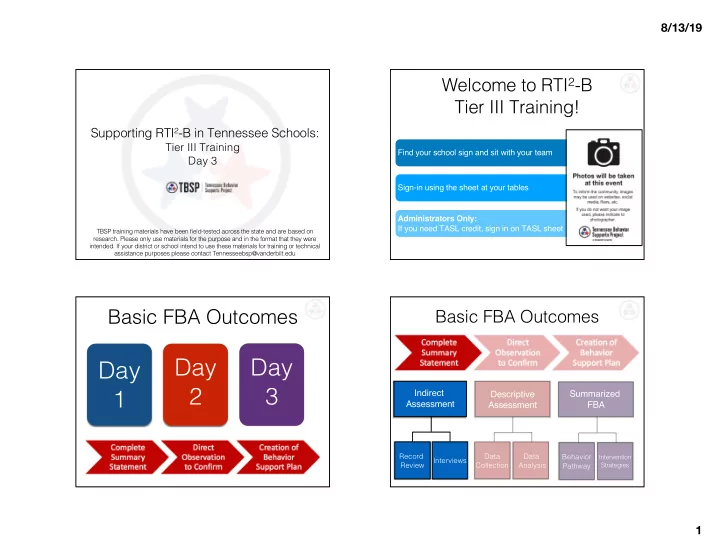
8/13/19 Welcome to RTI 2 -B Tier III Training! Supporting RTI -B in Tennessee Schools: Tier III Training Find your school sign and sit with your team Day 3 Sign-in using the sheet at your tables Administrators Only: If you need TASL


slide-1
SLIDE 1

8/13/19 1

Supporting RTI²-B in Tennessee Schools:

Tier III Training Day 3

TBSP training materials have been field-tested across the state and are based on

  • research. Please only use materials for the purpose and in the format that they were
  • intended. If your district or school intend to use these materials for training or technical

assistance purposes please contact Tennesseebsp@vanderbilt.edu .

Welcome to RTI2-B Tier III Training!

Find your school sign and sit with your team Sign-in using the sheet at your tables Administrators Only: If you need TASL credit, sign in on TASL sheet

Basic FBA Outcomes

Day 1

Day 1 Day 2 Day 3

Indirect Assessment Descriptive Assessment

Record Review Interviews Data Collection Data Analysis

Basic FBA Outcomes

Summarized FBA

Behavior Pathway

Intervention Strategies

slide-2
SLIDE 2

8/13/19 2

Indirect Assessment Descriptive Assessment

Record Review Interviews Data Collection Data Analysis

Basic FBA Outcomes

Summarized FBA

Behavior Pathway

Intervention Strategies

Indirect Assessment Descriptive Assessment

Record Review Interviews

Basic FBA Outcomes

Data Collection Data Analysis

Summarized FBA

Behavior Pathway

Intervention Strategies

Schedule for Today

Review of Homework FBA Summary Sheet Competing Behavior Pathway Behavior Support Plan (BSP) Progress Monitoring and Maintenance

Training Materials

Day 3 Workbook Day 3 Presentation Handout

slide-3
SLIDE 3

8/13/19 3

Accessing Electronic Materials

Our Website:

  • tennesseebsp.org
  • Click on “Team Login”
  • Tier III
  • Password: tbsp3
  • Download materials

Accessing Electronic Materials

Implementation Manual

2019-2020

FBA Summary Sheet

Support Plans

3.10 Hypothesis Statement

Tiered Fidelity Inventory

slide-4
SLIDE 4

8/13/19 4

Functional Behavior Assessment Summary Sheet Step 1: Student Information Last name: First name: Gender: Age: Birthdate: Click or tap to enter a date. Date: Click or tap to enter a date. Grade: School: ☐Special Education If SPED, list eligibility: ☐ General Education Step 2: Assessment tools used to determine function (complete and attach) Item Reviewed Staff Interview Family Interview Student Interview Date Completed Click or tap to enter a date. Click or tap to enter a date. Click or tap to enter a date. Step 3: Problem Behavior Definition: Write the problem behavior and definition Problem Behavior: Step 4: FACTS Summary of Behavior During insert target routine, insert student name is likely to insert problem behaviors, when s/he insert details of antecedent conditions that trigger behavior, and we believe that s/he does this to insert details of consequence/function. It is more likely to occur when insert details of setting events. Step 5: Summary of ABC Data: Attach ABC Observation Form as documentation Activity Antecedent Behavior Consequence #1 #1 Ratio / #1 Ratio / Ratio / Ratio / Does Summary of ABC Data match the FACTS Summary of Behavior? ☐Yes ☐No (if no collect more ABC data or revisit the FACTS) Step 6: Summary of Baseline Data: Attach baseline data as documentation Check the type of data collected ☐Rate (freq/time) ☐Time Sampling ☐Average duration ☐Direct Behavior Rating Enter at least 3 baseline data points into the table below and calculate the baseline average Data #1 Data #2 Data #3 Data #4 Data #5 Data #6 Average

A place to summarize your indirect and descriptive assessments, as well as the competing behavior pathway, which will lead to development of a behavior support plan.

Conduct FBA

FBA Summary Sheet

Student Information Record student’s name, gender, age, DOB, date, grade level, school, and if they receive special education services or are in general education. If receiving special education services, list eligibility. Step 1

Conduct FBA

St Step 1: St Student Information Last name: First name: Gender: Age: Birthdate: Date: Grade: School: Special Education General Education If SPED, list eligibility:

FBA Summary Sheet

Student Information Record student’s name, gender, age, DOB, date, grade level, school, and if they receive special education services or are in general education. If receiving special education services, list eligibility. Step 1

Conduct FBA

St Step 1: St Student Information La Last na name: First na name: Stevens Shane Ge Gender: Male Ag Age: 13 Bi Birthdate: 11/26/04 Da Date: 11/22/17 Gr Grade: 8th Sc School: Bramble Middle School Sp Special Education Ge General Education If If S SPED, l , list e t eligibility ty: X

FBA Summary Sheet

Assessment tools used to determine function Document date staff, parent/guardian, and student interviews were completed. Attach completed interviews to this form. Step 2

Conduct FBA

St Step 2: Assessment tools used to determine function (complete and attach) Ite Item R Reviewed Staff Interview Family Interview Student Interview Da Date Co Completed

slide-5
SLIDE 5

8/13/19 5

FBA Summary Sheet

Assessment tools used to determine function Document date staff, parent/guardian, and student interviews were completed. Attach completed interviews to this form. Step 2

Conduct FBA

St Step 2: Assessment tools used to determine function (complete and attach) Ite Item R Reviewed Staff Interview Family Interview Student Interview Da Date Co Completed 11/12/17 11/14/17 11/15/17

FBA Summary Sheet

Problem Behavior Definition Copy and paste problem behavior from the FACTS Summary Statement Step 3

Conduct FBA

St Step 3: Problem Behavior Definition: Write the problem behavior and definition Problem Behavior:

FBA Summary Sheet

Problem Behavior Definition Copy and paste problem behavior from the FACTS Summary Statement Step 3

Conduct FBA

St Step 3: Problem Behavior Definition: Write the problem behavior and definition Problem Behavior: Defiance - putting head down, not looking at board, ignoring teacher directives and instructions, talking back to teacher, doodling, refusing to follow directions, yelling “leave me alone” or “I don’t know”, walking out of class. Non-examples including doodling when work is completed, leaving the room with permission.

FBA Summary Sheet

FACTS Summary of Behavior Copy and paste FACTS Summary of Behavior statement Step 4

Conduct FBA

St Step 4: FACTS S Su Summary of Behavior During <insert target routine>, <insert student name> is likely to <insert problem behavior(s), when s/he <insert details of antecedent conditions that trigger behavior>, and you believe that s/he does this to <insert details of consequence/function>. It is more likely to occur when <insert details of setting events>.

slide-6
SLIDE 6

8/13/19 6

FBA Summary Sheet

FACTS Summary of Behavior Copy and paste FACTS Summary of Behavior statement Step 4

Conduct FBA

St Step 4: FACTS S Su Summary of Behavior During math, Shane is likely to become defiant (putting head down, not following directions, talking back to teacher, doodling, yelling, or walking out of class), when he is asked to do a math problem, and he does this to avoid math tasks. It is more likely to occur when homework is not completed.

FBA Summary Sheet

Summary of ABC Data Calculate summary of data from ABC Data Collection Form. Attach ABC Observation Form. Step 5

Conduct FBA

St Step 5: Su Summary of ABC Data: Attach ABC Observation Form as documentation Ac Activity An Antecedent Be Behavior Co Consequence #1 Ratio ___/ ___ #1 Ratio ___/ ___ Ratio ___/ ___ #1 Ratio ___/ ___ Does Summary of ABC Data match the FACTS Summary of Behavior? YES NO (If no, collect more ABC data or revisit the FACTS

FBA Summary Sheet

Session 1 Session 2

Conduct FBA

FBA Summary Sheet

Conduct FBA

Session 1 Session 2

slide-7
SLIDE 7

8/13/19 7

FBA Summary Sheet

Verify if summary of ABC data matches FACTS Summary of Behavior statement. Step 5b Do at least 75% of the ABC data occurrences match the FACTS Summary Statement? YES Confidently conclude that ABC data matches FACTS Summary Statement NO Do further ABC

  • bservations and/or go

back to interviews

Adapted from Portland State University

Conduct FBA

Comparing Shane’s ABC to Summary Statement

Conduct FBA

St Step 4: FACTS S Su Summary of Behavior During math, Shane is likely to become defiant (putting head down, not following directions, talking back to teacher, doodling, yelling, or walking out of class), when he is asked to do a math problem, and he does this to avoid math tasks. It is more likely to occur when homework is not completed.

FBA Summary Sheet

Conduct FBA

St Step 6: Su Summary of Baseline Data: Attach baseline data as documentation Ch Check the type of data collected Rate (freq/time) Time Sampling Duration Direct Behavior Rating En Enter at least 3 baseline data points into the table below and calculate the baseline average. Da Data #1 Da Data #2 Da Data #3 Da Data #4 Da Data #5 Da Data #6 Av Average

Summary of Baseline Data Mark box of the type of data collected. Record baseline data points in table and calculate average. Step 6

FBA Summary Sheet

Summary of Baseline Data Mark box of the type of data collected. Record baseline data points in table and calculate average. Step 6

Conduct FBA

X 70 80 80 76

St Step 6: Su Summary of Baseline Data: Attach baseline data as documentation Ch Check the type of data collected Rate (freq/time) Time Sampling Duration Direct Behavior Rating En Enter at least 3 baseline data points into the table below and calculate the baseline average. Da Data #1 Da Data #2 Da Data #3 Da Data #4 Da Data #5 Da Data #6 Av Average

slide-8
SLIDE 8

8/13/19 8

FBA Summary Sheet

Competing Behavior Pathway Complete Competing Behavior Pathway using all the information collected through indirect and descriptive assessments. Step 7

The competing behavior pathway model allows us to use our summary statement and begin developing a plan for addressing a student’s problem behavior.

Conduct FBA

Activity #1: FBA Summary Sheet

FACTS, ABC, baseline

Page 2 20 minutes

  • 1. Complete Steps 1-6 of FBA

Summary Sheet using

  • FACTS
  • ABC data
  • Baseline data
Functional Behavior Assessment Summary Sheet Step 1: Student Information Last name: First name: Gender: Age: Birthdate: Click or tap to enter a date. Date: Click or tap to enter a date. Grade: School: ☐Special Education If SPED, list eligibility: ☐ General Education Step 2: Assessment tools used to determine function (complete and attach) Item Reviewed Staff Interview Family Interview Student Interview Date Completed Click or tap to enter a date. Click or tap to enter a date. Click or tap to enter a date. Step 3: Problem Behavior Definition: Write the problem behavior and definition Problem Behavior: Step 4: FACTS Summary of Behavior During insert target routine, insert student name is likely to insert problem behaviors, when s/he insert details of antecedent conditions that trigger behavior, and we believe that s/he does this to insert details of consequence/function. It is more likely to occur when insert details of setting events. Step 5: Summary of ABC Data: Attach ABC Observation Form as documentation Activity Antecedent Behavior Consequence #1 #1 Ratio / #1 Ratio / Ratio / Ratio / Does Summary of ABC Data match the FACTS Summary of Behavior? ☐Yes ☐No (if no collect more ABC data or revisit the FACTS) Step 6: Summary of Baseline Data: Attach baseline data as documentation Check the type of data collected ☐Rate (freq/time) ☐Time Sampling ☐Average duration ☐Direct Behavior Rating Enter at least 3 baseline data points into the table below and calculate the baseline average Data #1 Data #2 Data #3 Data #4 Data #5 Data #6 Average

Competing Behavior Pathway

Summary of Behavior

Setting Events Antecedent Problem Behavior Consequence/ Function

Adapted from MIBLISI

Conduct FBA

slide-9
SLIDE 9

8/13/19 9

Summary of Behavior Shane

Homework not completed When asked to do math word problems Refusing to work, not following directions (doodling, head down, ignoring teacher), yelling “leave me alone”, and walking out of class Math assignment is removed or number of problems are decreased

Setting Events Antecedent Problem Behavior Consequence/ Function

Adapted from MIBLISI

Conduct FBA

Function of Behavior

Setting Events Antecedent Problem Behavior Consequence/ Function

Student learns: When (A), If I (B), then (C)… Therefore: Continues to keep doing (B)

Adapted from MIBLISI

Conduct FBA

Function of Behavior Shane

Homework not completed When asked to do math word problems Refusing to work, not following directions (doodling, head down, ignoring teacher), yelling “leave me alone”, and walking out of class Math assignment is removed or number of problems are decreased Avoid activity

Setting Events Antecedent Problem Behavior Consequence/ Function

Adapted from MIBLISI

Conduct FBA

Why is Function Important?

1

Guides selection of interventions Should help identify more efficient and effective interventions Avoids selecting interventions that may make things worse

2

Adapted from MIBLISI

Conduct FBA

3

slide-10
SLIDE 10

8/13/19 10

Setting Events Antecedent Problem Behavior Consequence/ Function Desired Behavior Replacement Behavior Consequence/ Outcome

Competing Behavior Pathway

Adapted from MIBLISI

Conduct FBA

(O’Neill et al., 1997, p.71)

“You should not propose to reduce a problem behavior without also identifying alternative, desired behaviors a person should perform instead

  • f the problem behavior.”

Setting Events Antecedent Problem Behavior Consequence/ Function Desired Behavior Consequence/ Outcome

Competing Behavior Pathway

Adapted from MIBLISI

Conduct FBA

Problem Behavior Consequence/ Function Desired Behavior Consequence/ Outcome

Competing Behavior Pathway

Desired behavior is what we want to see instead of the problem behavior

Adapted from MIBLISI

Conduct FBA

slide-11
SLIDE 11

8/13/19 11

Homework not completed When asked to do math word problems Refusing to work, not following directions (doodling, head down, ignoring teacher), yelling “leave me alone”, and walking out of class Math assignment is removed or number of problems are decreased Avoid activity

Setting Events Antecedent Problem Behavior Consequence/ Function

Complete math word problems

Desired Behavior

Success and teacher acknowledgement

Consequence/ Outcome

Adapted from MIBLISI

Conduct FBA

Homework not completed When asked to do math word problems Refusing to work, not following directions (doodling, head down, ignoring teacher), yelling “leave me alone”, and walking out of class Math assignment is removed or number of problems are decreased Avoid activity

Setting Events Antecedent Problem Behavior Consequence/ Function

Complete math word problems

Desired Behavior

Success and teacher acknowledgement

Consequence/ Outcome

The function of these consequences do not match

Conduct FBA

Adapted from MIBLISI

Homework not completed When asked to do math word problems Refusing to work, not following directions (doodling, head down, ignoring teacher), yelling “leave me alone”, and walking out of class Math assignment is removed or number of problems are decreased Avoid activity

Setting Events Antecedent Problem Behavior Consequence/ Function

Complete math word problems

Desired Behavior

Success and teacher acknowledgement

Consequence/ Outcome

This is what we are asking the student to do Conduct FBA

Adapted from MIBLISI

Homework not completed When asked to do math word problems Refusing to work, not following directions (doodling, head down, ignoring teacher), yelling “leave me alone”, and walking out of class Math assignment is removed or number of problems are decreased Avoid activity

Setting Events Antecedent Problem Behavior Consequence/ Function

Complete math word problems

Desired Behavior

Success and teacher acknowledgement

Consequence/ Outcome

This is what the student is currently

  • btaining

Conduct FBA

Adapted from MIBLISI

slide-12
SLIDE 12

8/13/19 12

Homework not completed When asked to do math word problems Refusing to work, not following directions (doodling, head down, ignoring teacher), yelling “leave me alone”, and walking out of class Math assignment is removed or number of problems are decreased Avoid activity

Setting Events Antecedent Problem Behavior Consequence/ Function

Complete math word problems

Desired Behavior

Success and teacher acknowledgement

Consequence/ Outcome

Notice how different this looks from what is happening now Conduct FBA

Adapted from MIBLISI

Homework not completed When asked to do math word problems Refusing to work, not following directions (doodling, head down, ignoring teacher), yelling “leave me alone”, and walking out of class Math assignment is removed or number of problems are decreased Avoid activity

Setting Events Antecedent Problem Behavior Consequence/ Function

Complete math word problems

Desired Behavior

Success and teacher acknowledgement

Consequence/ Outcome

Shane is going to need to learn more skills before being able to do this Conduct FBA

Adapted from MIBLISI

Homework not completed When asked to do math word problems Refusing to work, not following directions (doodling, head down, ignoring teacher), yelling “leave me alone”, and walking out of class Math assignment is removed or number of problems are decreased Avoid activity

Setting Events Antecedent Problem Behavior Consequence/ Function

Complete math word problems

Desired Behavior

Success and teacher acknowledgement

Consequence/ Outcome

Raise hand and ask for a break

Replacement Behavior

Therefore, in the mean time we need a replacement behavior Conduct FBA

Adapted from MIBLISI

Homework not completed When asked to do math word problems Refusing to work, not following directions (doodling, head down, ignoring teacher), yelling “leave me alone”, and walking out of class Math assignment is removed or number of problems are decreased Avoid activity

Setting Events Antecedent Problem Behavior Consequence/ Function

Complete math word problems

Desired Behavior

Success and teacher acknowledgement

Consequence/ Outcome

Raise hand and ask for a break

Replacement Behavior

Before we work on the desired behavior, we need to focus on the replacement behavior that will serve the same function as the problem behavior Conduct FBA

Adapted from MIBLISI
slide-13
SLIDE 13

8/13/19 13

Refusing to work, not following directions (doodling, head down, ignoring teacher), yelling “leave me alone”, and walking out of class Math assignment is removed or number of problems are decreased Avoid activity

Setting Events Antecedent Problem Behavior Consequence/ Function

Complete math word problems

Desired Behavior

Success and teacher acknowledgement

Consequence/ Outcome

Raise hand and ask for a break

Replacement Behavior

Replacement Behavior Immediate attempt to reduce problem behavior

Replacement behaviors should be:

  • Socially acceptable
  • Efficient
  • Obtain same function

as problem behavior Replacement behaviors should:

  • Actively begin breaking

student’s habit of using problem behavior

  • Meet their needs by
  • btaining same function

Conduct FBA

Adapted from MIBLISI

Desired Behavior Replacement Behavior

Competing Behavior Pathway

Adapted from MIBLISI

Conduct FBA

Homework not completed When asked to do math word problems Refusing to work, not following directions (doodling, head down, ignoring teacher), yelling “leave me alone”, and walking out of class Math assignment is removed or number of problems are decreased Avoid activity

Setting Events Antecedent Problem Behavior Consequence/ Function

Complete math word problems

Desired Behavior

Success and teacher acknowledgement

Consequence/ Outcome

Raise hand and ask for a break

Replacement Behavior

When choosing replacement behavior, ask 3 questions:

  • 1. Does it serve the same

function?

  • 2. Is it easier?
  • 3. Is it socially acceptable?

Conduct FBA

Adapted from MIBLISI

Which of the Following are Appropriate Replacement Behaviors?

Conduct FBA

Rules #1 It’s a game #2 Remember replacement behavior vs desired behavior #3 It’s a game

slide-14
SLIDE 14

8/13/19 14

Which of the Following are Appropriate Replacement Behaviors?

Jason is 13 and argues with the teacher when asked to write in his

  • journal. He then does not complete the journal task.

The function of arguing with the teacher is avoiding difficult tasks.

  • A. Request reward for completing task
  • B. Ask for an easier task (i.e. drawing)
  • C. Ask to play with his Gameboy
  • D. Appropriately request adult attention
  • E. Request to listen to music while working

Adapted from MIBLISI

Conduct FBA

Which of the Following are Appropriate Replacement Behaviors?

Leslie is 6 and cries during independent work time. The teacher then comes over to comfort her. The function of crying is to obtain adult attention.

  • A. Put her head down on the desk quietly
  • B. Ask a student for help
  • C. Ask the teacher for help
  • D. Request a prize after completing work
  • E. Complete work on the computer

Adapted from MIBLISI

Conduct FBA

Which of the Following are Appropriate Replacement Behaviors?

Emily is 8 and asks to go to the restroom every time there is loud noise during school assemblies. Staff allow her to go to the restroom when

  • asked. The function of spending time in the restroom is

avoiding sensory stimulation.

  • A. Putting her head down during the assembly
  • B. Sitting in the front to be further engaged
  • C. Giving Emily an iPad during an assembly
  • D. Wearing headphones during an assembly
  • E. Sitting by the door to take breaks when needed

Adapted from MIBLISI

Conduct FBA

Activity #2: Roll the Dice

Competing Behavior Pathway

Page 3 15 minutes

  • 1. Roll Dice

One will land on a function Other will land on a problem behavior

  • 2. Identify an appropriate replacement behavior

Document in workbook

slide-15
SLIDE 15

8/13/19 15

Problem Behavior Consequence/ Function Desired Behavior Replacement Behavior Consequence/ Outcome

Competing Behavior Pathway

Goal: Make problem behaviors in ineffectiv ive in ineffic icie ient ir irrele levant for student

Adapted from MIBLISI

Conduct FBA

Activity #3: FBA Summary Sheet

FBA Summary Sheet

Page 4 10 minutes

  • 1. Complete Step 7: Competing Behavior Pathway of

FBA Summary Sheet in workbook

Basic FBA Process

Step 1 Identify Students Obtain Consent Conduct FBA Create BSP Progress Monitor Action Team Tier III Team Step 2 Step 3 Step 4 Step 5 Step 6 Step 7

Create BSP Step 6

slide-16
SLIDE 16

8/13/19 16

Support Plans

3.11 Comprehensive Support 3.12 Formal and Natural Supports

Tiered Fidelity Inventory

Team Activity

5 minutes

  • 1. Brainstorm interventions used in classrooms and

with students

  • 2. Write each intervention on separate post-it note
  • 3. Keep in center of table

Behavior Support Plan

Defines how an educational setting will be changed to improve behavioral success of student. Developed based on information gained from completed FBA.

Adapted from MIBLSI and Missouri Materials

Create BSP

Behavior Support Plan Student Information Last name: First name: Gender: Age: Birthdate: Date: Grade: School: Special Education If SPED, list eligibility: General Education Replacement Behavior Goals Condition Replacement Behavior Criteria Setting Event Interventions Intervention Who will complete? When will it
  • ccur during
the day? When will the intervention begin? Materials Needed Antecedent Interventions Intervention Who will complete? When will it
  • ccur during
the day? When will the intervention begin? Materials Needed Teaching Interventions Intervention Who will complete? When will it
  • ccur during
the day? When will the intervention begin? Materials Needed

Create BSP

Behavior Support Plan

Critical Components

  • 1. Describes how environment will be changed

to prevent occurrences of problem behavior

  • 2. Describes teaching that will occur to give

student appropriate replacement behavior

  • 3. Describes consequences provided to

reinforce appropriate behavior

Adapted from MIBLISI

Behavior Support Plan Student Information Last name: First name: Gender: Age: Birthdate: Date: Grade: School: Special Education If SPED, list eligibility: General Education Replacement Behavior Goals Condition Replacement Behavior Criteria Setting Event Interventions Intervention Who will complete? When will it
  • ccur during
the day? When will the intervention begin? Materials Needed Antecedent Interventions Intervention Who will complete? When will it
  • ccur during
the day? When will the intervention begin? Materials Needed Teaching Interventions Intervention Who will complete? When will it
  • ccur during
the day? When will the intervention begin? Materials Needed
slide-17
SLIDE 17

8/13/19 17

Create BSP

Keep In Mind…

Do function-based strategies…

work with available resources “fit” with administrative structure/support

compliment skills and values of implementers

work for teachers implementing plan Strategies with “good fit” are more likely to be implemented accurately and consistently

Create BSP

Behavior Support Plan

Antecedent Problem Behavior Consequence/ Function

Adapted from MIBLSI

Can we change things so that whatever set off the problem behavior is no longer an issue?

Create BSP

Behavior Support Plan

Antecedent Problem Behavior Consequence/ Function

Adapted from MIBLSI

Can we teach an alternative behavior that gets results more quickly or easily than the problem behavior?

Create BSP

Behavior Support Plan

Antecedent Problem Behavior Consequence/ Function

Adapted from MIBLSI

Can whatever was “rewarding” the problem behavior be discontinued to reward appropriate behavior instead?

slide-18
SLIDE 18

8/13/19 18

Create BSP

Replacement Behavior Goals

Adapted from MIBLSI

Condition Replacement Behavior Criteria

Create BSP

Replacement Behavior Goals

Adapted from MIBLSI

Condition Replacement Behavior Criteria

During Math Class, when Shane needs help with a math problem, Shane will ask for help in 4 out of 5

  • pportunities

Create BSP

Replacement Behavior Goals

Antecedent

Adapted from MIBLSI

During Math Class, when Shane needs help with a math problem, Shane will ask for help in 4 out of 5

  • pportunities

When problem behavior occurs What you want student to do instead Criteria for success

Replacement Behavior Goals

Replacement Behavior Goals

Adapted from Borgmeier & Lohman, 2012

Create BSP

Condition Replacement Behavior Criteria

When asked to complete a math word problem that Shane needs help on, Shane will raise his hand and ask for a break in 4 out of 5

  • pportunities.
slide-19
SLIDE 19

8/13/19 19

Replacement Behavior Goals Condition Replacement Behavior Criteria

Activity #4: Replacement Behavior Goals

Competing Behavior Pathway

Page 5 15 minutes

  • 1. Review your Competing Behavior Pathway
  • 2. Determine what behaviors you will teach
  • 3. Complete Replacement Behavior Goals Grid in BSP

Setting Event Interventions

Setting Events Events that happen outside of immediate routine that commonly make problems more likely or worse Setting Event Examples Setting Events will vary with each individual

  • Slept fewer or more hours than usual
  • Irregular on unpredictable schedule or routine
  • Chaotic or demanding environment
  • Missing the school bus
  • Victim of verbal or physical aggression
  • Missed meals
  • Academic skill deficits

Adapted from MIBLSI Materials

Create BSP

Setting Event Interventions

Build in strategies to:

  • Diminish

effect of setting events

  • Decrease

likelihood that behavior will occur

Adapted from MIBLSI Materials

Create BSP Setting Event Interventions

Intervention Who will complete? When will it be completed? Materials Needed

Shane will sign-up for and attend Homework Club. Shane will speak to

  • Mr. Vetri about

signing-up and the School Counselor will check with Mr. Vetri to ensure it has happened. 12/4/2017 - during lunch Pen Daily check-in and check-out with School Counselor to turn in homework and review homework to be completed. School Counselor/Shane Daily- starting 12/4/2017 8:25 (morning) 2:50 (afternoon) Shane will need to bring his agenda and homework with him. Develop a homework plan with Shane and his parents. Shane’s parents, School Counselor, Shane 12/5/2017 N/A Provide Shane with additional math instruction to help close gaps in Shane’s to help close gaps in Shane’s math skills. RTI2 Intervention Teacher 3 times weekly during Intervention Block RTI2 Intervention curriculum

Setting Event Interventions

Adapted from Borgmeier & Lohman, 2012

Create BSP

slide-20
SLIDE 20

8/13/19 20 Team Activity

2 minutes

  • 1. Find Setting Event Intervention card
  • 2. Sort through post-it notes
  • 3. Identify interventions that are Setting Event Interventions
  • 4. Place on card

Setting Event Interventions

Activity #5: Setting Event Interventions

Intervention Menu

Page 5 15 minutes

  • 1. Review FACTS Summary Sheet and Competing

Behavior Pathway

  • 2. Determine Setting Events for student
  • 3. Brainstorm list of Setting Event Interventions for student
  • 4. Complete Setting Event Interventions Grid in BSP

Antecedent Interventions

Antecedents Preventing problem behavior and prompting desired behavior Antecedent Intervention Examples

  • Increase student’s opportunities to respond during class
  • Increase active supervision throughout the classroom
  • Preferential seating
  • Provide choice throughout instruction
  • Modify task difficulty within the classroom

Adapted from MIBLSI Materials

Create BSP

Antecedent Interventions

Antecedents Preventing problem behavior and prompting desired behavior. Build in interventions to:

  • Prevent

problem behavior

  • Support

student to promote replacement

  • r desired

behavior

Adapted from MIBLSI Materials

Create BSP

slide-21
SLIDE 21

8/13/19 21

Create BSP Antecedent Interventions

Intervention Who will complete? When will it be completed? Materials Needed

Only call on Shane 2 times in class, call on other students instead. Math Teacher Daily during math class N/A The math teacher will give word problems in advance to work on before asking him to do the problem on the board in front of

  • ther students.

Math Teacher Whenever necessary Future math problems Remind Shane at the beginning

  • f each class he can signal to

take 1 minutes break from a math problem or ask for help during work time. Math Teacher Daily during math class N/A

Antecedent Interventions

Adapted from Borgmeier & Lohman, 2012

Team Activity

2 minutes

  • 1. Find Antecedent Intervention card
  • 2. Sort through post-it notes
  • 3. Identify interventions that are Antecedent Interventions
  • 4. Place on card

Antecedent Interventions

Activity #6: Antecedent Interventions

Intervention Menu

Page 7 15 minutes

  • 1. Review FACTS Summary Sheet and Competing

Behavior Pathway

  • 2. Determine antecedents are for student’s

behavior

  • 3. Brainstorm list of Antecedent Interventions for

student

  • 4. Complete Antecedent Interventions Grid in BSP

Consequence/ Outcome

Teaching Intervention

Teaching Intervention Teach a replacement behavior that is more efficient than problem behavior at meeting the function of student’s behavior

Teaching Intervention Examples

Teach replacement behaviors that will meet the same function of behavior as the problem behavior.

  • Social Skill instruction
  • Self-Management
  • How to ask for a break
  • How to request attention from the teacher
  • Receiving redirection or feedback

Adapted from MIBLSI Materials

Create BSP

slide-22
SLIDE 22

8/13/19 22

Refusing to work, not following directions (doodling, head down, ignoring teacher), yelling “leave me alone”, and walking out of class Math assignment is removed or number of problems are decreased Avoid activity

Setting Events Antecedent Problem Behavior Consequence/ Function

Complete math word problems

Desired Behavior

Success and teacher acknowledgement

Consequence/ Outcome

Raise hand and ask for a break

Replacement Behavior

Replacement behavior is an immediate attempt to reduce problem behavior

Replacement behaviors should be:

  • Socially acceptable
  • Efficient
  • Obtain the same function

as the problem behavior Replacement behaviors should:

  • Actively begin breaking

student’s habit of using problem behavior

  • Meet their needs by
  • btaining same function

Remember!!

Create BSP

Teaching Interventions

Antecedents Preventing problem behavior and prompting desired behavior.

Create BSP

Adapted from MIBLSI Materials

Strategies to:

  • Teach

replacement/ desired behavior that is more efficient than problem behavior

  • Teach

academic and social skill deficits that student may have

Create BSP

Teaching Interventions

Intervention Who will complete? When will it be completed? Materials Needed

Teach Shane to politely request a break or help with his math work. School Counselor and Math teacher will meet with Shane to discuss appropriate ways to request a break and how to ask for help. 12/7/2017 during Advisory A list of phrases for how to ask for a break and how to ask for help.

Teaching Interventions

Adapted from Borgmeier & Lohman, 2012

S h

  • u

l d i n c l u d e a p l a n t

  • t

e a c h r e p l a c e m e n t b e h a v i

  • r

! !

Team Activity

2 minutes

  • 1. Find Teaching Intervention card
  • 2. Sort through post-it notes
  • 3. Identify interventions that are Teaching Interventions
  • 4. Place on card

Teaching Interventions

slide-23
SLIDE 23

8/13/19 23

Activity #7: Teaching Interventions

Intervention Menu

Page 9 15 minutes

  • 1. Review Competing Behavior Pathway
  • 2. Make sure student’s replacement behavior and desired

behavior match the function of problem behavior

  • 3. Plan for teaching replacement and desired behaviors to

student

  • 4. Write plan down in Teaching Intervention Section of BSP

Consequence Strategies

Consequence Strategies

Consequence Strategies

Consequence Strategies should include strategies to make problem behavior ineffective and plan to reinforce replacement and desired behavior.

  • Receiving a break
  • Receiving reduced work
  • A chance to spend one on one time with adult
  • Increased time with peer
  • Special job or responsibility in classroom

Adapted from MIBLSI Materials

Add effective and remove ineffective reinforcers

Create BSP

Antecedent Problem Behavior Consequence/ Function

Focus on what is reinforcing the behavior and change adult and peer response to problem behavior and appropriate behavior. Student talks out Teacher tells student to stop calling out Teacher asks class to answer a question

Create BSP

Antecedent Problem Behavior Consequence/ Function

Student talks out Teacher tells student to stop calling out Teacher asks class to answer a question Teacher asks class to answer a question Student talks out Teacher does not respond to student. Teacher calls on another student.

Strategies to Make Problem Behavior Ineffective

Do not reinforce problem behavior

Create BSP

slide-24
SLIDE 24

8/13/19 24

Consequence Strategies

Reinforcement

Adapted from MIBLSI Materials

Create BSP

To make problem behavior ineffective, we must change the consequences

Create BSP

Strategies to Make Problem Behavior Ineffective Intervention Who will complete? When will it be completed? Materials Needed

When Shane engages in non- compliance and refusal to do work, Shane’s teachers will use prompting to complete work. Math Teacher Daily during math class N/A

Consequence Strategies: To Make Problem Behavior Ineffective

Adapted from Borgmeier & Lohman, 2012

Antecedent Problem Behavior Consequence/ Function

Teacher asks class to answer a question Student talks out Teacher does not respond to student. Calls on another student.

Replacement Behavior

Student Raises Hand

Teacher calls on student and says, “thank you for being respectful and raising your hand.” Response to Problem Behavior Response to Appropriate Behavior

Create BSP

Consequence Strategies

Reinforcement

Adapted from MIBLSI Materials

Create BSP

To make problem behavior ineffective, we must change the consequences

slide-25
SLIDE 25

8/13/19 25

Create BSP

Strategies to Reinforce Replacement Behaviors Intervention Who will complete? When will it be completed? Materials Needed

When Shane raises 1 index finger in the air he can take a 1 minute break from a math problem or ask for help during work time. Math Teacher Daily during math class N/A Use a point card for him to earn points for attempting to answer questions, class participation and homework completion. When Shane earns 70% of his points weekly, he will earn an incentive, determined by Shane and the School Counselor Math Teacher, Shane, School Counselor Daily – starting 12/8/2017 Daily Point Card, Point Total Graph, Pen

Consequence Strategies: To Reinforce Replacement Behaviors

Adapted from Borgmeier & Lohman, 2012

Create BSP

Time Behavior Intensity

  • 1. Calm
  • 2. Trigger
  • 3. Agitation
  • 4. Acceleration
  • 5. Peak
  • 6. De-escalation
  • 7. Recovery

Phases of Escalation

Teach appropriate behavior during the calm Watch for agitation and intervene Minimize the peak and focus on safety Avoid confrontation in de-escalation Debrief and follow-through with recovery

Extinction Burst

  • Behavior can get worse

before it gets better

  • Important to take data
  • Plan for extinction burst

(de-escalation, recovery, and safety)

Create BSP

Team Activity

2 minutes

  • 1. Find Consequence Strategies card
  • 2. Sort through post-it notes
  • 3. Identify interventions that are Consequence Strategies
  • 4. Place on card

Consequence Strategies

slide-26
SLIDE 26

8/13/19 26

Activity #8: Consequence Strategies

Intervention Menu

Page 11 15 minutes

  • 1. Review FACTS Summary Sheet and Competing Behavior

Pathway

  • 2. Determine Consequence Strategies that match function
  • f student’s problem behavior
  • 3. Create plan for both making problem behavior ineffective

and for reinforcing replacement behavior

  • 4. Complete Consequence Strategy Grid in BSP

Whole Group Activity

5 minutes

  • 1. As a team, identify your favorite intervention on

each card

  • 2. Post it on the whole group chart paper

Setting Event Intervention Antecedent Intervention Teaching Intervention Consequence Strategies

STOP, DROP, BOX

5 minutes Upload to Vanderbilt Box

  • FBA Summary Sheet
  • Behavior Support Plan

(even a screenshot or picture

  • f this will work for now)
Behavior Support Plan Student Information Last name: First name: Gender: Age: Birthdate: Date: Grade: School: Special Education If SPED, list eligibility: General Education Replacement Behavior Goals Condition Replacement Behavior Criteria Setting Event Interventions Intervention Who will complete? When will it
  • ccur during
the day? When will the intervention begin? Materials Needed Antecedent Interventions Intervention Who will complete? When will it
  • ccur during
the day? When will the intervention begin? Materials Needed Teaching Interventions Intervention Who will complete? When will it
  • ccur during
the day? When will the intervention begin? Materials Needed Functional Behavior Assessment Summary Sheet Step 1: Student Information Last name: First name: Gender: Age: Birthdate: Click or tap to enter a date. Date: Click or tap to enter a date. Grade: School: ☐Special Education If SPED, list eligibility: ☐ General Education Step 2: Assessment tools used to determine function (complete and attach) Item Reviewed Staff Interview Family Interview Student Interview Date Completed Click or tap to enter a date. Click or tap to enter a date. Click or tap to enter a date. Step 3: Problem Behavior Definition: Write the problem behavior and definition Problem Behavior: Step 4: FACTS Summary of Behavior During insert target routine, insert student name is likely to insert problem behaviors, when s/he insert details of antecedent conditions that trigger behavior, and we believe that s/he does this to insert details of consequence/function. It is more likely to occur when insert details of setting events. Step 5: Summary of ABC Data: Attach ABC Observation Form as documentation Activity Antecedent Behavior Consequence #1 #1 Ratio / #1 Ratio / Ratio / Ratio / Does Summary of ABC Data match the FACTS Summary of Behavior? ☐Yes ☐No (if no collect more ABC data or revisit the FACTS) Step 6: Summary of Baseline Data: Attach baseline data as documentation Check the type of data collected ☐Rate (freq/time) ☐Time Sampling ☐Average duration ☐Direct Behavior Rating Enter at least 3 baseline data points into the table below and calculate the baseline average Data #1 Data #2 Data #3 Data #4 Data #5 Data #6 Average

Basic FBA Process

Step 1 Identify Students Obtain Consent Conduct FBA Create BSP Progress Monitor Action Team Tier III Team Step 2 Step 3 Step 4 Step 5 Step 6 Step 7

slide-27
SLIDE 27

8/13/19 27

Progress Monitor Step 7

BSP Maintenance

Support Plans

3.11 Comprehensive Support 3.15 Data-based Decision Making

Tiered Fidelity Inventory

Maintenance

Maintenance A plan to evaluate and ensure a student will continue to exhibit a replacement behavior after the teaching strategies have been removed.

After you have removed the teaching strategies, continue the consequence strategies:

  • Consequence strategies to make problem behavior

ineffective

  • Consequence strategies to reinforce replacement behavior

Continue to implement consequence strategies: Continue to implement antecedent strategies:

Continue to implement the antecedent strategies you have put into place that occur prior to the behavior.

Adapted from MO-SWPB Tier 3 Handbook

The Student Support Team must develop a plan to ensure continued support for the student that has achieved his or her behavioral goals.

Next Steps

Student receives Tier III intervention

With the team, review these 5 questions: 1. Is the intervention aligned with the function of the behavior? (See function flowchart and menu of function-based

  • ptions for behavior support planning)

2. Is the reinforcement effective for the student? (See FACTS, parent interview, student interview) 3. Is the student’s goal attainable? (Review baseline data points) 4. Is the frequency of intervention adequate? (Discuss with Student Support Team) 5. Is the individual providing intervention a good match for the student? (Discuss with Student Support Team) With the team, review these 4 choices: 1. Continue with the intervention with current goal and continue to monitor (See Behavior Support Plan) 2. Continue the intervention but decrease the problem behavior goal (See Behavior Support Plan) 3. Teach self-management strategies for interventions (See Behavior Support Plan) 4. Fade intervention components (See Behavior Support Plan)

Is the intervention being implemented with fidelity? Yes No Discuss barriers with implementing staff (See BSP Fidelity Checklist) Data shows that the student is responding poorly to the intervention. Data shows that the student is responding positively to the intervention. If “Yes” To all 5 questions refer for Tier III Intervention.

Progress Monitor

slide-28
SLIDE 28

8/13/19 28

Start with Fidelity of Implementation

Progress Monitor

Student receives Tier III intervention Is the intervention being implemented with fidelity? Yes No Discuss barriers with implementing staff (See BSP Fidelity Checklist)

  • 1. Data Sheet Review
  • Review data sheet 3-5 times to

verify data is being collected accurately and consistently

  • 2. Fidelity Checklist
  • Student Support Team Member

can observe whether specific features of intervention occurred

  • r not using a fidelity checklist
  • Staff can self-evaluate using

fidelity checklist

  • 1. Fidelity of

Implementation data

Progress Monitor

BSP Fidelity Checklist

Progress Monitor

To answer yes: Complete Fidelity Checklist with at least 80% implementation

BSP Fidelity Checklist

Setting Event Interventions Intervention (How will the team intervene?) Date Observed 10/1/2017 Date Observed 10/8/2017 Date Observed _________ Date Observed __________ Shane will sign-up for and attend Homework Club Y N N/A Y N N/A Y N N/A Y N N/A Daily check-in and check-

  • ut with School Counselor

to turn in homework and to review homework to be completed. Y N N/A Y N N/A Y N N/A Y N N/A Develop a homework plan with Shane and his parents. Y N N/A Y N N/A Y N N/A Y N N/A

Progress Monitor

slide-29
SLIDE 29

8/13/19 29 Group Discussion

What would your team do if fidelity of implementation was below 80%?

Activity #9: BSP Fidelity Checklist

Behavior Support Plan

Page 14 10 minutes

  • 1. Create BSP Fidelity

Checklist from intervention plan drafted today

BSP Fidelity Data Sheet Observer:

Student Information Last name: First name: Gender: Age: Birthdate: Date: Grade: School: Special Education If SPED, list eligibility: General Education Replacement Behavior Goals Condition Replacement Behavior Criteria Setting Event Interventions Intervention Date Observed ___________ Date Observed ________ Date Observed _________ Date Observed ___________ Y N N/A Y N N/A Y N N/A Y N N/A Y N N/A Y N N/A Y N N/A Y N N/A Y N N/A Y N N/A Y N N/A Y N N/A Antecedent Interventions Y N N/A Y N N/A Y N N/A Y N N/A Y N N/A Y N N/A Y N N/A Y N N/A Y N N/A Y N N/A Y N N/A Y N N/A Teaching Interventions Y N N/A Y N N/A Y N N/A Y N N/A Y N N/A Y N N/A Y N N/A Y N N/A Y N N/A Y N N/A Y N N/A Y N N/A
  • 1. Student Graphs
  • Data sheets should be

collected and graphed weekly

  • Student Support Team should

review data and determine if student is making positive or poor response to interventions weekly

2. Progress Monitoring Data

Progress Monitor

When graphing problem behavior: Decreasing or stable trend at or below goal line that occurred shortly after intervention began

Positive Response

Progress Monitor

0.5 1 1.5 2 2.5 1 2 3 4 5 6 Rate (n/t) Session

Rate of Tim Using the Word “Excited”

Phase Change Goal Line Trend Line Legend

slide-30
SLIDE 30

8/13/19 30

Student receives Tier III intervention

With the team, review these 5 questions: 1. Is the intervention aligned with the function of the behavior? (See function flowchart and menu of function-based

  • ptions for behavior support planning)

2. Is the reinforcement effective for the student? (See FACTS, parent interview, student interview) 3. Is the student’s goal attainable? (Review baseline data points) 4. Is the frequency of intervention adequate? (Discuss with Student Support Team) 5. Is the individual providing intervention a good match for the student? (Discuss with Student Support Team) With the team, review these 4 choices: 1. Continue with the intervention with current goal and continue to monitor (See Behavior Support Plan) 2. Continue the intervention but decrease the problem behavior goal (See Behavior Support Plan) 3. Teach self-management strategies for interventions (See Behavior Support Plan) 4. Fade intervention components (See Behavior Support Plan)

Is the intervention being implemented with fidelity? Yes No Discuss barriers with implementing staff (See BSP Fidelity Checklist) Data shows that the student is responding poorly to the intervention. Data shows that the student is responding positively to the intervention. If “Yes” To all 5 questions refer for Tier III Intervention.

Progress Monitor Progress Monitor

With the team, review these 4 choices:

  • 1. Continue the intervention with current goal

and continue to monitor. (See Behavior Support Plan)

  • 2. Continue the intervention but decrease the

problem behavior goal. (See Behavior Support Plan)

  • 3. Teach self-management strategies for
  • interventions. (See Behavior Support Plan)
  • 4. Fade intervention components. (See

Behavior Support Plan) Data shows that the student is responding po positively to the interventions. Yes

Positive Response

Continue with current goal

Progress Monitor

Decrease problem behavior goal Fade intervention components Teach self- management strategies

When graphing problem behavior: Increasing trend above goal that occurred after intervention began

Poor Response

Progress Monitor

0% 10% 20% 30% 40% 50% 60% 70% 80% 90% 100% 1 2 3 4 5 6 Percentage of Points Earned Sessions

Phase Change Goal Line Trend Line Legend

Johnny’s Off-Task Behavior

slide-31
SLIDE 31

8/13/19 31

Student receives Tier III intervention

With the team, review these 5 questions: 1. Is the intervention aligned with the function of the behavior? (See function flowchart and menu of function-based

  • ptions for behavior support planning)

2. Is the reinforcement effective for the student? (See FACTS, parent interview, student interview) 3. Is the student’s goal attainable? (Review baseline data points) 4. Is the frequency of intervention adequate? (Discuss with Student Support Team) 5. Is the individual providing intervention a good match for the student? (Discuss with Student Support Team) With the team, review these 4 choices: 1. Continue with the intervention with current goal and continue to monitor (See Behavior Support Plan) 2. Continue the intervention but decrease the problem behavior goal (See Behavior Support Plan) 3. Teach self-management strategies for interventions (See Behavior Support Plan) 4. Fade intervention components (See Behavior Support Plan)

Is the intervention being implemented with fidelity? Yes No Discuss barriers with implementing staff (See BSP Fidelity Checklist) Data shows that the student is responding poorly to the intervention. Data shows that the student is responding positively to the intervention. If “Yes” To all 5 questions refer for Tier III Intervention.

Progress Monitor Progress Monitor

1. Is the intervention aligned with the function of the behavior? (See function flowchart and menu

  • f function-based options for behavior support

planning) 2. Is the reinforcement effective for the student? (See FACTS, parent interview, student interview) 3. Is the student’s goal attainable? (Review baseline data points) 4. Is the frequency of intervention adequate? (Discuss with Student Support Team) 5. Is the individual providing intervention a good match for the student? (Discuss with Student Support Team)

Data shows that the student is responding po poorly to the interventions. No

Poor Response

Was the intervention implemented as intended?

Progress Monitor

Poor Response

Is the intervention aligned with the function of the behavior?

Progress Monitor

slide-32
SLIDE 32

8/13/19 32

Poor Response

Is the reinforcement effective for the student?

Progress Monitor

Poor Response

Is the student’s goal attainable?

Questions to Consider:

  • How many times/how long is student

currently engaging in problem behavior?

  • Are number of times student has to

engage in positive behavior feasible? Progress Monitor

Poor Response

Progress Monitor

Is the frequency of intervention adequate?

Questions to Consider:

  • Review student data, are there
  • bservable patterns?
  • What are situations in which

student is missing reinforcement?

Poor Response

Is the individual providing intervention a good match for the student?

Questions to Consider:

  • Would student have a more positive

response to another adult?

  • Can additional adults be trained on

interventions to provide varied Intervention Facilitators throughout day? Progress Monitor

slide-33
SLIDE 33

8/13/19 33

Teams should consider a referral to district supports when following conditions are met:

Continued Poor Response

Data indicates interventions were implemented with fidelity Student demonstrates persistent non- response to interventions Team is confident that modifications to current intervention will not result in a better response

Progress Monitor

Activity #10: Example Student Case Study

Shane Case Study

Page 16 10 minutes

  • 1. Review Shane’s case study
  • 2. Determine next steps using
  • Guiding questions in workbook
  • FBA Summary Sheet
  • BSP
  • Data Sheets
  • FBA Fidelity Checklist
  • Progress Monitoring Flowchart
  • 3. Follow guiding questions in workbook

Activity #11: Maintenance

Fidelity Sheet Progress Monitoring Flowchart

Page 17 5 minutes

  • 1. Determine
  • what data will be collected

(e.g. progress monitoring and fidelity)

  • who will complete it
  • when it will be collected
  • when it will be reviewed
  • what materials are needed
  • 2. Complete Maintenance Grid in BSP

Tier III Support Meeting Process

Support Team Meeting 2

  • Review and summarize observation

information on FBA Summary Sheet

  • Confirm summary statement
  • Complete Competing Behavior Pathway
  • Complete Behavior Support Plan
  • Develop plan to train staff
  • Assign teachers to complete progress-

monitoring

  • Determine who will check fidelity of

implementation

  • Schedule Meeting 3
  • Review BSP (implement with fidelity?)
  • Review progress-monitoring data
  • Based on data, team will determine

whether to reteach adults and/or students, continue, modify or intensify intervention(s)

  • Schedule next review meeting (repeat

Meeting 3 agenda) Support Team Meeting 3

slide-34
SLIDE 34

8/13/19 34 Homework

Da Day 3 Ho Homework Ch Checklist and Action Plan: Ac Action Item: Wh Who? By By When? No Notes:

Complete Competing Behavior Pathway Develop Behavior Support Plan Develop plan to train staff Assign teachers to complete progress monitoring Determine who will check fidelity of implementation Schedule meeting #3