SLIDE 1
Decay experiments at RIKEN: neutron-rich Sm & Gd isotopes
Zena Patel University of Surrey
SLIDE 2
Radioactive Isotope Beam Factory: RIBF
Linac + 4 cyclotrons: RRC, fRC, IRC, SRC → 70% c Be target with various beams U: 345 MeV/nucleon U: 10-15 pnA
SLIDE 3
BigRIPS & ZeroDegrees
SLIDE 4
BigRIPS detectors
PPAC: Parallel Plate Avalanche Counter
→ trajectory of particle
TEGIC: Tilted Electrode Gas Ionisation Chamber
→ energy loss of particle
Plastic detectors
→ TOF of particle
SLIDE 5
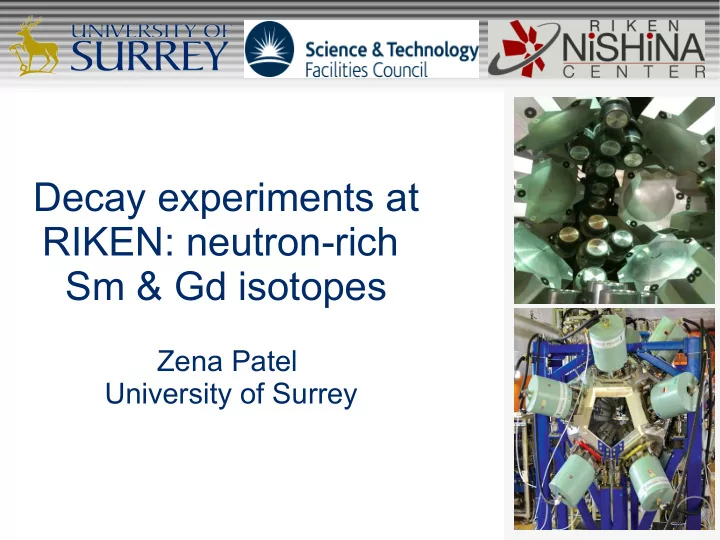
WAS3ABI & EURICA
WAS3ABI: Wide-range Active Silicon-Strip Stopper Array for Beta and Ion detection Upto 5 DSSDs 60x40 1mm strips
EURICA: Euroball RIKEN Cluster Array
84 HPGe crystals in 12x7 clusters from the RISING array Analogue & digital branches for energy & timing LaBr3(Ce) (Surrey & Brighton) and plastics
SLIDE 6
The nuclear landscape
Analysis in other regions is ongoing
SLIDE 7 Published results: 131In
131In = 1 proton hole nucleus w.r.t. 132Sn New single-particle state (red) in 131In used for shell model calculations below N=82 No evidence for a Z=40 subshell closure at N=82
- J. Taprogge et. al. Phys. Rev. Lett. 112, 132501 (2014)
SLIDE 8 Published results: 126,128Pd
- H. Watanabe et. al. Phys. Rev. Lett. 111, 152501 (2013)
126Pd80 128Pd82
New isomers in 126Pd & 128Pd Lowest Z for N=82 Evidence for a robust N=82 shell closure
SLIDE 9 Published results: β decay around 78Ni
5 new β t1/2s measured Half-lives show magicity of Z=28 & N=50
- Z. Y. Xu et. al. Phys. Rev. Lett. 113, 032505 (2014)
Half-life (ms) Neutron Number
SLIDE 10 Fast timing data: 104Zr
University of Brighton
Previously measured as: τ(2+) = 2.9(4) ns
SLIDE 11
Maximum deformation expected at doubly mid-shell region Closed-shell nuclei → “waiting points” of the r process REP → mid-shell nuclear deformation
Mid-shell region
SLIDE 12
Nuclear deformation → K isomers Quasiparticle configuration → spin projections, K, on symmetry axis Transitions can be forbidden by ΔK≤λ K-forbiddenness → long-lived states: K isomers Use to probe low-lying excited states
K isomers
SLIDE 13
Measures of collectivity:
Collectivity
B(E2) = transition strength I = moment of inertia, proportional to deformation J= spin of state
SLIDE 14
≈ 40,000 implanted 166Gd nuclei ≈ 8,000 implanted 164Sm nuclei
In-beam PID
SLIDE 15 Prompt flash removed to reduce background in spectrum Fixed time cut for γ intensities Half-life found from strong γs
166Gd: γ spectroscopy
- Z. Patel et. al. Phys. Rev. Lett. 113, 262502 (2014)
SLIDE 16 Level scheme based on γ-γ coincidences Transition multipolarities from intensity balance Fragment of 2-qp band → 4+ bandhead
166Gd level scheme
- Z. Patel et. al. Phys. Rev. Lett. 113, 262502 (2014)
SLIDE 17 Statistics too low to see the 2+ → 0+
164Sm: γ spectroscopy
- Z. Patel et. al. Phys. Rev. Lett. 113, 262502 (2014)
SLIDE 18 PES calculations
Nucleus K config. Ex (MeV) Ex (MeV) exp. 166Gd 6-
ν5/2-[512] x ν7/2+[633]
1.288 1.601 166Gd 4+
π3/2+[411] x π5/2+[413]
1.300 1.350 164Sm 6-
ν5/2-[512] x ν7/2+[633]
1.301 1.416+E(2+)
Potential energy surface calculations minimised in β2, β4, β6 deformation space with γ=0
SLIDE 19
Energy systematics
Most deformed N=102 nuclei to date Highlights an increase at N=100: deformation minimum or shell gap Most calculations → maximum deformation at N=104 PES calculations → maximum deformation at N=100, 102
SLIDE 20 Deformed shell gap
- L. Satpathy and S.K. Patra Nucl. Phys. A722, C24 (2003)
- L. Satpathy & S. K. Patra predict a
deformed shell gap at N=100 from S2n Our systematics support a deformed shell gap This will influence r-process calculations
SLIDE 21
160Sm
New 4qp state in 160Sm Lightest nucleus with a 4qp state to date
SLIDE 22
Data from 164Sm & 166Gd → first evidence of a deformed shell gap at N=100 Using the RIBF we can probe further away from stability into neutron-rich regions We can get information on excited states for nuclei with a very small yield
Summary
SLIDE 23 Thank you for your attention. Questions?
Collaborators: P.-A. Soderstrom,1 Zs. Podolyak,2 P. H. Regan,2 P. M. Walker,2 H. Watanabe,2,4,5
- E. Ideguchi,6,7 G. S. Simpson,8 H. L. Liu,9 S. Nishimura,2 Q. Wu,10 F. R. Xu,10
- F. Browne,2, 11 P. Doornenbal,2 G. Lorusso,2 S. Rice,1,2 L. Sinclair,2,12 T. Sumikama,13
- J. Wu,2,10 Z.Y. Xu,14 N. Aoi,6,7 H. Baba,2 F. L. Bello Garrote,15 G. Benzoni,16 R. Daido,7
- Y. Fang,7 N. Fukuda,2 G. Gey,8 S. Go,17 A. Gottardo,18 N. Inabe,2 T. Isobe,2
- D. Kameda,2 K. Kobayashi,19 M. Kobayashi,17 T. Komatsubara,20,21 I. Kojouharov,22
- T. Kubo,2 N. Kurz,22 I. Kuti,23 Z. Li,24 M. Matsushita,17 S. Michimasa,17 C.-B. Moon,25
- H. Nishibata,7 I. Nishizuka,13 A. Odahara,7 E. Şahin,15 H. Sakurai,2,14 H. Schaffner,22
- H. Suzuki,2 H. Takeda,2 M. Tanaka,7 J. Taprogge,26,27 Zs. Vajta,23 A. Yagi,7
and R. Yokoyama17
1RIKEN Nishina Center 2University of Surrey 3NPL, Teddington 4,5Beihang University 6,7Osaka University 8LPSC, Universite Joseph Fourier/INPG, Grenoble 9Xi'an Jiaotong University 10Peking University 11University of Brighton 12University of York 13Tohoku University 14University of Tokyo 15University of Oslo 16INFN, Milano 17CNS, University of Tokyo 18INFN, Legnaro 19Rikkyo University 20University of Tsukuba 21Institute for Basic Science, Korea 22 GSI, Darmstadt 23ATOMKI 24Peking University 25Hoseo University 26CSIC, Madrid 27Universidad Autonoma