Declaration Syntax General form of a declaration: - - PDF document

declaration syntax
SMART_READER_LITE
LIVE PREVIEW

Declaration Syntax General form of a declaration: - - PDF document

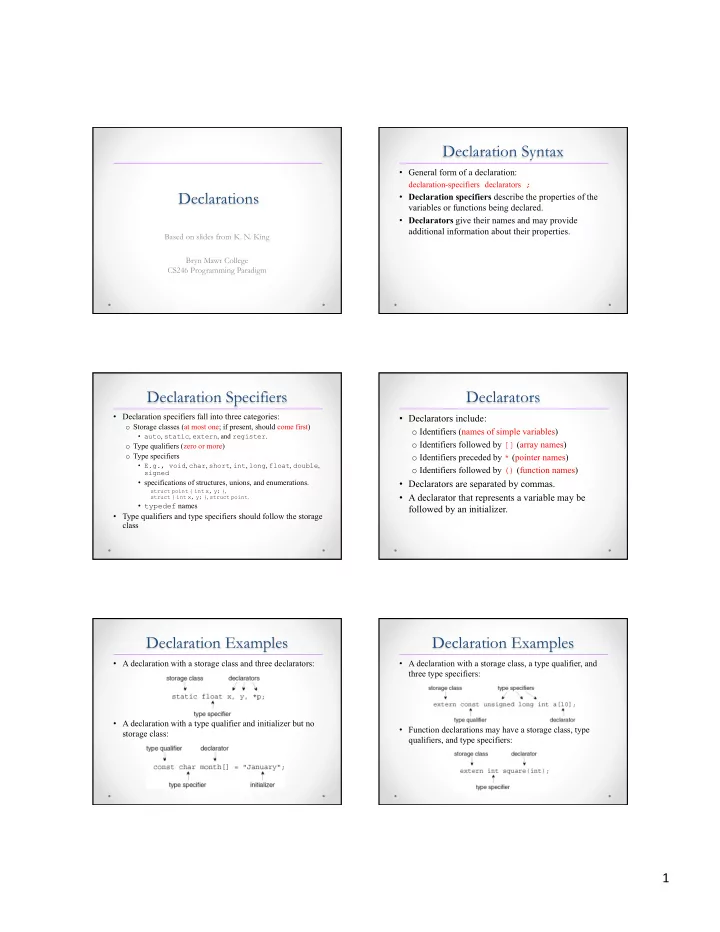
Declaration Syntax General form of a declaration: declaration-specifiers declarators ; Declarations Declaration specifiers describe the properties of the variables or functions being declared. Declarators give their names and may


slide-1
SLIDE 1

1 ¡

Declarations

Based on slides from K. N. King Bryn Mawr College CS246 Programming Paradigm

Declaration Syntax

  • General form of a declaration:

declaration-specifiers declarators ;

  • Declaration specifiers describe the properties of the

variables or functions being declared.

  • Declarators give their names and may provide

additional information about their properties.

Declaration Specifiers

  • Declaration specifiers fall into three categories:
  • Storage classes (at most one; if present, should come first)
  • auto, static, extern, and register.
  • Type qualifiers (zero or more)
  • Type specifiers
  • E.g., void, char, short, int, long, float, double,

signed

  • specifications of structures, unions, and enumerations.

struct point { int x, y; }, struct { int x, y; }, struct point.

  • typedef names
  • Type qualifiers and type specifiers should follow the storage

class

Declarators

  • Declarators include:
  • Identifiers (names of simple variables)
  • Identifiers followed by [] (array names)
  • Identifiers preceded by * (pointer names)
  • Identifiers followed by () (function names)
  • Declarators are separated by commas.
  • A declarator that represents a variable may be

followed by an initializer.

Declaration Examples

  • A declaration with a storage class and three declarators:
  • A declaration with a type qualifier and initializer but no

storage class:

Declaration Examples

  • A declaration with a storage class, a type qualifier, and

three type specifiers:

  • Function declarations may have a storage class, type

qualifiers, and type specifiers:

slide-2
SLIDE 2

2 ¡

Properties of Variables

  • Every variable in a C program has three properties:
  • Storage duration determines when memory is set

aside for the variable and when that memory is released

  • Scope is the portion of the program text in which

the variable can be referenced.

  • Linkage determines the extent to which a variable

can be shared.

Properties of Variables

  • The storage duration of a variable determines

when memory is set aside for the variable and when that memory is released.

  • Automatic storage duration: Memory for variable

is allocated when the surrounding block is executed and deallocated when the block terminates.

  • Static storage duration: Variable stays at the same

storage location as long as the program is running, allowing it to retain its value indefinitely.

Properties of Variables

  • The scope of a variable is the portion of the

program text in which the variable can be referenced.

  • Block scope: Variable is visible from its point of

declaration to the end of the enclosing block.

  • File scope: Variable is visible from its point of

declaration to the end of the enclosing file.

Properties of Variables

  • The linkage of a variable determines the extent to

which it can be shared.

  • External linkage: Variable may be shared by

several (perhaps all) files in a program.

  • Internal linkage: Variable is restricted to a single

file but may be shared by the functions in that file.

  • No linkage: Variable belongs to a single function

and can’t be shared at all.

Properties of Variables

  • The default storage duration, scope, and linkage of a

variable depend on where it’s declared:

  • Variables declared inside a block (including a function

body) have

  • automatic storage duration,
  • block scope, and
  • no linkage.
  • Variables declared outside any block, at the outermost

level of a program, have

  • static storage duration,
  • file scope, and
  • external linkage.

Properties of Variables

  • Example:
  • We can alter these properties by specifying an explicit

storage class: auto, static, extern, or register.

slide-3
SLIDE 3

3 ¡

The auto Storage Class

  • The auto storage class is legal only for variables

that belong to a block.

  • An auto variable has automatic storage duration,

block scope, and no linkage.

  • The auto storage class is almost never specified

explicitly.

The static Storage Class

  • The static storage class can be used with all

variables, regardless of where they’re declared.

  • When used outside a block, static specifies that a

variable has internal linkage.

  • When used inside a block, static changes the

variable’s storage duration from automatic to static.

The static Storage Class

  • When used outside a block, static hides a variable

within a file:

static int i; /* no access to i in other files */ void f1(void) { /* has access to i */ } void f2(void) { /* has access to i */ }

  • This use of static is helpful for implementing

information hiding.

The static Storage Class

  • A static variable declared within a block resides at

the same storage location throughout program execution.

  • A static variable retains its value across the entire

run of the program.

  • Properties of static variables:
  • A static variable is initialized only once, prior to

program execution.

  • A static variable declared inside a function is shared

by all calls of the function, including recursive calls.

  • A function may return a pointer to a static variable.

The static Storage Class

  • Declaring a local variable to be static allows a function to

retain information between calls.

void func() { static int x = 0; printf("%d\n", x); x = x + 1; } int main() { func(); // prints 0 func(); // prints 1 func(); // prints 2 return 0; }

The static Storage Class

  • More often, we’ll use static for reasons of

efficiency:

char digit_to_hex_char(int digit) { static const char hex_chars[16] = "0123456789ABCDEF"; return hex_chars[digit]; }

  • Declaring hex_chars to be static saves time,

because static variables are initialized only once.

slide-4
SLIDE 4

4 ¡

The extern Storage Class

  • The extern storage class enables several source

files to share the same variable.

  • A variable declaration that uses extern doesn’t

cause memory to be allocated for the variable:

extern int i; // not a definition of i.

  • A variable can have many declarations in a

program but should have only one definition.

The extern Storage Class

Exception:

  • An extern declaration that initializes a variable

serves as a definition of the variable.

  • For example, the declaration

extern int i = 0;

is effectively the same as

int i = 0;

  • This rule prevents multiple extern declarations

from initializing a variable in different ways.

The extern Storage Class

  • Storage duration: always static
  • Inside a block – block scope; otherwise, file scope.
  • Linkage: if the variable was declared static earlier

in the file (outside of any function definition) – internal linkage; otherwise, external linkage.

The register Storage Class

  • Using the register storage class in the

declaration of a variable asks the compiler to store the variable in a register.

  • A register is a high-speed storage area located in a

computer’s CPU.

  • Specifying the storage class of a variable to be

register is a request, not a command.

  • The compiler is free to store a register variable

in memory if it chooses.

The register Storage Class

  • The register storage class is legal only for

variables declared in a block.

  • A register variable has the same storage

duration, scope, and linkage as an auto variable.

  • Since registers don’t have addresses, it’s illegal to

use the & operator to take the address of a register variable.

  • This restriction applies even if the compiler has

elected to store the variable in memory.

The register Storage Class

  • register is best used for variables that are

accessed and/or updated frequently.

  • The loop control variable in a for statement is a

good candidate for register treatment:

int sum_array(int a[], int n) { register int i; int sum = 0; for (i = 0; i < n; i++) sum += a[i]; return sum; }

slide-5
SLIDE 5

5 ¡

The register Storage Class

  • register isn’t as popular as it once was.
  • Many of today’s compilers can determine

automatically which variables would benefit from being kept in registers.

  • Still, using register provides useful

information that can help the compiler optimize the performance of a program.

  • In particular, the compiler knows that a

register variable can’t have its address taken, and therefore can’t be modified through a pointer.

The Storage Class of a Function

  • Function declarations (and definitions) may include

a storage class.

  • The only options are extern and static:
  • extern specifies that the function has external

linkage, allowing it to be called from other files.

  • static indicates internal linkage, limiting use of

the function’s name to the file in which it’s defined.

  • If no storage class is specified, the function is

assumed to have external linkage.

The Storage Class of a Function

  • Examples:

extern int f(int i); static int g(int i); int h(int i);

  • Using extern is unnecessary, but static has

benefits:

  • Easier maintenance. A static function isn’t visible
  • utside the file in which its definition appears, so future

modifications to the function won’t affect other files.

  • Reduced “name space pollution.” Names of static

functions don’t conflict with names used in other files.

The Storage Class of a Function

  • Function parameters have the same properties as

auto variables: automatic storage duration, block scope, and no linkage.

  • The only storage class that can be specified for

parameters is register.

Summary

  • Of the four storage classes, the most important are

static and extern.

  • auto has no effect, and modern compilers have

made register less important.

Type Qualifiers

  • const is used to declare “read-only” objects.
  • Examples:

const int n = 10; const int tax_brackets[] = {750, 2250, 3750, 5250, 7000};

slide-6
SLIDE 6

6 ¡

Declarators

  • Identifiers (names of simple variables)
  • Simplest case: a declarator is just an identifier

int i;

  • Identifiers followed by [] (array names)
  • Identifiers preceded by * (pointer names)

int *p;

  • Identifiers followed by () (function names)

Deciphering Complex Declarations

  • But what about declarators like the one in the

following declaration?

int *(*x[10])(void);

  • It’s not obvious whether x is a pointer, an array, or

a function.

  • Rules for understanding declarations:
  • Always read declarators from the inside out.

Locate the identifier that’s being declared, and start deciphering the declaration from there.

  • When there’s a choice, always favor [] and ()
  • ver *. Parentheses can be used to override the

normal priority of [] and () over *.

  • Examples:

int *ap[10]; //ap is an array of pointers. float *fp(float); //fp is a function that returns a pointer.

Deciphering Complex Declarations

  • Example:

void (*pf)(int);

  • Since *pf is enclosed in parentheses, pf must be a

pointer.

  • But (*pf) is followed by (int), so pf must

point to a function with an int argument.

  • The word void represents the return type of this

function.

Deciphering Complex Declarations

  • Example:
  • int *(*x[10])(void);

Deciphering Complex Declarations

  • Certain things can’t be declared in C.
  • Functions can’t return arrays:

int f(int)[]; /*** WRONG ***/

  • Functions can’t return functions:

int g(int)(int); /*** WRONG ***/

  • Arrays of functions aren’t possible, either:

int a[10](int); /*** WRONG ***/

  • In each case, pointers can be used to get the desired

effect.

  • For example, a function can’t return an array, but it can

return a pointer to an array.

Deciphering Complex Declarations

slide-7
SLIDE 7

7 ¡

Initializers

  • For convenience, C allows us to specify initial

values for variables as we’re declaring them.

  • To initialize a variable, we write the = symbol after

its declarator, then follow that with an initializer.

Initializers

  • The initializer for a simple variable is an

expression of the same type as the variable:

int i = 5 / 2; /* i is initially 2 */

  • If the types don’t match, C converts the initializer

using the same rules as for assignment:

int j = 5.5; /* converted to 5 */

  • The initializer for a pointer variable must be an

expression of the same type or of type void *:

int *p = &i;

Initializers

  • The initializer for an array, structure, or union is

usually a series of values enclosed in braces:

int a[5] = {1, 2, 3, 4, 5};

  • An initializer for a variable with static storage

duration must be constant:

#define FIRST 1 #define LAST 100 static int i = LAST - FIRST + 1;

  • If LAST and FIRST had been variables, the

initializer would be illegal.

Initializers

  • If a variable has automatic storage duration, its

initializer need not be constant:

int f(int n){ int last = n - 1; … }

  • A brace-enclosed initializer for an array, structure, or

union must contain only constant expressions:

#define N 2 int powers[5] = {1, N, N * N, N * N * N, N * N * N * N};

If N were a variable, the initializer would be illegal.

Initializers

  • The initializer for an automatic structure or union

can be another structure or union:

void g(struct part part1) { struct part part2 = part1; … }

  • The initializer doesn’t have to be a variable or

parameter name, although it does need to be an expression of the proper type.

Uninitialized Variables

  • The initial value of a variable depends on its

storage duration:

  • Variables with automatic storage duration have no

default initial value.

  • Variables with static storage duration have the value

zero by default.

  • A static variable is correctly initialized based on its

type, not simply set to zero bits.

  • It’s better to provide initializers for static variables

rather than rely on the fact that they’re guaranteed to be zero.