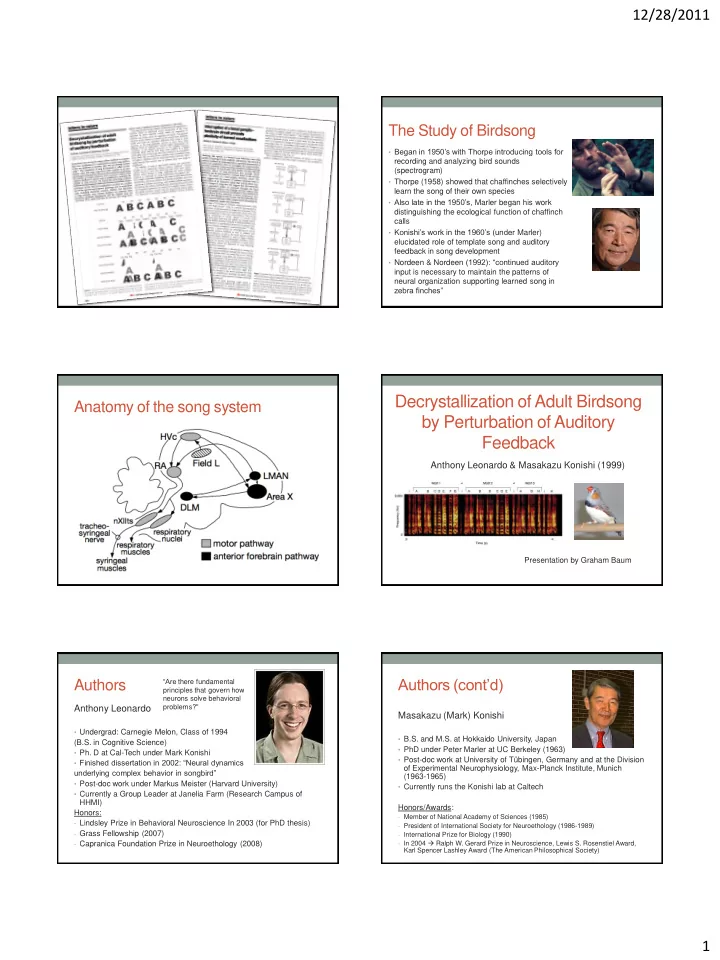
Decrystallization of Adult Birdsong Anatomy of the song system by - - PDF document

decrystallization of adult birdsong
SMART_READER_LITE
LIVE PREVIEW

Decrystallization of Adult Birdsong Anatomy of the song system by - - PDF document

12/28/2011 The Study of Birdsong B egan in 1950s with Thorpe introducing tools for recording and analyzing bird sounds (spectrogram) Thorpe (1958) showed that chaffinches selectively learn the song of their own species Also late


slide-1
SLIDE 1

12/28/2011 1 The Study of Birdsong

  • Began in 1950’s with Thorpe introducing tools for

recording and analyzing bird sounds (spectrogram)

  • Thorpe (1958) showed that chaffinches selectively

learn the song of their own species

  • Also late in the 1950’s, Marler began his work

distinguishing the ecological function of chaffinch calls

  • Konishi’s work in the 1960’s (under Marler)

elucidated role of template song and auditory feedback in song development

  • Nordeen & Nordeen (1992): ―continued auditory

input is necessary to maintain the patterns of neural organization supporting learned song in zebra finches‖

Anatomy of the song system

Decrystallization of Adult Birdsong by Perturbation of Auditory Feedback

Anthony Leonardo & Masakazu Konishi (1999) Presentation by Graham Baum

Authors

Anthony Leonardo

  • Undergrad: Carnegie Melon, Class of 1994

(B.S. in Cognitive Science)

  • Ph. D at Cal-Tech under Mark Konishi
  • Finished dissertation in 2002: ―Neural dynamics

underlying complex behavior in songbird‖

  • Post-doc work under Markus Meister (Harvard University)
  • Currently a Group Leader at Janelia Farm (Research Campus of

HHMI) Honors:

  • Lindsley Prize in Behavioral Neuroscience In 2003 (for PhD thesis)
  • Grass Fellowship (2007)
  • Capranica Foundation Prize in Neuroethology (2008)

―Are there fundamental principles that govern how neurons solve behavioral problems?"

Authors (cont’d)

Masakazu (Mark) Konishi

  • B.S. and M.S. at Hokkaido University, Japan
  • PhD under Peter Marler at UC Berkeley (1963)
  • Post-doc work at University of Tübingen, Germany and at the Division
  • f Experimental Neurophysiology, Max-Planck Institute, Munich

(1963-1965)

  • Currently runs the Konishi lab at Caltech

Honors/Awards:

  • Member of National Academy of Sciences (1985)
  • President of International Society for Neuroethology (1986-1989)
  • International Prize for Biology (1990)
  • In 2004  Ralph W. Gerard Prize in Neuroscience, Lewis S. Rosenstiel Award,

Karl Spencer Lashley Award (The American Philosophical Society)

slide-2
SLIDE 2

12/28/2011 2 Journal: Nature

  • First Issue: November, 1869
  • Impact Factor: 36.101

Key Points of the Study

  • What is the role of auditory feedback in adult zebra finch

song maintenance?

  • How do differences in auditory feedback perturbation

affect the gradual loss of song stereotypy? (What features characterize the process of decrystallization?)

  • To what extent (and over what time-frame) do zebra

finches with decrystallized song recover full song stereotypy?

Birdsong Organization

  • Syllable – individual sound components separated by

silent intervals

  • Motif – sequence of syllables
  • Bout – sequence of motifs

Passerine Birds

  • 4000 species

3000 ―Oscines‖

  • Complex song

production generated by CPG which is modified by auditory feedback 1000 ―Suboscines‖

  • Less complex songs

(usually)

  • Can develop normal

songs without auditory feedback (CPG-controlled)

  • Inability to imitate

song

Bird Song Acquisition: Ontogeny and

Crystallization

  • Sub-song  Plastic Song  Crystallization
  • Crystallization

(Brainard and Doupe, 2002)

Auditory Feedback Perturbation Protocol

“Adaptive Protocol” “Syllable-Triggered Protocol”

slide-3
SLIDE 3

12/28/2011 3 Decrystallization of Birdsong

  • Decrystallization

Adaptive Protocol Group (n=3 birds)

  • Increase in stuttering; increase in maximum song length
  • Syllable addition/deletion
  • Spectral distortion (―wobbling‖ of harmonic structure) – indicates loss
  • f precise control over the syrinx
  • *Results paralleled previous studies with deafened birds

Adaptive Protocol Decrystallization: Syllable-Triggered

Syllable-Triggered Protocol (n=2 birds)

  • Harmonic stacking on targeted syllable
  • Apparent changes after one week of feedback exposure

Syllable-Triggered Protocol

Baseline version of Syllable A After one week of protocol After one month of protocol

Understanding Decrystallization Through Brainard & Doupe’s Model (2000)

Question: Why did birdsongs decrystallize differently

in the different auditory feedback conditions?

Markov Chain

Statistical parameter for variability

  • The next state in the chain depends only on the current state and not
  • n the sequence of events that preceded it
  • What significance does this have for birdsong?
slide-4
SLIDE 4

12/28/2011 4 Song Recovery (―Re-crystallization‖)

Adaptive Protocol Birds

  • Complete recovery (return to baseline song) after 2-4 months of

removal from feedback condition

Syllable-Triggered Bird

  • Made ―partial recovery‖ by 8 months after cessation of feedback

Conclusions

  • ―We revealed that the songs were stable not because they had

become hardwired but because they are maintained dynamically‖ – Leonardo

  • ―This finding is not consistent with the classical depiction of

song development in which a dynamic learning period in youth ends in a static maintenance period in adulthood‖ (p. 469)

  • Feedback-based evaluation is essential for maintenance of

adult song stability

  • Differences in decrystallization due to variable levels of

disturbed feedback and vocal output modification (more on this later)

  • Re-crystallization: Gradual return to stereotyped baseline song

after normal auditory feedback

References

1.

Brainard, M.S., & Doupe, A.J. (2002) What songbirds teach us about learning. Nature, 417, 351-358.

2.

Konishi, M. (2010) From central pattern generator to sensory template in the evolution of birdsong. Brain & Language 115, 18-20

3.

Nordeen K, & Nordeen E. (1992) Auditory feedback is necessary for the maintenance of stereotyped song in adult zebra finches. Behav. Neural Biol., 57, 58- 66

2 possible explanations:

Synapses in the motor pathway become stable after the sensorimotor learning period, once song crystallizes. Active evaluation of auditory feedback is

  • ngoing, but song stabilizes

because auditory input matches the stored target.

Observation 1: Songs become stable and stereotyped in adults Observation 2: Adult songs degrade when auditory feedback is altered

?

Interruption of a basal ganglia- forebrain circuit prevents plasticity of learned vocalizations

Michael Brainard and Allison Doupe (2000)

Petra Deane

The authors

Michael Brainard

Assistant Professor Depts of Physiology and Psychiatry, UCSF BA from Harvard, 1985, Biochemistry PhD from Stanford, 1995, Neuroscience The Brainard lab:

“how experience, particularly during early life, shapes the functioning of the nervous system” “a combination of behavioral and neurophysiological techniques to investigate the mechanisms underlying vocal learning in songbirds”

1 RA, 3 post-docs, 3 grad students

Allison Doupe

Professor Dept of Psychiatry, UCSF Editor for the Journal of Neuroscience and the Journal of Neurobiology The Doupe lab:

“how the nervous system mediates behavior, especially complex behaviors that must be learned” “we are studying how the different features of song are represented [in the AFP], how the animal's auditory experience and vocal learning shape its neuronal properties, and what the crucial function of this pathway might be”

2 RAs, 7 post-docs, 2 grad students

slide-5
SLIDE 5

12/28/2011 5

The journal

  • What are the potential neural mechanisms for ongoing,

active, feedback-based evaluation?

  • What are the candidate brain regions/pathways involved?
  • Is there actually evidence?

Active evaluation of auditory feedback is

  • ngoing, but song stabilizes

because auditory input matches the stored target.

Key points of the study

Hypothesis

Proposed neural mechanism

\ \ \ vs. ⌥ ⌥ ⌥ \ \ \ ⌥ ⌥ ⌥ ⌥ ⌥ ⌥

adaptive modification LEARNING JUVENILE

Proposed neural mechanism

\ \ \ vs. \ \ \ \ \ \ \ \ \ \ \ \

stable song ADULT

Proposed neural mechanism

\ \ \ vs. no signal \ \ \ \ \ \

no signal non-adaptive modification DEAFENED ADULT What brain regions evaluate feedback and/or transmit this instructive signal?

slide-6
SLIDE 6

12/28/2011 6

Candidate brain regions/pathway responsible Candidate brain regions/pathway responsible

  • AFP is necessary for juvenile vocal learning, lesion studies prevent learning
  • Spatially well-placed to instructively alter the motor pathway at the level of RA
  • Neurons in the AFP respond preferentially to tutor song and a bird’s own song

Selectivity to both tutor and self song would allow the AFP to evaluate the fit between incoming auditory signals and a memorized tutor model.

Anterior Forebrain Pathway (AFP)

Testing the proposed neural mechanism

\ \ \ vs. no signal \ \ \ \ \ \

no signal stable song DEAFENED & LESIONED ADULT Prediction: Lesion LMAN in the AFP

Methods

Two aspects of song have been shown to be controlled independently:

  • 1. Changes to syllables (nucleus RA)
  • 2. Changes to overall song structure, syllable order (nucleus HVC)

So, in this study, they tested both independently:

  • 1. Scored how well syllables from pre-treatment repertoire were preserved (RA)
  • 2. Assessed changes in the syllable order, deviations from A B C D E (HVC)

Confirmed this method by cutting tracheosyringeal nerve.. Syllable structure deteriorated, order of syllables sung remained stable ✓

Results

Lesions to LMAN prevent post-deafening deterioration in both syllables and song: different same confirms role of AFP (LMAN)

Results

Lesions to LMAN prevent post-deafening deterioration in both syllables and song:

slide-7
SLIDE 7

12/28/2011 7

Conclusions

Changes in song when auditory feedback is disrupted are due to an active process, not through passive changes in the motor pathway. AFP plays the same role in adults as it does in juveniles— adult songs are stable only because their auditory feedback matches the template.

Understanding Decrystallization Through Brainard & Doupe’s Model (2000)

Question: Why did birdsongs decrystallize differently

in the different auditory feedback conditions?