DEEP LEARNING FRAMEWORK FOR DIAGNOSTICS AND PATIENT-SPECIFIC DESIGN - - PowerPoint PPT Presentation

deep learning framework
SMART_READER_LITE
LIVE PREVIEW

DEEP LEARNING FRAMEWORK FOR DIAGNOSTICS AND PATIENT-SPECIFIC DESIGN - - PowerPoint PPT Presentation

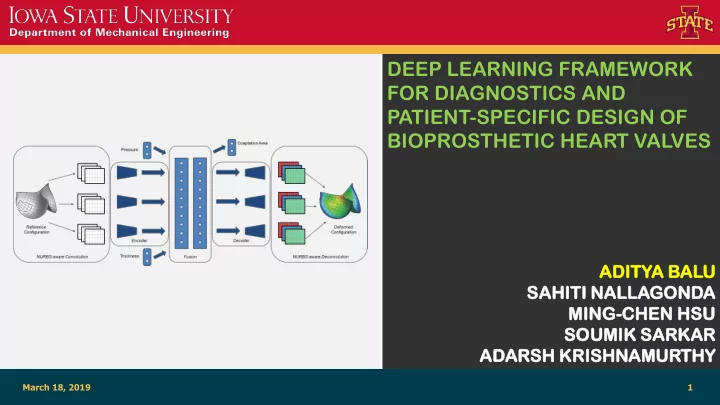
DEEP LEARNING FRAMEWORK FOR DIAGNOSTICS AND PATIENT-SPECIFIC DESIGN OF BIOPROSTHETIC HEART VALVES ADITY TYA A BALU SAHI HITI TI NALL LLAGOND GONDA MING NG-CHEN HEN HSU SOUM UMIK SARKAR RKAR ADAR ARSH SH KRISH SHNAM AMUR URTH


slide-1
SLIDE 1

DEEP LEARNING FRAMEWORK FOR DIAGNOSTICS AND PATIENT-SPECIFIC DESIGN OF BIOPROSTHETIC HEART VALVES

ADITY TYA A BALU SAHI HITI TI NALL LLAGOND GONDA MING NG-CHEN HEN HSU SOUM UMIK SARKAR RKAR ADAR ARSH SH KRISH SHNAM AMUR URTH THY

March 18, 2019 1

slide-2
SLIDE 2

Heart Diseases

  • Leading cause of death
  • In both the US and the

world

  • 1 in every 4 deaths
  • A heart attack every 40s
  • Loss of revenue
  • $200 billion each year

$11.588B $6.336B $6.116B $3.518B

March 18, 2019 2

slide-3
SLIDE 3

Valvular Diseases

  • Valvular Heart diseases
  • Affects more than 2.5% of US population
  • Causes
  • Calcification (Narrowing at the opening)
  • Regurgitation (Leakage and reverse flow)
  • Intervention
  • Surgical replacement
  • 90,000 prosthetic heart valves per year

[1] https://www.webmd.com/heart-disease/guide/heart-valve-disease#1

March 18, 2019 3

slide-4
SLIDE 4

Artificial Heart Valves

  • Mechanical Valve
  • Advantages
  • Durable
  • Disadvantages
  • Causes damage to blood cells
  • Need blood thinner to prevent clots
  • Noisy (can cause sleepless nights)
  • Bioprosthetic Valves
  • Use bovine or porcine pericardium
  • Advantages
  • Replicates the valve tissue
  • Disadvantages
  • Durability due to fatigue
  • Prone to calcification

Mechanical valve Bioprosthetic valve

March 18, 2019 4

Suture Ring

slide-5
SLIDE 5

Patient-Specific Replacement Heart Valves

  • Common sizes
  • Disadvantages of wrong sizing
  • Poor valve function (regurgitation, low flow rate)
  • Durability
  • BHV Replacements
  • 10 years

March 18, 2019 5

[2] https://www.medtronic.com/ca-en/healthcare-professionals/products/cardiovascular/heart-valves-surgical/mosaic-mosaic-ultra-bioprostheses.html [3] https://www.heartvalvechoice.com/tissue-vs-mechanical-heart-valve/

slide-6
SLIDE 6

Patient-Specific Design of Heart Valves

March 18, 2019 6

  • Design heart valves for every patient using their medical results

A view of one leaflet of the heart valve with its parametric curve boundary An aortic bioprosthetic heart valve with its placement on aorta

slide-7
SLIDE 7

Valve Function

  • Coaptation Area
  • Open area

March 18, 2019 7

Coaptation Area Open Area

slide-8
SLIDE 8

Design of BHV

  • Custom design requires evaluation of the valve function
  • Simulation speeds up the process

March 18, 2019 8

A view of one leaflet of the heart valve with its parametric curve boundary

slide-9
SLIDE 9

Simulations of BHVs

  • Imaging analysis for surgical decision making is difficult
  • Simulation of physics is necessary

Phase contrast MRI image data

[4] M. C. Hsu et al., “Dynamic and fluid–structure interaction simulations of bioprosthetic heart valves using parametric design with T-splines and Fung-type material models,” Computational Mechanics, 55 (2015) 1211-1225

March 18, 2019 9

slide-10
SLIDE 10

Computational Modeling of BHVs ML Framework for Valve Mechanics Data Representation and Data Generation Results and Conclusions

Outline

March 18, 2019 10

slide-11
SLIDE 11

[5] S Morganti, F Auricchio, DJ Benson, FI Gambarin, S Hartmann, TJR Hughes, and A Reali. Patient-specific isogeometric structural analysis of aortic valve closure. Computer Methods in Applied Mechanics and Engineering, 284:508–520, 2015 [6] Fei Xu, Simone Morganti, Rana Zakerzadeh, David Kamensky, Ferdinando Auricchio, Alessandro Reali, Thomas JR Hughes, Michael S Sacks, and Ming-Chen Hsu. A framework for designing patient-specific bioprosthetic heart valves using immersogeometric fluid– structure interaction analysis. International journal for numerical methods in biomedical engineering, 34(4):e2938, 2018.
Computational Modeling Frameworks for BHVs

  • Reconstruct the heart valve from medical images
  • Generate geometric representation of the heart valve (NURBS)
  • Perform valve closure simulations
  • Use Isogeometric analysis

March 18, 2019 11

slide-12
SLIDE 12

Reconstruction of Aortic Valve

Reconstruction of Aortic Root from CTA for a patient

March 18, 2019 12

[5] S Morganti, F Auricchio, DJ Benson, FI Gambarin, S Hartmann, TJR Hughes, and A Reali. Patient-specific isogeometric structural analysis of aortic valve closure. Computer Methods in Applied Mechanics and Engineering, 284:508–520, 2015 [6] Fei Xu, Simone Morganti, Rana Zakerzadeh, David Kamensky, Ferdinando Auricchio, Alessandro Reali, Thomas JR Hughes, Michael S Sacks, and Ming-Chen Hsu. A framework for designing patient-specific bioprosthetic heart valves using immersogeometric fluid– structure interaction analysis. International journal for numerical methods in biomedical engineering, 34(4):e2938, 2018.

slide-13
SLIDE 13

Valve Reconstruction and design

  • Interface valve with the patient’s aortic root
  • Define parameters for the designing
  • Vary them to get good performance

March 18, 2019 13

slide-14
SLIDE 14

Parametric Design of Heart Valve Geometry

  • Parameters of the heart valve affecting

the geometry

  • Belly curvature (x3)
  • Height of free edge (x2)
  • Curvature of free edge (x1)

March 18, 2019 14

[5] S Morganti, F Auricchio, DJ Benson, FI Gambarin, S Hartmann, TJR Hughes, and A Reali. Patient-specific isogeometric structural analysis of aortic valve closure. Computer Methods in Applied Mechanics and Engineering, 284:508–520, 2015 [6] Fei Xu, Simone Morganti, Rana Zakerzadeh, David Kamensky, Ferdinando Auricchio, Alessandro Reali, Thomas JR Hughes, Michael S Sacks, and Ming-Chen Hsu. A framework for designing patient-specific bioprosthetic heart valves using immersogeometric fluid– structure interaction analysis. International journal for numerical methods in biomedical engineering, 34(4):e2938, 2018.

slide-15
SLIDE 15

Non-Uniform Rational B-Spline Representation

  • Approximate the geometry using:
  • Control Points
  • Basis Functions (Piecewise polynomial)
  • Knot vectors
  • Weights

March 18, 2019 15

[7] http://web.me.iastate.edu/idealab/c-nurbs-python.html

A sample NURBS curve representation

slide-16
SLIDE 16

Non-Uniform Rational B-Spline Representation

  • Approximate the geometry using:
  • Control Points
  • Basis Functions
  • Knot vectors
  • Weights
  • Tensor Product for surfaces

March 18, 2019 16

[7] http://web.me.iastate.edu/idealab/c-nurbs-python.html

A sample NURBS surface representation

slide-17
SLIDE 17

Non-Uniform Rational B-Spline Representation

De facto surface representation

  • Most general spline
  • Piecewise-polynomial tensor product

surfaces

  • Can represent complex geometry

such as heart valves

March 18, 2019 17

[7] https://github.com/orbingol/NURBS-Python [8] Piegl, L., & Tiller, W. (2012). The NURBS book. Springer Science & Business Media.

slide-18
SLIDE 18

NURBS Evaluation

1 1 1 1 1 1 1

( ) ( ) ( ) 1 ( )

i p p p p i i i i i p i i p i i i i

u u u u N u N u N u u u u u if u u u N u

  • therwise

         

           

( ) ( ) ( , ) ( ) ( )

m n p q i j ij ij j i m n p q i j ij j i

N u N v w P S u v N u N v w

   

 

Basis Functions Control Points p = degree

Model Space

x y z

(u0,v0) S(u0, v0)

S(1,0) S(0,0) S(0,1) S(1,1)

(0,0) (0,1) (1,1) (0,1) u1 u2 u3 v1 v2 v3

Knots (u or v)

Parametric Space

u v

Compact definition: Defined completely by

  • Control mesh
  • u and v knot vectors

March 18, 2019 18

slide-19
SLIDE 19

Patient Specific Design of Heart Valve Geometry

March 18, 2019 19

[9] https://web.me.iastate.edu/jmchsu/heart-valves.html

slide-20
SLIDE 20

Isogeometric Analysis

  • Based on technologies such as NURBS
  • Same (“exact”) functional description is

used for geometry and simulation.

  • Includes standard FEA as a special case,

but offers other possibilities:

  • Precise and efficient geometric modeling
  • Superior approximation properties
  • Smooth and higher-order basis functions
  • Integration of design and analysis

March 18, 2019 20

slide-21
SLIDE 21

Isogeometric Analysis

Quadratic NURBS Linear FEM

CAD Model Analysis Mesh

CAD Model Coarse Mesh Refined Mesh FEM IGA

slide-22
SLIDE 22

M.C. Hsu et.al., “Dynamic and fluid–structure interaction simulations of bioprosthetic heart valves using parametric design with T-splines and Fung-type material models,” Computational Mechanics, 55 (2015) 1211-1225

Challenges of Using IGA for BHV Design

  • Patient-specific design of bioprosthetic heart valves

(BHV) require extensive exploration of design parameter space

  • Computational analysis is tedious and compute

intensive

  • Lot of historical simulation data
  • Real-time decision support tool for analyzing valve

function is difficult

March 18, 2019 22

slide-23
SLIDE 23

Deep Learning

  • Lots of Uses in Medical Sciences
  • Can learn complex phenomenon like the biomechanics
  • Can provide real-time support

March 18, 2019 23

slide-24
SLIDE 24

Computational Modeling of BHVs ML Framework for Valve Mechanics Data Generation Results and Conclusions

Outline

March 18, 2019 24

slide-25
SLIDE 25

ML Framework for Valve Biomechanics

Physical characteristics to learn:

  • 1. Learn from 3D input space and predict 3D
  • utput deformation
  • 2. Learn the effect of loads and boundary

conditions

  • 3. Interaction among the different leaflets
  • 4. Material behavior and dependence on the

thickness of the leaflets Embed phenomenon for learning:

  • 1. Data Representation
  • 2. Model Representation
  • 3. Training Algorithms

March 18, 2019 25

slide-26
SLIDE 26
  • Convolution Operator
  • Neural Networks
  • Convolutional Neural Networks
  • NURBS as Convolution

X

W1

W2

Y

W0

[3] Krishnamurthy, Adarsh, Rahul Khardekar, Sara McMains, Kirk Haller, and Gershon Elber. "Performing efficient NURBS modeling operations on the GPU." IEEE Transactions on Visualization and Computer Graphics 15, no. 4 (2009): 530-543.

Convolutional Neural Networks

u v

Basis Functions

n m

Control Mesh

u v

Evaluation Mesh

March 18, 2019 26

slide-27
SLIDE 27

NURBS-aware Convolution

  • Use textural representation of the NURBS control points as input to

a regular CNN

  • Localization of geometry

March 18, 2019 27

slide-28
SLIDE 28

ML Framework for Valve Biomechanics

Physical characteristics to learn:

  • 1. Learn from 3D input space and predict 3D
  • utput deformation
  • 2. Learn the effect of loads and boundary

conditions

  • 3. Interaction among the different leaflets
  • 4. Material behavior and dependence on the

thickness of the leaflets Embed phenomenon for learning:

  • 1. Data Representation
  • 2. Model Representation
  • 3. Training Algorithms

March 18, 2019 28

slide-29
SLIDE 29

CNN Architecture

March 18, 2019 29

Pressure Thickness Encoder Fusion Coaptation Area Decoder Deformed Configuration NURBS-aware Deconvolution Reference Configuration NURBS-aware Convolution

slide-30
SLIDE 30

DLFEA Hyper-parameters

  • Encoder and Decoder architecture
  • Number of convolution layers
  • Number of filters in each layer
  • Repetition size for capturing the effect of pressure and thickness
  • Number of neurons in FC layer (Data Fusion)
  • Need to be carefully selected for performance vs. underfitting
  • Number of FC layers and size of deconvolution

March 18, 2019 30

slide-31
SLIDE 31

ML Framework for Valve Biomechanics

Physical characteristics to learn:

  • 1. Learn from 3D input space and predict 3D
  • utput deformation
  • 2. Learn the effect of loads and boundary

conditions

  • 3. Interaction among the different leaflets
  • 4. Material behavior and dependence on the

thickness of the leaflets Embed phenomenon for learning:

  • 1. Data Representation
  • 2. Model Representation
  • 3. Training Algorithms

March 18, 2019 31

slide-32
SLIDE 32

Training Algorithm

  • Optimization algorithm: Adam
  • Loss function:
  • Account for
  • fixed boundary conditions
  • Interaction

March 18, 2019 32

Fixed BC Fixed BC Interactions

slide-33
SLIDE 33

ML Framework for Valve Biomechanics

Physical characteristics to learn:

  • 1. Learn from 3D input space and predict 3D
  • utput deformation
  • 2. Learn the effect of loads and boundary

conditions

  • 3. Interaction among the different leaflets
  • 4. Material behavior and dependence on the

thickness of the leaflets Embed phenomenon for learning:

  • 1. Data Representation
  • 2. Model Representation
  • 3. Training Algorithms

March 18, 2019 33

slide-34
SLIDE 34

Computational Modeling of BHVs ML Framework for Valve Mechanics Data Generation Results and Conclusions

Outline

March 18, 2019 34

slide-35
SLIDE 35

Data Generation

  • Geometry Parameters
  • Aortic Pressure
  • From 70 mm-Hg to 90 mm-Hg (21 values)
  • Heart Valve Thickness
  • From 0.00386cm to 0.0772cm (20 values)
  • 18,668 simulations

Parameter 1 2 3 4 5 Curvature of free edge (cm) 0.05 0.25 0.45

  • Belly curvature (cm)

0.2 0.6 0.9 1.2 1.4 Height of free edge (cm)

  • 0.1

0.1 0.3 0.5

  • March 18, 2019

35

slide-36
SLIDE 36

Isogeometric Analysis of Heart Valves

  • Perform valve closure simulation
  • Store key metrics from the analysis
  • Coaptation area
  • Deformed geometry

March 18, 2019 36

Coaptation Area Deformations

slide-37
SLIDE 37

Training Process

  • End-to-end training
  • Split the data for training, validation, and testing
  • 60% of data for training
  • 20% for validation
  • 20% for testing the generalization capability of the model
  • Fine-tune the hyper-parameters for lowest validation loss

March 18, 2019 37

slide-38
SLIDE 38

Computational Modeling of BHVs ML Framework for Valve Mechanics Data Generation Results and Conclusions

Outline

March 18, 2019 38

slide-39
SLIDE 39

Statistical Results

  • Coaptation Area
  • RMSE: 0.056cm2
  • Median: 0.03cm2
  • Correlation Coefficient: 0.994

R² = 0.9935 0.5 1 1.5 2 2.5 3 0.5 1 1.5 2 2.5 3

Predicted Simulated March 18, 2019 39

slide-40
SLIDE 40

Statistical Results

  • Procrustes Matching:
  • Accounts for shift and transformation

in geometry

  • Provides a dissimilarity measure (cm)

Γ is rotation matrix, 𝛿 is translation matrix, 𝛾 is scale factor

  • Results:
  • Median value of 0.0442cm
  • 10% of maximum deformation

March 18, 2019 40

slide-41
SLIDE 41

Anecdotal Results

Pressure (mm-Hg) Thickness (cm) x1 (cm) x2 (cm) x3 (cm) Simulated CA (cm2) Predicted CA (cm2) 89 0.0695 0.1 0.45 0.9 0.4505 0.3913

March 18, 2019 41

slide-42
SLIDE 42

Anecdotal Results

Pressure (mm-Hg) Thickness (cm) x1 (cm) x2 (cm) x3 (cm) Simulated CA (cm2) Predicted CA (cm2) 75 0.0540 0.3 0.45 0.8 2.9276 2.9659

March 18, 2019 42

slide-43
SLIDE 43

Anecdotal Results

Pressure (mm-Hg) Thickness (cm) x1 (cm) x2 (cm) x3 (cm) Simulated CA (cm2) Predicted CA (cm2) 73 0.0579 0.1 0.45 0.6 0.0217 0.0207

March 18, 2019 43

slide-44
SLIDE 44

Timings & Demo

March 18, 2019 44

  • IGA:
  • 2 core, 32 threads each
  • ~5mins of runtime
  • DLFEA:
  • Training: ~3-4 hours in P40s
  • Deployment: <5s in Titan Xp
slide-45
SLIDE 45

Conclusions

  • Fast simulation of heart valves using DLFEA
  • DLFEA is able to learn the deformation biomechanics
  • Including complicated dependence on geometry and boundary conditions
  • Results show DLFEA matches the fidelity of valve simulations
  • Can provide interactive decision support

March 18, 2019 45

slide-46
SLIDE 46

Future Work

  • Interactive design and optimization framework using DLFEA
  • Improve performance of design-through-analysis pipelines
  • Add additional components to the ML framework to enable direct

prediction of results from raw medical images

  • End-to-end learning

March 18, 2019 46

slide-47
SLIDE 47

Acknowledgements

  • Funding Sources
  • National Science Foundation
  • CMMI:1644441 – CM: Machine-Learning Driven Decision Support in Design for Manufacturability
  • OAC:1750865 – CAREER: GPU-Accelerated Framework for Integrated Modeling and Biomechanics

Simulations of Cardiac Systems

  • nVIDIA
  • Titan Xp GPU for Academic Research

March 18, 2019 47

slide-48
SLIDE 48

Thank You! Questions?

March 18, 2019 48

slide-49
SLIDE 49

Extra Slides

March 18, 2019 49

slide-50
SLIDE 50

March 18, 2019 50