Defending No-Injury Class Actions Post-Spokeo: Standing for - - PowerPoint PPT Presentation

defending no injury class actions post spokeo standing
SMART_READER_LITE
LIVE PREVIEW

Defending No-Injury Class Actions Post-Spokeo: Standing for - - PowerPoint PPT Presentation

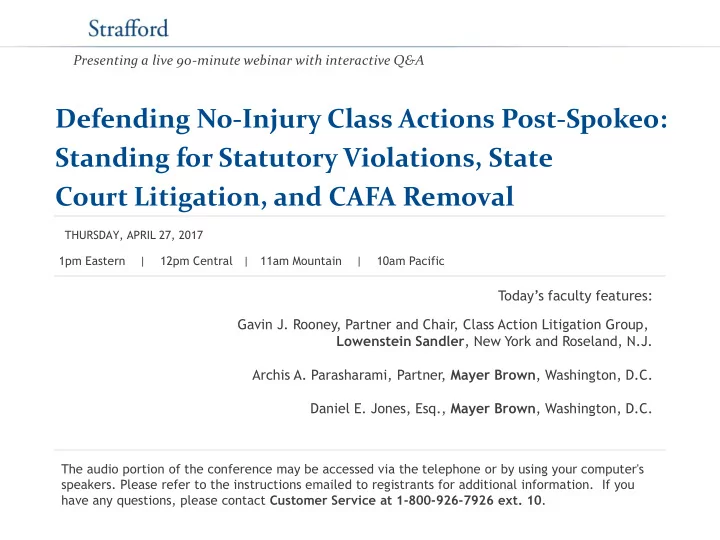
Presenting a live 90-minute webinar with interactive Q&A Defending No-Injury Class Actions Post-Spokeo: Standing for Statutory Violations, State Court Litigation, and CAFA Removal THURSDAY, APRIL 27, 2017 1pm Eastern | 12pm Central |


slide-1
SLIDE 1 The audio portion of the conference may be accessed via the telephone or by using your computer's
  • speakers. Please refer to the instructions emailed to registrants for additional information. If you
have any questions, please contact Customer Service at 1-800-926-7926 ext. 10. Presenting a live 90-minute webinar with interactive Q&A

Defending No-Injury Class Actions Post-Spokeo: Standing for Statutory Violations, State Court Litigation, and CAFA Removal

Today’s faculty features: 1pm Eastern | 12pm Central | 11am Mountain | 10am Pacific THURSDAY, APRIL 27, 2017 Gavin J. Rooney, Partner and Chair , Class Action Litigation Group, Lowenstein Sandler, New York and Roseland, N.J. Archis A. Parasharami, Partner, Mayer Brown, Washington, D.C. Daniel E. Jones, Esq., Mayer Brown, Washington, D.C.
slide-2
SLIDE 2

Tips for Optimal Quality

Sound Quality If you are listening via your computer speakers, please note that the quality

  • f your sound will vary depending on the speed and quality of your internet

connection. If the sound quality is not satisfactory, you may listen via the phone: dial 1-866-871-8924 and enter your PIN when prompted. Otherwise, please send us a chat or e-mail sound@straffordpub.com immediately so we can address the problem. If you dialed in and have any difficulties during the call, press *0 for assistance. Viewing Quality To maximize your screen, press the F11 key on your keyboard. To exit full screen, press the F11 key again.

FOR LIVE EVENT ONLY
slide-3
SLIDE 3

Continuing Education Credits

In order for us to process your continuing education credit, you must confirm your participation in this webinar by completing and submitting the Attendance Affirmation/Evaluation after the webinar. A link to the Attendance Affirmation/Evaluation will be in the thank you email that you will receive immediately following the program. For additional information about continuing education, call us at 1-800-926-7926

  • ext. 35.
FOR LIVE EVENT ONLY
slide-4
SLIDE 4

Program Materials

If you have not printed the conference materials for this program, please complete the following steps:

  • Click on the ^ symbol next to “Conference Materials” in the middle of the left-

hand column on your screen.

  • Click on the tab labeled “Handouts” that appears, and there you will see a

PDF of the slides for today's program.

  • Double click on the PDF and a separate page will open.
  • Print the slides by clicking on the printer icon.
FOR LIVE EVENT ONLY
slide-5
SLIDE 5

Defending No-Injury Class Actions Under Spokeo Inc. v. Robins:

Standing for Statutory Violations, State Court Litigation, and CAFA Removal

Gavin Rooney

grooney@lowenstein.com Lowenstein Sandler LLP

Archis A. Parasharami

aparasharami@mayerbrown.com Mayer Brown LLP

Daniel E. Jones

djones@mayerbrown.com Mayer Brown LLP April 2017
slide-6
SLIDE 6

Agenda

  • Review of the Spokeo decision, its background, and ramifications.
  • Review of Spokeo’s treatment in the circuit courts.
  • Case study in Spokeo’s application by the district courts: TCCWNA class

actions.

  • Impact of Spokeo on removal of no-injury class actions.
  • Implications for future defense of no-injury class actions.
  • Questions and answers.
6
slide-7
SLIDE 7

THE SPOKEO DECISION

7
slide-8
SLIDE 8

Robins’ Lawsuit

  • Spokeo is a people search engine: aggregates publicly available info from

variety of sources into an online searchable database

  • Disclaims any guarantees as to accuracy of information and warns that

information should not be used for FCRA purposes

  • Plaintiff says that information about him suggests that he is wealthier and

more educated than he really is, and married when he is single

  • He filed a putative class action alleging that Spokeo is a consumer reporting

agency and that it violates FCRA; seeks statutory damages

– In amended complaint, in addition to claiming a bare statutory violation, he says that he has suffered purportedly concrete harm because of allegedly diminished employment prospects and related anxiety

8
slide-9
SLIDE 9

District Court Proceedings

  • Dismissed initial complaint
  • Initially concluded that amended complaint could go forward
  • After Spokeo sought Section 1292(b) certification, district court reversed

course and on its own motion decided to dismiss for lack of standing

  • Held that allegations about harm to future employment prospects were too

speculative to satisfy Supreme Court’s injury-in-fact standard

9
slide-10
SLIDE 10

Ninth Circuit’s Decision

  • Ninth Circuit reversed district court’s dismissal for lack of standing
  • Did not reach the argument about diminished employment prospects
  • Found standing based on the broad theory that it is sufficient simply to

allege a statutory violation

  • Relied on prior CA9 decision in Edwards v. First American Corp., 610 F.3d

514 (9th Cir. 2010)

– Supreme Court had granted cert; “DIG” on last day of term in June 2012

10
slide-11
SLIDE 11

The Supreme Court’s Holding

  • Court vacated and remanded; Ninth Circuit had focused on “particularized”

element only, holding that the plaintiff had standing based simply on his allegation that Spokeo “violated his statutory rights”

– This was error, the Supreme Court explained, because it ignored the “concreteness” element of injury in fact

  • Core holding: “Congress’ role in identifying and elevating intangible harms

does not mean that a plaintiff automatically satisfies the injury-in-fact requirement whenever a statute grants a person a statutory right and purports to authorize that person to sue to vindicate that right.”

  • Instead, “Article III standing requires a concrete injury even in the context
  • f a statutory violation.”
11
slide-12
SLIDE 12

What Does “Concrete” Mean?

  • Injury must be “de facto”—that is, it must “actually exist” and be “‘real,’

and not ‘abstract’”

  • Includes not just “tangible” injuries (such as loss of money) but also some

“intangible” harms

– “In determining whether an intangible harm constitutes injury in fact, both history and the judgment of Congress play important roles”

  • Existence of a private right of action under a statute does not automatically

meet the “real” harm standard

– If concrete harm is not an element of statutory cause of action, it must be proven separately

12
slide-13
SLIDE 13

Claimed Future Harms Likely Must Satisfy Clapper

  • The Court also pointed out that the plaintiff need not always have suffered

concrete harm in the past in order to sue: a “risk of real harm” can in some circumstances satisfy the concrete harm requirement

– The Court cited its prior ruling in Clapper v. Amnesty International USA, 133 S.

  • Ct. 1138 (2013)

– Clapper: a “‘threatened injury must be certainly impending to constitute injury in fact,’ and ‘[a]llegations of possible future injury’ are not sufficient.”

  • Id. at 1147 (quotation marks omitted)
13
slide-14
SLIDE 14

POST-SPOKEO CIRCUIT COURT DECISIONS

14
slide-15
SLIDE 15

Post-Spokeo Circuit Court Decisions

  • Hundreds of cases applying Spokeo already, just under a year later. Courts are

divided; however, many appellate decisions reaffirm Spokeo’s core holding that bare violation of statute not sufficient to satisfy Article III.

  • CA7: Meyers v. Nicolet Rest., 843 F.3d 724 (7th Cir. 2016). No injury in fact for bare

allegation that restaurant violated FACTA by failing to truncate expiration date on receipt.

– Plaintiff retained the receipt and nobody else ever saw it, so “it is hard to imagine how the expiration date’s presence could have increased the risk that Meyers’ identity would be compromised.” Also rejects distinction between “substantive” and “procedural” rights: what matters is injury in fact, not characterization of the violation.
  • Gubala v. Time Warner Cable, 846 F.3d 909 (7th Cir. 2017). No injury from allegation

that cable company violated Cable Communications Policy Act (CCPA) by retaining consumers’ personal information beyond the statutory deadline for deleting it.

15
slide-16
SLIDE 16

Post-Spokeo Circuit Court Decisions

  • CA8: Braitberg v. Charter Commc’ns, 836 F.3d 925 (8th Cir. 2016). Nearly identical

CCPA claim brought by same plaintiff’s lawyer as in Gubala. Again no injury in fact for mere retention of info beyond statutory deadline.

– Held that Spokeo changed the law and superseded the “absolute” view of prior 8th Cir. decisions holding that any statutory violation amounts to injury in fact.

  • DC Cir.: Hancock v. Urban Outfitters, 830 F.3d 511 (D.C. Cir. 2016). No injury in fact

from requesting customer’s zip code at time of purchase in alleged violation of D.C. consumer protection statute.

– “If, as the Supreme Court advised, disclosure of an incorrect zip code is not a concrete Article III injury, then even less so is [plaintiffs’] naked assertion that a zip code was requested and recorded without any concrete consequence.”

  • CA11: Nicklaw v. CitiMortgage, 839 F.3d 998 (11th Cir. 2016). No injury in fact from

defendant’s allegedly delayed recording of a mortgage after NY statutory deadline

  • f 90-days, with no consequence.
16
slide-17
SLIDE 17

Post-Spokeo Circuit Court Decisions

  • CA6: Lyshe v. Levy, --- F.3d ---- 2017 WL 1404182 (6th Cir. 2017). No injury in fact in

FDCPA case alleging that discovery requests that failed to provide for electronic discovery and that required notarized responses violated Ohio procedural rules.

– “[B]ald allegations of state procedural violations that did not result in any concrete harm are insufficient to confer standing.”
  • CA6: Soehnlen v. Fleet Owners Ins. Fund, 844 F.3d 576 (6th Cir. 2016). No injury in

fact in ERISA case for bare violation of Affordable Care Act mandate to eliminate certain benefit caps, nor for payment of money into an allegedly non-compliant plan without showing concrete harm from the alleged noncompliance.

  • CA5: Lee v. Verizon Commc’ns, 837 F.3d 523 (5th Cir. 2016). Another ERISA case—no

injury in fact for violation of ERISA right to “proper plan management” based on alleged breach of fiduciary duty.

17
slide-18
SLIDE 18

Post-Spokeo Circuit Court Decisions

  • CA2: Strubel v. Comenity Bank, 842 F.3d 181 (2d Cir. 2016). Alleged violations of

Truth in Lending Act in connection with inadequate disclosures when opening a Victoria’s Secret brand credit card account.

– No injury in fact for two of four claims (failure to inform customer about auto pay and billing error
  • bligations, where no auto pay plan and no claim of billing error)
– Injury for other two claims (failure to inform customer about obligations pertaining to disputed credit card purchases)
  • CA2: Ross v. AXA, --- F. App’x ----, 2017 WL 730266 (2d Cir. 2017). No injury in fact

for bare violations of NY Insurance Law sections prohibiting insurers from making misrepresentations, without any allegations of resulting harm.

18
slide-19
SLIDE 19

Post-Spokeo Circuit Court Decisions

  • Some Third Circuit decisions have reflected the most significant departure from

current trend, at least in privacy context

  • In re Nickelodeon Consumer Privacy Litig., 827 F.3d 262 (3d Cir. 2016) (unauthorized

disclosure of minors’ Internet browsing patterns to third parties = intangible privacy injury)

  • In re Horizon Healthcare Services Data Breach Litig., 846 F.3d 625 (3d Cir. 2017)

(data breach resulting in disclosure of personal information to third parties = intangible privacy harm cognizable under FCRA)

  • These decisions can be distinguished on factual basis
19
slide-20
SLIDE 20

Post-Spokeo Circuit Court Decisions: Summary

  • Spokeo’s application to particular statutes defies easy characterization,

though on the whole, Spokeo has bite: much harder than it was before for plaintiffs to bring no-injury class actions

  • One disappointment has been TCPA litigation: a number of decisions

holding that Congress made a judgment that any marketing call in violation

  • f TCPA amounts to invasion of privacy, e.g., Van Patten v. Vertical Fitness

Grp., 847 F.3d 1037 (9th Cir. 2017); some lower courts say that there is standing even if call was never heard or answered (which in our view can’t be right)

  • At some point, standing issue likely to return to Supreme Court
20
slide-21
SLIDE 21

CASE STUDY OF SPOKEO IN DISTRICT COURTS

21
slide-22
SLIDE 22

Case Study in Spokeo’s in Application in the District Courts: TCCWNA Class Actions

New Jersey Truth in Consumer Contract Notice Warranty Act (“TCCWNA”), N.J.S.A. 56:12-4, et seq.

  • Prohibits provisions in consumer agreements which violate the consumer’s

“clearly established” legal rights or fail to advise of a provision’s enforceability in New Jersey.

  • Allows “aggrieved” consumers to recover a civil penalty of $100 or more.
  • Injury or damages are not required.
22
slide-23
SLIDE 23

TCCWNA Class Actions

  • First wave: actions against door-to-door sellers based upon form contracts.

– United Consumer Financial Services Co. v. Carbo, 410 N.J. Super. 291 (App. Div. 2009), awarding $100 to every class member on summary judgment ($1,685,000).

  • Second wave: actions against brick-and-mortar retailers that use form

contracts.

  • Third wave: actions against online retailers, challenging provisions in

website terms of use and privacy policies.

– 50-plus class actions filed in the District of New Jersey in 2016 alone.

23
slide-24
SLIDE 24

Rulings Required to Address the Wave of TCCWNA Class Actions

  • What does it mean for a consumer to be “aggrieved” within the meaning of

the statute?

  • What is a “clearly established” right?
  • Is a class action an appropriate means of adjudicating TCCWNA claims?
24
slide-25
SLIDE 25

Spokeo Dismissals of TCCWNA Class Actions

  • Hecht v. Hertz Corp., 2016 WL 6139911 (D.N.J. 2016) (no standing where

complaint did not allege that any provision was actually unenforceable in New Jersey).

  • Candelario v. RIP Curl, Inc., 2016 U.S. Dist. LEXIS 163019 (C.D. Cal. Sept. 7,

2016) (rejecting theory of “informational injury,” where plaintiff did not allege he read the online terms of use).

  • Robin v. J. Crew Group, Inc., 2017 WL 1170854 (D.N.J. 2017) (no standing

where plaintiff failed to allege she read online terms of use). Each action dismissed without prejudice.

25
slide-26
SLIDE 26

Standing and Class Certification

We now squarely hold that unnamed, putative class members need not establish Article III standing. Instead, the ‘cases or controversies’ requirement is satisfied so long as a class representative has standing, whether in the context of a settlement or litigation class.

  • Neale v. Volvo Car”s of North America, LLC, 794 F.3d 353 (3d Cir. 2015).

But see Denney v. Deutsche Bank AG, 443 F.3d 253 (2d Cir. 2006) (“no class may be certified that contains members lacking Article III standing.”); Avritt v. Reliastar Life

  • Ins. Co., 615 F.3d 1023 (8th Cir. 2010) (“[a] class must therefore be defined in such a

way that anyone within it would have standing.”)

“ ”

26
slide-27
SLIDE 27

Spokeo Moves the Battle to State Court

Substantively, Defendant seeks to dismiss Plaintiff’s Complaint based on statutory standing under the TCCWNA. In that respect, the parties argue whether Plaintiff is an ‘aggrieved consumer’ within the definition of the Act, which dispute raises substantially similar issues as those raised under Article III standing. However, because Plaintiff lacks constitutional standing, which is a threshold question, I need not address Defendant’s argument on statutory standing predicated on New Jersey law. Rubin v. J. Crew Group, Inc., 2017 WL 117084 (D.N.J. 2017)

“ ”

27
slide-28
SLIDE 28

Defense Strategy: Withhold Spokeo Arguments

  • Hite v. Lush Internet, Inc., 2017 U.S. Dist. LEXIS 40949 (D.N.J. March 23,

2017) (defendant did not advance Spokeo standing argument, and solely relied on argument that plaintiff was not an “aggrieved” consumer because he had not been impacted by the challenged contractual language).

28
slide-29
SLIDE 29

SPOKEO IN STATE COURT: IMPLICATIONS FOR REMOVAL AND CAFA JURISDICTION

29
slide-30
SLIDE 30

Impact of Spokeo on Removal of No-Injury Class Actions

By now, there should be little debate about the numerous problems with our current class action system … One key reason for these problems is that most class actions are currently adjudicated in state courts, where there is often inadequate supervision over litigation procedures and proposed settlements. Senate Report No. 109-14 to the Class Action Fairness Act of 2005 (Feb. 28, 2005).

“ ”

30
slide-31
SLIDE 31

Can You Remove to Federal Court and Move to Dismiss Under Spokeo?

Schartel v. One Source Technology, LLC, 2016 WL 6024558 (N.D. Ohio Oct. 14, 2016).

  • FCRA class action filed in state court, and then removed under CAFA. Stayed

pending issuance of the Spokeo decision.

  • District court refused to dismiss, and instead remanded because lack of

Article III standing deprived federal court of subject-matter jurisdiction.

  • Relied on 28 U.S.C. § 1447(c), which “requires remand in the event the Court

determines that it lacks subject-matter jurisdiction.”

31
slide-32
SLIDE 32

Remands of Removed Class Actions Due to Spokeo

  • Hopkins v. Staffing Network Holdings, LLC, 2016 WL 6462095 (N.D. Ill. Oct.

18, 2016) (“Illinois’ doctrine of standing is ‘the business of the [Illinois] courts.’”).

  • But see Tyus v. United States Postal Service, 2017 WL 52609 (E.D.
  • Wisc. Jan. 4, 2017) (dismissing, rather than remanding, a no-injury class

action where standing did not exist under Spokeo, because this action against a federal agency had been removed under 28 U.S.C. § 1442(a)(1)).

32
slide-33
SLIDE 33

Sanctions For Removal and a Motion to Dismiss Under Spokeo?

Mocek v. Allsaints USA Limited, 2016 WL 7116590 (N.D. Ill. Dec. 7, 2016)

  • Defendant removed under CAFA, and then sought dismissal under Spokeo;

plaintiff cross-moved to remand to state court.

  • District court found defendant’s positions on removal and standing to be

incompatible, as a Spokeo argument means the defendant contends there is no federal subject-matter jurisdiction.

  • Ordering defendant to pay $58,112.50 for improvidently removing the

action.

33
slide-34
SLIDE 34

Cases Dismissing, Rather Than Remanding, Federal Claims Under Spokeo

  • Advocates for Individuals with Disabilities Foundation, Inc. v. Russell Enterprises,

Inc., 2016 WL 7187931 (D. Ariz. Dec. 12, 2016)

  • Timothy Woods v. Caremark, L.L.C., 2016 WL 6908108 (W.D. Mo. July 28, 2016)
  • St. Louis Heart Center, Inc. v. Nomax, Inc., 2017 WL 1064669 (E.D. Mo. March 20,

2017)

34
slide-35
SLIDE 35

Will Spokeo Have Legs In State Court?

Examples of state standing doctrines:

– Michigan rejects federal standing principles in favor of a more liberal policy. Lansing

  • Sch. Educ. Ass’n. v. Lansing Bd. of Educ., 792 N.W. 2d 686, 699 (Mich. 2010).

– Wisconsin construes standing “liberally,” and “even an injury to a trifling interest may suffice.” McConkey v. Van Hulen, 783 N.W. 2d 855, 860 (Wis. 2010). – California links its standing analysis to the intent of the underlying statute. Midpeninsula Citizens v. Westwood Inus., 271 Cal Rptr. 99,104 (Cal. Ct. App. 1990).

Standing analysis in state court likely conflates with interpretation of the underlying statutory violation and right of action.

– Is the plaintiff the “aggrieved” consumer under TCCWNA?

35
slide-36
SLIDE 36

Summary Of Implications

1. Spokeo is an effective tool to achieve dismissals (without prejudice) of no-injury class actions pending in federal court. 2. Defendants wishing to preserve a federal forum may withhold Spokeo arguments, although federal courts may decide the issue sua sponte. 3. State court actions cannot be removed if Spokeo applies. 4. Spokeo may undo CAFA for no-injury class actions, and prevent removal

  • f federal question class actions.
36
slide-37
SLIDE 37

QUESTIONS?

37