SLIDE 1
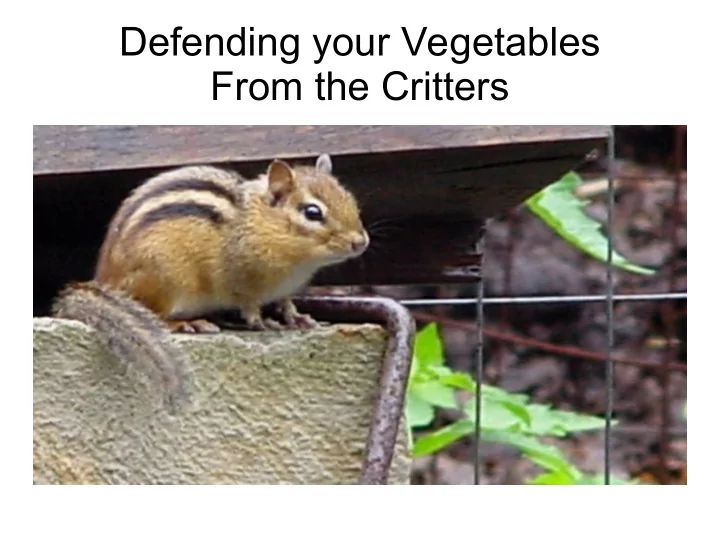
Defending your Vegetables From the Critters
SLIDE 2
When you buy a house...
On a road like this...
SLIDE 3
You should expect this!
SLIDE 4 Strategies
- Change the habitat
- Get a pet that chases
- Install scare devices
- Plant things they don’t like
- Kill or trap the animal
- Make the area smell bad or taste nasty
- Put up a fence
- Not recommended: poison
SLIDE 5 How to choose?
– Immediate – Ongoing
- Effectiveness
- Convenience
- Safety
- Appearance
SLIDE 6 Strategy: distasteful plants Herbs
protection from deer!
chives, lemon balm, mint, summer savory, oregano, sage and thyme
- Exception: parsley
- Onion family safe
from deer Common Chives
SLIDE 7 Strategy: Population Control
– Must follow hunting regulations
- licenses
- distance from dwellings
- Trapping
– Kill traps – Capture traps
SLIDE 8 NYS Law
- Unprotected animals can be killed at any time
– Chipmunks, voles, moles, red squirrels, &
woodchucks
- Hunting & trapping for protected animals
controlled by law
– Rabbits, skunks, grey squirrels, & deer
- Exceptions made for animals causing extensive
property damage
– Permits required
SLIDE 9
Strategy: Trapping
It is illegal for a home owner to transport live wild animals off one's property in NYS What are you going to do with it???
SLIDE 10 Evaluation: Population Control
Advantages
- Does not change the appearance of property
Disadvantages
– Restrictions – Animals quickly refill vacated space – Most of us can't or won't kill
SLIDE 11
Strategy: Smell & Taste Repellents
Repellents are pesticides = controlled substances Must be used according to label directions Smell based repellents usually work better than taste based.
SLIDE 12 What is in a Repellent?
- Putrescent egg solids – highly effective - deer
- Capsaicin – highly effective against deer
- Garlic
- Cinnamon oil, clove oil
- Dried blood meal
- Ammonium soaps of higher fatty acids -
medium
SLIDE 13
Invest in a pump sprayer
SLIDE 14 Read the label before you buy!
- What plants can be sprayed?
– Does it damage flowers? – It is OK for vegetables? Fruit?
- Are there times plants should not be sprayed?
- How often should plants be sprayed?
SLIDE 15 General directions for use
- Spray at or before the FIRST sign of damage
– Before THEY get to know & love your plants
- Spray on regular schedule – every 4 weeks or
as label directs
– More often to cover new growth
- Allow 24 hours of dry weather after spraying
- Spray when temperatures between 40-80F
SLIDE 16 Effectiveness
- Best for small areas
- Best in summer
– when deer have other foods
- Works best when fewer deer
- Works best when used with other techniques
- Alternating sprays may help
SLIDE 17 Why did the repellent stop working?
- Did not spray often enough
– Deer must be able to smell repellent!
- Did not spray after heavy rains
- There was no other food around
- Remember: the deer never give up!!
SLIDE 18 Fence plus Repellent
- Combines visual barrier & odor repellent
- 3'-4' fence posts around perimeter
- Cotton cord or rope at 30” for deer and at 6” for
woodchuck
- Tie strips of cotton cloth every 3' and dip
- OR use paint brush to paint repellent on rope
SLIDE 19
Fence plus Repellent
Edible Landscape 9/24/2008
SLIDE 20 Evaluation: spray repellents
Advantages
– No change in the appearance of the garden – Lower initial expense for a small garden
Disadvantages
– Open windows? – Continual maintenance expense – Very expensive for large areas – Will suffer some damage – Many/most not recommended for vegetables
SLIDE 21
Gardener: Know thyself!
SLIDE 22 Strategy: Exclusion
- Fence the garden with wire fencing, netting or
electric fencing
SLIDE 23 Deer Fence
- Permanent woven wire 8' high
– lasts 20 years
- Polypropylene Netting – 6'-8' high
- Shorter fences work around smaller areas
SLIDE 24 Fences for Rabbits and Woodchucks
- 4' high hardware cloth with 1” mesh buried 12”
deep or bent into L and buried 1-2” deep
- Plus electric wires at 2-6” above ground and 3”
above top
- or
- Deer netting behind/above the hardware cloth
SLIDE 25
Poughkeepsie Farm Project 8' deer fence
SLIDE 26
Woven Wire
SLIDE 27
Every fence needs a gate... Locust Grove
SLIDE 28
Or a bigger gate...
SLIDE 29
The backup fence...
SLIDE 30 Polypropylene Netting
- Less visible than wire
- Inexpensive
- Less durable than
wire
solution
rabbits
SLIDE 31
N E T T I N G T Y P E S
SLIDE 32
Netting Installation
SLIDE 33 Electric Fences
- Temporary or permanent
- Fur is an insulator
- Deer must be trained to the fence
– Peanut butter on foil hung from wire encourages
nose to fence contact
SLIDE 34 Evaluation: Electric Fencing
Advantages
– Almost invisible – Cheaper than a permanent fence
Disadvantages
– Must keep vegetation clear under fence – Vulnerable to falling branches, etc. – Some animals learn to go through, under, or over
Deer can slide under 2' wire
SLIDE 35
What's wrong with this fence?
SLIDE 36
Damage by leaping deer
SLIDE 37
Next Problem!
SLIDE 38
What's wrong with this fence?
SLIDE 39
Next problem! 2001
SLIDE 40
Why is Chuck still a problem? 2006
SLIDE 41
The Gardener!
We don't do the things we know must be done to solve the problem.
SLIDE 42 Fence Finally Fixed! 2009
- 1’ trench, lined with old wire fence & palisades
SLIDE 43
I hope!
Super tall deer netting & 3’ chicken wire
SLIDE 44
Things that go bump in the night...
1:05am 8/31/2009
SLIDE 45
Coping with Chipmunks
SLIDE 46
Protecting Squash Seeds
Leave some air circulation
SLIDE 47
Protecting Bush Beans
SLIDE 48
Sacrificial Tomatoes
SLIDE 49
Sometimes there is no defense!
SLIDE 50 Links
- www.gardening.cornell.edu search on deer
- www.gardening.cornell.edu/factsheets/deerdef/
index.html
– Links section contains fact sheets for control of
several animals
- Library catalog search Subject “Deer – Control”
- “The $64 Tomato” by William Alexander – for
information on electric fences
SLIDE 51 A special thanks to:
- My husband, Ed Nisley, for many of the photos
- Several Master Gardeners for sharing
information
- The horticulturists at the Locust Grove Estate