DEFINING A LANGUAGE Robert Harper Friday, April 27, 12 - - PowerPoint PPT Presentation

defining a language
SMART_READER_LITE
LIVE PREVIEW

DEFINING A LANGUAGE Robert Harper Friday, April 27, 12 - - PowerPoint PPT Presentation

DEFINING A LANGUAGE Robert Harper Friday, April 27, 12 ACKNOWLEDGEMENTS I am honored to have had the privilege of working with Robin on the development of Standard ML. It is also a pleasure to thank my collaborators, Karl Crary, Derek Dreyer,


slide-1
SLIDE 1

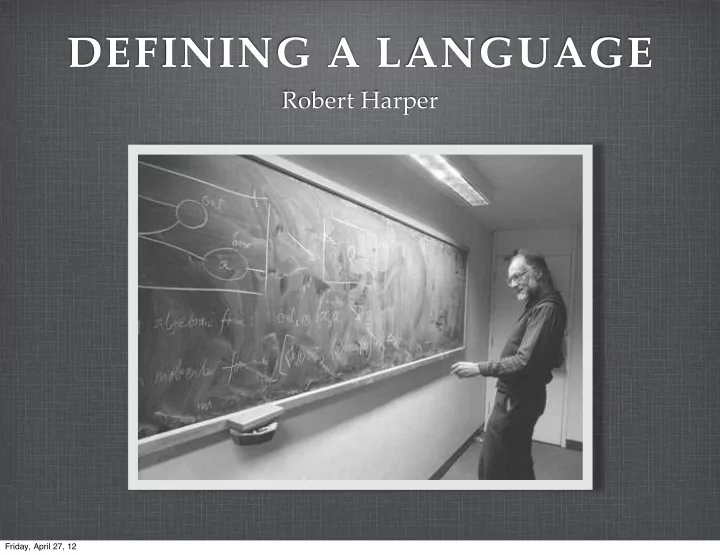
DEFINING A LANGUAGE

Robert Harper

Friday, April 27, 12
slide-2
SLIDE 2

ACKNOWLEDGEMENTS

I am honored to have had the privilege of working with Robin on the development of Standard ML. It is also a pleasure to thank my collaborators,

Karl Crary, Derek Dreyer, Daniel Lee, Mark Lillibridge, David MacQueen, John Mitchell, Eugenio Moggi, Greg Morrisett, Frank Pfenning, Chris Stone, and Mads Tofte.

And many colleagues in the field over the years.

Friday, April 27, 12

slide-3
SLIDE 3

STANDARD ML

Robin sought to consolidate disparate work on ML to formulate a common language to support research on automated reasoning and functional programming. The result was the language Standard ML. The design and implementation of Standard ML set new standards for the field and led to a wealth of further developments.

Friday, April 27, 12

slide-4
SLIDE 4

BOLD OBJECTIVES

A full-scale language with polymorphism, pattern matching, exceptions, higher-order functions, mutable references, abstract types, modules. A precise definition that would admit analysis, inform implementation, and ensure portability. An implementation based on the definition that would support application to mechanized proof.

Friday, April 27, 12

slide-5
SLIDE 5

A PROVOCATIVE QUESTION

What does it mean for a language to exist? Just what sort of thing is a language? When is a language well-defined? What can we prove about a language? Robin’s thesis: a language is a formal object amenable to rigorous analysis.

Friday, April 27, 12

slide-6
SLIDE 6

THE ENTERPRISE OF SEMANTICS

Answering such questions is the province of semantics, to which Robin’s work was devoted. Generally speaking, one wishes to give a mathematical formulation of computational ideas, often using ideas from logic, algebra, and topology. But such methods had never been tried at scale, and there was reason to doubt they would work.

Friday, April 27, 12

slide-7
SLIDE 7

AN ELEGANT IDEA

Robin proposed an operational approach that stressed the symmetries between two aspects of a language: Statics, which defines when programs are properly formed. Dynamics, which defines the execution behavior of a program. At the time denotational methods were more popular, but had more limited scope.

Friday, April 27, 12

slide-8
SLIDE 8

NATURAL SEMANTICS

The statics consists of typing judgements context ⊢ expression ⇒ type The dynamics consists evaluation judgements environment ⊢ expression ⇒ value Both are given by inductive definitions in the form of inference rules like those used in formal logic.

Friday, April 27, 12

slide-9
SLIDE 9

STATIC SEMANTICS

Γ ` e1 ) real ! int Γ ` e2 ) real Γ ` e1(e2) ) int Γ ` e1 ) int Γ ` e2 ) int Γ ` e1 + e2 ) int Γ, x ) τ ` x ) τ

Friday, April 27, 12

slide-10
SLIDE 10

STATIC SEMANTICS

Type inference, which is of great practical importance, is expressed by non-determinism in the rules. Expressions have many types (are polymorphic). Just “guess” the appropriate type for a particular situation:

Γ, x ) int ` x ) int Γ ` λx.x ) int ! int

Friday, April 27, 12

slide-11
SLIDE 11

DYNAMIC SEMANTICS

E, x ) 17 ` x ) 17 E ` e1 ) 17 E ` e2 ) 4 E ` e1 + e2 ) 21 E ` e1 ) λx.e E ` e2 ) v2 E, x ) v2 ` e ) v E ` e1(e2) ) v

Friday, April 27, 12

slide-12
SLIDE 12

TYPE SAFETY

A language is well-defined (aka type safe) if the statics and the dynamics are coherent. The statics “predicts” the form of value. The dynamics “realizes” the prediction. For example, a number should not be given a function type, nor a function a numeric type.

Friday, April 27, 12

slide-13
SLIDE 13

RIGHT AND WRONG

Expressing coherence is trickier than it seems! What cannot happen, not just what does happen. Robin’s answer was to introduce answers: environment ⊢ expression ⇒ answer An answer is either a value or wrong (a technical device to express impossibility).

Friday, April 27, 12

slide-14
SLIDE 14

WELL-TYPED PROGRAMS DO NOT GO WRONG

Instrument dynamics with run-time checks: Safety Theorem: If exp ⇒ typ and exp ⇒ ans, then ans is not wrong. Show that answer admits type. Show that wrong does not admit a type.

E ` e1 ) “abc” E ` e1 + e2 ) wrong

Friday, April 27, 12

slide-15
SLIDE 15

PRINCIPAL TYPES

Principal Type Theorem In any given context a well- typed expression has a most general, or principal, type

  • f which all others are substitution instances.

Computed using unification (constraint solving). Corollary Either context ⊢ exp ⇒ typ or not. Compute principal type (if it has one). Check that typ is an instance of it.

Friday, April 27, 12

slide-16
SLIDE 16

PRINCIPAL TYPES

Consider the function Constraints: Solution:

λf.map f [1, 2, 3] α = β → γ β = δ1 → δ2 δ1 list = int list (int → δ) → δ

Friday, April 27, 12

slide-17
SLIDE 17

SCALING UP

This methodology works well for functional programs, but can it scale up? Computational effects, such as mutable storage and exceptions. Modularity and abstraction mechanisms. Modules posed the most interesting challenges. (But effects caused trouble too!)

Friday, April 27, 12

slide-18
SLIDE 18

MODULES

The most ambitious aspect of Standard ML was the module system (designed by Dave MacQueen). Signatures are the types of modules. Structures are hierarchical modules. Functors are functions over modules. The crux is the concept of type sharing, which controls visibility of types across interfaces.

Friday, April 27, 12

slide-19
SLIDE 19

SIGNATURES

signature QUEUE = sig type α queue val empty : α queue val insert : α × α queue → α queue val remove : α queue → α × α queue end

Friday, April 27, 12

slide-20
SLIDE 20

STRUCTURES

structure Queue : QUEUE = struct type α queue = α list × α list val empty = (nil, nil) val insert = λ(x,q).... val remove = λq.... end

Friday, April 27, 12

slide-21
SLIDE 21

REALIZATION

The abstract signature QUEUE instantiates to the concrete signature QUEUE’ given by signature QUEUE’ = sig type α queue = α list × α list val empty : α queue val insert : α × α queue → α queue val remove : α queue → α × α queue end

Friday, April 27, 12

slide-22
SLIDE 22

MODULES

Remarkably, the definition method scales to modules: Statics: context ⊢ module ⇒ interface Dynamics: environment ⊢ module ⇒ structure Type sharing relationships are “guessed” non- deterministically. Generalizes polymorphic inference described above with type definitions.

Friday, April 27, 12

slide-23
SLIDE 23

PRINCIPALITY, REVISITED

Principal Signature Theorem Every well-formed module has a most general interface of which all interfaces are realizations obtained by substitution. Signature matching is mediated by realization. (And enrichment, or “width” subtyping.) Decidability of signature checking follows directly.

Friday, April 27, 12

slide-24
SLIDE 24

SUCCESSES AND FAILURES

The Definition of Standard ML realizes Robin’s vision: A language is defined by an inductive definition of its statics and dynamics. Safety is formulated and proved using wrong answers. Principality supports inference and checking. At least seven compatible compilers exist for SML!

Friday, April 27, 12

slide-25
SLIDE 25

SUCCESSES AND FAILURES

Nevertheless, The Definition has some shortcomings: Interaction between polymorphism and effects is problematic (loss of safety and principality). Dynamics “cheats” to manage exceptions. Use of wrong seems needlessly indirect. Fudge for the dynamic effect of enrichment order. Spurred lots of further research in how to do better.

Friday, April 27, 12

slide-26
SLIDE 26

TYPE-THEORETIC FOUNDATIONS

The type-theoretic foundations for modularity. MacQueen: dependent types. Leroy: manifest types, applicative functors. H+Lillibridge, H+Stone: translucent sums, singleton kinds Russo+Dreyer: higher-order polymorphism. Crucial for code certification and mechanization.

Friday, April 27, 12

slide-27
SLIDE 27

TYPE-THEORETIC FOUNDATIONS

Phase distinction: types are static, values dynamic. Open-scope abstraction: Queue.queue is abstract in all contexts Singleton kinds: τ has kind S(ρ) iff τ is equivalent to ρ. Generativity: track effects, object identity/ownership General Σ and Π signatures.

Friday, April 27, 12

slide-28
SLIDE 28

REDEFINING A LANGUAGE

Statics is now elaboration from an “external language” to a type-theoretic “internal language”. context ⊢ expression ⇒ term : type Dynamics is defined on internal language using Plotkin’s structural operational semantics. term [memory] ↦ term’ [memory’]

Friday, April 27, 12

slide-29
SLIDE 29

REDEFINING A LANGUAGE

statics dynamics SML SML TIL TIL statics dynamics

Friday, April 27, 12

slide-30
SLIDE 30

REDEFINING A LANGUAGE

Safety may be expressed as progress and preservation. Progress: every well-formed state is either final or makes a transition. Preservation: every transition from a well-formed state is well-formed. No need for artificial wrong transitions that cannot

  • ccur (and avoids problems with exceptions).

Friday, April 27, 12

slide-31
SLIDE 31

CERTIFYING COMPILERS

The type-theoretic framework is crucial to type-based code certification. Transform a series of typed internal languages starting with elaboration through to assembly. Transfer external language typing properties to

  • bject code.

Example: TILT/TAL compiler for Standard ML.

Friday, April 27, 12

slide-32
SLIDE 32

CERTIFYING COMPILERS

The statics is the front-end, elaborating SML into a clean type theory. Compiler transformations are type-preserving. eg, continuation conversion a la Griffin Object code is Morrisett’s typed assembly language. type checking ensures safety

Friday, April 27, 12

slide-33
SLIDE 33

CERTIFYING COMPILERS

SML TIL1 TIL2 elab phase1 TIL2 TIL3 phase2 ...

Friday, April 27, 12

slide-34
SLIDE 34

MECHANIZED METATHEORY

Doing meta-theory at scale is not humanly feasible. Hundreds of twisty little cases, all alike. (Except the one that isn’t.) Mechanization is clearly desirable, but it proved difficult to use general provers to check safety of The Definition of Standard ML. van Inwegen’s early effort to prove safety in HOL

Friday, April 27, 12

slide-35
SLIDE 35

MECHANIZED META- THEORY

The Redefinition of Standard ML is much more amenable to mechanization. Type theory instead of “static semantic objects.” Transitional, rather than relational, dynamics. Twelf makes formalization and verification easy! LF encoding of internal language Relational meta-theory + coverage checking.

Friday, April 27, 12

slide-36
SLIDE 36

MECHANIZED META- THEORY

Safety of The Redefinition of Standard ML has been fully verified (Crary + D. Lee + H). Statics and dynamics expressed in LF. Relational meta-theory verified by Twelf coverage checking. About 30,000 lines of Twelf developed using “extreme programming”.

Friday, April 27, 12

slide-37
SLIDE 37

MECHANIZATION USING TWELF

LF encoding of statics and dynamics: app_s : of (app M N) B ← of M (arr A B) ← of N A. app_d : steps (app M N) (app M’ N) ← steps M M’. Relational meta-theory acts on derivations: pres : steps M M’ → of M A → of M’ A → type. prog : of M A → val-or-step M.

Friday, April 27, 12

slide-38
SLIDE 38

MECHANIZATION USING TWELF

State cases of a proof preservation and progress.

  • : pres (app_d DM) (app_s SM SN) (app_s SM’ SN)

← pres DM SM SM’. Twelf checks coverage and termination. ∀ D : steps M M’ ∀ S : of M A ∃ S’ : of M’ A ⊤

Friday, April 27, 12

slide-39
SLIDE 39

A HUGE SUCCESS

Robin’s methods inspired much future work in language design, and will continue to do so: eg, Haskell, O’Caml, F#, Scala Precise language definition is not only possible, but practical and useful. Compatibility among compilers. Safety properties, code certification.

Friday, April 27, 12